 Skip to Content

Assignment of Benefits Is Now Restricted for Florida Homeowners
If your Florida property insurance policy was issued or renewed on or after January 1, 2023, you cannot legally assign your post-loss benefits to a contractor or vendor. Florida law now prohibits post-loss assignment of benefits agreements on those policies, under Florida Statutes section 627.7152. Older AOBs signed before that date may still be valid, but only if they met the strict contract requirements the legislature added in 2019.
Here’s what that means for you in practical terms:
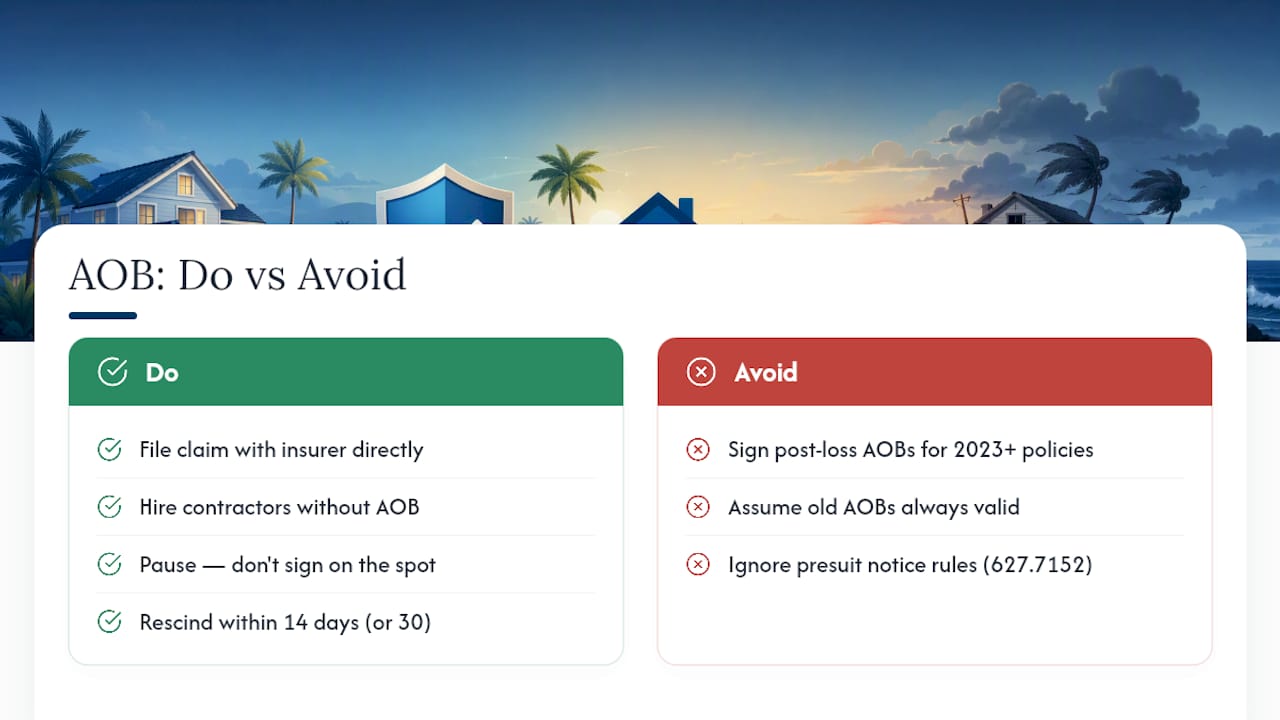
- You generally do not need to sign an AOB to get your roof, drywall, or plumbing repaired after a covered loss.
- FLOIR and the Florida Chief Financial Officer’s office both advise contacting your insurer directly before signing anything a contractor hands you.
- If a vendor insists an AOB is required to start work, that itself is a warning sign worth a phone call to your carrier.
Pro Tip: Call your insurance company the same day damage happens, even before a contractor arrives. Filing the claim yourself keeps you in control of the settlement instead of a repair company.
Key Takeaways
Florida law bans post-loss assignment of benefits on property policies issued or renewed on or after January 1, 2023, making direct communication with your insurer the safest path after damage occurs.
| Point | Details |
|---|---|
| Post-2023 AOB ban | Property policies issued or renewed on or after January 1, 2023, cannot use post-loss assignment agreements. |
| Older AOBs need scrutiny | Pre-2023 agreements are only valid if they met the 2019 reform’s contract requirements. |
| Rescission windows exist | Cancel within 14 days of signing, or 30 days if work hasn’t substantially started. |
| Emergency work is capped | Assignee compensation for urgent work is capped at the greater of $3,000 or 1% of Coverage A. |
| Get legal help early | Calillaw reviews AOB disputes and negotiates directly with insurers and vendors on your behalf. |
Table of Contents
- What Is an Assignment of Benefits in Florida Insurance?
- The 2019 and 2023 Reforms That Reshaped Florida Benefits Assignment Laws
- Why Florida Lawmakers Cracked Down on AOB Abuse
- How to File a Florida Property Claim Without Signing an AOB
- Rescission Rights and Required Contract Terms Under Florida Law
- When to Bring in a Florida Litigation Attorney Over an AOB Dispute
- An Attorney’s Take on Florida’s AOB Reform
- How Calillaw Helps When an AOB Dispute Threatens Your Property Claim
- Frequently Asked Questions
- Sources
What Is an Assignment of Benefits in Florida Insurance?
An assignment of benefits is a legal document that lets a policyholder hand over their claim rights to a third party, typically a contractor, water mitigation company, or roofer. Once signed, that third party can “stand in the shoes” of the homeowner, filing the claim, negotiating with the adjuster, endorsing insurance checks, and even suing the insurance company if the payout falls short, according to FLOIR. You, the assignor, transfer your claim; the contractor, the assignee, takes it from there.
This is the healthcare benefits assignment concept applied to property claims. Just as a patient might assign medical benefits directly to a hospital so the hospital bills the insurer instead of the patient, a homeowner assigns property benefits so a restoration company gets paid straight from the insurer. The mechanics are similar. The stakes, when a $40,000 roof job is on the line, are considerably higher.
Not every party can become an assignee under Florida’s insurance assignment process. The statute governs contracts between insureds and providers like contractors, roofers, and water restoration firms. Public adjusters operate under separate licensing rules and are not addressed the same way under section 627.7152.
A few things define whether an AOB has any legal weight in Florida today:
- Policy date matters. Post-loss assignments are banned outright for property policies issued or renewed on or after January 1, 2023.
- Older contracts still get scrutinized. An AOB executed before that date only holds up if it met every requirement of the 2019 reform law.
- Scope is limited to certain claim types. Auto glass claims, for instance, follow different rules than homeowners’ property claims.
The 2019 and 2023 Reforms That Reshaped Florida Benefits Assignment Laws
Florida didn’t ban AOBs overnight. Lawmakers spent years tightening the rules before pulling the plug on post-loss assignments entirely, and understanding that sequence explains why your neighbor’s five-year-old AOB might still be enforceable while a new one would be rejected outright.
-
2019: House Bill 7065 creates section 627.7152. This law didn’t ban AOBs. It forced them to meet specific standards. Contracts needed rescission rights, itemized per-unit pricing estimates, and an 18-point notice in capital letters warning homeowners what they were signing away, according to the Florida CFO. Insurers also had to start reporting AOB-related litigation data to the state.
-
January 1, 2023: the prohibition takes effect. For any residential or commercial property policy issued or renewed on or after this date, post-loss assignment of benefits agreements are no longer permitted under F.S. 627.7152. This is the single most important fact for anyone searching “assignment of benefits Florida” today: if your policy renewed anytime after that date, signing an AOB with a contractor carries no legal force.
-
Exceptions and carve-outs remain narrow. Motor vehicle glass claims follow a different framework and were not swept into the same prohibition. Delivery requirements also survived. An assignee must still deliver a copy of any executed agreement to the insurer within 3 business days.
-
Emergency work has its own dollar cap. Even where an assignment-type arrangement might apply to urgent mitigation, an assignee generally cannot receive more than the greater of $3,000 or 1% of the policy’s Coverage A limit for that emergency work, per F.S. 627.7152.
If you’re holding an AOB signed in, say, 2021, it isn’t automatically void. It has to be measured against the 2019 reform’s checklist, which is a far higher bar than most contractors’ paperwork actually cleared.
Why Florida Lawmakers Cracked Down on AOB Abuse
The reforms didn’t happen in a vacuum. Florida’s AOB insurance system became a magnet for litigation abuse, and homeowners footed the bill through rising premiums.
Once you sign an AOB, you’re often no longer a party to your own claim negotiation. The contractor, now the assignee, can negotiate the settlement, dispute the payout, and file suit against your insurer, sometimes without ever consulting you again. If the vendor and insurer end up in court, you may find your name attached to litigation you never intended to start and have little power to stop.
The Florida CFO’s office points to excessive litigation tied to assignment agreements as the central driver behind rising insurance costs across the state. Every lawsuit a vendor filed against a carrier added legal fees to the system, and insurers priced those costs into everyone’s premiums, not just the policyholders whose claims triggered the suits.
Watch for these red flags before signing anything at the door:
- A contractor pressuring you to sign immediately, often before an adjuster has even inspected the damage.
- Blank or incomplete forms where the price or scope of work isn’t filled in yet.
- No itemized, per-unit estimate attached to the agreement, which the statute requires.
- An offer to waive or “rebate” your deductible in exchange for signing, a practice regulators specifically warn against.
If a vendor pushes back when you ask for a written scope of work, or gets cagey about a required disclosure, stop and call your insurance company. The Department of Financial Services helpline at 877-693-5236 exists specifically for homeowners caught in this spot.
How to File a Florida Property Claim Without Signing an AOB
You have more control here than most contractors let on; to understand the full range of insurance agency services available can help you navigate the claims process more effectively. Here’s the sequence that protects both your claim and your finances.
-
Document everything before touching anything. Photograph and video the damage from multiple angles, room by room, before cleanup starts. Keep every receipt tied to temporary repairs.
-
Call your insurer immediately. File the claim yourself, directly, rather than letting a contractor “handle it” through an assignment. This is the single biggest step in preserving your seat at the table.
-
Mitigate further damage, but don’t destroy evidence. Tarping a roof or shutting off water is expected and often required by your policy. Just document the damage first.
-
Get approvals before major repairs when your policy allows it. Rushing into a full remodel before the adjuster inspects can complicate your payout.
-
Hire contractors on your own terms. Insist on a written contract that doesn’t require assigning benefits, ask for an itemized invoice, and never accept an offer to waive your deductible.
-
Know the emergency work threshold. Statutorily, urgent work tied to an assignment arrangement caps out at the greater of $3,000 or 1% of your Coverage A limit, per F.S. 627.7152. Anything beyond that needs your insurer’s sign-off, not just a handshake with a restoration crew.
For storm-related losses specifically, the documentation habits matter even more, since hurricane damage claims often involve multiple contractors bidding for the same job before your insurer has even inspected the property.
Rescission Rights and Required Contract Terms Under Florida Law
If you already signed an AOB and now regret it, Florida law gives you a way out, but the clock is running the moment you sign.
You can cancel a valid AOB without penalty under three separate windows, according to the Florida CFO’s consumer guide:
- Within a short period after the agreement is executed, no questions asked.
- At least a month after the scheduled start date, if substantial work hasn’t begun yet.
- At least a month after execution, if there’s no start date listed and no substantial work performed.
A compliant AOB also has to include specific safeguards, or it may not be enforceable at all:
- The 18-point uppercase notice explaining exactly what rights you’re giving up.
- An itemized, per-unit price estimate for the work, not a vague lump sum.
- Indemnity and hold-harmless language protecting you from liability tied to the contractor’s work.
- Delivery of the signed agreement to your insurer within 3 business days of execution.
One catch worth knowing: rescinding an AOB doesn’t erase your obligation to pay for work the contractor already completed before you canceled. Cancellation stops what’s ahead of you, not what’s already behind you.
When to Bring in a Florida Litigation Attorney Over an AOB Dispute
Most AOB situations resolve without a lawsuit. Some don’t, and knowing the presuit rules matters if yours is heading that direction.
Before an assignee can sue your insurer, Florida law requires a written pre-suit notice at least 10 business days before filing, spelling out the disputed amount and a detailed invoice or estimate, under section 627.7152. The insurer then has 10 business days to respond with a settlement offer or a request for alternative dispute resolution. The statute also limits how assignees recover attorney’s fees, generally confining them to Florida’s frivolous-claim fee statute, section 57.105, rather than the more generous fee-shifting rules that used to fuel AOB litigation.
You should talk to a Florida litigation attorney if:
- A vendor threatens to sue your insurer, or you, over a disputed AOB.
- A contractor attempts to collect payment directly from you despite an assignment arrangement.
- A lien gets placed on your property tied to unpaid work.
- Your insurer issues a denial that seems inconsistent with your policy language or the documented damage.
Homeowners frequently discover the hard way that an AOB dispute isn’t really about the roof or the water damage anymore. It’s about who controls the narrative between two parties, the contractor and the insurer, neither of whom answers to the homeowner once litigation starts. Getting a lawyer involved early often resets that balance before it spirals into a drawn-out fight.
A Florida insurance claim attorney can review an AOB you’ve already signed, walk you through your rescission options, and step in to negotiate directly with vendors or carriers on your behalf. If your insurer is dragging its feet or denying a claim outright, that pattern can sometimes cross into bad faith territory, which changes the legal remedies available to you entirely.
An Attorney’s Take on Florida’s AOB Reform
The conventional advice on AOBs tends to stop at “don’t sign one,” which is true but incomplete. The more useful lesson from Florida’s reform history is that the law didn’t ban assignment of benefits because the concept is inherently bad. It banned it because the paperwork consistently failed to protect the person who needed protecting most: the homeowner holding the policy.
What gets underestimated is how much leverage you keep simply by calling your insurer first. Contractors have gotten faster and pushier about AOB paperwork precisely because homeowners, especially right after a storm or a burst pipe, are exhausted and want the problem solved immediately. That urgency is exactly when bad contract terms get signed.
If you take one thing from Florida’s benefits assignment laws, let it be this: speed favors whoever moves first, and it should be you, not the contractor standing in your driveway. File your claim, document the damage, and only then bring in outside help, ideally people who work for you rather than around you.
How Calillaw Helps When an AOB Dispute Threatens Your Property Claim
If you’re dealing with a contractor who won’t release a lien, an insurer stonewalling a legitimate claim, or an AOB you signed under pressure and now need out of, Calillaw brings Board Certified civil trial experience to disputes most homeowners have never had to navigate before.
Unlike a contractor’s in-house “claims specialist” who works for the vendor’s interest, Calillaw works only for you, reviewing the actual contract language, calculating whether statutory rescission windows still apply, and dealing directly with insurers and vendors so you don’t have to. The firm takes property insurance disputes on a contingency basis, meaning there’s no upfront cost to find out where you stand. If you’re facing a denied claim, a lien from an unpaid contractor, or a dispute tied to an assignment agreement, reach out to Calillaw’s insurance claim team today to get a clear read on your options before the presuit clock starts running.
Frequently Asked Questions
Is assignment of benefits still legal in Florida?
Only in limited circumstances. Post-loss AOBs are prohibited for property policies issued or renewed on or after January 1, 2023. Older agreements may remain valid if they met the 2019 statutory requirements.
Do I have to sign an AOB to get my roof or water damage repaired?
No. FLOIR and the Florida CFO both confirm you can file your claim directly with your insurer and hire contractors without assigning your benefits.
What happens if I already signed an AOB and want out?
You may be able to rescind it within 14 days of signing, or within 30 days if substantial work hasn’t started, though you’ll still owe for any work already completed.
What should I do if a contractor pressures me to sign an AOB?
Pause, don’t sign anything on the spot, and call your insurer or the Department of Financial Services helpline at 877-693-5236 before agreeing to anything.
Can a contractor sue my insurance company if I signed an AOB?
Under a valid pre-2023 AOB, yes, an assignee can pursue payment and even litigation, but strict presuit notice rules under section 627.7152 now govern that process.
This article is general information, not a substitute for advice from a qualified lawyer. Consult a qualified legal professional about your own circumstances before acting on anything here.
Sources
- Assignment of Benefits Resources — Florida Office of Insurance Regulation (FLOIR)
- Assignment of Benefits (AOB) — Florida CFO consumer page
- F.S. 627.7152 — Assignment agreements (Florida Statutes)


