 Skip to Content

Can I Sue for Slander? What to Prove and Next Steps
Yes, you can sue for slander, but only if you can prove four specific things: the statement was false, it reached someone besides you, the speaker was at fault, and it caused real harm. Without all four, most slander claims collapse before they reach a jury.
Before you do anything else, confirm you can check these boxes:
- False statement of fact made about you, not a matter of opinion.
- Publication to at least one third person who heard it.
- Fault on the speaker’s part, which changes depending on who you are.
- Damages you can actually document or that the law presumes for you.
Pro Tip: If any deadline feels close, stop reading and call an attorney today. Preserve every text, recording, and witness name now. Evidence disappears fast, and so does your filing window. See the evidence checklist below for exactly what to save.
Key Takeaways
Winning a slander case requires proving falsity, publication, fault, and damages, and most claims fail when one of those four elements is missing or undocumented.
| Point | Details |
|---|---|
| Four elements required | You must prove a false statement, publication to a third party, fault, and damages. |
| Public figures face a higher bar | Public officials must prove actual malice, not just negligence, under New York Times Co. v. Sullivan. |
| Truth ends the claim | A factually accurate statement defeats a slander lawsuit regardless of the harm caused. |
| Act within one to two years | Most states impose a one to two year statute of limitations on slander claims. |
| Evidence decides outcomes | Witness names, recordings, and financial records collected early are often the difference between a viable and weak case. |
| Calillaw evaluates viability first | Calillaw reviews evidence and collectability before recommending litigation, on a contingency basis for qualifying matters. |
Primary Sources and References to Check Next
- Cornell Law’s Wex: core legal elements and public-figure standards.
- Ask a Law Librarian: filing deadlines and proof requirements.
- FindLaw: truth and opinion defenses.
- State statutes and local court rules ultimately control deadlines and retraction requirements, always confirm your state’s specific rules.
Table of Contents
- How Do You Sue Someone for Slander? Start With the Definition
- The Legal Elements You Must Prove to Win
- Common Defenses That Can Defeat a Slander Claim
- Timing Matters: How Long Do You Have to File?
- What Damages Can You Actually Recover?
- Evidence to Collect and Preserve Right Now
- Is It Worth Suing for Slander? Weighing Costs and Alternatives
- Steps to Take If You Decide to Move Forward
- When to Consult a Lawyer and What Counsel Actually Does
- Slander in the Workplace and Government Settings Plays by Different Rules
- Online and Social Media Slander Cases Work Differently
- Remedies Beyond Money: Retractions and Injunctions
- Considering Legal Action for a False Statement Against You?
- Frequently Asked Questions
- Sources
How Do You Sue Someone for Slander? Start With the Definition
Defamation is the umbrella term for a false statement that damages someone’s reputation. Slander is the spoken version. Libel is the written or recorded version. If your coworker tells the break room you stole from the register, that’s slander. If they post the same accusation on Facebook, that’s libel.
The line blurs with video and podcasts. Courts increasingly treat recorded spoken statements with the same weight as libel, since a recording spreads and persists the same way a written post does.
- Spoken accusation at a dinner party: slander.
- Written email sent to your boss: libel.
- A recorded Zoom call later shared publicly: often treated like libel.
The Legal Elements You Must Prove to Win
Every state builds its defamation law around the same skeleton. To sue for slander, you need to show:
- A false statement of fact. Not an insult, not an exaggeration, an assertion presented as true that isn’t.
- Publication to a third party. The statement had to reach someone other than you. A private argument between two people, with no one else listening, generally doesn’t count.
- Fault. Private individuals typically only need to show the speaker was negligent, careless with the truth. Public officials and public figures face a much steeper bar: they must prove actual malice, meaning the speaker knew the statement was false or recklessly disregarded the truth. That standard traces directly back to New York Times Co. v. Sullivan, the 1964 Supreme Court case that reshaped American defamation law.
- Damages. Real harm, whether financial, reputational, or emotional.
Some statements skip the damages requirement entirely. These fall under “slander per se,” a legal category where harm is presumed because the accusation is so inherently damaging. Classic examples include falsely accusing someone of a serious crime, claiming they have a contagious disease, or alleging professional incompetence in their trade. If you’re drafting a complaint alleging slander per se, your attorney will typically include language like: “Defendant’s statement falsely accused Plaintiff of [crime/incompetence], constituting slander per se, and damages are therefore presumed as a matter of law.”
Common Defenses That Can Defeat a Slander Claim
Defendants have real tools to shut a slander lawsuit down early, and they use them often.
- Truth. If the statement is factually accurate, the claim ends there. Truth is an absolute defense to defamation, no matter how much damage the statement caused.
- Opinion. “I think she’s a terrible manager” reads very differently in court than “She embezzled company funds.” Courts generally protect rhetorical hyperbole and pure opinion.
- Privilege. Statements made during court testimony carry absolute privilege. Many workplace and official communications carry qualified privilege, meaning they’re protected unless the speaker acted with actual malice.
Courts consistently hold that a defendant who tells the truth, however unflattering, cannot be held liable for defamation. The remedy for a bad reputation earned honestly is not a lawsuit.
Timing Matters: How Long Do You Have to File?
Slander claims move on a short clock. Most states give you one to two years from the date of the statement to file, and a handful of states cut that window even shorter.
Some states apply a “discovery rule,” meaning the clock starts when you actually learned about the statement, not necessarily when it was made. That distinction matters if the slander happened behind your back and you only found out months later.
- Check your specific state’s statute of limitations immediately, don’t assume you have more time.
- If a deadline is within 90 days, treat this as urgent and consult an attorney this week.
- Missing the deadline bars your claim entirely, regardless of how strong your evidence is.
What Damages Can You Actually Recover?
Winning proves your case; damages determine whether it was worth pursuing. Courts recognize three categories.

Special damages cover provable financial losses: a lost job offer, a canceled contract, a client who walked away after hearing the false statement. Courts want documentation here, pay stubs, termination letters, signed contracts that fell through.
General damages cover reputational and emotional harm that’s harder to put a number on. Juries weigh factors like how widely the statement spread, how humiliating it was, and whether it affected your relationships or standing in the community.
Punitive damages are reserved for cases involving actual malice or particularly reckless conduct. About half of U.S. states have retraction statutes that limit or bar punitive damages if the defendant issued a prompt, adequate retraction, so a fast retraction demand can directly affect what you’re eligible to recover later.
Evidence to Collect and Preserve Right Now
The strength of a slander claim usually comes down to what you can document, not what you can remember. Start collecting:
- Names and contact information for every witness who heard the statement.
- Any recordings, voicemails, or transcripts of the statement itself.
- Contemporaneous notes you wrote down close to when it happened.
- Screenshots, emails, or texts that reference or repeat the false statement.
- Employment records, client emails, or contracts showing lost income tied to the statement.
Early preservation does more than build your case; it protects you if the defendant files an anti-SLAPP motion trying to get your case dismissed as an attack on their free speech.
Pro Tip: Create a dated log the day you first hear the statement. List who said it, who was present, and word-for-word what was said. For anything digital, save the original file and note the date, time, and platform, metadata that gets stripped out when you just take a screenshot.
Is It Worth Suing for Slander? Weighing Costs and Alternatives
Here’s the uncomfortable truth: slander lawsuits are expensive and difficult to win, and attorneys routinely advise clients to think hard before filing.
Two questions matter more than most people realize. First, can the defendant actually pay if you win? A judgment against someone with no assets and no insurance is a moral victory, not a financial one. Second, does your state have an anti-SLAPP law? Roughly 40 states plus D.C. have some version of these statutes, and losing an anti-SLAPP motion can shift the defendant’s attorney fees onto you.
Before committing to litigation, consider:
- A formal cease-and-desist or retraction demand letter, often resolves disputes without a courtroom.
- Mediation, faster and dramatically cheaper than trial.
- Online reputation management or targeted takedown requests for digital statements.
- A frank conversation with an attorney about collectability before you spend a dollar on filing fees.
Steps to Take If You Decide to Move Forward
If you’ve confirmed the elements and decided the case is worth pursuing, the path generally looks like this:
- Document everything you’ve gathered, this takes days to a couple of weeks if you start immediately.
- Send a demand or retraction request, giving the defendant a chance to correct the record, often required by state retraction statutes before you can file.
- Consult an attorney to evaluate elements, collectability, and jurisdiction, typically a single consultation.
- Satisfy any pre-suit requirements, like formal notice, which some states mandate.
- File the complaint in the proper venue, usually where the defendant resides or where the statement caused harm.
- Survive early motions, including anti-SLAPP challenges, which can add months.
- Proceed through discovery toward settlement or trial, this phase often stretches from several months to over a year.
When to Consult a Lawyer and What Counsel Actually Does
A defamation attorney assesses whether your facts satisfy each legal element, drafts a retraction demand that meets your state’s requirements, evaluates whether the defendant is worth suing, and prepares your case for anti-SLAPP exposure before it becomes a problem.
Look for trial experience, not just a law degree, someone who has actually argued motions and tried cases, not just settled them. Firms like Calillaw that handle contingency-fee litigation in personal injury and commercial disputes bring that same trial-tested judgment to reputation harm claims. An early consult costs you little and can save you from filing a claim that was never viable.
Slander in the Workplace and Government Settings Plays by Different Rules
Not all slander claims are created equal, and where the statement happens changes the legal analysis substantially.
Employment-related slander often runs into qualified privilege. If your former manager tells a prospective employer during a reference check that you were “let go for performance issues,” that statement is typically protected, even if it stings, because employers have a legitimate interest in sharing job-related information. The privilege disappears if you can show the manager knew the statement was false or spread it with reckless disregard for the truth, or if they shared it far beyond anyone with a legitimate need to know.
Government and official contexts raise the bar even higher. Statements made by legislators during official proceedings, judges from the bench, or government witnesses in court typically carry absolute privilege, meaning no defamation claim can touch them regardless of what was said. Public employees speaking about matters of public concern may also fall under the “public official” standard, requiring you to prove actual malice rather than mere negligence.
This distinction trips people up constantly. Someone assumes their manager’s comments to HR are automatically slander because they’re false, without realizing internal HR communications often carry qualified privilege specifically because companies need to be able to discuss personnel issues honestly. The workaround isn’t proving the statement was false, it’s proving the speaker abused that privilege through malice or excessive publication beyond who needed to know.
Online and Social Media Slander Cases Work Differently
Here’s a distinction that catches a lot of people off guard: most slander involving social media isn’t actually slander at all, it’s libel, because a written post, even one dictated by voice-to-text, is a permanent record rather than a fleeting spoken statement.
The practical result is that online defamation cases often have an evidentiary advantage traditional slander never had. Screenshots, timestamps, and platform metadata create a paper trail that a courtroom “he said, she said” dispute never provides. That’s a meaningful edge when you’re trying to prove publication and the exact wording used.
But social media introduces its own complications. Posts spread and get reshared, multiplying the number of potential publications and witnesses, but also making it harder to trace the original source or prove who first made the statement. Anonymous or pseudonymous accounts add another layer, sometimes requiring a separate legal process just to unmask the poster before you can even name a defendant.
If you’re dealing with a spoken accusation that later gets referenced online, say, someone repeats a verbal accusation in a text thread or a video call gets uploaded, you may have both a slander claim for the original spoken statement and a libel claim for its written or recorded republication. Document both separately. Save the original context of where and how it was first said, then separately preserve every digital instance where it reappeared, with dates and platform details for each.
Remedies Beyond Money: Retractions and Injunctions
Winning a slander case doesn’t always mean walking away with a check, and sometimes money isn’t even the primary goal.
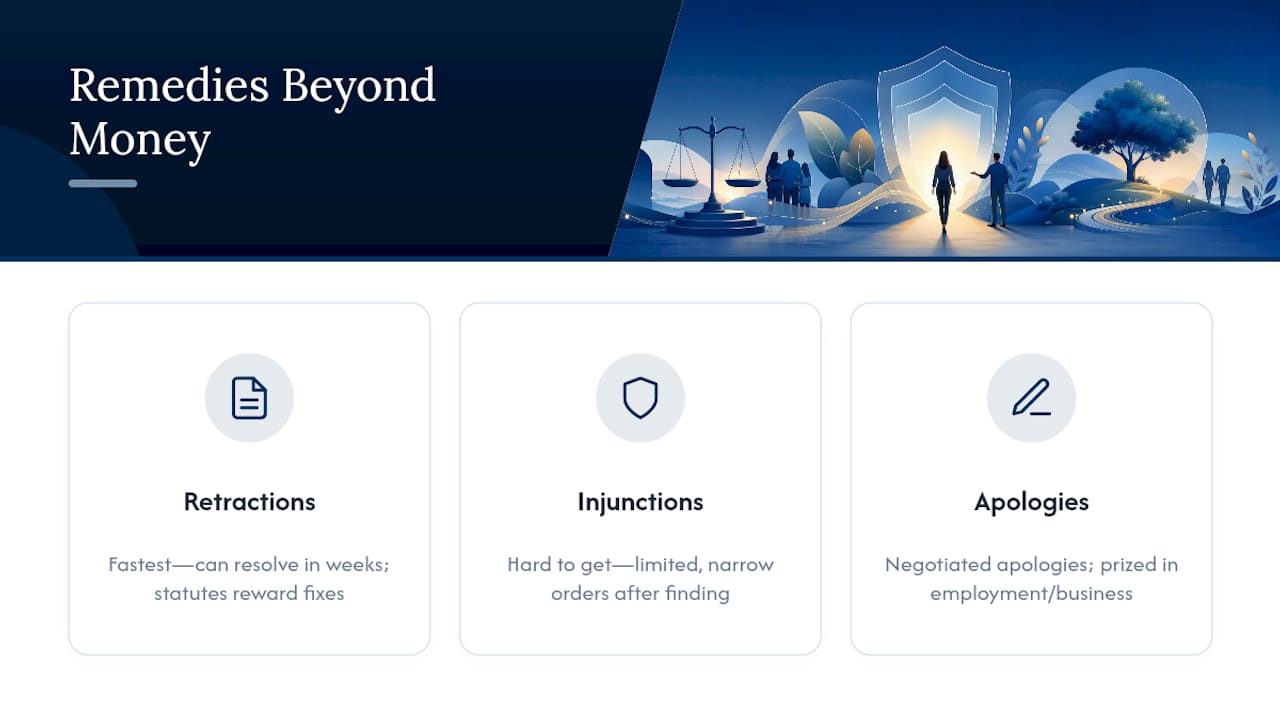
Retractions are often the fastest, cheapest path to resolution. Many states have retraction statutes that reward defendants for correcting the record promptly, and reward plaintiffs by preserving their right to full damages if the defendant refuses. A well-timed retraction demand can resolve a dispute in weeks rather than years, and it often matters more to the plaintiff’s reputation than any dollar amount.
Injunctions are harder to get in defamation cases specifically because courts are wary of anything that resembles a prior restraint on speech. Courts generally won’t order someone to stop talking about a topic altogether. But narrower injunctions, ordering removal of a specific false post or barring repetition of a specific proven-false statement, are sometimes available after a court has already found the statement defamatory.
Formal apologies or corrective statements can also be negotiated as part of a settlement, particularly in employment or business disputes where an ongoing relationship makes an apology more valuable than damages. If your goal is restoring your reputation rather than collecting a payout, tell your attorney that upfront. It changes the strategy from day one, shifting the emphasis toward retraction demands and negotiated corrections rather than a damages-focused trial.
A Trial Attorney’s View on Realistic Outcomes
Slander is genuinely hard to prove without early evidence. Most viable cases hinge on documentation gathered in the first weeks, not sworn testimony gathered months later. Anyone considering this path benefits from a trial-ready attorney who tells them the truth about damages and collectability before filing, not after.
Considering Legal Action for a False Statement Against You?
If someone’s false statement has cost you a job, a client, or your standing in your community, Calillaw brings the same disciplined trial preparation to defamation-adjacent disputes that it brings to serious injury and commercial litigation, built around documented harm and a realistic read on what a case is actually worth before you spend a dollar pursuing it.

Bring what you’ve gathered, witness names, recordings, screenshots, any financial records showing loss, and Calil Law Trial Attorneys will walk through whether your facts meet the legal elements and whether the defendant is realistically worth pursuing. The firm handles qualifying matters on a contingency basis, meaning you owe nothing upfront while your case is evaluated. Start by reviewing what a personal injury claim actually involves or call to schedule a case evaluation before your filing window closes.
Frequently Asked Questions
Can I file slander charges against someone?
Slander is a civil matter, not a criminal one, so you can’t “file charges” the way you would with a crime. You sue the speaker in civil court for damages instead.
How do you prove slander happened?
You need a witness who heard the statement, evidence it was false, and proof it caused you harm, financial, reputational, or emotional. Recordings and contemporaneous notes strengthen a weak memory significantly.
Who can sue for slander?
Anyone about whom a false, damaging statement was made and communicated to a third party can sue, provided they can meet the fault and damages requirements that apply to their specific status as a private or public individual.
What’s the difference between slander and libel?
Slander is spoken; libel is written or recorded. Libel claims generally don’t require proof of specific financial damages the way slander claims usually do, unless the slander falls into a per se category.
How much can you get in a slander lawsuit?
There’s no fixed number. Special damages depend on documented financial loss, general damages depend on a jury’s assessment of reputational harm, and punitive damages require proof of actual malice, making outcomes highly case specific.
This article is general information, not a substitute for advice from a qualified lawyer. Consult a qualified legal professional about your own circumstances before acting on anything here.
Sources
- Defamation (Wex — Legal Information Institute, Cornell Law)
- What is defamation? What is slander and libel? (Ask a Law Librarian)
- Defamation law — the basics (FindLaw)
- Attorneys warn about costs and feasibility of slander suits (Forbes Advisor)
- What to do if someone slanders you (LegalClarity)


