 Skip to Content

Catastrophic Injury Claim Explained: Your 2026 Guide
A catastrophic injury claim is a legal action seeking compensation for injuries that permanently alter a victim’s ability to work, live independently, or maintain their quality of life. These claims go far beyond standard personal injury cases. They involve lifetime medical costs, lost earning capacity, long-term rehabilitation, and profound personal losses. If you or someone you love has suffered a spinal cord injury, traumatic brain injury (TBI), amputation, or severe burns, understanding the catastrophic injury claim process is the first step toward protecting your rights and your future.
What legally qualifies as a catastrophic injury?
The legal definition of a catastrophic injury centers on permanence, not just severity. Legal definitions across jurisdictions emphasize permanent loss of function, the inability to work, or the loss of independent living. A broken arm, even a serious one, does not qualify. A spinal cord injury that leaves someone paralyzed does.
The defining trait of a catastrophic injury is its permanent impact on daily functioning and employment, not simply the medical diagnosis itself. That distinction matters enormously in court. Two people can receive the same diagnosis and face very different legal outcomes based on how the injury affects their specific life and livelihood.
Common injury types that meet the catastrophic threshold include:
- Spinal cord injuries resulting in partial or complete paralysis
- Traumatic brain injuries causing cognitive, behavioral, or physical impairment
- Amputations of limbs affecting mobility and employment
- Severe burns covering large body surface areas, requiring repeated surgeries
- Blindness or deafness caused by trauma
- Crush injuries leading to permanent organ damage or loss of function
Medical evidence alone does not win these cases. Functional impact evidence does. Physicians, neurologists, and rehabilitation specialists must document how the injury changes the victim’s daily life, not just what the imaging shows.
What damages can you recover in a catastrophic injury case?
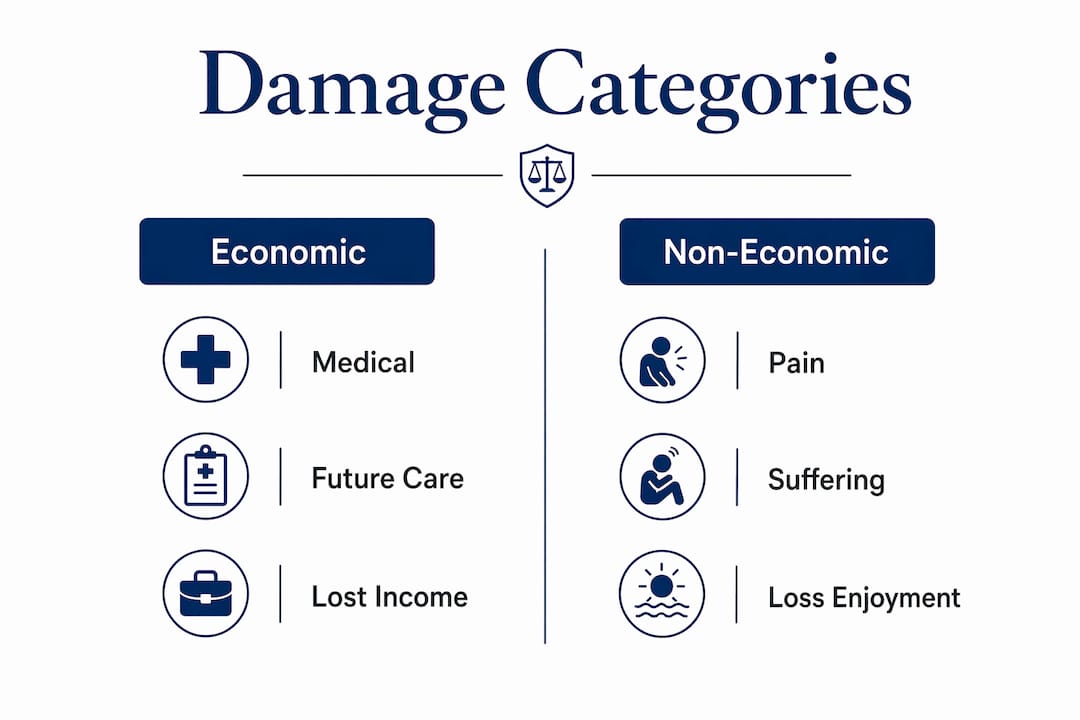
Catastrophic injury compensation falls into two broad categories: economic damages and non-economic damages. Economic damages are calculable. Non-economic damages require skilled legal argument to quantify.

| Damage Category | Examples |
|---|---|
| Immediate medical expenses | Emergency care, surgery, hospitalization |
| Future medical costs | Ongoing treatment, medications, assistive devices |
| Lost wages | Income lost during recovery |
| Lost earning capacity | Reduced or eliminated future income |
| Long-term care and rehabilitation | Home health aides, physical therapy, facility care |
| Pain and suffering | Physical pain, emotional distress, loss of enjoyment |
| Loss of consortium | Impact on spousal and family relationships |
Well-documented catastrophic claims with strong liability tend to settle between $1 million and $10 million or more, depending on severity and care requirements. That range reflects the genuine lifetime cost of serious injuries, not an inflated figure. A 30-year-old with a complete spinal cord injury may require $5 million or more in lifetime care alone.
Catastrophic claims require expert testimony from life care planners and vocational economists to build accurate damages models. A life care planner projects every medical cost over the victim’s lifetime. A vocational expert calculates the precise income loss based on the victim’s career, education, and injury. Without these experts, insurers will lowball the claim.
Standard auto liability policies typically cap at $100,000 or $300,000, which falls far short of what catastrophic cases require. Experienced attorneys look beyond the primary policy. They identify umbrella coverage, underinsured motorist coverage, and employer liability policies to maximize total recovery.
Pro Tip: Ask your attorney to conduct a full insurance audit before accepting any settlement offer. Multiple coverage layers often exist and go unclaimed without a thorough investigation.
How does the catastrophic injury claims process work?
The claims process follows a clear sequence, but each step carries real legal risk if handled carelessly.
-
Seek immediate medical care. Your health comes first, and your medical records become the foundation of your claim. Gaps in treatment give defense attorneys ammunition to argue your injuries are not as serious as claimed.
-
Preserve evidence. Photographs, witness contact information, accident reports, surveillance footage, and physical evidence must be secured quickly. Evidence disappears fast, especially in commercial vehicle or premises liability cases.
-
File a claim and establish liability. Your attorney investigates the accident, identifies all responsible parties, and files the claim within Florida’s statute of limitations. Missing this deadline ends your case permanently.
-
Engage with insurance companies carefully. Defense attorneys scrutinize treatment adherence and healing progress to challenge severity claims. Every recorded statement you give an adjuster can be used against you.
-
Build the damages model with experts. Life care planners, economists, and medical specialists compile the full picture of your losses. This process takes months and requires managing large volumes of documentation and billing records.
-
Negotiate or proceed to trial. Most catastrophic cases settle before trial. However, insurers know which attorneys try cases and which do not. A firm with genuine trial experience negotiates from a position of strength.
Pro Tip: Never give a recorded statement to an insurance adjuster without your attorney present. Adjusters are trained to ask questions that minimize your claim.
Timelines for catastrophic cases typically run one to three years from filing to resolution. Complex injuries, disputed liability, and large damages all extend the process. Patience, combined with thorough preparation, produces better outcomes.
What should you do immediately to protect your claim?
The actions you take in the days and weeks after a catastrophic injury directly affect the value and outcome of your claim. Five essential steps protect your legal position from the start.
- Get medical treatment immediately, even if symptoms seem minor. TBIs and spinal injuries often present delayed symptoms. A gap between the accident and your first medical visit gives insurers grounds to dispute causation.
- Document everything at the scene. Take photos, collect witness names and numbers, and request a copy of the police report. Your attorney can build on this foundation.
- Keep organized records of every medical appointment, prescription, therapy session, and out-of-pocket expense. Comprehensive medical and expense records reduce delays and strengthen your claim during negotiation.
- Limit contact with insurance adjusters. Do not accept a settlement offer, sign any documents, or give a recorded statement before speaking with an attorney. Early settlement offers are often significantly lower than true lifetime care costs.
- Consult a catastrophic injury attorney as soon as possible. The earlier you get legal guidance, the better your attorney can preserve evidence, identify all liable parties, and build a complete damages picture.
Common mistakes that harm claims include posting on social media about your activities, missing medical appointments, and assuming the first offer reflects fair value. Each of these errors gives the defense a tool to minimize what you receive.
Key Takeaways
A catastrophic injury claim succeeds when victims act quickly, document thoroughly, and work with attorneys who understand how to build and prove lifetime damages.
| Point | Details |
|---|---|
| Legal definition centers on permanence | An injury qualifies as catastrophic when it permanently limits work or independent living, not just by diagnosis. |
| Compensation ranges are substantial | Well-documented claims with strong liability settle between $1 million and $10 million or more. |
| Expert witnesses are non-negotiable | Life care planners and vocational economists are required to calculate accurate lifetime damages. |
| Insurance policy limits are rarely enough | Attorneys must identify umbrella and underinsured motorist coverage beyond standard auto policy caps. |
| Early action protects your claim | Prompt medical care, evidence preservation, and attorney consultation directly affect claim outcomes. |
What I’ve learned after years of catastrophic injury cases
What I’ve seen that most victims never expect
The gap between what insurers offer early and what a case is actually worth is the single most damaging blind spot I see in catastrophic injury cases. Families are exhausted, bills are mounting, and a six-figure check feels like relief. It rarely is. A 40-year-old with a TBI may need decades of care that costs multiples of that initial offer.
Victims’ adherence to prescribed medical treatment is essential evidence. I have watched defense teams use missed appointments and inconsistent therapy attendance to argue that a client’s injuries were not as limiting as claimed. Consistent treatment is not just good medicine. It is good legal strategy.
The other thing most victims do not realize is how many insurance policies may apply to their case. Umbrella policies, employer coverage, and underinsured motorist coverage can dramatically increase total recovery. Finding those layers requires experience and persistence. A firm that only negotiates and never tries cases will often settle before that work is done.
My advice is simple: do not sign anything, do not talk to adjusters alone, and do not assume the first number you hear reflects your real losses. Your life has value that a form letter cannot calculate.
— Jorge
Calillaw’s approach to catastrophic injury claims
Calillaw is a Florida litigation firm led by a Board Certified Civil Trial Lawyer with decades of courtroom experience in serious personal injury cases. When the stakes are this high, you need a firm that prepares every case as if it will go to trial, because that preparation is what drives real results at the negotiating table.

Calillaw handles catastrophic personal injury claims involving motor vehicle collisions, premises liability, and other serious accidents across Florida. The firm works with life care planners, medical experts, and vocational economists to build complete damages models that reflect your true lifetime losses. If you have been seriously injured and want to understand your options, contact Calillaw for a free case evaluation. You deserve representation that fights for the full value of your claim.
FAQ
What is a catastrophic injury claim?
A catastrophic injury claim is a legal action seeking compensation for injuries that permanently impair a victim’s ability to work, live independently, or maintain their quality of life. These claims typically involve spinal cord injuries, TBIs, amputations, or severe burns.
How much is a catastrophic injury claim worth?
Claims with strong liability and documented lifetime damages settle between $1 million and $10 million or more. The final amount depends on injury severity, lifetime care costs, lost earning capacity, and available insurance coverage.
How long does a catastrophic injury claim take?
Most catastrophic injury claims take one to three years to resolve, depending on the complexity of the injuries, disputed liability, and the size of the damages being pursued.
What is the biggest mistake victims make after a catastrophic injury?
Accepting an early settlement offer before the full extent of injuries and lifetime costs is known is the most damaging mistake. Insurers use early low offers to close claims before victims understand their true losses.
Do I need an attorney for a catastrophic injury claim?
Yes. These cases require expert witnesses, insurance audits, and complex damages modeling that go far beyond what a victim can manage alone. An experienced personal injury attorney protects your rights and maximizes your recovery.
Recommended
- Florida Personal Injury Statute Of Limitations – A 2023 Guide
- Navigating Slip and Fall Settlements with Surgery: A Guide
- What Kind of Damages is Available to Car Crash Victims? – Calil Law
- How Accident Cases And Their Compensation Are Determined When A Lawsuit Is Filed Against The Insurance Companies – Calil Law


