 Skip to Content

What Is a Civil Remedy Notice in Florida, and When Must You File One?
In Florida, a Civil Remedy Notice is the mandatory 60-day pre-suit notice under Fla. Stat. §624.155. You file it with the Florida Department of Financial Services (DFS) before you can bring most statutory bad-faith claims against an insurer. Filing it correctly starts the insurer’s 60-day window to pay the claim or fix the violation. Get it wrong, and a judge can throw your entire bad-faith lawsuit out before it starts.
Here’s what the notice does and why the timeline matters:
- What it is: A statutory pre-suit filing that puts your insurer on formal notice of an alleged violation.
- Where it’s filed: Directly through the DFS Civil Remedy portal, not with the insurer or a court.
- What it triggers: A 60-day cure period during which the insurer can pay damages or correct the problem.
Statutory Callout: Under §624.155, if the insurer pays the claim or corrects the violation within 60 days of the notice, you lose your right to bring the statutory bad-faith action. Missing a required element in the notice, or filing before you’re ready, can cost you that claim entirely.
Key Takeaways
A Civil Remedy Notice filed under Fla. Stat. §624.155 through the DFS portal is the mandatory first step, and its 60-day cure period decides whether your bad-faith claim can proceed at all.
| Point | Details |
|---|---|
| File through DFS only | Submit your notice via the DFS Civil Remedy portal, the sole channel that satisfies the statute. |
| Specificity is mandatory | Cite the exact statutory subsection, name individuals, and reference the policy to avoid dismissal. |
| No edits after submission | Correct mistakes by filing a new notice and adding a comment to the original. |
| Public record warning | Never include Social Security numbers or sensitive identifiers in your filing. |
| Consult Calillaw when the cure period expires | Calillaw’s bad-faith insurance practice helps claimants build the factual record needed once statutory litigation becomes an option. |
Table of Contents
- Civil Remedy Notice Requirements in Florida: What Must Be Included
- How Do You File a Civil Remedy Notice Through the DFS Portal?
- What Happens After You File: Tolling, Cure, and Dismissal Risk
- Can You Fix a Mistake After Submitting a Civil Remedy Notice?
- When Does the Civil Remedy Notice Process Not Apply?
- A Practical Checklist and Sample Language for Your Notice
- Who’s Behind This Guide
- Do You Have to Serve the Notice on Anyone Besides Filing With DFS?
- Do You Need a Lawyer to Draft or File a Civil Remedy Notice?
- What Do Properly and Improperly Drafted Notices Actually Look Like?
- What Remedies Are Available Once the 60-Day Cure Period Expires?
- The Part of This Process Most Guides Skip
- How Calillaw Helps After Your Civil Remedy Notice Is Filed
- Sources
Civil Remedy Notice Requirements in Florida: What Must Be Included
Florida law doesn’t let you file a vague complaint and call it a Civil Remedy Notice. Section 624.155 spells out exactly what has to be in there, and the DFS Civil Remedy FAQs make clear that courts hold filers to that standard closely. A notice that just says “my insurer is acting in bad faith” won’t survive scrutiny.
Your notice needs to include:
- The specific statutory provision you claim the insurer violated, not a general reference to “bad faith.”
- A clear statement of the facts and circumstances giving rise to the violation.
- The names of the individuals involved, including adjusters or representatives if known.
- The policy number or relevant policy language, when it’s available to you.
- A statement that you’re preserving your right to pursue the statutory remedy.
DFS provides the form fields through its portal, and the specificity requirement is not a formality. Courts have dismissed bad-faith suits where the underlying Civil Remedy Notice recited boilerplate language instead of the actual facts. If you’re a third-party claimant and the insurer hasn’t given you a copy of the policy, the statute allows you to proceed without quoting exact policy language, but you still need to identify the claim and coverage as specifically as you can.
How Do You File a Civil Remedy Notice Through the DFS Portal?
The DFS Civil Remedy filing portal is the only channel that satisfies the statute’s filing requirement. You cannot mail this to DFS or email it in and expect it to count. Here’s how the process actually works.
- Create an account on the DFS Civil Remedy system using a valid email address, since you’ll need it to receive confirmation and any future correspondence about the filing.
- Select the insurer from the “Authorized Insurer” dropdown. This list only includes companies authorized by the Office of Insurance Regulation, so double-check the exact legal entity name on your policy.
- Complete every required field: statutory citation, factual narrative, named individuals, and the remedy-preserving statement.
- Submit the notice. The moment you click submit, the system transmits it electronically to the insurer, and you cannot edit it afterward.
- Save the confirmation page and print or download the PDF containing your filing number immediately.
Pro Tip: Screenshot the confirmation screen before you close the browser tab. The portal generates a filing number you’ll need for any later reference, and losing it means digging through email confirmations instead of having it on hand.
One detail trips up a lot of filers: everything you submit becomes public record. Never include a Social Security number, account numbers, or anything else you don’t want searchable by the public.
What Happens After You File: Tolling, Cure, and Dismissal Risk
Filing a Civil Remedy Notice doesn’t just start a clock. It legally reshapes your case. Under §624.155, the statute of limitations for your bad-faith claim tolls, or pauses, during the 60-day period following the notice. That protects you from running out of time while you wait on the insurer’s response.
- The insurer has 60 days from the date of filing to pay the claim or correct the circumstances described in the notice.
- If the insurer cures the violation within that window, you lose your right to bring the statutory action based on that notice.
- Insurers have a reporting obligation to DFS regarding how they resolved, or didn’t resolve, the notice.
- For residential property claims, if the insurer invokes the appraisal process, that generally bars you from filing a Civil Remedy Notice within 60 days of the appraisal being invoked.
The Civil Remedy process functions as a strict procedural gate. A poorly drafted or prematurely filed notice risks outright dismissal of the later lawsuit, and insurers often use the full 60 days to reassess exposure rather than rush to settle.
Can You Fix a Mistake After Submitting a Civil Remedy Notice?
No. Once you hit submit on the DFS portal, the notice locks and cannot be edited. If you catch an error, whether it’s a wrong policy number or a missing statutory citation, your only option is to file a brand-new notice and add a comment to the original explaining the mistake.
- Submit a corrected Civil Remedy Notice as a separate filing rather than trying to amend the old one.
- Add a comment to the earlier filing noting the error and pointing to the corrected version.
- Notify the insurer directly by certified mail or email if the correction is significant.
- Keep a folder with your filing number, the saved PDF, transmission confirmation, and dated email logs.
Good recordkeeping here isn’t optional. It’s what separates a claim that survives a dismissal motion from one that doesn’t.
When Does the Civil Remedy Notice Process Not Apply?
Not every insurance dispute qualifies for this process, and filing when it doesn’t apply wastes your 60-day clock.
- If the insurer already invoked appraisal on a residential property claim, you generally cannot file a new Civil Remedy Notice within 60 days of that invocation.
- If your insurer doesn’t appear in the DFS “Authorized Insurer” dropdown, the statutory process likely doesn’t reach that entity, since only companies authorized by the Office of Insurance Regulation are listed.
- Don’t confuse this process with DFS’s general consumer complaint or assistance services, which are separate from the statutory pre-suit notice and don’t preserve the same legal rights.
A Practical Checklist and Sample Language for Your Notice
Before you open the DFS portal, assemble everything on paper first. A rushed filing is how filers miss the specificity the statute demands.
- Write out the exact statutory subsection you believe the insurer violated.
- Draft a two or three paragraph factual summary: what happened, when, and who was involved.
- Name every adjuster, agent, or representative connected to the alleged violation.
- Reference your policy number and the relevant coverage provision.
- Include a sentence preserving your statutory remedy.
- Gather supporting documents: correspondence, denial letters, inspection reports, and claim numbers.
Here’s the kind of language that tends to hold up:
That kind of specificity, citing the exact subsection and stating concrete facts, is what separates a notice that survives judicial scrutiny from one that gets picked apart. Once you’ve filed, save the PDF, the filing number, and every piece of supporting documentation in one place. For readers dealing with a property claim specifically, this homeowner’s guide to construction defect claims covers related procedural timelines worth understanding.
Who’s Behind This Guide
Calillaw is a Florida litigation firm built around trial-tested judgment, led by a Board Certified Civil Trial Lawyer with decades of courtroom experience. The firm’s practice areas touch directly on Civil Remedy Notice work: insurance disputes, statutory and common-law bad-faith litigation, and property-damage claims where appraisal and cure-period issues come up often.
At the Civil Remedy stage, Calillaw typically helps claimants nail down the statutory language, verify the correct insurer entity, and build the factual record a notice needs to survive a later dismissal challenge. That’s case preparation done before the lawsuit even exists, which is exactly when the details matter most.
Do You Have to Serve the Notice on Anyone Besides Filing With DFS?
Filing through the DFS portal is what the statute requires, and that filing is what electronically transmits your notice to the insurer. You don’t need to separately serve a paper copy on the insurer through a process server or certified mail to satisfy §624.155’s core filing requirement, since the portal handles that transmission the moment you submit.
That said, treating the DFS filing as your only communication with the insurer is a mistake many claimants make. If you have an open claim number and an assigned adjuster, send a direct notice, by email or certified mail, referencing the Civil Remedy Notice filing number and summarizing the alleged violation. This creates a second paper trail independent of the DFS system and gives you proof the insurer had actual knowledge of the claim beyond the portal’s automated transmission.

If multiple parties are involved, such as a third-party administrator handling the claim on behalf of the insurer, or a managing general agent with claims authority, consider notifying them directly as well. The statute’s filing requirement runs to the “Authorized Insurer,” but bad-faith litigation often turns on who actually knew what and when. Documented notice to every stakeholder with claims authority strengthens your position if the case proceeds past the 60-day window.
Keep copies of every transmission: the DFS confirmation, sent emails, certified mail receipts, and any read receipts or responses. If your case later heads toward litigation, a firm like Calillaw’s bad-faith insurance practice will want that full record, not just the DFS filing number, to establish exactly when the insurer had notice of the violation.
Do You Need a Lawyer to Draft or File a Civil Remedy Notice?
Florida law doesn’t require an attorney to file a Civil Remedy Notice. The DFS portal is open to any claimant, and plenty of people file their own notices without legal representation. That’s the honest answer to a question a lot of claimants ask before they’ve spent a dime on legal help.
Whether you should handle it yourself is a different question. The statute’s specificity requirement is where self-filed notices most often fail. Citing “bad faith” generally, instead of quoting the exact statutory subsection allegedly violated, is one of the most common errors DFS itself flags in its FAQs, along with failing to name the individuals involved and misidentifying the insurer in the dropdown list. Any one of those errors can give an insurer’s defense counsel an opening to argue the notice didn’t satisfy the condition precedent, which can sink the entire bad-faith claim before it reaches a jury.
An attorney’s value at this stage isn’t paperwork. It’s knowing which statutory subsection actually fits your facts, how to phrase the factual narrative so it holds up under later scrutiny, and when filing early or waiting serves your claim better. Attorneys also know how insurers typically respond during the 60-day cure period and can use that window to negotiate from a position of leverage rather than just waiting passively. If your claim involves significant property damage, a denied personal injury protection payment, or a six-figure exposure, the cost of a drafting mistake usually outweighs whatever you’d save filing it yourself. You can review how bad-faith claims typically unfold in Florida before deciding which route fits your situation.
What Do Properly and Improperly Drafted Notices Actually Look Like?
The gap between a notice that survives a motion to dismiss and one that doesn’t usually comes down to specificity, not length.
A properly drafted notice names the exact statutory subsection, such as citing failure to pay a claim within the timeframe required under a specific provision of §624.155, rather than a generic reference to “bad faith handling.” It states dates: when the claim was filed, when it was denied or underpaid, and when follow-up communications occurred. It names the adjuster or claims representative by name, not just “the adjuster.” It references the policy number and, where possible, quotes the specific coverage provision at issue. And it closes with a clear sentence preserving the claimant’s right to pursue the statutory remedy if the violation isn’t cured within 60 days.
An improperly drafted notice tends to make several predictable mistakes. It describes the insurer’s conduct in vague terms, something like “the insurer acted in bad faith,” without tying that language to a specific statutory provision. It omits names entirely, referring only to “the insurance company” as if a single faceless entity handled the claim. It skips the policy number or coverage language, leaving the insurer’s counsel room to argue the notice failed to identify the claim with adequate specificity. And in a surprising number of cases, filers select the wrong entity from the authorized insurer dropdown, naming a parent company when the actual policy was issued by a subsidiary, which can undermine the notice’s validity entirely.
The difference between these two versions of the same complaint often decides whether a bad-faith suit gets to proceed at all.
What Remedies Are Available Once the 60-Day Cure Period Expires?
If the insurer doesn’t pay the claim or correct the violation within 60 days of your Civil Remedy Notice, the statutory bar to filing a bad-faith lawsuit lifts. At that point, you can proceed with a statutory action under §624.155 seeking damages caused by the insurer’s violation, which can include the amount of the underlying claim plus consequential damages tied to the insurer’s handling of it.
This differs meaningfully from simply winning the underlying coverage dispute. A statutory bad-faith claim under §624.155 lets you pursue damages beyond policy limits when the insurer’s conduct meets the statute’s standard, something a straightforward breach-of-contract claim over a denied claim typically doesn’t offer. The expiration of the cure period is what unlocks that broader remedy.
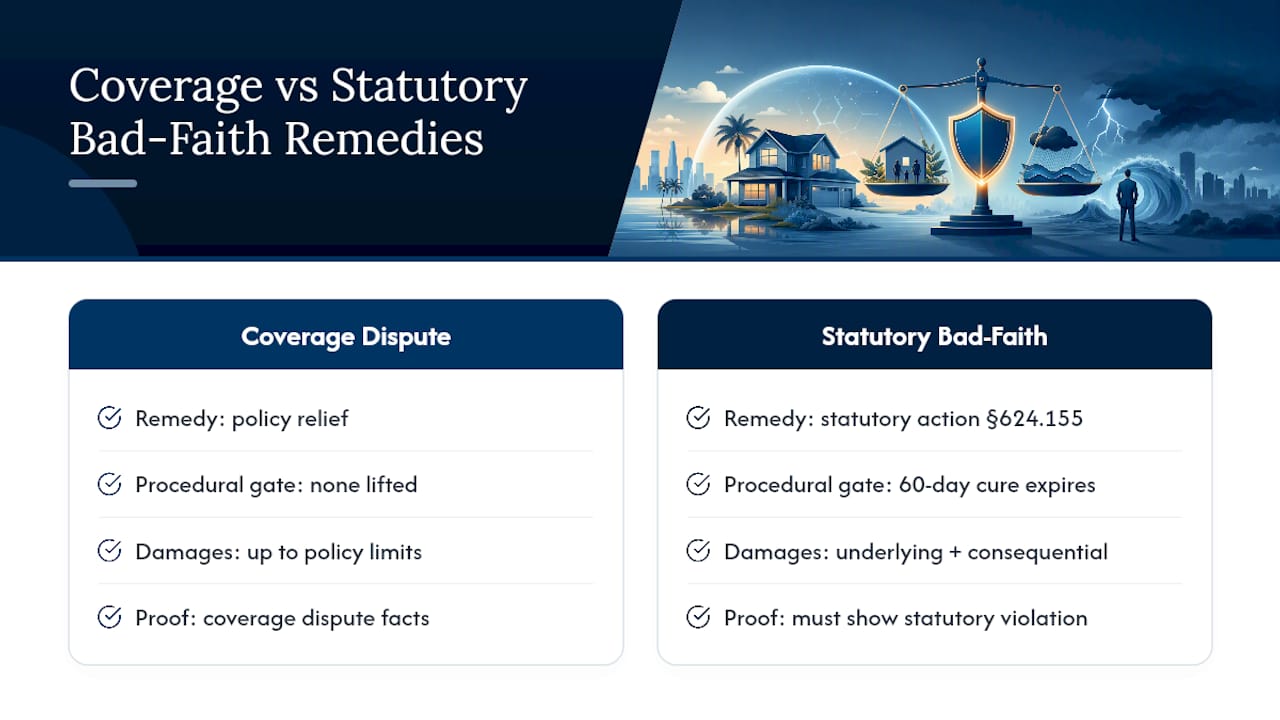
It’s worth being clear about what doesn’t happen automatically. The insurer’s failure to cure within 60 days doesn’t guarantee you’ll win the bad-faith claim outright. It clears the procedural gate that §624.155 requires before you can even file suit. From there, you still have to prove the insurer’s conduct actually violated the statute and caused you damages. That’s typically where the factual record you built for your Civil Remedy Notice, the named individuals, the dated correspondence, and the specific statutory citation, becomes the backbone of the lawsuit itself rather than just paperwork you filed and forgot about.
If your notice period has expired without resolution, this is usually the point where consulting counsel makes the most sense, since the strategic decisions from here (what damages to pursue, whether to negotiate before filing suit) shape the rest of the case.
The Part of This Process Most Guides Skip
Most explanations of the Civil Remedy Notice process read like a summary of the statute and stop there. What they leave out is how much of the damage happens in the mechanics: the dropdown menu that only lists authorized insurers, the inability to fix a typo after you hit submit, the fact that your factual narrative becomes searchable public record forever.

I’d argue the conventional advice, “just file the notice and wait 60 days,” undersells how much the drafting itself determines the outcome. A notice that cites “bad faith” generically instead of the exact statutory subsection isn’t a paperwork issue. It’s the difference between a claim that survives a motion to dismiss and one that doesn’t. Insurers’ defense counsel look for that gap first.
What actually matters, based on how this statute is written and enforced, is treating the notice like the opening filing in litigation, not a courtesy heads-up. Build the factual timeline before you touch the portal. Confirm the correct insurer entity. Cite the subsection, not the concept. If you’re dealing with anything beyond a small, straightforward denial, get a bad-faith case reviewed before the 60-day clock starts, not after it expires.
— Jorge
How Calillaw Helps After Your Civil Remedy Notice Is Filed
Calillaw is the option for claimants who’ve filed a Civil Remedy Notice and don’t want to gamble the next 60 days on a form they filled out alone. Unlike generic legal directories or DIY filing guides, Calillaw is a Florida trial firm led by a Board Certified Civil Trial Lawyer who has handled the exact statutory bad-faith litigation that follows an expired cure period.
If your insurer hasn’t paid or corrected the violation within its 60-day window, the next decision, what damages to pursue and how aggressively to litigate, shapes the entire case. Calillaw works on contingency, so there’s no upfront cost to find out where you stand. The firm handles the full range of insurance disputes, from denied property claims to catastrophic injury cases tangled up in coverage fights, and builds the factual record your Civil Remedy Notice started.
If your cure period has expired or you’re unsure whether your notice was drafted with enough specificity to survive a challenge, schedule a consultation with Calillaw’s bad-faith insurance team before you file anything else.
This article is general information, not a substitute for advice from a qualified lawyer. Consult a qualified legal professional about your own circumstances before acting on anything here.


