 Skip to Content

Avoid Fee Risk in Florida Civil Theft With a 30 Day Demand
Florida law allows a civil theft claim under Fla. Stat. § 772.11 that can recover treble damages, a $200 minimum, and reasonable attorney’s fees when someone knowingly takes or misuses your property. Before filing suit, you must send a written pre-suit demand and allow the other side a legally specified period to pay or resolve the matter. Miss that step, and a judge can dismiss your case before it starts.
TL;DR:
- A written demand must be sent at least 30 days before filing a civil theft lawsuit in Florida, clearly specifying the amount and supporting details.
- Civil theft claims require proof of criminal intent beyond control or wrongful exercise of property, with evidence needing to satisfy a clear and convincing standard.
- The damages awarded can be up to three times the actual loss, with a minimum recovery of $200, plus attorney’s fees and court costs.
- Defense strategies often focus on contesting the felonious intent or arguing the conduct was a good-faith business decision, risking fee-shifting liabilities.
- Special protections exist for elderly and disabled victims, but licensed healthcare providers or residential care facilities are generally excluded from civil theft liability for property related to services within their scope.
Table of Contents
- What Is Civil Theft Under Florida Law?
- What Damages Can You Recover for Civil Theft in Florida?
- Do You Have to Send a Demand Letter Before Suing for Civil Theft?
- How Do Courts Decide If Theft Happened? The Clear and Convincing Standard
- How Long Do You Have to File a Civil Theft Claim in Florida?
- What Defenses Can Defeat a Civil Theft Claim in Florida?
- Are There Special Rules for Elderly Victims or Healthcare Providers?
- When Should You Hire a Civil Theft Attorney in Florida?
- Sources
- FAQ
What Is Civil Theft Under Florida Law?
Civil theft in Florida is a statutory cause of action, not just a fancy label for a bad debt or a broken promise. It lives in Fla. Stat. § 772.11, which gives a person or business injured by a violation of Florida’s theft statutes the right to sue for money damages, separate and apart from any criminal case.
The civil remedy borrows its definition of “theft” directly from chapter 812 of the Florida Statutes, the same criminal code prosecutors use to charge petit theft, grand theft, and related offenses. To win a civil theft claim, you generally need to prove three things:
- Property was taken or used in a way that fits the definition of theft under chapter 812, meaning it belonged to you and was taken without your authorization.
- The defendant acted with felonious intent, knowingly obtaining or using your property with the intent to deprive you of it or to appropriate it for their own benefit.
- You suffered actual injury as a direct result of that conduct, whether that is a missing bank deposit, diverted business funds, or converted equipment.
That second element is what separates civil theft from a routine conversion claim. Conversion just requires that someone wrongfully exercised control over your property. Civil theft raises the bar: you have to show criminal intent, the same mental state a prosecutor would need for a theft conviction, but you’re proving it in civil court under civil procedure rules, not a criminal courtroom.
This distinction matters enormously for strategy. A contractor who overbilled you by mistake, or a business partner who made a bad-faith but honest business decision, probably isn’t a civil theft defendant. A bookkeeper who quietly diverted client funds into a personal account for years, knowing full well it wasn’t hers, is a textbook candidate. If you’ve read about false arrest claims in Florida, you already understand the general idea that civil remedies and criminal prosecutions run on separate tracks. Civil theft works the same way. A criminal case against the wrongdoer can proceed, stall, or never happen at all, and your civil claim stands on its own regardless.
What Damages Can You Recover for Civil Theft in Florida?
The payoff for proving civil theft is real leverage, not just a modest damages award. Section 772.11 entitles a prevailing claimant to up to three times the actual damages sustained, with a minimum recovery amount, plus reasonable attorney’s fees and court costs at trial and on appeal.
Here’s how the math plays out. Say a former employee siphoned $40,000 from a company account over eighteen months before getting caught. Under a straightforward breach-of-contract or conversion theory, the company recovers $40,000, maybe with interest. Under civil theft, that same set of facts can support a judgment of $120,000, treble the actual loss, plus the attorney’s fees the company spent proving it.
That treble-damages structure exists for a reason: Florida wants ordinary conversion and contract disputes settled quietly, but it wants intentional theft punished hard enough to deter it.
Key components of a civil theft recovery in Florida:
- Threefold the actual damages proven at trial
- A $200 minimum recovery, even where actual losses are smaller
- Reasonable attorney’s fees for the prevailing claimant
- Court costs, including expert and litigation expenses
- Fees recoverable through trial and any appeal
Statutory snapshot: Under § 772.11, a claimant who proves civil theft on $10,000 in actual losses can recover up to $30,000 before fees and costs are even added.
The fee-shifting piece changes the calculus for defendants, too. A business or individual facing a well-documented civil theft claim often has strong incentive to settle before trial, since losing means paying triple damages plus the other side’s legal bill. If you’ve dealt with a contingency-fee structure before, our breakdown of how attorneys charge for cases in Florida explains the general mechanics, though civil theft fee awards work through the statute itself rather than a private fee agreement.
Do You Have to Send a Demand Letter Before Suing for Civil Theft?
Yes, and skipping this step is one of the fastest ways to lose a case that otherwise had merit. Section 772.11 requires a written demand for either $200 or the treble-damage amount you’re claiming, sent before you file suit. The recipient then has 30 days to pay and receive a written release covering that specific act of theft.
Courts treat this as a genuine condition precedent, not a formality. If you sue without sending a proper demand, or without waiting out the 30 days, the defendant can move to dismiss, and you may have to start the clock over.
A compliant demand letter needs to do more than accuse someone of stealing from you. Build it around these elements:
- State the exact dollar amount demanded, calculated as either $200 or your treble-damage figure, whichever applies to your facts.
- Summarize the underlying facts clearly enough that the recipient understands exactly which act of theft you’re referencing.
- Send it in a way you can prove, certified mail with return receipt, or a process server, so you can document delivery if the case proceeds.
- Ask the recipient to preserve relevant records, including financial documents, communications, and account histories tied to the dispute.
- State the 30-day compliance window explicitly, so there’s no ambiguity about when the response period runs.
Pro Tip: A demand letter that reads like a vague accusation invites a fast dismissal. Attach your damages calculation, reference specific transactions or dates, and make the recipient’s obligation unmistakable. A well-documented demand also does double duty: it often prompts a pre-suit settlement, saving both sides the cost of litigation.
The most common pitfalls we see are demands that lack specificity, demands sent without proof of delivery, and demands that never state a clear dollar figure. Any one of those gaps gives opposing counsel an easy argument that you never satisfied the statute.
How Do Courts Decide If Theft Happened? The Clear and Convincing Standard
Civil theft in Florida requires proof by clear and convincing evidence, a standard well above the preponderance-of-the-evidence bar that governs most civil disputes. Preponderance just means “more likely than not,” roughly a coin flip tipped slightly in your favor. Clear and convincing evidence demands a firm belief in the truth of your claim, evidence that leaves the fact-finder without serious or substantial doubt.
That heightened standard exists because civil theft imports a criminal intent element, and Florida courts don’t hand out treble damages on thin proof. Evidence that tends to satisfy the standard usually falls into a few categories:
- Contracts, invoices, or agreements that establish what the defendant was and wasn’t authorized to do with your property
- Bank records and account reconciliations showing money moving somewhere it shouldn’t have gone
- Emails, texts, or internal communications revealing knowledge or intent
- Transaction logs and audit trails that show a pattern rather than a single mistake
- Witness statements from people who observed the conduct or heard the defendant discuss it
Circumstantial evidence carries real weight here. A single missing payment might be an honest error. A pattern of similar diversions, timed to avoid detection, paired with inconsistent or shifting explanations once questioned, starts to look like exactly the kind of felonious intent the statute requires. Trial preparation in these cases often comes down less to a single damning document and more to assembling a consistent financial trail, a clear timeline, and testimony that corroborates it.
Preserve everything early. Screenshot messages before accounts get deleted, pull bank statements before records age out of easy access, and get statements from witnesses while memories are fresh. If digital assets or cryptocurrency are involved in the underlying theft, recovery and tracing can get technical fast. Resources like Recovera’s guide on crypto recovery costs illustrate how specialized that tracing work can become once funds move through digital wallets.
How Long Do You Have to File a Civil Theft Claim in Florida?
Florida gives claimants a statutory period to file a civil theft lawsuit, generally around several years, running from when the cause of action accrues. In most cases, that clock starts when the theft occurred or when you reasonably should have discovered it.
That second half matters. Theft that’s actively concealed, a bookkeeper falsifying records, an employee covering tracks with fake documentation, can push the accrual date later under discovery-rule principles, since you can’t be expected to sue over a theft you had no reasonable way of knowing about. If you’re weighing whether older conduct still falls inside the window, our general overview of Florida’s personal injury statute of limitations explains how Florida courts approach filing deadlines more broadly, though civil theft runs on its own five-year track under the statute.
Venue for a civil theft claim generally follows standard Florida civil procedure: you file in the circuit or county court where the defendant resides, where the theft occurred, or where the property is located, depending on the dollar amount and specific facts. Circuit court handles claims above the county court jurisdictional threshold, which covers most treble-damage civil theft cases given how quickly trebling pushes claims past smaller-dollar limits.
Expect a real timeline once you file. Investigation and pre-suit demand can take weeks to a couple of months. After filing, discovery, motions, and any dispositive briefing typically run six months to well over a year before trial, longer if the case involves extensive financial records or forensic accounting.
What Defenses Can Defeat a Civil Theft Claim in Florida?
Defendants in civil theft cases rarely deny that money or property changed hands. They fight the intent element, and Florida’s fee-shifting provision gives them real incentive to fight hard.
Common defenses include:
- Lack of felonious intent, arguing the conduct was a mistake, negligence, or a good-faith business decision rather than knowing theft
- Bona fide contractual dispute, framing the disagreement as a breach-of-contract issue rather than theft, since honest disputes over what a contract required generally don’t meet the statute’s intent standard
- Statutory exclusions, arguing the conduct falls outside chapter 812’s definition of theft entirely
- Failure to satisfy the pre-suit demand requirement, a procedural defense that can end a case before the merits are even reached
The fee-shifting risk cuts both ways under § 772.11. If you win, you recover your attorney’s fees. But if a court finds your claim lacked substantial fact or legal support, the defendant can recover their fees from you, and the statute specifically bars courts from considering your ability to pay when awarding those fees. That’s a meaningful exposure for someone who files a civil theft claim over what turns out to be a garden-variety contract dispute.
This is exactly why courts and defense counsel push back hard when civil theft gets used to dress up an ordinary business disagreement in treble-damage clothing. Before filing, have counsel evaluate whether the facts genuinely show knowing, intentional misconduct, not just a deal that went badly. Our piece on common mistakes that sink injury and civil claims covers several procedural traps that apply just as easily here.
Are There Special Rules for Elderly Victims or Healthcare Providers?
Florida’s civil theft statute includes protections specifically for elderly and disabled victims. A victim who is elderly or disabled can move to advance the trial setting on the court’s docket, getting the case heard faster than the standard civil calendar would otherwise allow. The statute also specifies that if such a victim dies during the litigation, the court doesn’t lose jurisdiction over the claim, so the case can continue rather than evaporate.
On the other side, the statute carves out important exclusions. Property covered by a patient’s or resident’s rights under other Florida statutes doesn’t trigger civil theft liability the same way ordinary property does, and properly licensed healthcare providers and residential care facilities generally aren’t civilly liable for theft claims arising from services rendered within their licensed scope of care.
That distinction matters if your dispute involves a nursing home or assisted living facility. A billing disagreement or a dispute over how a facility handled a resident’s funds may need to run through different legal channels entirely, not a civil theft claim. The full statutory text, including these exclusions, is available through Florida’s official legislative statutes page.
When Should You Hire a Civil Theft Attorney in Florida?
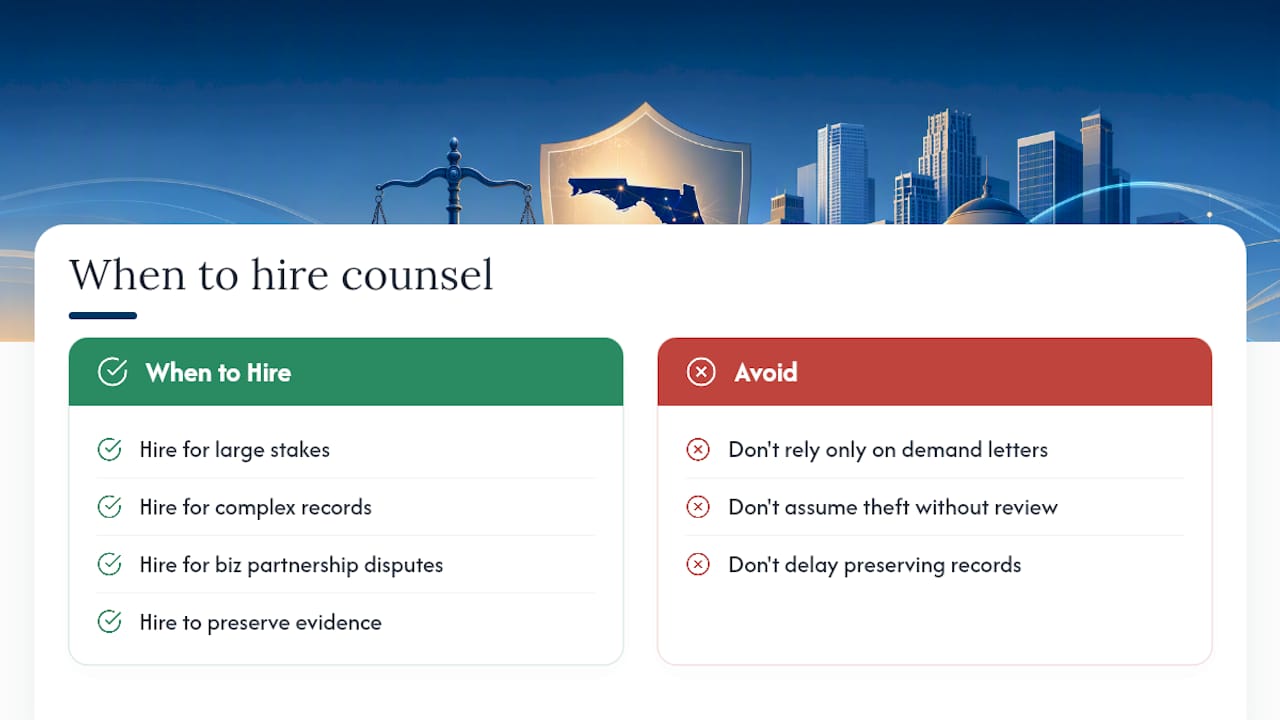
Some civil theft situations are simple enough to handle with a well-drafted demand letter and a little patience. Most aren’t. Once the amount at stake climbs into the tens or hundreds of thousands, once financial records span multiple accounts or years, or once the case touches a business partnership or commercial dispute, the margin for error narrows fast, and so does your tolerance for the fee-shifting risk we covered above.
Experienced counsel earns their keep early, not just at trial. A lawyer who’s tried civil theft cases knows how to draft a pre-suit demand that actually satisfies the statute’s specificity requirements, how to preserve financial and digital evidence before it disappears, and how to frame circumstantial proof so it clears the clear-and-convincing bar rather than falling short of it. That same counsel can also give you an honest read on whether your facts show genuine felonious intent or a contract dispute wearing a theft claim’s clothes, before you’re the one exposed to the other side’s attorney’s fees.
The trial team has spent decades preparing complex commercial and property disputes for verdict, not just settlement leverage. That trial-tested judgment matters most in cases where the other side is betting you’ll fold before trial. If you’re weighing whether a dispute belongs in commercial litigation or under the civil theft statute specifically, our guide to what qualifies as a commercial litigation claim walks through how those categories overlap and where they diverge.
If you believe someone knowingly took property, funds, or assets that belonged to you, reach out to discuss your legal rights and next steps. Legal representation is available for individuals and businesses in commercial and property disputes, often on a contingency-fee basis so clients pay nothing upfront while the case is built.
This article is general information, not a substitute for advice from a qualified lawyer. Consult a qualified legal professional about your own circumstances before acting on anything here.
FAQ
What Makes a Theft a Civil Matter Instead of a Criminal One?
A theft becomes a civil matter when the victim sues the wrongdoer directly under Fla. Stat. § 772.11 for money damages, separate from any criminal prosecution the state may or may not pursue. Civil and criminal cases can run simultaneously, and a civil claim doesn’t require a criminal conviction to succeed.
What Is the 30-Day Rule in Florida Civil Theft Cases?
Before filing a civil theft lawsuit, you must send the defendant a written demand for $200 or your treble-damage amount, and the defendant then has 30 days to pay and receive a written release for that specific act. Filing suit before that 30-day window closes, or without sending a compliant demand, can get your case dismissed.
Can Petit Theft Charges Be Dropped in Florida?
Criminal petit theft charges can be dropped or dismissed by a prosecutor for various reasons, including insufficient evidence or a negotiated resolution, but that’s a separate track from a civil theft claim under § 772.11. Dropped criminal charges don’t automatically bar you from pursuing civil theft damages, since the civil case doesn’t depend on a criminal conviction.
How Long Do You Go to Jail for Theft in Florida?
Jail exposure for theft in Florida depends on the degree of the offense under chapter 812, ranging from up to a year for petit theft to decades for first-degree grand theft involving large sums, but that’s a criminal sentencing question separate from a civil theft lawsuit. A civil theft claim seeks money damages, treble damages, fees, and costs, regardless of whether the defendant ever faces jail time.


