 Skip to Content

6 Differences U.S. Injury Victims Must Know: Class Action vs Mass Tort
If your injuries came from a defective drug, a faulty medical device, or industrial chemical exposure and your damages differ from other victims, you likely have a mass tort claim coordinated through multidistrict litigation. If everyone harmed suffered the same, easily calculated loss, such as a flat junk fee or an identical stock drop, a class action under Rule 23 probably fits better. Class actions trade individual control for convenience; mass torts trade convenience for a shot at full, personalized compensation.
TL;DR:
- Mass torts involve thousands of individual lawsuits with personalized damages, often managed through multidistrict litigation with bellwether trials, rather than a certification process.
- Class actions require strict certification under Rule 23, with criteria like numerosity, commonality, typicality, and adequacy, and tend to settle faster once certified.
- If your injury is severe or requires detailed medical proof, opting out of a class and pursuing individual or mass tort litigation usually yields better compensation.
- In mass torts, settlement offers are reviewed and accepted individually, without judge approval, while class actions require court approval and fairness hearings.
- Early and thorough evidence collection, along with timely legal advice, is critical, since statute of limitations deadlines do not pause during ongoing group or mass claims.
Table of Contents
- Class Action vs Mass Tort: What Rule 23 Certification Actually Requires
- Mass Tort Basics: MDL, Bellwether Trials, and Individual Claims
- Class Action vs Mass Tort: A Side-by-Side Comparison
- How to Decide: A Checklist Before You Join or Opt Out
- What to Expect Once You’re In: Notices, Deadlines, and Next Steps
- Legal Strategy and Defense Tactics: Class Actions vs Mass Torts
- Who Represents You: Class Representatives vs Lead Plaintiffs
- Weighing the Tradeoffs: Advantages and Disadvantages
- Settlement Structure and Court Approval: Why It Differs
- A Trial Lawyer’s View on Choosing the Right Path
- How Calil Law Can Help With Your Injury Claim
- Sources
Class Action vs Mass Tort: What Rule 23 Certification Actually Requires
A class action isn’t a type of claim. It’s a procedural device that lets one or a few plaintiffs sue on behalf of an entire group of people with the same legal grievance. Before that can happen, a federal judge has to certify the class under Rule 23 of the Federal Rules of Civil Procedure, and that certification is where most proposed class actions actually die.
Rule 23(a) demands four things, and courts apply them strictly:
- Numerosity: the group is too large for individual lawsuits to make sense.
- Commonality: legal or factual questions are shared across the group.
- Typicality: the lead plaintiff’s claim mirrors the group’s claims.
- Adequacy: the representative and their attorneys can fairly protect everyone’s interests.
Beyond that, Rule 23(b) requires additional findings, often that common issues predominate over individual ones. If certified, class members get formal notice of the suit and a window to opt out; those who stay in are bound by whatever settlement or verdict follows, even if they never set foot in a courtroom.
Mass Tort Basics: MDL, Bellwether Trials, and Individual Claims
A mass tort skips certification entirely. Instead of one case representing thousands, you get thousands of separate lawsuits, each with its own facts, injuries, and damages, tied together for efficiency rather than merged into one. Federal courts typically manage this through multidistrict litigation, which transfers similar cases to a single judge for coordinated pretrial work: shared discovery, unified expert challenges, and consistent rulings on legal questions common to the group.
Each plaintiff’s case still stands on its own once pretrial work wraps up. That structure explains why mass torts dominate pharmaceutical, medical device, and toxic exposure litigation:
- Injuries vary wildly from one plaintiff to the next.
- Causation often depends on individual medical history, dosage, or exposure length.
- Damages can range from modest to catastrophic within the same litigation.
Courts manage this variety with bellwether trials, a handful of representative cases tried to verdict early to test how juries value the claims. Those results shape settlement matrices that assign compensation tiers based on injury severity, age, and other individual factors.
Pro Tip: If your injury involves a specific product, drug, or exposure event with a nationwide MDL already forming, don’t assume your case is identical to your neighbor’s. The strength of your individual medical proof often matters more than the size of the overall litigation.
Class Action vs Mass Tort: A Side-by-Side Comparison
The practical differences come down to six things: how the case is structured, how it gets aggregated, how money gets calculated, how much say you have, and how long it takes.
- Case structure. A class action is one lawsuit with a single named representative standing in for everyone. A mass tort is hundreds or thousands of individual lawsuits that happen to share a defendant and a common set of facts.
- Certification vs. MDL transfer. Class actions require a judge to certify the class under Rule 23, a formal, often contested process that can take months or years and frequently fails. Mass torts require no certification. A Judicial Panel on Multidistrict Litigation simply transfers related cases to one court for coordinated pretrial handling.
- Damages calculation. Class-wide claims usually get resolved with a formula, an equal payout, or a pro rata share of a settlement fund. Mass tort compensation is individualized: your payout reflects your specific injury, medical costs, lost wages, and pain and suffering, not an average.
- Participation and control. Class members are passive by design. You get notice, you can opt out if you want to sue separately, and if you stay in, the outcome binds you. Mass tort plaintiffs retain individual control throughout. You have your own attorney relationship, your own settlement decision, and your own right to reject an offer.
- Settlement approval. Class settlements need a judge’s approval and a fairness hearing before anyone gets paid. Mass tort settlements are typically negotiated in aggregate but paid out individually according to a matrix, without a single binding court-approved deal covering everyone.
- Timelines. Class actions can resolve faster once certified because there’s one case to settle. Mass torts often take longer because bellwether trials and individual case reviews happen before a global resolution takes shape.
One practitioner analysis notes that the choice between these vehicles shapes far more than paperwork. It affects which court hears your case, what evidence gets developed, and ultimately how much relief you can realistically expect.
How to Decide: A Checklist Before You Join or Opt Out
Start with your injury, not the litigation. If your harm is severe, your medical history is complicated, or your damages are significantly higher than the “average” victim in a proposed class, a class action formula will likely shortchange you. Mass tort treatment, or an individual lawsuit outside any aggregate proceeding, generally serves you better when causation and damages are personal rather than shared.
Run through this before signing anything:
- How severe is your injury compared to others described in the notice or complaint?
- Does proving your case require individualized medical evidence, or is liability essentially identical for everyone?
- Do you want a say in settlement decisions, or is a faster, hands-off resolution more valuable to you?
- Are you relying on this recovery for near-term expenses, which might make a slower mass tort timeline harder to absorb?
Before hiring counsel, ask direct questions: What percentage does the firm take under the fee agreement, and does it change if the case settles versus goes to trial? How is settlement money actually distributed among plaintiffs? What happens to your right to sue individually if you opt out of a class and later change your mind?
Pro Tip: Watch for settlement notices that promise a payout far smaller than your attorney’s fee percentage suggests it should be. A vague claims process, unclear deadlines, or pressure to sign quickly are all signs worth a second opinion before you commit.
What to Expect Once You’re In: Notices, Deadlines, and Next Steps
Whether you land in a class action or a mass tort, the clock starts moving the moment you’re injured, not the moment a lawsuit gets filed.
- Watch for notice. In a class action, notice usually arrives by mail, email, or publication once the class is certified, spelling out your opt-out deadline and how to file a claim form if you stay in. In a mass tort, there’s no formal class notice; instead, your own attorney tracks the MDL’s bellwether schedule and settlement matrix as it develops.
- Respect the statute of limitations. Florida and most states impose strict deadlines for filing personal injury claims, and those deadlines don’t pause just because a related mass tort or class action already exists. Waiting for a notice that may arrive months or years later can cost you your claim entirely.
- Preserve your evidence now. Keep every medical record, bill, and product packaging related to your injury. Avoid posting about your case or your recovery on social media, since defense attorneys routinely mine those posts for material that undercuts your damages.
- Talk to counsel before deciding anything. Whether the right move is joining a class, participating in an MDL, or filing an individual personal injury claim, an attorney can map your specific facts to the right vehicle before any deadline closes.
Legal Strategy and Defense Tactics: Class Actions vs Mass Torts
Defense strategy in a class action almost always targets certification first. Defendants argue the class lacks commonality, that individualized issues predominate over shared ones, or that the proposed representative isn’t typical of the group. Beat certification, and the case usually collapses into nothing, since few individual plaintiffs can afford to litigate alone over a small claim.
Mass tort defense plays a different game. Since certification isn’t in play, defendants focus on attacking causation and general medical evidence, arguing a drug or product didn’t actually cause the specific harm claimed. They also lean heavily on bellwether trial results, using early wins to pressure plaintiffs’ attorneys toward lower global settlement figures, and early losses to push their own side toward the table.
Plaintiffs’ counsel mirrors this divide. Class counsel builds a case around uniformity, showing the judge that one trial can fairly resolve everyone’s claim. Mass tort counsel builds a case around causation science and individual harm, often coordinating with a plaintiffs’ steering committee to share the cost of experts across thousands of cases while still preserving each client’s unique damages story.
Discovery timing differs too. Class litigation front loads discovery into the certification fight. Mass tort discovery unfolds in phases, general causation first, then case specific discovery tied to bellwether selections, which stretches timelines but strengthens the individualized proof each plaintiff eventually needs.
Who Represents You: Class Representatives vs Lead Plaintiffs
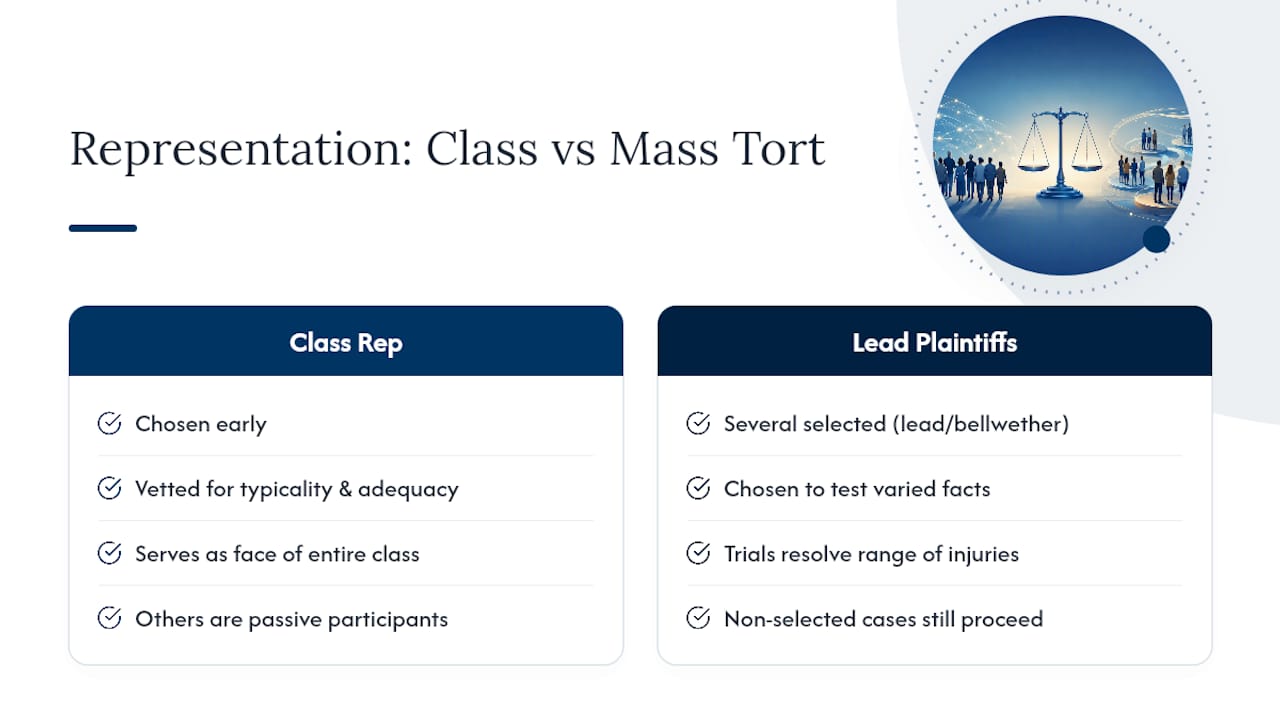
A class representative is chosen early and serves as the face of the entire class. Courts vet this person carefully under the typicality and adequacy requirements, checking whether their injury and circumstances genuinely mirror the group’s and whether they can be trusted to protect absent members’ interests rather than cutting a side deal for themselves.
Lead plaintiffs in a mass tort work differently. Rather than one person representing everyone, courts and plaintiffs’ committees select several lead or bellwether plaintiffs whose cases get tried first, specifically because their facts vary in ways that test the range of the litigation. A bellwether plaintiff with a moderate injury and one with a catastrophic injury might both get selected, precisely so the eventual settlement matrix reflects that spread.
The practical difference matters to you directly. If you’re not the class representative, your role is passive. You don’t testify, you don’t negotiate, and you don’t see your individual damages calculated separately. If you’re a mass tort plaintiff, even one who isn’t selected for a bellwether trial, your case still moves forward on its own footing once general causation issues are resolved, and your attorney still has to prove your specific injury and damages to get you paid.
Weighing the Tradeoffs: Advantages and Disadvantages
Class actions offer real advantages when your damages are genuinely uniform. You spend little time or money pursuing the claim, you don’t need your own expert witnesses, and you get a resolution without ever appearing in court. That convenience comes at a cost: your payout gets averaged across the group, and if your actual harm is worse than typical, you’re stuck with a formula that doesn’t reflect it unless you opt out in time.
Mass torts flip that equation. You keep your own attorney, your own say over settlement offers, and a compensation outcome tied to your actual injury rather than a group average. That individualized attention takes longer to resolve and requires more from you personally: medical documentation, deposition testimony, and patience through a multi-year process. Nevada Lawyer’s practitioner guidance notes that plaintiffs with unique medical histories or serious injuries usually come out ahead in individualized mass tort treatment compared to a class-wide formula built for the average claimant, not the worst-off one.
The disadvantage cuts both ways. A mass tort plaintiff with a mild, well-documented injury might actually net less after individual litigation costs than they would have received from a quick class settlement check.
Settlement Structure and Court Approval: Why It Differs
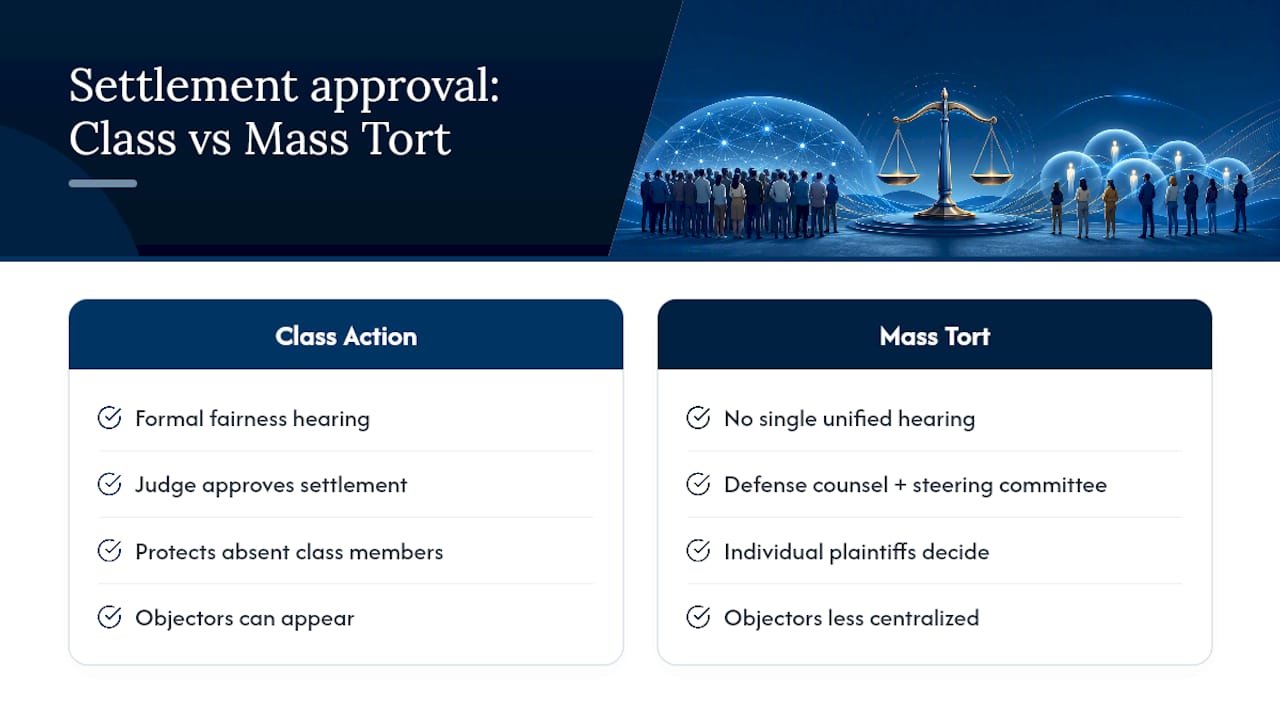
Class action settlements require a formal fairness hearing before a judge signs off, and that hearing exists specifically to protect absent class members who never had a direct hand in negotiating the deal. The judge reviews whether the settlement amount is reasonable, whether attorney’s fees are proportionate, and whether the distribution formula treats class members fairly relative to their claims. Objectors can appear and challenge the deal before it becomes final.
Mass tort settlements skip that single unified approval step. Instead, a global settlement typically gets negotiated between defense counsel and a plaintiffs’ steering committee, then individual plaintiffs decide whether to accept their calculated share under the settlement matrix or continue litigating separately. The Federal Judicial Center’s mass tort materials document cases where courts have actually borrowed Rule 23 settlement class mechanics to resolve mass tort claims in a single binding proceeding, blending the two models when a defendant wants finality and plaintiffs’ counsel wants efficient distribution.
That hybrid approach shows up more than people expect. Some of the largest pharmaceutical mass torts eventually roll into a Rule 23 settlement class specifically to bind holdouts and close the litigation permanently, trading some individual flexibility for a guaranteed, court-approved resolution everyone can rely on.
A Trial Lawyer’s View on Choosing the Right Path
Certification fights and MDL coordination are legal mechanics. What actually determines your outcome is whether your causation and damages evidence can stand on its own. Trial-tested counsel evaluates that early: how strong is your medical proof, how unique is your exposure history, and would a class formula actually undervalue what you’ve lost?
That evaluation often points toward opting out. When a client’s injury is severe enough that individualized proof would clearly beat a class-wide average, Calil Law treats trial readiness as the deciding factor, not convenience. A firm built to try cases to verdict, not just settle quickly, changes how a case gets valued from day one.
— Jorge
How Calil Law Can Help With Your Injury Claim
Deciding between a class action and a mass tort isn’t something you should figure out from a notice letter alone. The firm represents individuals in personal injury, product liability, and complex litigation matters, and often works on a contingency fee basis, meaning clients typically pay nothing upfront.

If you’ve received a class notice, been contacted about a mass tort, or you’re simply unsure which path fits your injury, a free consultation can clarify your options before any deadline passes. Bring what you have: medical records, bills, any notices or claim forms you’ve received, and a timeline of what happened. From there, legal counsel can evaluate whether your damages are better served by individualized litigation or participation in an existing group proceeding. Start by reviewing your personal injury claim options or reach out directly to discuss your specific situation before time runs out on your rights.
This article is general information, not a substitute for advice from a qualified lawyer. Consult a qualified legal professional about your own circumstances before acting on anything here.


