 Skip to Content

Commercial Litigation Strategy for Injury Plaintiffs
A commercial litigation strategy for injury plaintiffs is the systematic approach to navigating complex, multi-party business injury claims to secure fair compensation through disciplined preparation and trial readiness. Commercial and personal injury principles overlap in ways that create unique challenges: you may face corporate defendants with deep pockets, aggressive defense teams, and multiple liable parties all pointing fingers at each other. The Eggshell Skull Rule, statutory fault thresholds, and statutes of limitations are not abstract legal concepts. They are the tools that determine whether you walk away with fair compensation or nothing at all. Understanding how to use them is the first step toward protecting your rights.
What is the best commercial litigation strategy for an injury plaintiff?
The best plaintiff litigation strategy in a commercial injury case starts with one question: who can actually pay? Multi-defendant injury cases require identifying the most financially solvent defendants and steering your narrative toward crossing statutory liability thresholds, often set at 50% fault, to ensure any recovery is actually collectible. A defendant who bears 30% fault in a jurisdiction with a 50% threshold pays only their proportional share. That distinction can mean the difference between a meaningful verdict and an uncollectable one.
How fault thresholds shape your recovery
Fault apportionment rules vary by jurisdiction, but the core principle is consistent: defendants below a statutory fault threshold pay only their share, not the full judgment. This makes it critical to build your evidence toward concentrating liability on the most culpable and financially capable party. In cases involving a business and a contractor, for example, you want the evidence to show the business controlled the conditions that caused your injury.
| Liability scenario | Threshold rule | Plaintiff impact |
|---|---|---|
| Single corporate defendant at 60% fault | Exceeds 50% threshold | Full joint liability applies |
| Contractor at 40%, business at 60% | Business exceeds threshold | Business pays full damages |
| Two defendants, each at 25% | Neither exceeds threshold | Each pays proportional share only |
| Employee and employer, employer at 55% | Employer exceeds threshold | Employer bears primary liability |
Multi-defendant cases also invite mutual blame tactics. Corporate defendants routinely shift fault onto co-defendants, subcontractors, or even the plaintiff. Your attorney needs to anticipate this and structure discovery to expose each party’s actual control over the conditions that caused your injury.
- Identify which defendants carry liability insurance with adequate policy limits.
- Map the chain of control: who owned the property, who managed operations, who trained staff.
- Use industry safety standards and audit records to anchor liability to specific failures.
- Depose each defendant separately to capture contradictions in their accounts.
Pro Tip: Request organizational charts and management contracts early in discovery. Corporate defendants often obscure who actually controlled the dangerous condition, and those documents expose the real decision-makers.
How do you prepare a demand letter that forces insurer disclosure?
A well-supported demand letter does more than state your damages. Demand letters initiate insurer disclosure of files and witnesses, giving you a clearer picture of the defense’s evidence before litigation formally begins. Settlement is faster and cheaper when liability is clear and damages fall within policy limits. When liability is contested or damages exceed those limits, the demand letter becomes your opening argument, not just a formality.
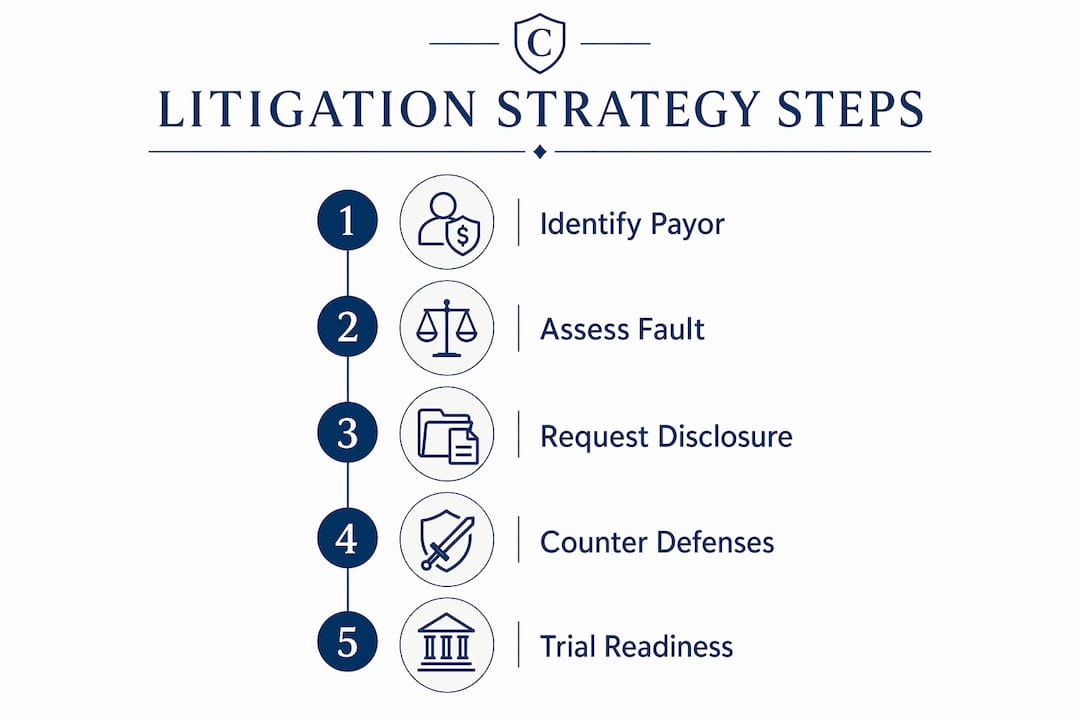
Statutes of limitations typically run 4–6 years depending on jurisdiction and claim type, but waiting erodes evidence and witness memory. Structured, prompt pre-filing preparation protects your position and signals that you are organized and serious.
Follow these steps to build a demand letter that creates real leverage:
- Write a factual narrative. Describe the incident in precise, chronological detail. Name the location, the conditions, the parties present, and the specific act or omission that caused your injury.
- Calculate damages completely. Include medical bills, projected future treatment costs, lost wages, loss of earning capacity, and non-economic damages such as pain and suffering.
- Attach supporting documentation. Medical records, incident reports, photographs, witness statements, and expert opinions all belong in the demand package.
- Reference applicable standards. Cite the safety regulations, industry codes, or operational manuals the defendant violated. This shifts the conversation from opinion to documented failure.
- Set a firm response deadline. A 30-day deadline creates urgency and establishes a clear record if the insurer delays or acts in bad faith.
- State your litigation intent clearly. Make it plain that you will file suit if the demand is not met. Insurers respond differently to plaintiffs who demonstrate they are ready to pursue litigation.
Pro Tip: Send the demand letter by certified mail and keep the return receipt. That timestamp matters if the insurer later claims they never received it or disputes the timeline.
How do you counter corporate defense tactics in injury litigation?
Corporate defense teams follow a predictable playbook: dispute causation, blame pre-existing conditions, and minimize the impact of your injuries on your daily life. Knowing this in advance lets you build your case to neutralize each tactic before it lands.

The Eggshell Skull Rule is your primary weapon against pre-existing condition defenses. This legal doctrine holds defendants fully liable for aggravating a dormant or asymptomatic condition, even if they did not cause the underlying condition. If you had a prior back injury and the defendant’s negligence made it significantly worse, they owe you for the full aggravation. Applying this rule requires a thorough review of your medical history, ideally covering the past decade, to document the baseline condition before the incident and the measurable worsening after it.
Documenting injury impact beyond medical records is equally important. Jurors and adjusters respond to concrete evidence of how your life changed. A daily journal, statements from family members, and records of activities you can no longer perform all build a picture that medical bills alone cannot convey.
Digital hygiene is a defense vulnerability most plaintiffs overlook. Defense teams hire private investigators and monitor social media to find posts, photos, or check-ins that contradict your injury claims. A single photo of you at a family barbecue can be framed as evidence you are not as injured as you claim.
- Lock down all social media accounts immediately after the incident.
- Do not post about your case, your activities, or your physical condition.
- Assume you are being watched in public spaces during the litigation period.
- Tell family and friends not to tag you in photos or posts.
- Preserve all communications with the defendant or their agents in writing.
Pro Tip: Ask your attorney to send a litigation hold letter to the defendant early. This legally obligates them to preserve evidence, including surveillance footage, maintenance logs, and internal communications that might otherwise be deleted.
Why does trial readiness improve your settlement offer?
Trial readiness is the most effective form of settlement leverage available to an injury plaintiff. When you walk into mediation with organized evidence, credible expert witnesses, and a clear narrative, insurers and corporate defendants recalculate their risk. A plaintiff who looks prepared to go to trial is a plaintiff who gets a better offer.
Trial preparation includes three core elements: evidence organization, expert witness preparation, and narrative clarity. Your expert witnesses, whether medical professionals, accident reconstructionists, or industry safety consultants, must be able to explain complex facts to a jury in plain language. Jurors decide cases on credibility and clarity, not legal sophistication.
Jury selection strategy also matters more than most plaintiffs realize. Identifying jurors who have personal experience with workplace injuries, insurance disputes, or corporate negligence can shift the room before a single witness takes the stand. Your attorney should use voir dire to surface bias and seat jurors who understand that higher compensation reflects real harm.
| Consideration | Trial | Settlement |
|---|---|---|
| Timeline | 1–3 years to verdict | Weeks to months |
| Cost | Higher attorney and expert fees | Lower overall cost |
| Outcome control | Jury decides | Parties negotiate |
| Privacy | Public record | Confidential |
| Enforcement | Requires active collection | Payment terms negotiated |
| Upside potential | Full verdict amount | Capped by negotiation |
A court judgment is a paper right, not automatic cash. Plaintiffs must prepare enforcement plans immediately after a verdict, including wage garnishments, asset levies, and statutory interest calculations. Without active enforcement, defendants may delay or resist payment despite a court order.
Pro Tip: Before trial, research the defendant’s assets: real property, bank accounts, and business holdings. Knowing what you can collect shapes how aggressively you should pursue a verdict versus a negotiated resolution.
Common pitfalls that derail injury plaintiffs in commercial cases
Most plaintiff losses in commercial injury litigation trace back to a small set of avoidable mistakes. Recognizing them early protects your case.
- Weak evidence collection. Failing to photograph the scene, preserve physical evidence, or obtain witness contact information immediately after an incident creates gaps that defense teams exploit.
- Poorly supported demands. A demand letter without documentation is easily dismissed. Every dollar you claim needs a corresponding record.
- Mismanaging multiple defendants. Spreading liability too thin across defendants means none of them cross the fault threshold that triggers full joint liability.
- Ignoring digital exposure. Social media posts and location data have derailed otherwise strong injury claims. Treat your digital presence as evidence from day one.
- Delaying post-judgment collection. Winning a verdict and then waiting to enforce it gives defendants time to move assets. File enforcement actions promptly.
- Missing limitation deadlines. Florida’s personal injury statutes and similar rules in other states impose hard deadlines. Missing them ends your case regardless of merit.
The best troubleshooting approach is prevention. Work with an attorney who maps your case strategy from intake, not just from the courthouse steps.
Key Takeaways
The most effective commercial litigation strategy for an injury plaintiff combines early liability focus, documented demands, defense anticipation, and trial readiness to maximize both settlement leverage and verdict outcomes.
| Point | Details |
|---|---|
| Focus liability strategically | Concentrate fault on solvent defendants who exceed statutory thresholds to ensure collectible recovery. |
| Build demand letters with documentation | Attach medical records, expert opinions, and safety standard violations to compel insurer disclosure. |
| Apply the Eggshell Skull Rule | Use this doctrine to hold defendants liable for aggravating pre-existing conditions, not just new injuries. |
| Treat trial readiness as leverage | Organized evidence and credible experts push insurers toward fair settlement offers before trial. |
| Enforce judgments immediately | File garnishments and asset levies right after a verdict to prevent defendants from delaying payment. |
What I’ve learned about plaintiff strategy that most articles won’t tell you
After years of working through high-stakes injury and commercial litigation cases, the pattern I see most often is this: plaintiffs lose leverage not in the courtroom, but in the months before they ever get there. They delay evidence collection. They post on social media. They send demand letters without documentation. By the time they realize the defense has built a counter-narrative, it is very hard to undo.
The Eggshell Skull Rule is one of the most underused tools in plaintiff litigation. Defense teams count on plaintiffs not knowing it exists. When you walk into a deposition and your attorney can document exactly how a pre-existing condition was aggravated, and by how much, the defense’s entire pre-existing condition argument collapses. That preparation requires pulling years of medical records, not just the records from after the incident. Most plaintiffs skip that step because it feels like extra work. It is not extra work. It is the case.
Trial readiness changes the negotiation dynamic in a way that is hard to overstate. I have seen cases where the insurer’s offer doubled between the first mediation session and the second, simply because the plaintiff’s attorney showed up to the second session with a trial exhibit binder and a retained expert ready to testify. The insurer did the math. You should too.
My honest advice: hire a board-certified civil trial lawyer, not just any attorney who handles injury cases. The difference in how a defense team responds to your representation is immediate and measurable. Corporate defendants and their insurers know who is actually prepared to try a case and who is not.
— Jorge
Calillaw’s approach to commercial injury litigation
Calillaw is a Florida litigation firm led by a Board Certified Civil Trial Lawyer with decades of courtroom experience in personal injury and commercial litigation. The firm handles motor vehicle collisions, premises liability, catastrophic injury claims, insurance disputes, and complex business litigation. Every case is built with trial in mind, which means the preparation that creates settlement leverage starts at intake, not at the courthouse door.

If you were injured in an accident involving a business, a commercial property, or multiple defendants, the strategy you build in the first weeks matters more than most people realize. Calillaw combines direct client communication with disciplined case preparation and a commitment to results. Contact the firm for a free consultation and find out what a focused plaintiff litigation strategy can do for your case.
FAQ
What is a commercial litigation strategy for injury plaintiffs?
A commercial litigation strategy for injury plaintiffs is a structured plan for pursuing compensation against business defendants through evidence organization, liability targeting, demand preparation, and trial readiness. It combines personal injury and commercial law principles to address multi-party, high-stakes claims.
How does the Eggshell Skull Rule help injury plaintiffs?
The Eggshell Skull Rule holds defendants fully liable for aggravating a pre-existing condition, even if they did not cause the original injury. Plaintiffs must document their medical baseline before the incident and the measurable worsening after it to apply this doctrine effectively.
When should an injury plaintiff file a demand letter?
An injury plaintiff should file a demand letter as early as the evidence supports it, well within the applicable statute of limitations, which typically runs 4–6 years depending on jurisdiction and claim type. Prompt filing compels insurer disclosure and preserves your negotiating position.
What happens after winning a court judgment in an injury case?
A court judgment does not guarantee immediate payment. Plaintiffs must actively enforce the judgment through wage garnishments, asset levies, and statutory interest calculations, beginning immediately after the verdict to prevent defendants from delaying or avoiding payment.
Why does trial readiness improve settlement offers?
Trial readiness signals to insurers and corporate defendants that the plaintiff is organized, credible, and prepared to proceed to verdict. Well-prepared plaintiffs with expert witnesses and documented evidence consistently receive higher settlement offers than those who appear unprepared for trial.
Recommended
- Why Using A Personal Injury Law Firm Is Critical Before Filing A Lawsuit In An Accident Case – Calil Law
- Navigating Slip and Fall Settlements with Surgery: A Guide
- How Accident Cases And Their Compensation Are Determined When A Lawsuit Is Filed Against The Insurance Companies – Calil Law
- Three Key Reasons to Hire a Personal Injury Attorney – Calil Law


