 Skip to Content

Concussion Settlement Amounts: What Injury Victims Can Expect
Most concussion settlements for individual personal injury claims fall somewhere in these ranges, depending on severity:
- Mild concussion (resolved symptoms): generally falls within a moderate settlement value range
- Post-concussion syndrome (persistent symptoms): typically commands a higher settlement value due to ongoing effects
- Severe traumatic brain injury (TBI) with permanent deficits: can result in very substantial settlements reflecting long-term care costs
Those numbers reflect individual tort claims. Class settlements like the NFL and NCAA programs operate on entirely different mechanics and are discussed separately below. The single most important action you can take right now is to get documented medical care immediately and consult a personal injury attorney before you speak with any insurance adjuster. Both steps directly protect the value of your claim.
Key Takeaways
Concussion settlements range from the low tens of thousands for resolved mild injuries to millions for permanent TBI, and the single most important factor separating those outcomes is how thoroughly the injury is documented from day one.
| Point | Details |
|---|---|
| Settlement ranges vary widely | Mild concussions often settle for —; severe TBI claims can reach $300,000 to millions. |
| Documentation is the foundation | Neuropsych testing, specialist notes, and a daily symptom journal are stronger evidence than imaging alone. |
| Don’t settle before MMI | Signing a release before reaching maximum medical improvement can forfeit compensation for future care costs. |
| Class settlements are not individual payouts | NFL and NCAA programs provide medical monitoring, not direct compensation for your personal injury losses. |
| Calil Law offers free evaluations | A Board Certified Civil Trial Lawyer reviews your claim at no cost, on a contingency fee basis. |
Table of Contents
- What a concussion settlement can pay for
- Typical settlement ranges, from mild concussion to severe TBI
- How the NFL and NCAA class settlements differ from your individual claim
- Key factors that most strongly affect a concussion settlement’s value
- How to prove a concussion in a claim
- How long a concussion claim typically takes to resolve
- Should you accept the insurer’s settlement offer?
- How an experienced personal injury attorney can increase your settlement
- What we see most often in concussion cases
- Calil Law is ready to evaluate your concussion claim at no cost
- Sources
What a concussion settlement can pay for
A concussion settlement agreement can cover far more than your emergency room bill. Understanding every category of damages is what separates a fair recovery from a shortchanged one.
Economic damages are the calculable losses:
- Past and future medical expenses (ER visits, neurology, neuropsychology, imaging, therapy)
- Lost wages from missed work during recovery
- Lost earning capacity if cognitive deficits affect your career long-term
- Future care costs (ongoing specialist visits, medication, cognitive rehabilitation)
- Home modifications if physical or cognitive limitations require them
- Vocational rehabilitation if you cannot return to your prior occupation
Non-economic damages compensate for what cannot be invoiced:
- Pain and suffering from headaches, light sensitivity, and cognitive fog
- Loss of enjoyment of life when hobbies, relationships, or daily routines are disrupted
- Emotional distress, including anxiety and depression that often follow post-concussion syndrome
Punitive damages are rare in concussion cases but possible when a defendant’s conduct was grossly negligent, such as a trucking company that knowingly ignored safety violations. They are not available in every state and require a high evidentiary bar.
Pro Tip: Keep every receipt, every explanation of benefits from your insurer, and every pay stub showing missed shifts. Economic damages are only as strong as the paper trail behind them.
Typical settlement ranges, from mild concussion to severe TBI
Settlement values for brain injuries vary more than almost any other personal injury category. A mild concussion that fully resolves within weeks sits at one end; a severe TBI with permanent cognitive or physical deficits sits at the other. Policy limits, jurisdiction, and the strength of your evidence all pull the final number in different directions.
Practitioner-reported ranges confirm that mild and moderate cases vary widely based on factors like symptom duration and the defendant’s insurance limits. A policy with a $100,000 cap will often define the ceiling in a mild case, regardless of what the damages actually total.
A few points worth understanding about the high-end numbers:
- Multi-million-dollar verdicts typically involve permanent cognitive impairment, loss of employment, and a formal life-care plan prepared by a medical economist.
- Settlements in the hundreds of thousands often reflect cases where the plaintiff’s attorney was prepared to go to trial, which changes the insurer’s calculus.
- Post-concussion syndrome can cause headaches, concentration problems, and mood changes lasting weeks to months or longer, and that persistence is what pushes a case from the low range into the mid-to-high range.
How the NFL and NCAA class settlements differ from your individual claim
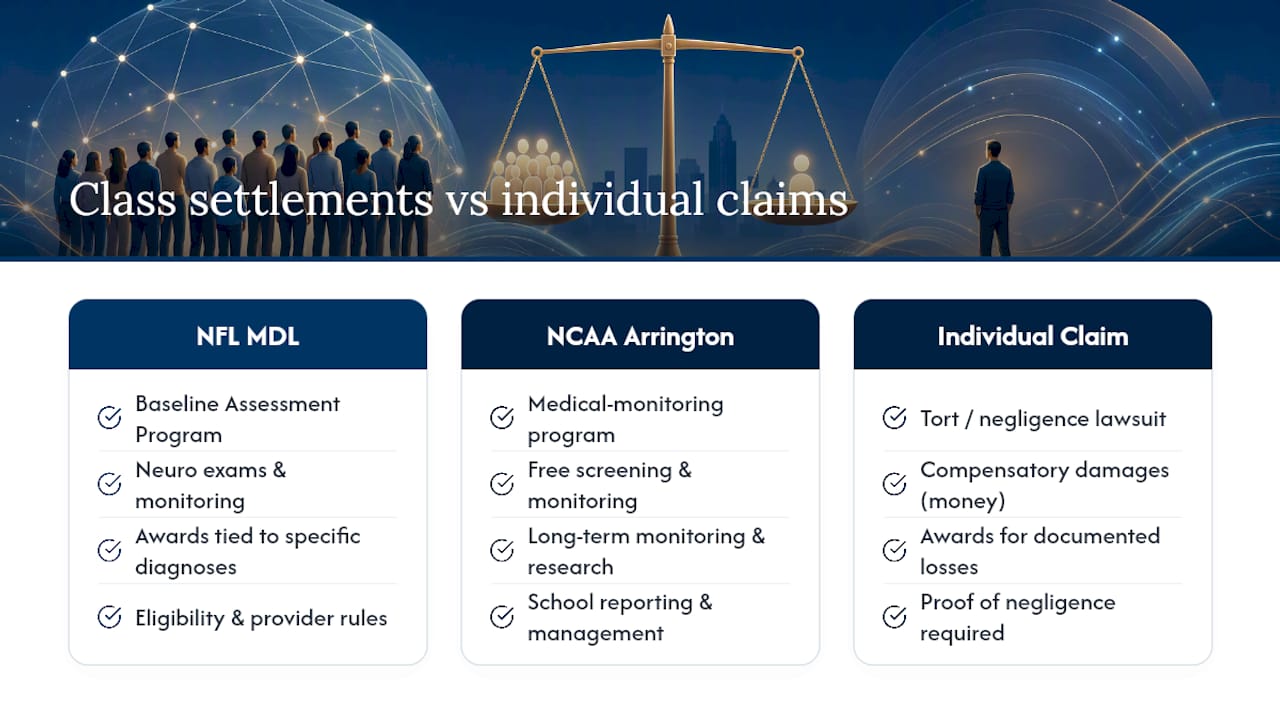
The two most prominent concussion class settlements in American history resolved claims by professional football players and college athletes. Neither is a model for what an individual personal injury plaintiff receives.
NFL MDL Settlement (In re: NFL Players’ Concussion Injury Litigation)
The NFL settlement agreement established a Baseline Assessment Program (BAP) providing qualifying retired NFL players with baseline neuropsychological and neurological exams. The settlement defines eligibility criteria, provider qualifications, and program term provisions. Monetary awards under the settlement are tied to specific diagnosed conditions (such as ALS, Parkinson’s, Alzheimer’s, and severe cognitive impairment) and are subject to offsets and audit procedures. This is not a general concussion payout for every player who ever took a hit.
NCAA Arrington Settlement
The Arrington v. NCAA settlement created a medical-monitoring program for eligible former student-athletes and required NCAA member schools to report diagnosed concussions and implement concussion-management processes. A federal judge approved an amended version of the settlement, as reported by AP News, establishing a long-term monitoring program and related research fund. According to the settlement administrator’s site, class members may be entitled to free medical screening and specified monitoring services under the program.
Class settlements such as the NFL and NCAA programs are designed to provide population-wide medical monitoring and access to neurological evaluation. They do not replace the compensatory damages available through an individual personal injury lawsuit. If you were injured in a covered sport and also have a separate negligence claim, these programs do not extinguish your right to pursue individual compensation.
The practical distinction: class settlement benefits are access-based (screening, monitoring, diagnosis). Individual tort settlements are compensation-based (money for your documented losses). They serve different purposes and are not mutually exclusive in every case.
Key factors that most strongly affect a concussion settlement’s value
No two concussion cases are worth the same amount. These are the variables that move the number most, in rough order of influence:
- Severity and duration of symptoms. A concussion that resolves in three weeks is worth far less than one producing cognitive deficits six months later. Permanency is the single biggest multiplier.
- Objective medical evidence. Neuropsychological testing, specialist notes, and documented functional limitations carry more weight than self-reported symptoms alone. As Mayo Clinic explains, standard imaging often shows no structural damage in mild TBI, so clinical documentation and cognitive testing become the evidentiary backbone of your claim.
- Lost wages and earning capacity. A 45-year-old professional who cannot return to cognitively demanding work has a fundamentally different damages profile than a retiree with no employment income.
- Age. Younger plaintiffs with longer projected work lives and more years of future suffering typically recover more.
- Liability and comparative fault. If you were partially at fault (for example, not wearing a helmet in a sport where one was available), your recovery may be reduced proportionally under your state’s comparative fault rules.
- Insurance policy limits. The defendant’s coverage cap often defines the practical ceiling, especially in auto accident cases.
- Prior concussion history. A documented history of prior head injuries can complicate causation arguments and give insurers room to dispute the severity of the current injury.
- Plaintiff credibility. Consistency between your reported symptoms, medical records, and daily behavior matters. Gaps or contradictions are exploited in negotiations and at trial.
- Defendant conduct. Gross negligence or willful misconduct can support punitive damages and tends to increase settlement pressure on the defense.
- Jurisdictional differences. Florida, for example, applies a modified comparative negligence standard that bars recovery entirely if you are more than 50% at fault. State law shapes every calculation.
Pro Tip: The single most effective negotiation lever is trial readiness. Insurers raise offers when they believe your attorney will actually try the case and that your life-impact evidence, including neuropsych testing and a life-care plan, will resonate with a jury.
How to prove a concussion in a claim
Concussion diagnosis depends primarily on clinical assessment and symptom history because standard imaging often shows no structural damage in mild TBI. That makes documentation your most powerful asset. Here is what a strong evidence package looks like:
- Emergency or urgent care records from the day of the injury, including the initial clinical assessment and any imaging ordered
- Contemporaneous symptom notes written in the days immediately after the incident, before memory fades
- Neurology or neuropsychology evaluation confirming functional deficits through standardized testing
- Neuropsychological testing results (ImPACT, COGSTATE, or similar validated tools) showing measurable cognitive impairment
- Medication and therapy records documenting the treatment course and its duration
- Employment records showing missed shifts, reduced hours, or a formal leave of absence tied to the injury
- Daily symptom journal maintained throughout recovery, noting headaches, cognitive fog, sleep disruption, and mood changes
- Witness statements from family members, coworkers, or friends who observed behavioral or cognitive changes
- Accident or incident report (police report, workplace incident report, or sports organization report)
- Follow-up specialist notes from Cleveland Clinic and similar authorities confirm that specialist follow-up is critical when symptoms persist beyond the expected recovery window
Strong vs. weak evidence packages at a glance:
| Evidence Element | Strong Package | Weak Package |
|---|---|---|
| Initial medical visit | Same-day ER or urgent care | Days or weeks later |
| Symptom documentation | Daily journal, consistent with records | Verbal history only, gaps in timeline |
| Specialist evaluation | Neuropsych testing with objective scores | Primary care note only |
| Work impact | Pay stubs, HR records, supervisor statement | Self-reported only |
| Imaging | MRI ordered and reviewed (even if normal) | No imaging attempted |
Delayed symptoms are common and do not disqualify a claim. What matters is that you document them as they emerge and connect them to the incident through medical records and specialist notes.
How long a concussion claim typically takes to resolve
The timeline for a concussion injury lawsuit depends heavily on whether symptoms resolve or persist. Here is a realistic sequence:
- Days to weeks: Seek medical care, document the incident, preserve evidence, and notify relevant insurers or employers.
- Weeks to months: Retain counsel, gather initial records, and file a formal claim or demand letter.
- Months: Negotiate with the insurer during the medical discovery phase. This stage should not conclude until you have reached maximum medical improvement (MMI) so future care costs can be accurately projected.
- 6–24+ months: If negotiations fail, litigation begins. Discovery, depositions, expert retention, and trial preparation extend the timeline considerably.
The most common mistake claimants make is settling before MMI. Once you sign a release, you cannot return for additional compensation if symptoms worsen or new deficits emerge. For cases involving post-concussion syndrome, where recovery timelines vary significantly and specialist follow-up is essential, waiting for medical stability almost always produces a higher settlement.
Resolved-symptom cases (mild concussions) often settle in 3–9 months. Cases involving persistent post-concussion syndrome or permanent TBI deficits routinely take 12–36 months, particularly if litigation is required.
Should you accept the insurer’s settlement offer?
The Brain Injury Association of America advises TBI claimants to weigh several factors carefully before accepting any settlement offer. The guidance applies equally to concussion claims.
Use this checklist before signing anything:
- Does the offer cover all documented past medical expenses, not just the ER bill?
- Does it account for projected future care costs, including specialist visits and cognitive therapy?
- Have you reached maximum medical improvement, or are your symptoms still evolving?
- Does the offer include non-economic damages (pain and suffering, loss of enjoyment of life)?
- Is the offer near the defendant’s policy limits, and if so, are there other sources of recovery?
- Does the release language cover only this incident, or does it release all future claims broadly?
Red flags that signal a premature or inadequate offer:
- A quick offer made within days of the injury, before your full diagnosis is known
- Pressure to sign within a short deadline (“this offer expires Friday”)
- Refusal to discuss future care costs or cognitive rehabilitation
- Vague or overbroad release language that could extinguish unrelated claims
- An offer that does not account for lost wages or earning capacity
When holding out makes sense: if your symptoms are still evolving, future care costs are unquantified, or your attorney believes a jury would award significantly more, waiting is usually the right call. Review your settlement vs. trial options carefully with counsel before deciding.
When accepting makes sense: when the offer approaches policy limits, future medical risk is genuinely low, liability is disputed, or you have an urgent financial need that outweighs the risk of a longer fight.
How an experienced personal injury attorney can increase your settlement
Represented claimants in personal injury cases consistently recover more than those who negotiate alone, and concussion cases are no exception. Here is what a trial-ready attorney actually does for your claim:
- Evidence preservation: Securing accident reports, surveillance footage, and witness statements before they disappear
- Medical expert retention: Engaging neurologists, neuropsychologists, and life-care planners whose testimony quantifies future damages
- Demand package preparation: Drafting a comprehensive demand letter that documents every damage category with supporting records
- Negotiation from strength: Presenting the insurer with a case that is ready for trial, which changes the settlement calculus
- Litigation and trial advocacy: Filing suit, conducting discovery, and trying the case to verdict when the insurer’s offer is unreasonable
- Future-care quantification: Working with medical economists to project lifetime care costs, which is often the largest single component of a severe TBI settlement
Contingency fees mean you pay nothing unless you recover. Most personal injury attorneys charge 33%–40% of the recovery, with the percentage sometimes increasing if the case goes to trial. That structure aligns your attorney’s incentive with yours: a higher settlement means a higher fee.
The trial-readiness point deserves emphasis. Insurers track which firms actually try cases and which ones settle everything. An attorney with a genuine trial record, like a Board Certified Civil Trial Lawyer, signals to the insurer that the case will not be resolved cheaply. That credibility alone often moves offers.
Pro Tip: Ask any attorney you interview: “Have you tried a brain injury case to verdict?” The answer tells you more about their negotiating leverage than any marketing claim.
What we see most often in concussion cases
Concussion cases are among the most undervalued personal injury claims in the American legal system, and the reason is almost always the same: the injury is invisible. There is no broken bone on an X-ray, no visible wound, and no dramatic imaging finding. What there is, consistently, is a person whose life has changed in ways that are real but hard to photograph.
After handling serious personal injury and catastrophic injury claims in Florida, the pattern is clear. Claimants who document early, see specialists promptly, and retain experienced counsel recover more. Those who wait, accept the first offer, or try to handle the claim alone routinely leave significant money on the table. The insurer’s first offer is almost never its best offer. It is a starting position.
One piece of practical advice: do not let the absence of a dramatic MRI finding convince you that your claim is weak. As Mayo Clinic confirms, standard imaging often shows no structural damage in mild TBI. The strength of your claim lives in your neuropsychological testing, your symptom journal, and your specialist’s notes. Build that record from day one.
Calil Law is ready to evaluate your concussion claim at no cost
When you are dealing with persistent headaches, cognitive fog, and a stack of medical bills, the last thing you need is uncertainty about your legal options. Calil Law Trial Attorneys, led by a Board Certified Civil Trial Lawyer with decades of courtroom experience, represents concussion and TBI victims throughout Florida on a contingency basis. You pay nothing unless we recover for you.

A free case evaluation gives you a clear picture of what your claim may be worth and what steps to take next. To make that conversation as productive as possible, bring:
- Medical records from every provider you have seen since the injury
- The accident or incident report
- Pay stubs or employment records showing missed work
- Any correspondence from the insurer (do not sign anything before we review it)
- A written summary of your symptoms and how they have affected your daily life
Call us or use our online intake form to schedule your consultation. If you are ready to understand your rights as an injury victim, start with this overview of what a personal injury claim covers. There are no upfront fees, no obligation, and no pressure.
Sources
These are the primary sources referenced throughout this article. Each is worth reviewing directly if you want to go deeper on any specific topic.
- IN RE: NATIONAL FOOTBALL LEAGUE PLAYERS’ CONCUSSION INJURY LITIGATION, MDL 2323, CLASS ACTION SETTLEMENT AGREEMENT AS OF JUNE 25, 2014
- NCAA Concussion Settlement Medical Monitoring Program …
- NCAA Concussion Settlement Medical Monitoring Program …
- Post concussion syndrome – Cleveland Clinic
- Judge approves settlement in concussion lawsuit against NCAA | AP News
- Should I Accept a Traumatic Brain Injury Settlement?
This article is general information, not a substitute for advice from a qualified lawyer. Consult a qualified legal professional about your own circumstances before acting on anything here.
Recommended
- how much an auto accident victim gets when filing a lawsuit with the insurance company – Calil Law
- What Kind of Damages is Available to Car Crash Victims? – Calil Law
- Settlement vs. Trial Explained: A Guide for Injury Victims – Calil Law
- How Accident Cases And Their Compensation Are Determined When A Lawsuit Is Filed Against The Insurance Companies – Calil Law


