 Skip to Content

Cruise Ticket Forum Selection Clauses: Where You Can Sue
A forum selection clause is a sentence in your cruise ticket contract that names the court where any lawsuit against the cruise line must be filed. If you were hurt on a ship, that sentence can decide whether your case is heard by a jury near home or in a courtroom in another state. U.S. courts often enforce these clauses, but not automatically, and the details of how your ticket was delivered and what it says matter. Our trial team at Calil Law handles cruise line accident claims in Florida, and the first thing we read in a passenger’s file is the ticket contract.
TL;DR
- A forum selection clause tells you which court must hear a dispute with the cruise line. Most injury claimants meet it for the first time after they are hurt.
- In 1991, the U.S. Supreme Court enforced a nonnegotiated cruise ticket clause in Carnival Cruise Lines, Inc. v. Shute, but said such clauses still face a fundamental-fairness review.
- Courts look at whether the terms were reasonably communicated, whether there was fraud or overreaching, and whether enforcing the clause would deny you a real day in court. Cost and inconvenience alone usually are not enough.
- The same contract often carries short notice and filing deadlines. Read the whole ticket contract, not only the forum paragraph, as soon as you can.
- Federal law protects the right of injury and death claimants to a trial by a competent court, which limits some arbitration-style workarounds.
Table of Contents
- What a forum selection clause in a cruise ticket does
- The Supreme Court case behind every cruise forum fight
- When a court will enforce the clause, and when it may not
- Bifurcated clauses and the right to a court
- Why the deadlines in the same contract matter more
- What to do in the first days after a cruise injury
- How we approach a cruise forum clause
- Perspective: the ticket is evidence, not just a contract
- Talk to a Florida cruise injury trial team
- FAQ
- Sources
What a forum selection clause in a cruise ticket does
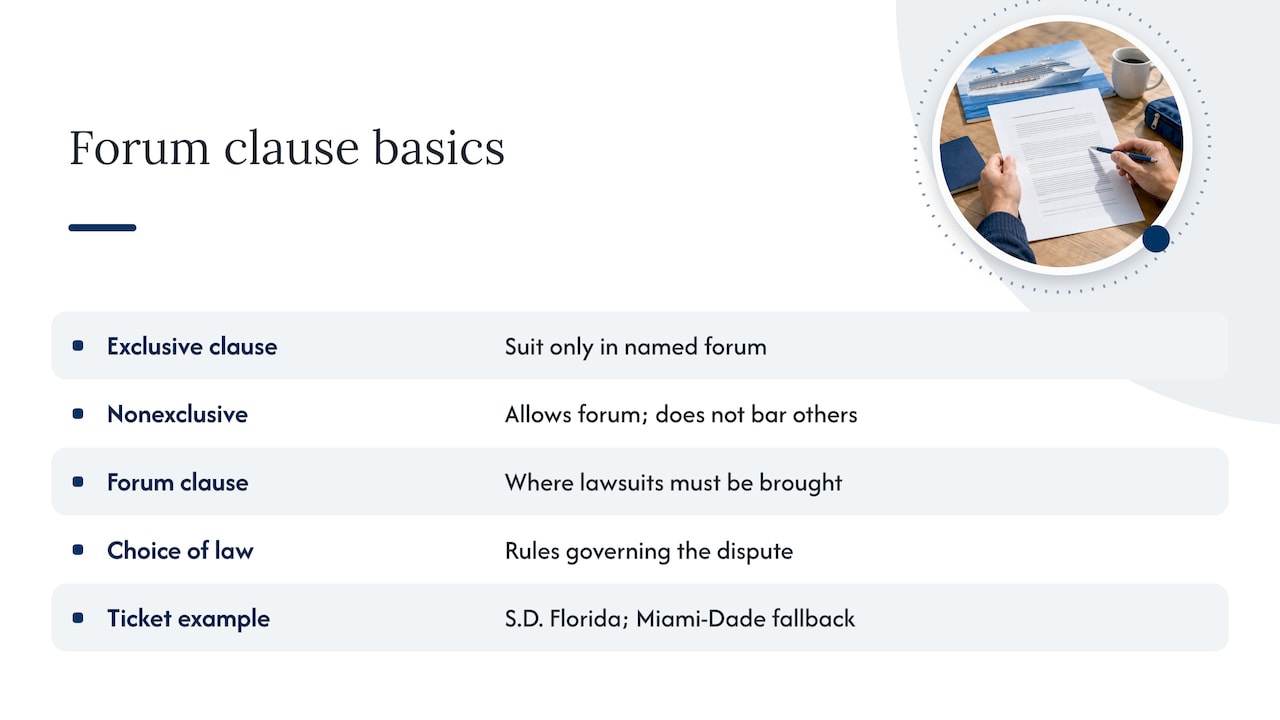
When you buy a cruise, you accept a passage contract. Somewhere in its terms is usually a provision saying that lawsuits must be brought in a particular court. Legal writers describe an exclusive clause as one that requires suit only in the named forum, while a nonexclusive clause permits that forum without barring others. Cruise lines generally write exclusive clauses.
A second clause often sits next to it. A choice-of-law clause names the law that will govern the dispute. The forum clause says where, the choice-of-law clause says under which rules. Together they can shape everything from the jury pool to the damages available to you.
For passengers who sail from Florida ports, the named forum is commonly a court in Florida. In one New York case, the ticket required suit in the Southern District of Florida in Miami, or in Miami-Dade County court if federal jurisdiction was lacking, and the same contract also carried a one-year limit on injury claims. Your own ticket may name a different place, so the document in your hands matters more than any general rule.
Where the clause hides
The clause is rarely on the first page. The front of a ticket often tells you to read the terms that follow. In a 1995 California federal case, the ticket pointed passengers to later pages and the forum clause appeared on page 10. Many passengers first see the full contract in an email link, a booking confirmation or a document packet delivered after payment.
That is why we ask injured cruise passengers for every document they received: the original booking confirmation, the e-ticket, the contract link, and any emails with dates. How and when those terms reached you can become the most important fact in the fight over the clause.
The Supreme Court case behind every cruise forum fight
The starting point is Carnival Cruise Lines, Inc. v. Shute, decided in 1991. A couple from Washington State was hurt on a cruise, and their ticket required suit in Florida. The Supreme Court held that a nonnegotiated clause in a form cruise ticket is not unenforceable simply because the passengers could not bargain over it, and it enforced the Florida provision. The Court also made clear that such clauses remain subject to fundamental-fairness scrutiny, including whether the clause was meant to discourage valid claims or was obtained by fraud or overreaching.
In plain terms: you cannot win just by saying you never negotiated the contract. Nobody negotiates a cruise ticket. But a clause is not bulletproof either, and the fairness review is where passengers’ arguments live.
The presumption courts start with
After Shute, courts treat cruise forum clauses as prima facie valid under federal admiralty law unless they are unreasonable. A 2025 scholarly article describes the result as a strong presumption in favor of forum clauses, extended even to adhesion contracts (take-it-or-leave-it forms), with an unconscionability backstop. That means the burden of showing why the clause should not apply usually falls on the passenger, and it is a real burden.
When a court will enforce the clause, and when it may not
Courts that review cruise clauses tend to ask the same few questions. The first is reasonable communication. A decision from the Illinois Appellate Court applied a two-part test: does the physical appearance of the ticket communicate the important terms, and do the circumstances of booking and keeping the ticket allow a passenger to become meaningfully aware of them? A New York appellate decision states the general rule that a cruise ticket’s forum clause is enforceable when reasonably communicated and fundamentally fair.
The full list of issues a court may weigh looks like this:
| Question the court asks | What it means for you |
|---|---|
| Was the clause reasonably communicated? | Did the ticket and booking process give you a fair chance to see the terms? |
| Was there fraud or overreaching? | Was the clause hidden, misdescribed or imposed in a way that was unfair? |
| Was it meant to discourage valid claims? | Does the forum make a legitimate injury claim impractical in effect? |
| Would enforcement deprive you of a day in court? | Not just expensive or inconvenient, but practically closed off |
The last point trips up many people. Ordinary expense or inconvenience alone is insufficient to defeat a clause. Traveling to Miami for a hearing, however burdensome, usually will not be enough.
The late-delivery argument
One argument has gained attention in scholarship. Professor John F. Coyle explains that when cruise contract terms arrive late, especially at a point where rejecting the contract would mean losing money you have already paid, some U.S. courts have refused to enforce the clause for inadequate notice. The idea is that real consent is hard to claim when walking away carries a financial penalty.
Whether that argument fits your situation depends on a timeline: when you booked, when you paid, when the contract was delivered, and what cancellation would have cost. That is the kind of record we build from the first meeting.
Bifurcated clauses and the right to a court
Some cruise contracts split disputes. A bifurcated clause assigns different types of claims to different procedures or forums. In an example analyzed in 2022, bodily injury, illness, emotional harm and death claims go to court in Seattle, while other claims go to arbitration. The same analysis explains that 46 U.S.C. § 30509 protects the right of personal injury and death claimants to a trial by a competent court. Cruise lines draft around that protection, which is why an injury claim and a refund or service complaint can land in different places.
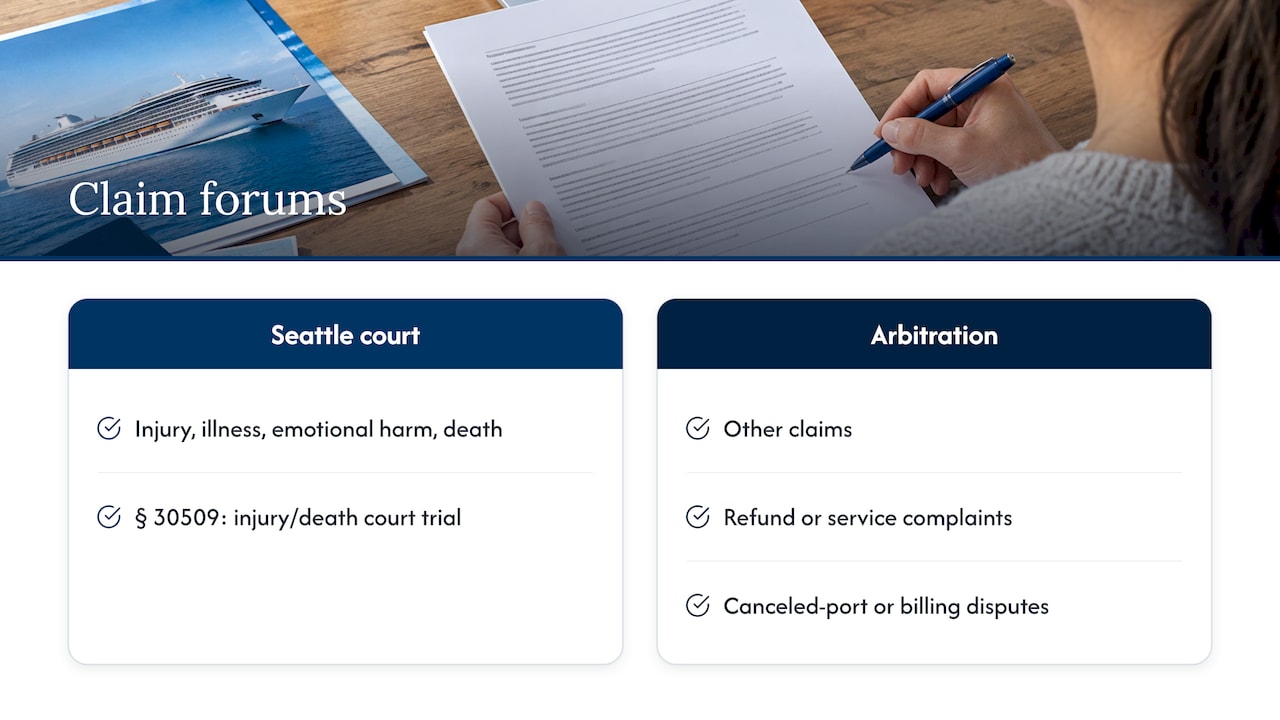
For an injured passenger, the practical lesson is that the label on your claim matters. A claim for bodily harm is treated differently from a dispute over a canceled port or a billing problem.
Why the deadlines in the same contract matter more
The forum clause is only one paragraph in a contract that may also shorten your time to act. The ticket in the New York case above carried a one-year filing limit for injury claims. If a clause sends your case to Florida and you spend months arguing about where to file, the clock does not stop for you.
We cover the notice requirements and filing windows in more detail in our guides to the cruise injury deadline and the cruise injury statute of limitations. Read them early, then compare them with the exact language in your own ticket.
What to do in the first days after a cruise injury
- Get medical care and keep every record. Ask the ship’s medical center for copies of what they documented. If treatment aboard was part of the problem, see our explanation of ship medical negligence.
- Report the incident in writing to the cruise line and to ship personnel, and keep a copy of anything you submit.
- Save every booking document. Confirmation emails, the e-ticket, any contract link, payment receipts and cancellation terms all help show when and how the contract reached you.
- Photograph the scene and gather names. Witnesses, crew names and cabin or deck numbers fade quickly.
- Do not sign a release or accept a quick offer before a lawyer has read your ticket contract. Early settlement paperwork can affect the rights you are trying to protect.
- Calendar the deadlines. Find the notice period and the lawsuit period in your contract and count from the date of injury.
- If the injury happened on a tour, read about shore excursion liability, because the excursion may have its own contract and its own forum language.
You do not need to have the legal answers before you call. You need the documents, and an attorney who knows how to read them.
How we approach a cruise forum clause
A cruise line’s lawyers will usually file a motion to dismiss or transfer based on the forum clause early in the case. That motion is a decision point. If the clause points to Florida and you are in Florida or can sue there, the case moves forward on the merits. If it points elsewhere, the argument turns on notice, fairness and the timeline of your booking.
Our firm is led by a Board Certified Civil Trial Lawyer with over 18 years of Florida experience, and we handle cruise line accident claims along with wrongful death, nursing home abuse and other serious injury cases. Because cruise lines so often name Florida courts, a Florida trial firm is in a natural position to litigate these cases. You can see how we work on our Miami cruise ship accident lawyer page, or through our offices in Fort Lauderdale, Boca Raton and West Palm Beach.
Perspective: the ticket is evidence, not just a contract
Most people who call us after a cruise injury ask the same thing: “Can they really make me sue in Florida?” The honest answer is that the clause is a serious hurdle but not the end of the story. Courts start from a presumption that these clauses are valid, so the challenge has to be built with facts, not frustration.
That is why we treat the ticket as evidence from day one. When did the contract reach you? Where in the document was the clause? What would it have cost to cancel? Those answers are what a judge weighs, and they are easiest to prove when the records are collected early.
We are a trial firm. We prepare every case as if it will be decided by a jury, and that preparation is also what gives us leverage when the cruise line’s lawyers argue about where the case belongs. Your injuries are real, your life has value, and the fine print should not be the reason a valid claim goes unheard.
Jorge
Talk to a Florida cruise injury trial team
Calil Law represents injured cruise passengers on a contingency fee basis: no upfront fees, and we are paid only when you receive a settlement or award. If you have a ticket contract, a booking confirmation and a date of injury, you have what we need to start. Tell us what happened and we will review the clause, the deadlines and your options through our personal injury and cruise line accident practice.
FAQ
Is a cruise ticket forum selection clause legal?
Generally yes. In Carnival Cruise Lines, Inc. v. Shute (1991), the Supreme Court enforced a nonnegotiated forum clause in a cruise ticket. The clause still has to pass a fundamental-fairness review, which looks at issues such as fraud, overreaching and adequate notice.
Can I sue in my home state if my ticket names Florida?
Often the clause will require suit in the named court, and courts presume it valid. Challenges focus on whether the terms were reasonably communicated and whether enforcement would effectively deprive you of your day in court. Travel cost and inconvenience alone usually are not enough.
Does a forum selection clause also shorten my deadline to sue?
They are separate terms, but they often appear in the same contract. One ticket reviewed by a New York court required suit in Miami and also set a one-year limit on injury claims. Check your own ticket for both, and see our guide to the cruise injury deadline.
What if my contract sends injury claims to court but other claims to arbitration?
That is a bifurcated clause. Federal law, 46 U.S.C. § 30509, protects personal injury and death claimants’ right to a trial by a competent court, so injury claims are treated differently from other kinds of disputes. Which category your claim falls into is something a lawyer should confirm from your contract.
When should I have a lawyer read my cruise contract?
As early as possible, ideally before you sign anything for the cruise line or accept an offer. The forum clause, the notice period and the filing deadline all sit in the same document, and the dates start running from your injury.
Sources
- After Carnival Cruise and Sky Reefer: An Analysis of Forum Selection Clauses (Journal of Air Law and Commerce, 2001)
- Roberson v. Norwegian Cruise Line, 897 F. Supp. 1285 (C.D. Cal. 1995)
- Carnival Cruise Lines, Inc. v. Shute, 499 U.S. 585 (1991)
- Walker v. Carnival Cruise Lines, Inc. (Illinois Appellate Court, 2008)
- Fritsche v. Carnival Corp. (New York Appellate Division, 2015)
- Notice, Consent, and Choice-of-Jurisdiction Clauses in the United States (2025)
- Adhesive Forum Selection Agreements and Access to Justice (German Law Journal, 2025)
- Bifurcated Forum Selection Clauses (Transnational Litigation Blog, 2022)


