 Skip to Content

Avoid Expert Exclusion in Florida: §90.702 Checklist for Litigators
Florida applies the Daubert reliability framework under §90.702, so a trial judge can exclude expert testimony that lacks sufficient facts, reliable methods, or reliable application to the case. The judge acts as a gatekeeper, screening testimony for whether the underlying facts, methods, and their application to the case are trustworthy before a jury ever hears it. In practice, that means pretrial Daubert motions now decide, in many Florida cases, whether an expert takes the stand at all.
TL;DR:
- Florida courts rely on a flexible multi-factor test that assesses whether expert methods are testable, peer-reviewed, and generally accepted in the relevant field.
- Daubert motions are usually filed as early as possible, with the burden on the proponent to prove admissibility by providing detailed reports and supporting literature.
- Effective preparation involves experts demonstrating their methodology through peer-reviewed studies and error rates, while challengers must identify specific flaws backed by evidence.
- Judges often limit or condition the scope of challenged expert testimony rather than excluding it outright, making strategic challenges and thorough documentation essential.
- Daubert rulings most impact cases relying on novel techniques or contested causation, but in routine cases, they typically serve to strengthen foundation rather than dismiss the entire expert opinion.
Table of Contents
- What Florida Law Says About the Daubert Standard in Florida
- How Florida Courts Analyze Whether Expert Testimony Holds Up
- Daubert Motions and Hearings: How the Challenge Actually Unfolds
- How to Prepare Experts and Challenge Them Effectively
- Calil Law’s Approach to Expert-Testimony Challenges
- When a Daubert Challenge Actually Changes the Outcome
- Get Help With Expert-Evidence Strategy From Calil Law
- Sources
- FAQ
What Florida Law Says About the Daubert Standard in Florida
Section 90.702 of the Florida Statutes sets the test. Expert testimony is admissible only when it rests on sufficient facts or data, reflects reliable principles and methods, and applies those methods reliably to the facts of the case. That three-part structure mirrors the federal rule and gives judges a checklist rather than a vague sense of whether an expert “seems qualified.”
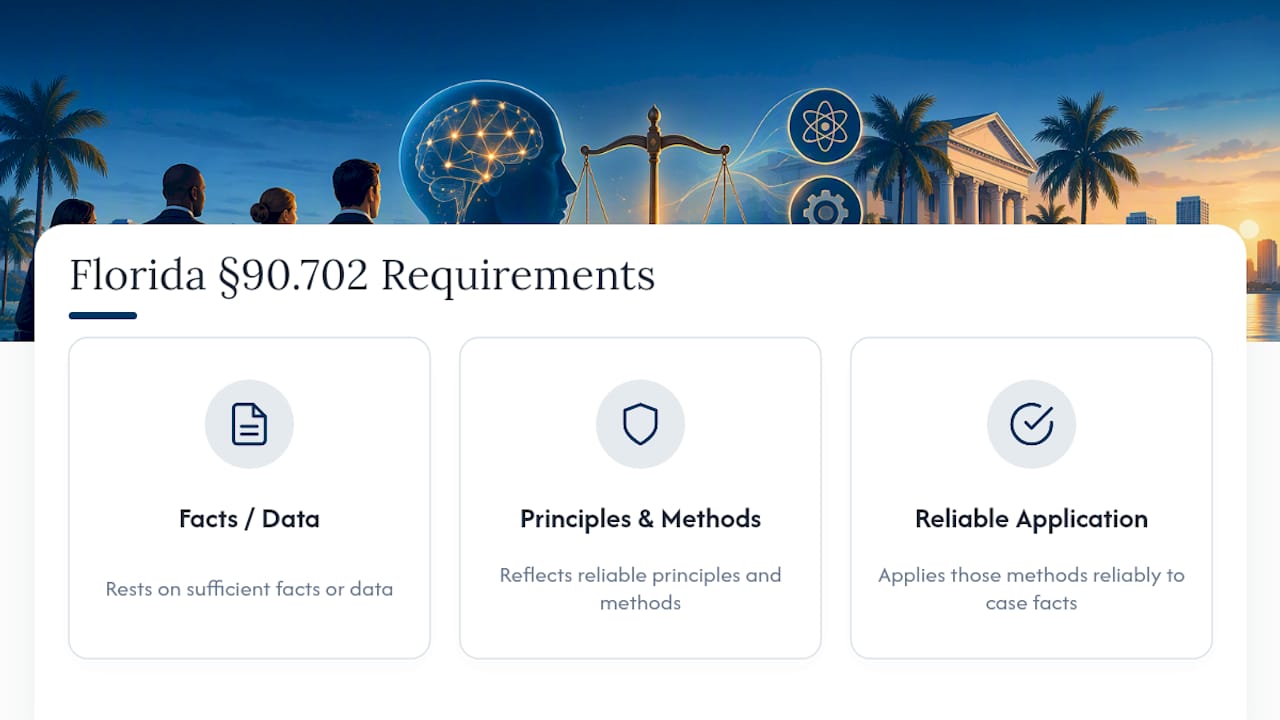
The Florida Legislature codified this Daubert framework in 2013, but for six years it lived in legal limbo. Florida courts weren’t required to follow it as a procedural rule until the Florida Supreme Court acted. In 2019, the court formally adopted the amendments in In re Amendments to the Florida Evidence Code, 278 So. 3d 551, closing the gap between statute and procedure. That ruling reversed the court’s own prior resistance to Daubert and settled the question for good.
The standard applies the same way in civil and criminal matters. A medical malpractice case and a criminal DUI prosecution involving breath-test science both run through the identical §90.702 filter.
How Florida Courts Analyze Whether Expert Testimony Holds Up
Judges don’t rubber stamp credentials. They dig into methodology, and the Daubert bench guide used in Florida trial courts lays out the questions judges typically ask:
- Can the method or theory be tested, and has it been?
- Has it been subjected to peer review and publication?
- Does it have a known or potential error rate?
- Do accepted standards govern how it’s applied?
- Is it generally accepted within the relevant field?
None of these factors is mandatory, and none by itself decides the outcome. The bench guide treats them as a flexible toolkit, not a five-part exam an expert must pass in full. Judges are supposed to scrutinize the principles and methods behind an opinion, not argue about whether the conclusion itself is correct. That distinction trips up a lot of lawyers who try to relitigate the merits inside a Daubert hearing.
The standard also reaches beyond hard science. Under Kumho Tire, Daubert’s reliability inquiry covers engineering, accident reconstruction, and medical causation testimony just as much as laboratory chemistry. On appeal, a trial judge’s admissibility ruling gets reviewed for abuse of discretion under the Joiner standard, a deferential bar that makes reversals uncommon.
Daubert Motions and Hearings: How the Challenge Actually Unfolds
A Daubert challenge almost always arrives as a motion in limine, filed before trial so the judge can rule before a jury is empaneled. Whether the court holds a live hearing is discretionary. Some judges decide the motion on the papers; others want testimony from the challenged expert and sometimes a competing one.
The burden falls on the side offering the expert. Once an opponent raises a genuine challenge, the proponent must establish admissibility by a preponderance of the evidence, not by simply asserting the expert is qualified. Here’s what that typically looks like in practice:
- The moving party files early and specifically. A vague “this expert is unreliable” motion rarely gets a hearing; courts want an identified methodological flaw.
- The proponent responds with the expert’s report, underlying data, and supporting literature. Under §90.705, the opposing side can also demand disclosure of the facts and data behind the opinion and probe them through voir dire.
- The court weighs competing showings, sometimes including a rival expert’s affidavit, before ruling on the record.
Timeliness matters. A Daubert motion filed the week before trial, with no supporting literature attached, tends to get short shrift.
How to Prepare Experts and Challenge Them Effectively
If you’re offering expert testimony, the mandate is simple: show your work. An expert who can point to peer-reviewed literature, explain a method’s known error rate, and connect that method step by step to the case facts survives a Daubert challenge far more often than one who relies on years of experience alone.
If you’re challenging an opposing expert, generic skepticism won’t move a Florida judge. A properly framed motion identifies the specific methodological gap and backs it with contrary literature or a competing expert’s affidavit.
- Depose the expert early enough to lock in their methodology before drafting the motion.
- Attach supporting literature or an affidavit rather than arguing conclusions in the abstract.
- Object on the record and renew it at trial to preserve the issue for appeal.
Pro Tip: Judges rarely exclude an expert outright on the first challenge. Far more often, they narrow the scope of what the expert can say or require additional foundation before allowing the testimony in. Plan your strategy around that middle outcome, not an all-or-nothing gamble.
Documenting the chain of evidence behind an expert’s opinion matters just as much as the opinion itself. Preservation issues, covered in our guide to spoliation of evidence in Florida, can undercut an expert’s factual basis before a Daubert motion is even filed.
Calil Law’s Approach to Expert-Testimony Challenges
Some litigation firms treat Daubert strategy as part of case strategy from day one, not an afterthought filed the month before trial. We vet experts before retaining them, stress test their methodology against known literature, and review opposing reports line by line for the gaps a well-supported motion can expose.
Expert challenges show up constantly in personal injury, vehicle collision, and premises liability cases. If you’re heading into a consult, bring the expert’s full report, any underlying data or testing records, and a timeline of when each opinion was formed. That groundwork lets us evaluate exposure on both sides of the aisle before you’re locked into a position.
When a Daubert Challenge Actually Changes the Outcome
Daubert rulings move the needle most in cases built on a novel technique, disputed causation, or a single expert-dependent issue where the whole claim rises or falls on one opinion. When the methodology is well established, courts rarely exclude it wholesale.
In routine matters, a motion is more likely to trim testimony or force better foundation than to end the case outright. Treat a Daubert challenge as leverage for settlement, not a guaranteed knockout.
— Jorge
Get Help With Expert-Evidence Strategy From Calil Law
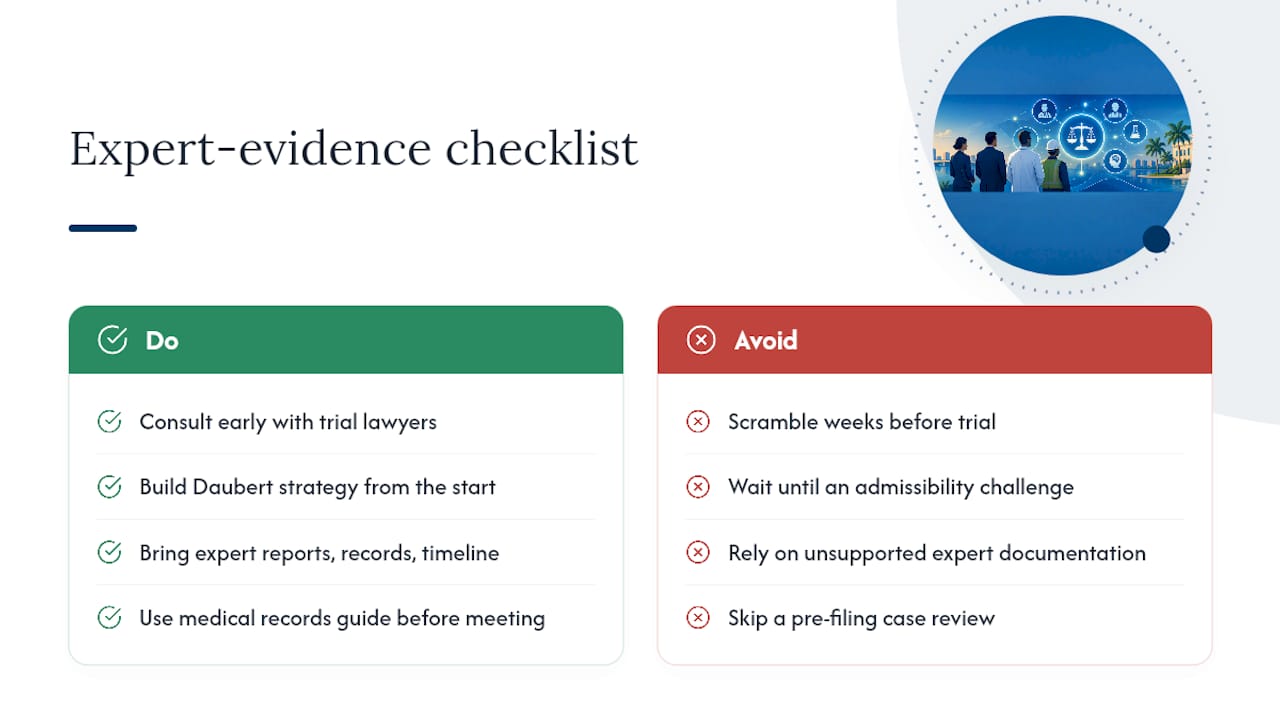
Some Florida litigation firms assist clients when a case hinges on handling expert testimony effectively. Some litigation firms led by experienced civil trial lawyers review expert reports closely and build Daubert strategy into the case plan from the start, rather than scrambling to respond to a challenge weeks before trial.
Whether you’re pursuing a claim involving disputed medical causation, an insurance dispute turning on a valuation expert, or a premises liability case that depends on accident reconstruction, expert admissibility can decide the outcome before a jury ever hears the evidence. Bring your expert reports, medical records, and case timeline to a consultation. Our medical records guide walks through what documentation typically supports a strong expert opinion.
Visit our personal injury practice page to review the case types we handle, and contact Calil Law for a case review before your next filing deadline.
This article is general information, not a substitute for advice from a qualified lawyer. Consult a qualified legal professional about your own circumstances before acting on anything here.
Sources
- Statutes & Constitution : View Statutes — §90.702 Testimony by experts (Florida Legislature)
- In re Amendments to the Florida Evidence Code, SC19-107 (Florida Supreme Court opinion)
FAQ
Does Florida Use the Daubert Standard?
Yes. Florida applies Daubert under §90.702, and the Florida Supreme Court made it the controlling procedural rule in 2019 through In re Amendments to the Florida Evidence Code.
What Replaced the Frye Standard in Florida?
The Daubert standard replaced Frye’s general-acceptance test with a multi-factor reliability inquiry that gives judges more direct control over what expert testimony a jury hears. The shift aligned Florida with federal practice rather than relying on whether a scientific community broadly accepts a method.
Who Decides Whether Expert Testimony Meets the Daubert Standard?
The trial judge decides, acting as a gatekeeper before the jury ever hears the testimony. On appeal, that ruling is reviewed for abuse of discretion, a standard that makes reversals relatively rare.
What Happens if an Expert Fails a Daubert Challenge in Florida?
Judges typically respond in one of three ways: excluding the testimony entirely, limiting its scope, or admitting it once additional foundation is supplied. Full exclusion is the least common outcome outside cases involving genuinely novel or untested methods.
Does Calil Law Handle Cases Involving Daubert Challenges?
Yes. Calil Law builds Daubert strategy into case preparation for personal injury, premises liability, and insurance dispute matters where expert testimony is central to the outcome. You can review the firm’s personal injury practice page for the case types handled.


