 Skip to Content
Demand Letter Personal Injury: A Practical Writing Guide
A demand letter personal injury is a formal written request sent to an at-fault party or their insurance company, asking for compensation after you have been injured. This document is not just a formality. Most personal injury cases settle before trial, and the demand letter shapes the entire compensation discussion. It sets your opening position, establishes the facts, and signals to the insurer that you are prepared to pursue your rights. Getting it right from the start protects your claim and your recovery.
What does a demand letter personal injury include?
A well-built personal injury claim letter follows a seven-part structure that covers every element an insurance adjuster needs to evaluate your claim. Each section serves a specific purpose. Skipping one weakens the whole document.
Here are the seven core sections every injury claim demand letter must contain:
- Claim information. Your name, contact details, the date of the incident, the location, and the names of all parties involved. This orients the reader immediately.
- Liability summary. A factual, chronological account of how the incident occurred and why the other party is legally responsible. Reference applicable statutes or legal theories such as negligence where relevant.
- Injury and treatment summary. A detailed description of your injuries, the medical treatment you received, the providers you saw, and the timeline of your recovery. Attach your medical records and reference them directly in this section.
- Economic damages. Itemized out-of-pocket losses including medical bills, lost wages, future treatment costs, and property damage. Provide exact dollar amounts backed by receipts and pay stubs.
- Non-economic damages. Pain and suffering, emotional distress, loss of enjoyment of life, and any lasting physical limitations. These are harder to quantify but must be described with specificity.
- Settlement demand. A clear, specific dollar amount you are requesting. Vague demands invite low offers. A justified number anchors the negotiation.
- Supporting evidence. Photographs, police reports, witness statements, and medical records listed and attached. Do not just attach documents. Reference each piece of evidence within the narrative so the adjuster understands its significance.
Strategically referencing evidence within the narrative strengthens persuasiveness far more than simply attaching documents. An adjuster reading a letter that connects each fact to a piece of proof sees a credible, organized claim. That perception directly influences the offer they make.
Pro Tip: Organize your letter chronologically. Start with the day of the incident and move forward through treatment and recovery. A clear timeline is harder to dispute than a scattered account.
How do you write a persuasive and professional demand letter?
Tone is the single most underestimated element of a personal injury settlement demand. Emotional or accusatory language reduces effectiveness. Adjusters read dozens of these letters. A letter that reads like an angry complaint gets dismissed. A letter that reads like a legal document gets taken seriously.
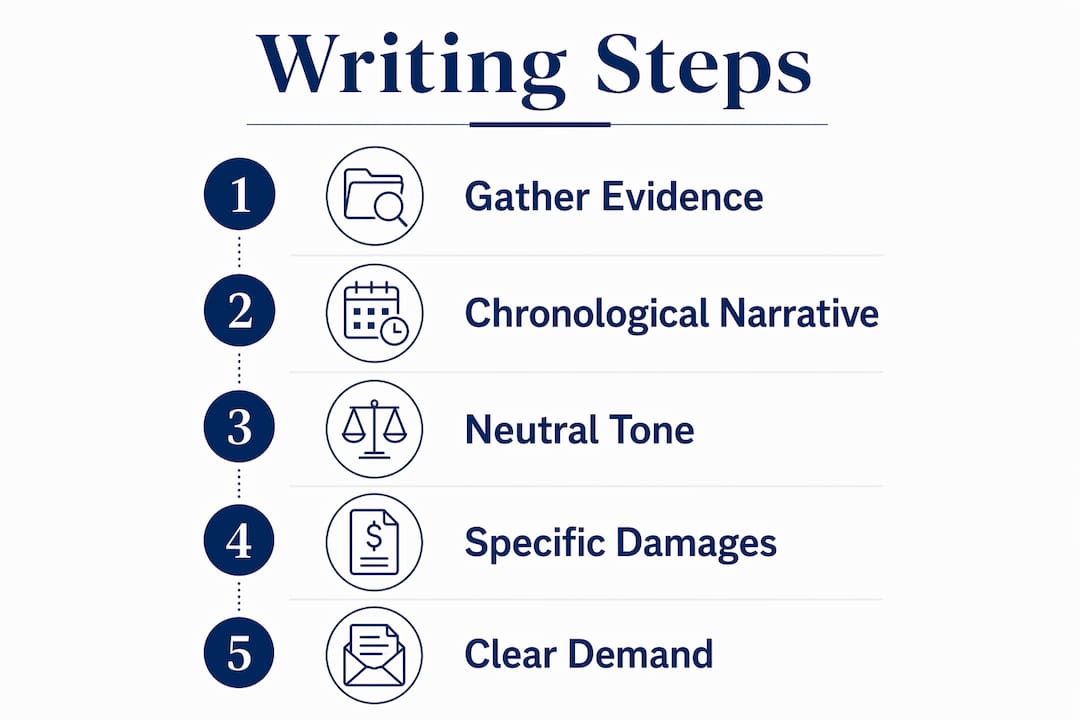
Write in a neutral, factual voice. State what happened, what you suffered, and what you are owed. Avoid phrases like “you people” or “I can’t believe.” Avoid exaggeration. Every claim you make must be supported by evidence you have already gathered. If you say your injuries prevented you from working for six weeks, attach pay stubs and a doctor’s note confirming it.

Use specific numbers everywhere. Saying you suffered “significant medical expenses” is weak. Saying you incurred $14,750 in emergency care, physical therapy, and follow-up visits is credible. Effective demand letters mirror the tone and organization of legal pleadings. That structure signals to the insurer that you understand the legal process and are ready to use it.
A few additional writing principles to follow:
- Use short, declarative sentences. One fact per sentence.
- Avoid legal jargon unless you define it. “Negligence” is fine. “Res ipsa loquitur” is not, unless you explain it.
- State the legal basis for your claim. Reference Florida statutes on negligence or premises liability if applicable.
- Set a specific response deadline. A standard 30-day response deadline is the industry norm and signals that you are serious.
Pro Tip: Read your letter out loud before sending it. If a sentence sounds angry or desperate, rewrite it. The goal is to sound like a lawyer presenting facts, not a victim venting frustration.
When and how should you send your demand letter?
Timing your personal injury settlement demand correctly is as important as writing it well. Sending too early is one of the most common and costly mistakes injured people make.
- Wait for maximum medical improvement (MMI). MMI is the point at which your doctor determines your condition has stabilized. Sending the demand letter at MMI means you know the full scope of your injuries and future treatment costs. Sending before MMI risks undervaluing your claim permanently.
- Gather all supporting documents first. Medical records, bills, wage loss documentation, and photographs should all be in hand before you write a single sentence.
- Send via USPS Certified Mail with Return Receipt Requested. Certified mail creates verifiable proof of delivery and establishes the exact date the response deadline begins. This is not optional. It is the only method that protects you legally.
- State the response deadline clearly in the letter. Thirty days is standard. Write the exact date by which you expect a response.
- Prepare for the negotiation phase. After sending, the insurer will typically respond with a counteroffer. Understand your bottom line before that conversation starts. Knowing how auto accident victims calculate their compensation helps you hold firm on a fair number.
Pro Tip: Keep a copy of everything you send. Create a folder with the letter, all attachments, the certified mail receipt, and the return receipt card. This file becomes your negotiation record.
Common mistakes that undermine a demand letter
Most demand letters are ignored because they read like complaints. Citing statutes, deadlines, and damages clearly improves response rates. Avoiding the following errors gives your letter the best chance of producing a real settlement offer.
- Vague or unjustified demand amounts. Asking for “fair compensation” without a specific number gives the insurer nothing to work with and signals that you are not prepared. Always anchor your demand to documented losses.
- Emotional or accusatory language. Anger undermines credibility. Adjusters are trained to dismiss letters that feel personal rather than legal.
- Failing to connect evidence to claims. Attaching a stack of medical bills without explaining what they prove leaves the adjuster to draw their own conclusions. Reference each document in the body of the letter.
- Ignoring legal citations. A letter that references applicable negligence statutes or premises liability law signals legal readiness. A letter with no legal basis reads like a complaint, not a claim.
- Sending too early. Submitting before you have reached MMI means your damages are incomplete. The insurer will use that gap against you.
- Underestimating non-economic damages. Pain and suffering, loss of enjoyment, and emotional distress are real losses. Failing to quantify and describe them leaves significant compensation on the table.
Failure to include a clear consequence for non-response also weakens your position. State plainly that failure to respond within the deadline will result in the filing of a formal lawsuit. That sentence alone changes how seriously your letter is treated. Understanding why legal representation matters before filing becomes clear when you see how much a single missing element can cost you.
Key Takeaways
A demand letter personal injury succeeds when it combines a factual narrative, documented damages, a specific settlement amount, and a firm response deadline sent via certified mail at maximum medical improvement.
| Point | Details |
|---|---|
| Send at maximum medical improvement | Waiting until MMI ensures your damages are complete and your demand is fully justified. |
| Use the seven-part structure | Cover claim info, liability, injuries, economic damages, non-economic damages, demand, and evidence. |
| Maintain a neutral, factual tone | Emotional language reduces credibility; write like a legal document, not a complaint. |
| Send via certified mail | USPS Certified Mail with Return Receipt Requested creates verifiable proof of delivery and starts the deadline clock. |
| State a clear consequence | Tell the insurer that no reasonable response within 30 days will result in formal litigation. |
What I have learned writing demand letters that actually work
After years of handling personal injury claims, the single biggest shift I have seen is when a client starts writing for the adjuster instead of writing for themselves. Most people write demand letters to express how much they have suffered. That is understandable. But the adjuster is not evaluating your pain. They are evaluating risk and cost.
When you frame your letter around the insurer’s calculation, everything changes. You are not asking for sympathy. You are presenting a documented liability exposure that is cheaper to settle than to litigate. That reframe changes the tone, the structure, and the outcome.
The deadline is another tool most people underuse. A 30-day deadline with a stated consequence is not a threat. It is a professional signal that you understand the process and are prepared to move forward. Adjusters respond differently to letters that have a clock attached. I have seen insurers who ignored a letter for weeks suddenly engage the day before a deadline.
The most effective demand packages I have seen treat the letter as the cover document and the evidence as the proof. Every claim in the letter points to a specific attachment. The adjuster reads the letter, checks the attachment, and sees that the claim holds up. That is when offers get serious. Knowing how lawyers negotiate with insurance companies gives you a real advantage when you are preparing your own package.
— Jorge
How Calillaw can strengthen your personal injury claim
Drafting a demand letter that actually moves an insurer requires more than a template. It requires knowing what evidence to highlight, how to calculate damages accurately, and how to position your claim for maximum negotiation leverage.
Calillaw’s personal injury attorneys bring decades of trial experience to every demand letter and settlement negotiation. The firm handles motor vehicle collisions, premises liability, catastrophic injuries, and insurance disputes across Florida. Calillaw reviews your medical records, calculates both economic and non-economic damages, drafts a legally grounded demand package, and negotiates from a position of genuine courtroom readiness. If the insurer refuses a fair offer, Calillaw is prepared to take the case to verdict. Schedule a free consultation to discuss your claim today.
FAQ
What is a demand letter in a personal injury case?
A demand letter is a formal written document sent to the at-fault party or their insurer requesting a specific dollar amount as compensation for injuries and losses. It initiates settlement negotiations and sets the legal and factual framework for the claim.
When should I send my personal injury demand letter?
Send your demand letter after reaching maximum medical improvement, which is the point your doctor confirms your condition has stabilized. Sending earlier risks undervaluing your claim because future treatment costs are still unknown.
What happens if the insurance company ignores my demand letter?
If the insurer fails to respond or make a reasonable offer within the stated deadline, typically 30 days, the next step is filing a formal lawsuit. Including this consequence in the letter signals legal readiness and often prompts a faster response.
Do I need a lawyer to write a demand letter?
You are not legally required to hire an attorney, but a lawyer experienced in personal injury claims will know how to calculate damages accurately, cite applicable statutes, and structure the letter to maximize its persuasive impact. Errors in a self-drafted letter can permanently reduce your settlement.
What is the difference between economic and non-economic damages in a demand letter?
Economic damages are documented financial losses such as medical bills, lost wages, and property damage. Non-economic damages cover pain and suffering, emotional distress, and loss of enjoyment of life. Both categories must appear in your demand letter with as much specificity as possible.
Recommended
- Commercial Litigation Strategy for Injury Plaintiffs – Calil Law
- Why Using A Personal Injury Law Firm Is Critical Before Filing A Lawsuit In An Accident Case – Calil Law
- 10 Reasons Why You Should Hire a Personal Injury Lawyer – Calil Law
- Medical Records in an Injury Claim: Your 2026 Guide – Calil Law


