 Skip to Content

How to Document Injuries After an Accident: A Practical Guide
How to document injuries after an accident right away
The single most important thing you can do after an accident is start building your evidence immediately. Photograph every visible injury before treatment, seek medical care the same day, and write down exactly how you feel before adrenaline fades. These first hours shape the entire trajectory of your claim.
- Photograph all visible injuries from multiple angles, placing a coin or ruler next to wounds for scale. Timestamped photos showing progression and severity are among the most persuasive evidence you can present.
- Seek medical evaluation immediately, even when injuries feel minor. Adrenaline can mask pain, and a same-day medical record creates the official link between the accident and your condition.
- Collect witness contact information and the badge numbers of any first responders at the scene. Third-party accounts carry weight that your own statements alone cannot.
- Start a daily symptom journal that same evening. Record pain levels on a 1–10 scale, sleep disruptions, emotional distress, and any activities you can no longer perform.
- Store everything securely. Save photos to a cloud service like Google Photos or iCloud immediately so nothing is lost if your phone is damaged or stolen.
Pro Tip: Photograph any medical equipment you receive, such as a cervical collar, sling, or crutches. These images visually communicate injury severity in a way that written descriptions alone rarely achieve.
Table of Contents
- Why documenting injuries is critical for your personal injury claim
- Step-by-step methods to document your injuries effectively
- Common mistakes to avoid when documenting injuries
- Legal insights on documenting injuries and their role in claims
- How to communicate injury information to insurers and your attorney
- Working with Calillaw to protect your claim
- Key Takeaways
Why documenting injuries is critical for your personal injury claim
Your documentation is your case. Without it, even a legitimate injury becomes difficult to prove, and insurance adjusters are trained to exploit every gap. The legal standard in personal injury litigation requires you to establish that the accident caused your specific injuries, and that burden falls on you.
- Medical records serve as legal proof. Courts and insurers rely on emergency room notes, diagnostic imaging, and physician findings to assess what happened and when. Complete medical documentation forms the foundation that both sides use to evaluate your claim.
- Visual evidence counters insurer challenges. Photos taken at the scene establish timing and severity before any treatment alters the picture. An adjuster cannot credibly argue that a bruise shown in a timestamped photo taken one hour post-accident was pre-existing.
- Symptom diaries support non-economic damages. Pain and suffering, loss of enjoyment of life, and emotional distress are real losses, but they are invisible without a written record. A consistent daily journal gives your attorney concrete material to present.
- Accurate records prove causation. The causal link between the accident and your injury must be documented, not assumed. Gaps in treatment or inconsistent reporting give the defense room to argue that something else caused your condition.
- Proper records prevent pre-existing condition disputes. Insurers routinely argue that injuries existed before the accident. Thorough, dated documentation makes that argument much harder to sustain.
Step-by-step methods to document your injuries effectively
Photograph injuries with forensic care
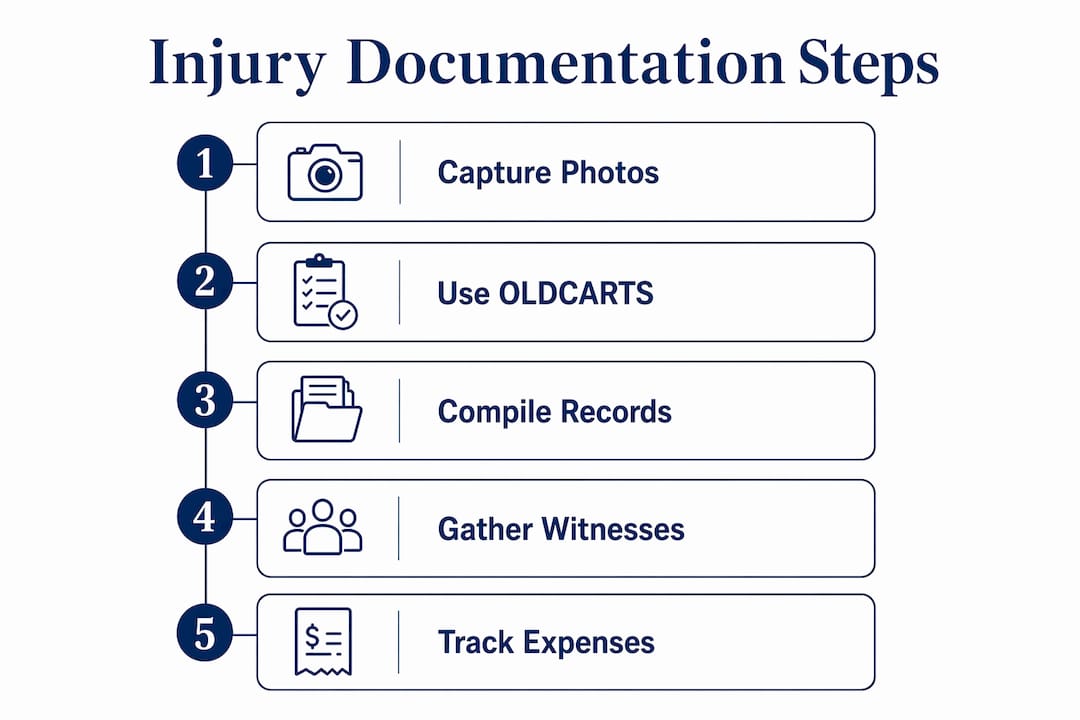
Use your smartphone to capture injuries before any treatment is applied. Photograph at right angles with a scale reference such as a coin or ruler, maintain consistent lighting, and document injuries at multiple stages of healing. Include contextual images of the accident scene, vehicle damage, and any protective equipment you were wearing.
Use the OLDCARTS method for your symptom journal
The OLDCARTS framework, used by medical professionals, gives your journal clinical structure: Onset, Location, Duration, Characteristics, Aggravating and Relieving factors, Timing, and Severity. Write an entry every day, even on days when you feel better. Improvement patterns matter as much as pain peaks.
Build a complete medical file
Every medical interaction generates documentation you need to preserve. Keep records from emergency visits, follow-up appointments, physical therapy, diagnostic imaging, and every prescription filled. Medical records must include emergency room notes, physician findings, and treatment plans to give insurers and courts a complete picture.
Secure witness statements and police reports
Witness contact information and official police reports add unbiased third-party evidence that can decide disputed facts. Request the police report number at the scene and follow up to obtain the full report within days. Ask willing witnesses to write down what they saw while memory is fresh. For additional guidance on post-accident steps, Calillaw’s attorneys have outlined the actions that protect your legal rights from the start.
Track every financial loss
Document medical bills, prescription costs, transportation to appointments, and any lost wages with pay stubs or employer letters. These records form the economic damages portion of your claim.
Organize everything into categories
Organizing documentation into clear categories reduces the risk of losing critical evidence and makes your attorney’s job faster and more effective.
| Damage Type | Examples | Documentation Needed |
|---|---|---|
| Economic | Medical bills, lost wages, therapy costs | Receipts, invoices, pay stubs, employer letters |
| Non-Economic | Pain, emotional distress, loss of enjoyment | Symptom journal, mental health records, personal statements |
Common mistakes to avoid when documenting injuries
Small missteps in the days after an accident can cost you far more than you realize. Insurance adjusters look for exactly these gaps, and defense attorneys use them at trial.
- Delaying medical treatment. Delays in seeking care give insurers grounds to argue that your injuries were not serious or were caused by something that happened after the accident. Go the same day, even if you feel fine.
- Relying on memory alone. Human memory degrades quickly, especially after a traumatic event. Notes and photos taken within hours are far more credible than recollections offered weeks later.
- Posting on social media. Insurance adjusters actively monitor claimants’ social media accounts. A single photo of you at a family gathering can be used to dispute your stated limitations. Say nothing about the accident or your injuries online.
- Skipping follow-up appointments. Missed appointments signal to insurers that your injuries resolved. Attend every scheduled visit and reschedule promptly when conflicts arise.
- Failing to report to your employer or insurer promptly. Late reporting creates credibility questions that are difficult to overcome, particularly in workers’ compensation and auto insurance claims. For a full breakdown of lawsuit mistakes that reduce compensation, the guidance from experienced accident attorneys is worth reviewing before you file anything.
- Keeping disorganized records. A shoebox of unsorted receipts and photos is not a case file. Organize documents chronologically from day one.
Legal insights on documenting injuries and their role in claims
The causation standard is non-negotiable
Personal injury law requires you to prove that the accident caused your injuries, not merely that both events occurred. Accurate medical records serve as forensic evidence critical for establishing that causal link. Physicians who document injury details with attention to plausibility, given the known mechanics of the accident, provide the kind of evidence that holds up under cross-examination.
Adrenaline is your documentation’s enemy
The body’s stress response after a collision suppresses pain perception. Victims who feel fine at the scene often discover serious injuries hours or days later. Adrenaline can mask injury severity, which is precisely why same-day medical evaluation matters so much. A medical record created the day of the accident is far harder to challenge than one created a week later.
What trial attorneys recommend
Experienced personal injury attorneys consistently point to the same documentation practices as the difference between a strong claim and a disputed one:
- Seek medical care the same day, regardless of how you feel
- Request copies of every medical record and imaging result
- Never give a recorded statement to an insurer without legal counsel
- Keep your symptom journal consistent and specific, not vague
- Preserve all physical evidence, including damaged clothing and personal items
“If it isn’t written down in a medical record, it didn’t happen.” This principle, repeated by legal and medical professionals across personal injury practice, captures why early and thorough documentation is the foundation of every successful claim. An injury that exists only in your memory cannot be compensated.
Medical documentation must go beyond surface descriptions. Detailed notes on symptom plausibility in relation to the accident’s mechanics strengthen legal causality arguments and make it far harder for insurers to attribute your injuries to a pre-existing condition or unrelated event. For a deeper look at how medical records affect your claim, Calillaw has prepared a dedicated guide covering what insurers and courts actually look for.
How to communicate injury information to insurers and your attorney
When you contact your insurance company, report the accident factually and briefly. Provide the date, location, and a general description of what happened. Do not speculate about fault, minimize your injuries, or agree to a recorded statement without speaking to an attorney first. Adjusters are skilled at using casual, seemingly harmless comments to reduce or deny claims.

With your attorney, be completely transparent. Share every document, every photo, and every journal entry, including entries that describe good days. Attorneys build the strongest cases when they have the full picture, not a curated version. Withholding information about prior injuries or pre-existing conditions, for example, can destroy credibility if the defense discovers it independently.
Written communication with insurers is generally safer than phone calls. Emails and letters create a record of what was said and when. If you do speak by phone, follow up in writing to confirm what was discussed. For guidance on what to do before filing with your insurer, Calillaw’s attorneys outline the steps that protect your position before you submit anything official.
Working with Calillaw to protect your claim

Thorough injury documentation is the foundation of every successful personal injury claim, but knowing what to document is only part of the challenge. Knowing how to present it, and how to counter an insurer’s tactics, requires trial-tested legal judgment. At Calillaw, our Board Certified Civil Trial Lawyers have spent decades building and litigating exactly these cases across Florida.
If you were injured in a motor vehicle collision, a premises liability incident, or any accident caused by someone else’s negligence, we are ready to help you protect your rights. Visit our personal injury practice page to learn how we approach these cases, or contact us directly for a free consultation. Your documentation is the evidence. We are the advocates who know how to use it.
Key Takeaways
Thorough injury documentation, starting on the day of the accident, is the single most effective way to protect your personal injury claim and counter insurer challenges.
| Point | Details |
|---|---|
| Photograph immediately | Capture injuries before treatment, using a scale reference and multiple angles, with timestamps intact. |
| Seek same-day medical care | A medical record created the day of the accident is the hardest evidence for insurers to dispute. |
| Use OLDCARTS journaling | Daily symptom entries structured around Onset, Location, Duration, Characteristics, Aggravating factors, Timing, and Severity build a credible pain record. |
| Avoid social media entirely | Adjusters monitor claimants’ accounts; a single post can be used to undermine your stated limitations. |
| Organize by category | Sorting records into scene evidence, medical, financial, and personal impact files prevents lost evidence and speeds up legal review. |
Recommended
- Know What To Do In An Event of A Car Accident and Why You Should Hire An Experienced Attorney – Calil Law
- 5 Things You Should Do After a Car Accident – Calil Law
- Medical Records in an Injury Claim: Your 2026 Guide – Calil Law
- 7 Top Things You Should Do Before Filing An Accident Case With Your Insurance Company – Calil Law


