 Skip to Content

Florida Dram Shop Law: When a Bar Can Be Held Liable
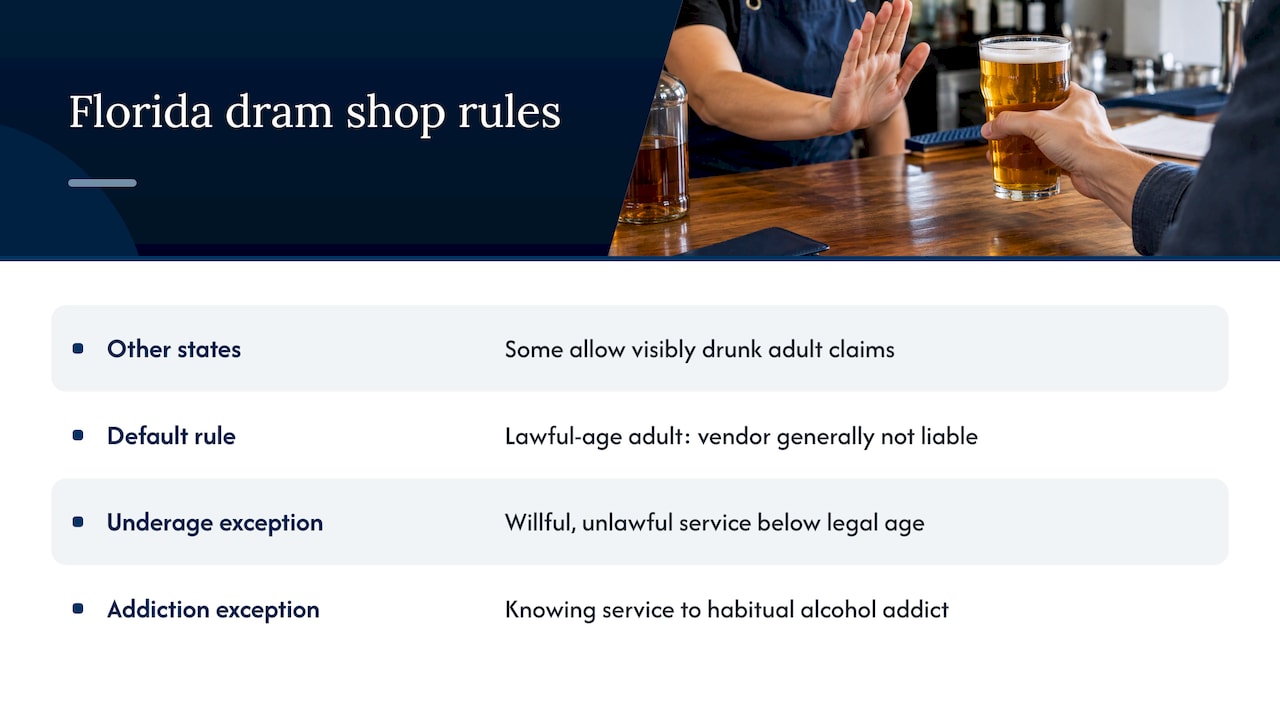
Florida’s dram shop law lets an injured person pursue a bar, restaurant or liquor seller in only two situations: the vendor willfully and unlawfully served someone under 21, or knowingly served a person habitually addicted to alcohol. Outside those two, the general rule protects the vendor. That narrow door is why these claims are won or lost on evidence gathered early, and why you want a trial lawyer who can build the record before it disappears. At Calil Law, a firm led by a Board Certified Civil Trial Lawyer, we handle injury claims across Florida on a contingency fee, with no upfront fees.
TL;DR
- Under Fla. Stat. § 768.125, a vendor is generally not liable when an adult of lawful drinking age becomes intoxicated and hurts someone.
- The two exceptions: willfully and unlawfully serving a person under 21, or knowingly serving a person habitually addicted to alcohol.
- Several drinks in one night do not, by themselves, prove a vendor knew a patron was a habitual drunkard. Proof of repeated service over time can.
- Your claim must also connect the alcohol to the injury, and your own share of fault can reduce what you recover.
- Time limits are short. Evidence such as video and receipts can vanish quickly.
Table of Contents
- What “dram shop” means and what Florida’s version allows
- Exception one: service to someone under 21
- Exception two: a person habitually addicted to alcohol
- Proving the alcohol caused the injury
- Fault sharing: what Faircloth changed
- Deadlines you cannot miss
- A first-week checklist if you were hurt by a drunk driver
- What you can pursue
- Perspective
- How Calil Law can help
- FAQ
- Sources
What “dram shop” means and what Florida’s version allows
A “dram” is an old unit for a small measure of liquor. A dram shop law is a rule that decides when a business that sells alcohol must pay for harm caused by a customer it served. Many states let injured people sue a bar that overserved a visibly drunk adult. Florida does not.
The statute starts with protection for the seller. Under the 2026 version of § 768.125, a vendor is generally not liable for injury or damage caused by an adult of lawful drinking age who becomes intoxicated after being served. Then it lists the exceptions: willful and unlawful sale or service to someone below the legal drinking age, and knowing service to a person habitually addicted to alcohol.
The Florida Supreme Court explained in Ellis v. N.G.N. of Tampa, Inc. (1991) that the statute limits vendor liability. It does not open an unlimited claim every time someone is served too much.
If a drunk driver hit you, that driver is still responsible for the crash. A dram shop claim adds a second possible defendant, the business that served the alcohol, but only if one of the two exceptions fits the facts.
Exception one: service to someone under 21
The first exception covers a vendor that willfully and unlawfully sells or gives alcohol to a person below the lawful drinking age, which is 21. Your claim then depends on what the vendor knew.
The Florida Supreme Court addressed this in its 2024 Faircloth decision. “Willfully” means the provider knew the person was under 21. The court also recognized that knowledge can be shown by circumstantial evidence, including how old the person looked.
In practice, that points to the evidence that matters:
- Whether the venue checked identification, and what the ID showed
- Whether the patron was a regular, a student, or known to staff
- Security or bar-camera video of the ordering and the service
- Point-of-sale records and receipts showing who ordered what
- Staff training records and house policies on carding
- Statements from servers, bartenders and other patrons
A vendor that was handed a convincing fake ID has a different story from one that served a teenager without looking. The evidence decides which story a jury hears.
Exception two: a person habitually addicted to alcohol
The second exception is harder to prove. The vendor must have knowingly served a person habitually addicted to alcohol. Two words carry the weight: “habitually” and “knowingly.”
What the courts have said about proof
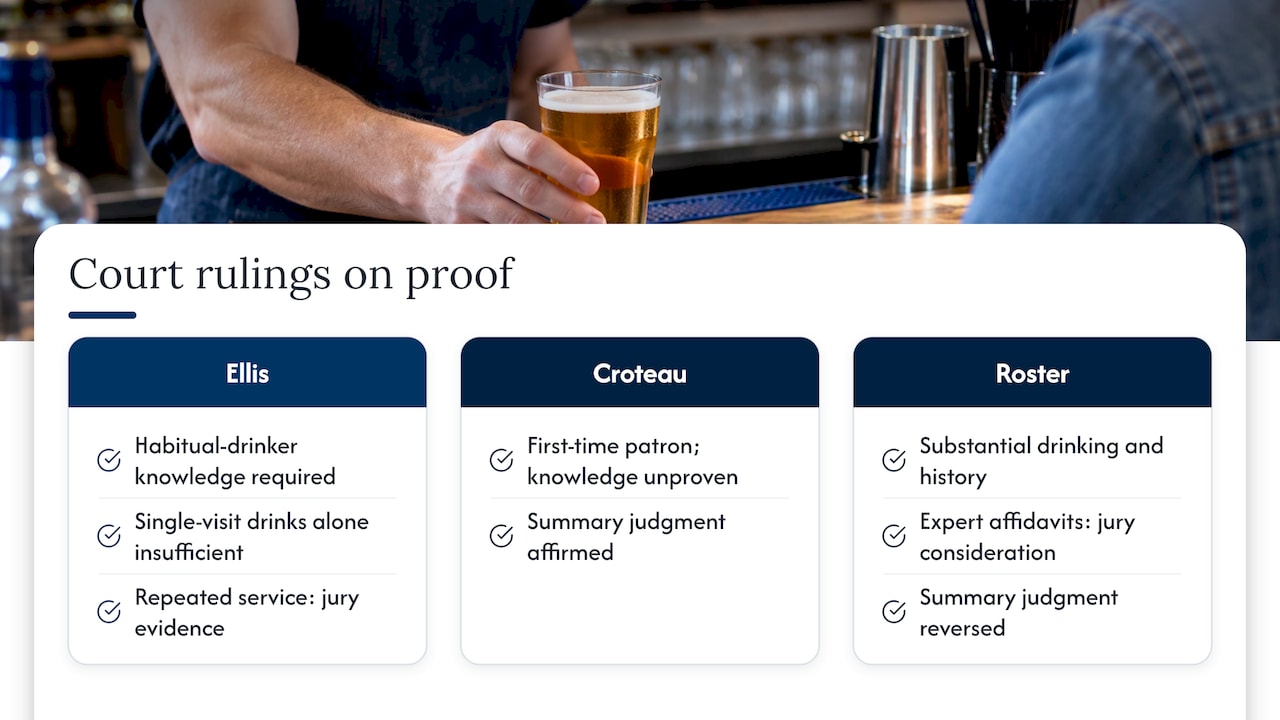
In Ellis, the Florida Supreme Court held that the claim requires evidence the vendor knew the person was a habitual drunkard. The court also said written notice under § 562.50 is not required for this civil negligence theory. Multiple drinks served on a single occasion, by themselves, are not enough. Substantial service over multiple occasions can serve as circumstantial evidence for a jury.
A recent case shows the line. In Croteau v. Family 5, Inc., decided November 18, 2026, Florida’s Fourth District affirmed summary judgment for a bar. The record did not create a genuine dispute that the bar knew a first-time patron was habitually addicted, and the court repeated Ellis’s rule that several drinks during one visit alone do not establish knowing service. Summary judgment means a judge ended the case without a trial.
Contrast that with Roster v. Moulton (1992). There the Fourth District reversed summary judgment. The evidence included substantial drinking, the patron’s history of a drinking problem, and expert affidavits, enough to let a jury decide whether the bar knew.
Evidence that moves this claim forward
Because a single night is not enough, the case is built on pattern. That means:
- Prior visits. Tabs, receipts, loyalty-card data and card statements showing the patron regularly bought large amounts at the same place.
- Staff knowledge. What bartenders and managers knew, shown through testimony, messages and scheduling records to identify who worked.
- The patron’s history. Medical, treatment and court records that show a long-standing drinking problem, handled through proper legal channels.
- Expert opinion. A qualified expert can address whether the patron’s drinking pattern was visible to a vendor serving them.
A claim built only on “they served him too much” will usually fail here. A claim that documents what the vendor knew and when has a path to a jury.
Proving the alcohol caused the injury
Winning on a vendor’s service is only part of the case. You must also connect that service to your injury. In Faircloth, the vendor disputed whether the underage driver was actually intoxicated at the time and whether intoxication caused the collision. The court’s opinion shows that service alone is not the whole claim.
That usually means gathering:
- Blood alcohol or breath test results and the time they were taken
- The police crash report and any charging documents
- Timeline evidence: when the person was served, when they left, when the crash happened
- Witness accounts of the person’s behavior
- Crash reconstruction showing how the impact occurred
If you were hurt by a driver, you can pursue the driver and the vendor in the same effort. See our page on car accident claims for how those claims work.
Fault sharing: what Faircloth changed
Florida uses modified comparative negligence. If a jury finds you more than 50% at fault for your own injury, you cannot recover, and any lesser share reduces your award. Our guide to Florida’s modified comparative negligence rule explains it.
In Faircloth, the Florida Supreme Court held that an underage-service claim under § 768.125 is a negligence action for purposes of the comparative-fault statute, § 768.81. The court did not decide how fault should be divided between the serving vendor and the underage patron. It left that derivative-liability question open. Defense lawyers will raise fault allocation, so how your case is framed matters from the first filing.
Deadlines you cannot miss
Florida’s 2023 tort reform law, HB 837, changed the general negligence limitations period from four years to two. The same bill text states a two-year period for wrongful-death actions. A limitations period is the deadline to file suit, and missing it usually ends the claim.
Two years sounds long. It is not, once you account for medical treatment, identifying the vendor, and sending preservation requests. For a broader view, read our guide to Florida’s personal injury statute of limitations. Because your specific deadline depends on the date and type of claim, confirm it with an attorney as soon as you can.
The practical deadline is earlier than the legal one. Bars overwrite security video on a rolling schedule, and receipts and staff schedules are not kept forever. Our article on saving evidence for a Florida dram shop claim lays out what to secure first.
A first-week checklist if you were hurt by a drunk driver
- Get medical care and follow your treatment plan. Your records document your injuries.
- Get the police report number and the names of everyone involved.
- Write down where the other driver said they had been drinking, and note any receipts, tabs or photos you know of.
- Photograph the scene, vehicles and injuries.
- Do not give a recorded statement to any insurer before speaking with a lawyer.
- Contact a Florida injury attorney so that written preservation demands reach the venue quickly.
Step six is where timing counts most. A preservation demand is a formal letter telling a business to keep specific records and video. Our team can send that demand while your attention is on recovery.
What you can pursue
A successful claim can seek the losses that Florida injury law allows, such as medical expenses, lost income, and pain and suffering. A wrongful-death claim has its own rules and its own two-year period. Which losses apply depends on your facts, so we review each case individually. Our personal injury and wrongful death page explains the types of claims we handle.
Perspective
Dram shop cases in Florida are not cases a lawyer can take lightly. The statute is narrow, the exceptions are specific, and the defense will say a patron simply drank too much and no one could have known.
Our answer is preparation. We are a trial firm, led by a Board Certified Civil Trial Lawyer and Supreme Court Certified Mediator with over 18 years of Florida experience. We look at every case personally, and you have direct access to the attorneys handling it. When the facts support a claim, we build it the way we would for a jury: the timeline, the records, the witnesses, and the proof of what the vendor knew.
If you were hurt because someone else’s choices, and a business’s, put you in harm’s way, your life has value. We have got your back.
Jorge
How Calil Law can help
If a drunk driver injured you or someone you love in Florida, we can review whether a vendor may share responsibility, along with the driver’s insurance and any other sources of recovery. We handle car, truck, Uber and Lyft, premises, and wrongful-death claims. Our fee is contingency-based: we are paid only when you receive a settlement or award, and there are no upfront fees.
Start on our personal injury page or reach us through calillaw.com for a free consultation.
FAQ
Does Florida let me sue a bar that served a visibly drunk adult?
Generally no. The statute protects vendors when an adult of lawful drinking age becomes intoxicated after service. Liability attaches only for willful, unlawful service to someone under 21, or knowing service to a person habitually addicted to alcohol.
Is serving someone several drinks in one night enough for a habitual-drunkard claim?
Not by itself. The Florida Supreme Court held in Ellis that multiple drinks on one occasion do not establish this exception. Evidence of substantial service on multiple occasions can let a jury decide.
How long do I have to file?
Florida’s 2023 reform shortened the general negligence period from four years to two, and wrongful-death actions have a two-year period. Your exact deadline depends on your case, so speak to an attorney promptly.
Can I still recover if I was partly at fault?
Often yes, but your share of fault reduces the recovery, and a finding that you were more than 50% at fault bars it. Faircloth confirmed that comparative fault applies to underage-service claims.
What does it cost to hire Calil Law?
We work on contingency. We collect a fee only if you receive a settlement or court award, and we charge nothing upfront.
Sources
- Fla. Stat. § 768.125 (2026), Florida Senate
- Ellis v. N.G.N. of Tampa, Inc. (Fla. 1991)
- Florida Supreme Court opinion SC2022-0910 (Faircloth, 2024)
- Croteau v. Family 5, Inc., Fourth District opinion
- Roster v. Moulton (Fla. 4th DCA 1992)
- HB 837 (2023) bill text, Florida Senate


