 Skip to Content

Employment Legal Advice: Where to Get Free Help Now
If you need employment legal advice right now, start with your state’s employment law hotline or a legal aid intake line, and file with the EEOC or the Department of Labor’s Wage and Hour Division if the issue involves discrimination or unpaid wages. These agencies and legal aid networks handle most workplace disputes at no cost, and getting your facts organized before you call makes the conversation far more useful.
Contact one of these first:
- Your state’s employment law hotline (Maryland’s Employment Law Hotline through the Women’s Law Center is one example of the model)
- Legal Aid at Work or a similar income-based legal aid organization near you
- Your state law library’s employment law guide, such as the one maintained by the Minnesota State Law Library
- A union representative, if you belong to one
Do this in the next hour:
- Write a short timeline of what happened, in order, with dates.
- Save paystubs, your offer letter, the employee handbook, and any relevant emails or texts.
- Call the hotline or legal aid line that matches your issue and ask what deadlines apply.
Key Takeaways
Free and low-cost resources, employment law hotlines, legal aid, and the EEOC, DOL, OSHA, and NLRB, resolve most workplace disputes without a private attorney or a courtroom.
| Point | Details |
|---|---|
| Start with triage | Call your state hotline or legal aid intake before assuming you need a lawyer. |
| Match issue to agency | Wage problems go to DOL, discrimination to the EEOC, safety hazards to OSHA. |
| Prepare a timeline | A one-page timeline and core documents make any consultation dramatically more useful. |
| Watch your deadlines | Discrimination charges often run 180 to 300 days, so act early. |
| Escalate deliberately | Mediation and agency conciliation resolve most disputes before litigation becomes necessary. |
Table of Contents
- Who Provides Employment Law Solicitor Services for Free or Cheap?
- What Workplace Problems Qualify for Employee Rights Advice?
- What Should You Bring to an Employment Law Consultation?
- When Do You File With the EEOC, DOL, or OSHA?
- What Does Employment Legal Advice Cost?
- Should You Call a Hotline, File With an Agency, or Hire a Lawyer?
- How These Resources Actually Play Out for Most People
- What Happens When Advice or Negotiation Doesn’t Resolve Things?
- Where to Go Next for Trusted Employment Law Information
- Frequently Asked Questions
- Sources
Who Provides Employment Law Solicitor Services for Free or Cheap?
Not every workplace problem needs a lawyer on retainer. Several tiers of help exist, and matching your problem to the right tier saves you time and money.
- Legal aid organizations, like Legal Aid at Work, take income-eligible cases involving wage theft, discrimination, and wrongful termination at no cost.
- State employment law hotlines triage calls quickly, telling you within minutes whether you have a viable issue and where to send it next.
- Bar association referral services connect you to employment law solicitors for a reduced-fee initial consultation, often $25 to $50.
- Law school clinics offer supervised student representation, usually for income-qualifying clients with straightforward claims.
- Unions provide grievance support and sometimes access to staff attorneys for members facing discipline or termination.
- State law libraries, including Minnesota’s, publish free plain-language guides explaining employee rights step by step.
- Contingency or limited-scope attorneys step in once a case has real damages or complexity that a hotline can’t resolve.
Wage disputes point you toward DOL’s Wage and Hour Division or legal aid. Discrimination points toward the EEOC plus a legal aid intake. Safety hazards point toward OSHA. Matching the problem to the provider on the first call, rather than the third, is what actually saves time.
What Workplace Problems Qualify for Employee Rights Advice?
Most calls fall into a short list of categories, and each one tends to route to a specific agency or resource.
- Unpaid wages or overtime: DOL Wage and Hour Division or legal aid
- Discrimination or harassment: EEOC plus a legal aid consultation
- Retaliation for reporting a problem: EEOC or NLRB, depending on the underlying activity
- Wrongful termination: legal aid intake or an employment law solicitor
- Leave or accommodation denials: EEOC (disability, pregnancy) or DOL (FMLA)
- Safety hazards: OSHA complaint process
- Wage theft or misclassification: DOL, plus resources like this employee classification guide for understanding contractor versus employee status
- Union or collective activity retaliation: NLRB
Purely interpersonal friction with a coworker or manager, without a legal violation attached, usually isn’t actionable on its own. It’s still worth a quick hotline call, since a pattern of comments or exclusion can sometimes cross into harassment once you describe it out loud.
What Should You Bring to an Employment Law Consultation?
A messy story wastes the first fifteen minutes of any call. A tight one gets you real advice.
Build a one-page timeline before you dial anything. List dates, what happened, and who was present. Gather your paystubs, offer letter, relevant handbook pages, performance reviews, and any emails or texts that back up your account. Note names and job titles of witnesses, and flag any upcoming deadlines or scheduled meetings.

Bring three questions to the call: Is there a viable claim here? What deadlines apply to my situation? Should I sign anything HR has sent me? Preparing a concise timeline and core documents is consistently what separates a useful ten-minute call from a frustrating one.
Do not delete emails, alter records, or fire off a long emotional message to HR before you’ve talked to someone. Keep copies of everything instead.
Pro Tip: A one-page timeline and three sharp questions will get you more out of a free consultation than an hour of rambling explanation would.
When Do You File With the EEOC, DOL, or OSHA?
Four federal agencies do most of the heavy lifting on workplace enforcement, and each one owns a different lane.
The EEOC handles discrimination, harassment, and retaliation tied to protected characteristics like race, sex, age, and disability. The Department of Labor’s Wage and Hour Division handles unpaid wages, overtime violations, and minimum wage disputes. OSHA takes complaints about unsafe working conditions. The NLRB covers union activity and protected concerted activity, meaning group efforts to improve pay or conditions, even without a union present.
Discrimination charges generally need to be filed within a window that runs 180 to 300 days from the incident, depending on the state, so acting early matters more than almost anything else on this list. Miss that window, and the agency route often closes even if your underlying claim is strong.
- Call the agency’s intake line before you file, since most offer a quick screening.
- Keep a copy of anything you submit, along with your confirmation number.
- Ask about mediation or conciliation, which resolve many charges without a hearing.
Watch for arbitration clauses buried in your offer letter or handbook. They can shift your dispute out of court and into private arbitration, changing your timeline and your options considerably.
What Does Employment Legal Advice Cost?
Cost is usually the first question people are afraid to ask, and it’s the one that determines whether you move forward at all.
- Free or pro bono: legal aid organizations and hotlines, typically income-restricted
- Sliding-scale legal aid: fees adjusted to what you can actually pay
- Contingency fee: common for many employment claims, with contingency fees charged as a percentage of any recovery, no upfront cost
- Hourly or flat-fee limited-scope advice: pay for a single consultation or document review without hiring full representation
- Reduced-fee bar referral consultations: often a flat rate for the first meeting
On your first call, ask directly how billing works, who covers court costs if you lose, and whether attorney’s fees might be recoverable from the employer under the relevant statute. Legal aid eligibility usually hinges on household income, while contingency arrangements depend on whether your damages are large enough to justify the fee.
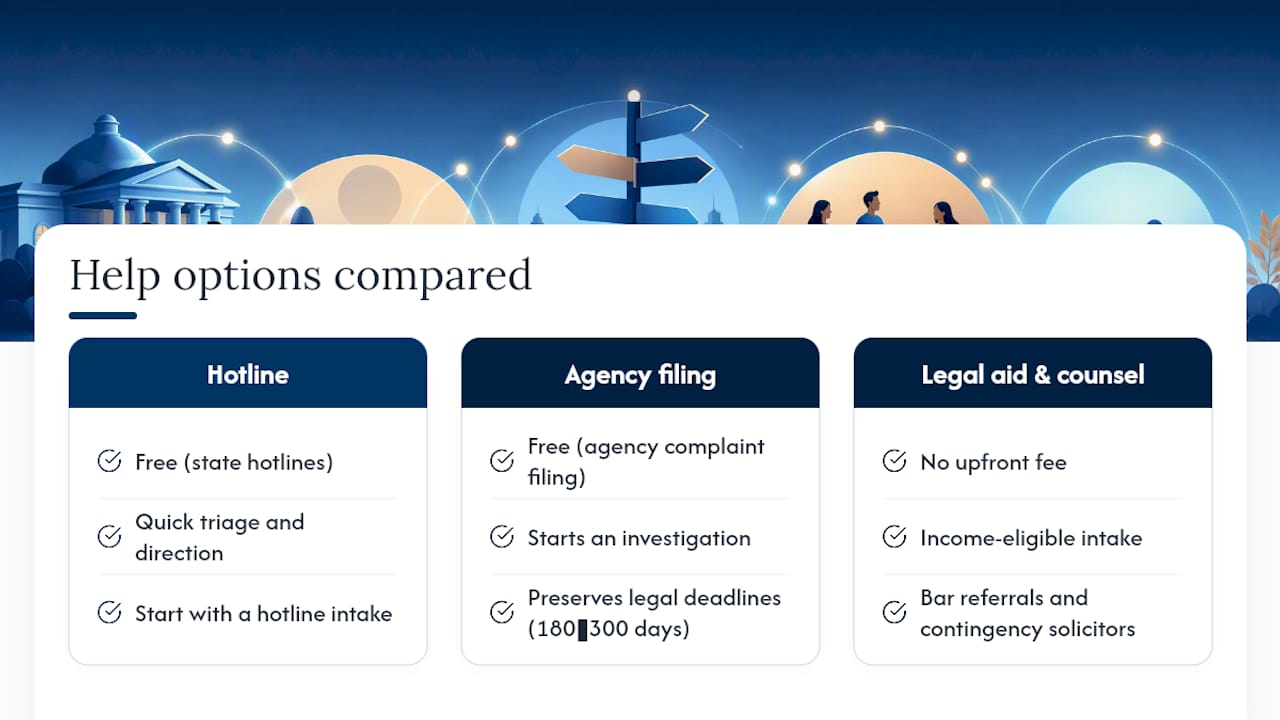
Should You Call a Hotline, File With an Agency, or Hire a Lawyer?
Picking the right first move keeps you from wasting weeks on the wrong track.
- Call a hotline first if you’re unsure whether your situation is even a legal issue, this gets you a fast, free triage.
- File with an agency if you have a discrimination or wage claim and a deadline is approaching; the EEOC or DOL Wage and Hour Division are the right first stop.
- Hire an employment law solicitor if you’re facing an imminent termination with a severance deadline, complex or high-dollar damages, an employer already represented by counsel, or a pattern of retaliation that keeps repeating.
Low stakes and a straightforward fact pattern usually point toward an agency or hotline. High stakes, tight deadlines, or an employer lawyering up point toward hiring counsel sooner rather than later. Weighing leverage, deadlines, and likely recovery before you decide saves you from either overreacting or waiting too long.
How These Resources Actually Play Out for Most People
Most callers move through a predictable sequence: a hotline gives triage and a next step, an agency complaint follows if there’s a deadline, and a lawyer enters the picture only if the case escalates. That’s a reasonable path, not a failure to act sooner.
Set your expectations accordingly. A hotline gives you direction, not a verdict. Legal aid picks up meritorious, income-eligible cases, but can’t take everyone. Many disputes end through negotiation or agency conciliation rather than a courtroom, and initial consultations mostly clarify your options and likely costs rather than promise a guaranteed outcome. Outcomes depend heavily on your specific facts, and deadlines rarely wait for you to feel ready.
What Happens When Advice or Negotiation Doesn’t Resolve Things?
If a hotline, agency complaint, or informal negotiation with your employer doesn’t get you anywhere, you still have real options. Mediation or agency-facilitated conciliation resolves a large share of discrimination and wage charges before they ever reach a hearing. Arbitration is the next step for many employment contracts that require it, and it moves faster than court but limits your appeal rights. A lawsuit remains the last resort, appropriate once you have real documented damages, a blown deadline elsewhere, or an employer unwilling to negotiate in good faith.
At Calillaw, we’ve seen how workplace disputes involving injury, safety violations, or an employer’s failure to address hazardous conditions often overlap with broader claims. If your situation involves a workplace injury tied to unsafe conditions rather than a pure employment dispute, our personal injury claim guidance walks through how contingency-fee representation works and what to expect from a consultation, without any upfront cost to you.
Where to Go Next for Trusted Employment Law Information
For direct next steps, the EEOC’s employee resources explain how to file a discrimination charge, and OSHA’s worker page walks through reporting unsafe conditions. The NLRB’s rights page covers union and collective-action protections. Pair those with your state law library’s employment guide and a local legal aid intake line for a complete picture of where you stand and what to do next.
Frequently Asked Questions
Is employment legal advice free?
Many resources are free, including state hotlines, legal aid intake for income-eligible cases, and agency complaint filing with the EEOC, DOL, OSHA, or NLRB. Private attorneys often work on contingency for stronger cases, meaning no upfront fee.
How fast do I need to act on a discrimination claim?
Discrimination charges typically must be filed within 180 to 300 days of the incident, depending on your state, so contact the EEOC or a legal aid organization as soon as possible.
Can I get employment law solicitor help without paying anything upfront?
Yes. Legal aid organizations, bar referral programs, and contingency-fee employment law solicitors all let you get started without paying anything before a case resolves.
What’s the difference between calling a hotline and filing an agency complaint?
A hotline gives you quick triage and direction. Filing with the EEOC, DOL, or OSHA formally starts an investigation and preserves your legal deadlines.
Do I need a lawyer for a wrongful termination claim?
Not always. Start with a hotline or legal aid intake to see if your facts support a claim, then consider hiring an employment law solicitor if damages are significant or your employer already has legal counsel.
This article is general information, not a substitute for advice from a qualified lawyer. Consult a qualified legal professional about your own circumstances before acting on anything here.
Sources
- EEOC: Employees
- OSHA: Workers
- NLRB: Rights we protect
- How to Prepare for a Consultation With an Employment Lawyer – Swartz Legal
- Is It Worth Suing? How to Decide Whether to File – Lawsuit Informer


