 Skip to Content
Examples of Corporate Entity Liability and the Case Law Behind Them
A corporation can be held liable through four main paths: vicarious liability for an employee’s acts (respondeat superior), corporate criminal liability, contractual liability, and, in rare circumstances, personal liability imposed on owners by piercing the corporate veil. Each path answers a different question about who did what, and who ultimately pays.
The clearest examples show up constantly in litigation:
- A delivery driver runs a red light on a company errand and injures a pedestrian.
- A manufacturer ships a defective product that hurts a customer.
- A facility violates environmental permits and faces regulatory fines.
- A company signs a supply contract, then breaches it and gets sued for damages.
The doctrine tracing corporate criminal responsibility back to an employee’s conduct comes from New York Central & Hudson River R.R. v. United States, 212 U.S. 481 (1909). Cornell Law’s Wex entry on entity liability explains the modern test, and Walkovszky v. Carlton remains the classic veil-piercing reference point.
Key Takeaways
Corporate entities are held liable through vicarious liability, criminal attribution, contract claims, and, in narrow cases, personal liability reached through veil-piercing.
| Point | Details |
|---|---|
| Four liability paths | Vicarious liability, corporate crime, contract breach, and veil-piercing each apply to different fact patterns. |
| Scope-and-benefit test | Respondeat superior requires the employee to act within employment scope and benefit the company, per New York Central. |
| Veil-piercing is rare | Courts mainly pierce the veil in closely held companies with undercapitalization or commingled funds. |
| Name the right defendant | Identifying the correct corporate entity and preserving records early protects your ability to collect a judgment. |
| Insurance shapes recovery | Indemnity and insurance coverage often determine what a plaintiff can actually recover. |
Table of Contents
- What Is Corporate Liability, in Plain English?
- What Are Common Examples of Corporate Entity Liability?
- When Do Courts Hold Owners or Officers Personally Liable?
- How Does Corporate Criminal and Vicarious Liability Work?
- What Limits and Defenses Apply to Corporate Liability?
- What Should You Do if a Corporation Caused Your Harm?
- A Trial Lawyer’s Take on Recognizing Corporate Liability
- Frequently Asked Questions
- Sources
What Is Corporate Liability, in Plain English?
A corporation is a separate legal person. It can own property, sign contracts, sue, and be sued, all independent of the people who founded it or work for it. That separation is the entire point of incorporating.
Under entity theory, the corporation’s debts and legal judgments generally belong to the corporation, not its shareholders. That’s what limited liability actually protects: an investor who buys stock typically can’t lose more than what they paid for it, even if the company gets hit with a massive jury verdict.
That structure has real consequences for anyone trying to collect a judgment or enforce a contract:
- The corporation, not the individual owner, is usually the proper defendant.
- Corporate assets, not personal ones, are typically what a plaintiff can reach.
- The corporation can be sued in its own name regardless of who currently owns or manages it.
This is why identifying the correct corporate entity at the start of a case matters more than most people realize. Sue the wrong subsidiary, and you may win a judgment against a shell with no assets.
What Are Common Examples of Corporate Entity Liability?
Corporate liability isn’t one thing. It’s a set of distinct legal theories that apply to different fact patterns, and recognizing which one fits your situation changes how a case gets built.
Negligence and workplace torts. If a company truck driver causes a crash while making deliveries, the employer is usually vicariously liable under respondeat superior, provided the driver was acting within the scope of employment. The same logic covers a store employee who negligently stacks merchandise that later falls on a customer.
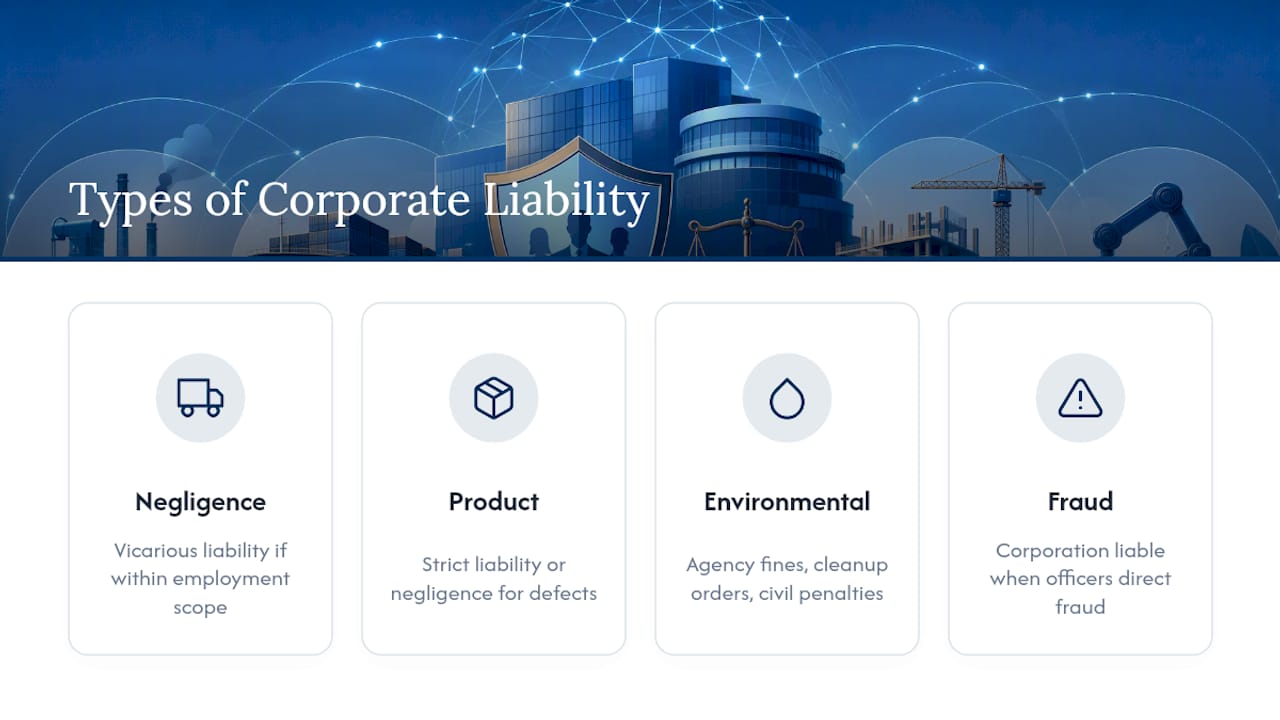
Product liability. When a manufactured product injures someone because of a design flaw or manufacturing defect, the company that made or sold it can face strict liability or negligence claims. This is one of the most litigated categories of corporate defendant liability examples, because the injury often has nothing to do with any individual employee’s mistake. The product itself is the problem.
Environmental and regulatory violations. A facility that exceeds emissions limits or mishandles hazardous waste can face agency fines, cleanup orders, and civil penalties, all directed at the corporate entity that holds the permit.
Contract breaches. When a business signs an agreement and later fails to perform, the counterparty can sue the company directly for damages. Successor liability questions often arise here too, particularly when one company absorbs another’s assets without also absorbing its contractual obligations.
Fraud and intentional wrongdoing. Some of the most consequential cases involve officers who direct fraudulent schemes on the company’s behalf. Here, the corporation can face liability alongside the individuals who orchestrated the conduct.
The corporation’s liability generally rises and falls on whether its agent acted within the scope of employment and, at least in part, to benefit the company. That single test decides whether a company answers for one bad actor’s decisions.
If you’re trying to sort out who’s responsible after an incident involving a business, the fact pattern usually points to one of these categories before you ever get near a courtroom. Situations involving a property owner’s negligence, covered in detail in premises liability cases, follow a similar analysis.
When Do Courts Hold Owners or Officers Personally Liable?
Courts pierce the corporate veil only when the corporate form has been abused, and they do it sparingly. The Vanderbilt Law Review’s analysis of limited liability found that successful veil-piercing claims almost always involve closely held companies where an individual acts as both owner and manager, not large public corporations with dispersed shareholders.
Courts typically weigh these factors together, not any single one in isolation:
- Undercapitalization — the company never had enough assets or insurance to cover foreseeable risks.
- Commingling of funds — personal and business finances blur together with no real separation.
- Failure to observe corporate formalities — no board meetings, no minutes, no separate bank accounts.
- Fraudulent use of the entity — the corporation exists mainly to shield wrongdoing.
- Domination by owners — the company has no independent will of its own.
Walkovszky v. Carlton is the foundational case testing whether a taxicab company’s minimal insurance and fragmented corporate structure justified reaching individual shareholders. People v. V&M Industries and Baatz v. Arrow Bar offer further illustrations of courts drawing that line, sometimes piercing the veil and sometimes declining to when the facts didn’t support it.
Pro Tip: If you’re dealing with a small, closely held company that skipped corporate formalities, start documenting that pattern early. It’s often the difference between collecting a judgment and holding worthless paper.
How Does Corporate Criminal and Vicarious Liability Work?
Respondeat superior imputes an employee’s conduct to the employer when two conditions are met: the employee acted within the scope of employment, and the act was intended, at least partly, to benefit the corporation.
- The seminal case is New York Central & Hudson River R.R. v. United States, 212 U.S. 481 (1909), which extended this logic from civil torts to corporate criminal liability, holding a railroad accountable for a rate-fixing scheme carried out by its agents.
- Cornell’s Wex entry on entity liability confirms the same scope-and-benefit test still governs corporate liability today.
- The limit matters just as much as the rule: if an employee acts entirely outside their authority and gains nothing for the company, that conduct is harder to pin on the corporation. A written compliance policy alone won’t shield the entity if the agent still acted within apparent authority.
Corporate white-collar conduct, discussed further in examples of white collar crimes, often turns on exactly this scope-of-employment analysis.
What Limits and Defenses Apply to Corporate Liability?
Limited liability remains strong for passive shareholders. Someone who owns stock but has no role in management is almost never personally exposed, even when the company loses a major lawsuit.
Corporations raise several recurring defenses:
- No agency relationship existed between the company and the person who caused the harm.
- No benefit to the corporation from the employee’s conduct, cutting against respondeat superior.
- Independent contractor status, since companies generally aren’t liable for contractors’ negligence the way they are for employees.
- Compliance programs that show the company took reasonable steps to prevent misconduct.
- Statute-of-limitations and other procedural bars that cut off stale claims.
Insurance and indemnification agreements are how most companies manage this exposure day to day, covering judgments and legal costs so the business doesn’t absorb every loss directly. Anyone weighing a claim against a business should understand how bodily injury liability coverage factors into what’s actually recoverable.
What Should You Do if a Corporation Caused Your Harm?
- Preserve everything — photos, communications, receipts, and any documents connecting the company to the incident.
- Identify the correct corporate entity, including whether a parent company or subsidiary is actually responsible.
- Look for insurance and indemnity clauses that might expand who can pay a judgment.
- Watch for veil-piercing signals — undercapitalization, commingled accounts, missing corporate records — and gather documentary proof where you can.
- Talk to an attorney early. Naming the wrong defendant or missing a filing deadline can quietly kill an otherwise strong case.
Pro Tip: Most successful alter-ego claims aren’t built at the start of a case. They’re built during discovery, once you’ve already sued the corporate entity and can subpoena its internal records.
A Trial Lawyer’s Take on Recognizing Corporate Liability
Most people wait too long to figure out which entity actually caused their harm, and by then, records disappear and the trail goes cold. I’ve seen how much a case turns on naming the right defendant early and preserving proof before it’s gone. If you’re weighing whether a business bears responsibility for what happened to you, get evidence-preservation and next steps sorted out fast.
If you believe a company’s negligence, a defective product, or a breach of contract caused you harm, Calillaw’s trial attorneys can help you identify the responsible corporate entity and build the record needed to hold it accountable. Learn more about what qualifies as a personal injury claim and how Calillaw’s personal injury practice approaches cases involving corporate defendants.
Frequently Asked Questions
What is entity liability?
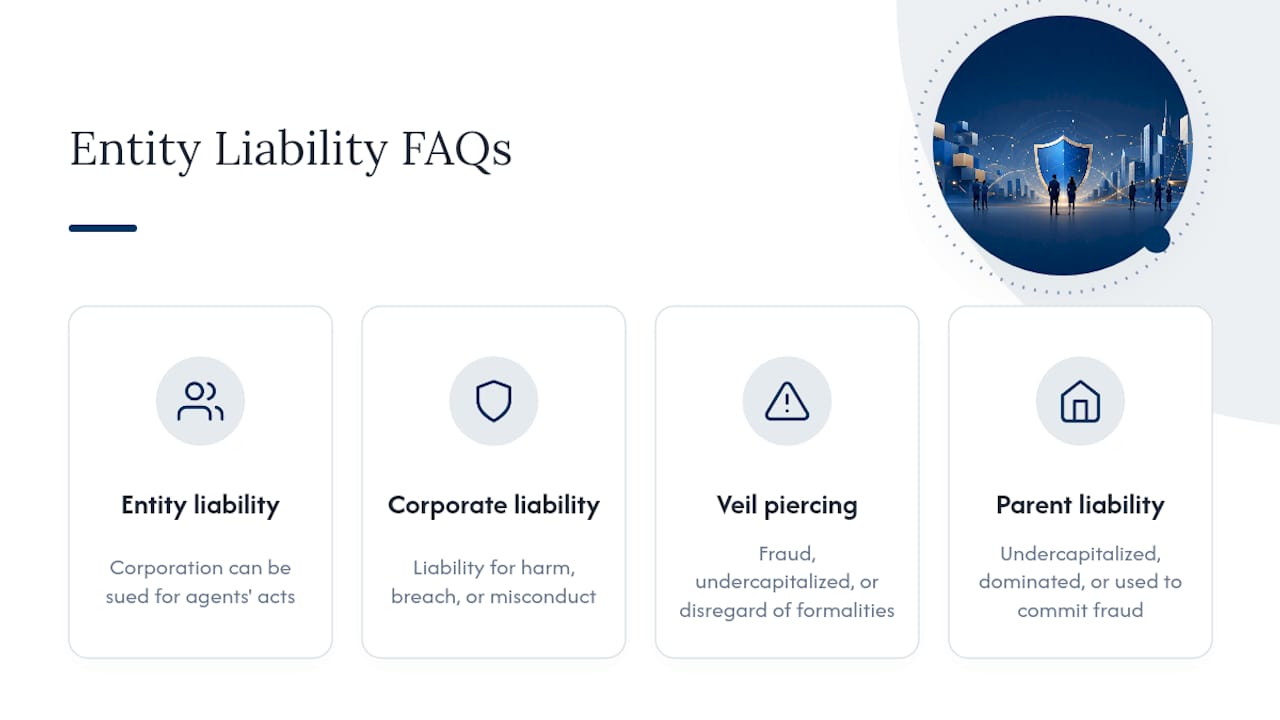
Entity liability is the legal principle that a corporation, as a separate legal person, can be sued and held responsible for debts, torts, and crimes connected to its agents, distinct from its individual owners.
What is corporate liability, exactly?
Corporate liability refers to the legal responsibility a business entity bears for harm, breach, or misconduct connected to its operations, whether through an employee’s negligence, a defective product, or a broken contract.
Can you sue a company and its owner at the same time?
Usually you sue the company first. Courts only reach individual owners through veil-piercing when there’s clear evidence of fraud, undercapitalization, or disregard for corporate formalities.
Are LLCs, S-corps, and C-corps liable the same way?
The liability shield works similarly across LLCs, S-corps, and C-corps, but courts scrutinize LLCs and closely held corporations more closely for formalities since owners often manage them directly.
Is a parent company liable for its subsidiary’s conduct?
Not automatically. A parent company is only liable for a subsidiary’s actions if the subsidiary was undercapitalized, dominated by the parent, or used to commit fraud, similar to the standard veil-piercing analysis.
This article is general information, not a substitute for advice from a qualified lawyer. Consult a qualified legal professional about your own circumstances before acting on anything here.
Sources
- entity liability | Wex | Legal Information Institute (Cornell Law)
- Vanderbilt Law Review analysis of limited liability and veil-piercing
Recommended
- Examples of Third Party Liability Claims Explained – Calil Law
- Examples of Product Liability Claims – Calil Law
- Types of Premises Liability Cases: Your 2026 Legal Guide – Calil Law
- How Accident Cases And Their Compensation Are Determined When A Lawsuit Is Filed Against The Insurance Companies – Calil Law


