 Skip to Content

Golf Cart Accident Florida: What Recent Crashes and Data Show
Yes, golf cart crashes in Florida have produced multiple fatalities, and the risk is rising. A statewide analysis covering 2011 through 2021 found 4,105 crashes, 2,718 injuries, and 72 deaths, with occupant ejection driving the most severe outcomes. If you or a family member has been hurt, help is available, and Calillaw’s personal injury team can walk you through your options.
TL;DR:
- Most fatal golf cart crashes in Florida occur at intersections involving full-sized vehicles, with ejection being a major factor in severe injuries.
- The number of crashes increased significantly after 2016, peaking in March, with older adults and children most at risk.
- Golf carts are poorly suited for mixed traffic, with common crashes caused by rollovers, lane crossings, and direct vehicle collisions.
- Insurance coverage gaps are widespread, leaving many families without proper compensation after a crash, especially when drivers are uninsured.
- Immediately after a crash, victims should call 911, document the scene, seek medical care, and consult an attorney to protect their legal rights.
Table of Contents
- Recent Golf Cart Accidents in Florida Making Headlines
- What the Statewide Study Reveals About Golf Cart Accident Statistics in Florida
- Why Golf Cart Crashes Turn Deadly So Fast
- Florida Golf Cart Laws and Insurance Rules You Should Know
- What to Do Immediately After a Golf Cart Accident in Florida
- How to Prevent Golf Cart Accidents in Florida
- The Legal Complexity Behind Golf Cart Injury Claims in Florida
- Why This Data Should Change How You Think About Golf Carts
- How Calillaw Helps After a Golf Cart Accident in Florida
- Sources
Recent Golf Cart Accidents in Florida Making Headlines
Florida’s news cycle rarely goes a month without a serious golf cart crash, and the pattern behind them is consistent: intersections, impaired drivers, and ejection.
- A car struck a golf cart in Cutler Bay, with surveillance footage capturing the collision and prompting a careless driving investigation.
- In St. Johns County, a man was charged with DUI after a fatal golf cart crash that killed his wife in December 2025.
- In Wesley Chapel, eight people were ejected and seriously injured after a vehicle struck the cart they were riding in.
- In Sumter County, two people died when a golf cart failed to stop at an intersection and overturned after being hit by a car in January 2026.
Across these incidents, the common thread is a road crossing or intersection where a golf cart met a full-sized vehicle. The cart almost never wins that exchange.
What the Statewide Study Reveals About Golf Cart Accident Statistics in Florida
The numbers behind Florida’s golf cart problem are sobering once you see them together.
Between 2011 and 2021, Florida recorded 4,105 golf cart crashes, 2,718 injuries, and 72 fatalities, according to the peer-reviewed statewide analysis.
Two patterns stand out. Crash frequency rose sharply after 2016, tracking the state’s booming golf cart and low-speed vehicle population in retirement communities and coastal towns. And crashes peak in March, likely tied to snowbird season and spring break traffic on residential streets.
- Ejection from the cart was tied to a large increase in the likelihood of serious injury.
- Children and older adults were disproportionately represented among the injured.
- Local reporting from Tampa Bay confirms the upward trend accelerating since 2021, with experts flagging insurance gaps as a recurring complication.
Why Golf Cart Crashes Turn Deadly So Fast
Golf carts weren’t built for the roles Florida communities ask them to play. Most were engineered for flat, controlled course terrain, not mixed traffic, uneven pavement, or intersections with cars traveling 40 miles per hour.
That mismatch shows up in a handful of recurring crash mechanisms:
- Rollovers from overcorrecting after a curb strike or a sharp turn taken too fast.
- U-turns or lane crossings on public roads, where a cart’s slow speed leaves little margin against oncoming traffic.
- Direct collisions with cars and trucks at intersections, the single most common serious-injury scenario in the data.
- Non-collision events, including sudden stops or uneven terrain that throw occupants without any second vehicle involved.
Ejection happens because most carts lack seatbelts, doors, or a low center of gravity. A body in motion during a rollover keeps moving even after the cart stops, and there’s rarely anything holding a passenger in place.
Pro Tip: Telling passengers to “just hold on” during a sharp turn doesn’t work. Even a low-speed rollover generates enough force that grip strength alone can’t keep someone in the seat. If the cart doesn’t have a seatbelt, the safest move is slowing down before the turn, not gripping harder during it.
Florida Golf Cart Laws and Insurance Rules You Should Know
Florida treats golf carts differently depending on where and how they’re used, and that distinction matters after a crash.
- Golf carts are typically restricted to daytime use on roads with posted speed limits of 30 mph or less, unless local ordinance allows otherwise.
- Drivers must generally be at least 14, though many communities and rental operators set higher minimums.
- Golf carts modified to meet certain safety equipment standards can qualify as street-legal low-speed vehicles, which changes licensing and insurance requirements.
- Standard auto insurance policies don’t automatically cover golf carts, and many owners assume coverage exists when it doesn’t, an issue Tampa Bay reporting flagged directly.
- HOAs and municipalities often layer their own restrictions on top of state law, including passenger limits and cart path curfews.
Before assuming who pays for an injury, it’s worth understanding how Florida auto insurance actually applies to the driver versus the vehicle, since coverage gaps are common in golf cart claims specifically.
What to Do Immediately After a Golf Cart Accident in Florida
The steps you take in the first hours and days after a crash can shape whether you’re able to recover compensation later.
- Call 911 first. Get police and medical responders to the scene, and don’t move a seriously injured person unless staying put creates further danger.
- Get medical care even if injuries seem minor. Ejection injuries and head trauma can be more serious than they first appear.
- Document everything. Photograph the cart’s final resting position, damage, skid marks, and the surrounding road or intersection before anything is moved.
- Collect witness information. Names and phone numbers fade fast once people disperse.
- Request the official accident report from the responding agency, whether that’s local police or the Florida Highway Patrol.
- Notify your insurer, but avoid giving a recorded statement until you’ve spoken with an attorney.
- Keep every medical bill and record. These documents become the backbone of a claim.
- Contact a personal injury lawyer before settlement talks begin, especially if a minor was driving, the at-fault driver was uninsured, or a death occurred. A trial-ready firm like Calillaw will move quickly to secure surveillance footage, cart data, and witness statements before they disappear.
If you’re unsure where to start, Calillaw’s personal injury help page lays out the immediate steps in plain language.
How to Prevent Golf Cart Accidents in Florida
Most golf cart injuries are preventable with a handful of consistent habits, both behind the wheel and around the community.
- Wear a seatbelt if the cart has one, and never allow standing passengers.
- Keep occupants at or below the manufacturer’s seating capacity. Overloading a cart raises rollover risk significantly.
- Never drive after drinking, and treat distracted driving on a cart with the same seriousness you would in a car.
- Avoid sharp turns, quick U-turns, and curb strikes, particularly on paved roads shared with vehicle traffic.
- Check tires, brakes, and lighting regularly, and follow the State Farm safety checklist for routine maintenance.
- Communities can help by posting and enforcing speed limits on cart paths, setting clear age minimums, and improving intersection signage where carts cross public roads.
Pro Tip: If your community allows carts on public roads, push your HOA to consider retrofitted seatbelts or grab bars rated for a rollover, not just a decorative bar. The difference between a bar that looks safe and one engineered to hold a body in place during a crash is significant.
The Legal Complexity Behind Golf Cart Injury Claims in Florida
Golf cart cases carry legal wrinkles that a standard car accident claim doesn’t. Calil Law is led by a Board Certified Civil Trial Lawyer with decades of courtroom experience across personal injury, wrongful death, and insurance dispute litigation, the kind of background these cases demand.
Minors are frequently behind the wheel, which raises questions about parental liability and whether a homeowner’s or auto policy extends coverage at all. Uninsured or underinsured at-fault drivers show up often in these claims, and coverage limits are rarely clear at the outset. Legal practitioners have warned that proving negligence in these scenarios takes disciplined investigation, not a form letter to an insurer.
That’s why trial readiness matters. A firm prepared to take a case to verdict, rather than settle quickly, has more leverage in negotiations from the start.
Why This Data Should Change How You Think About Golf Carts
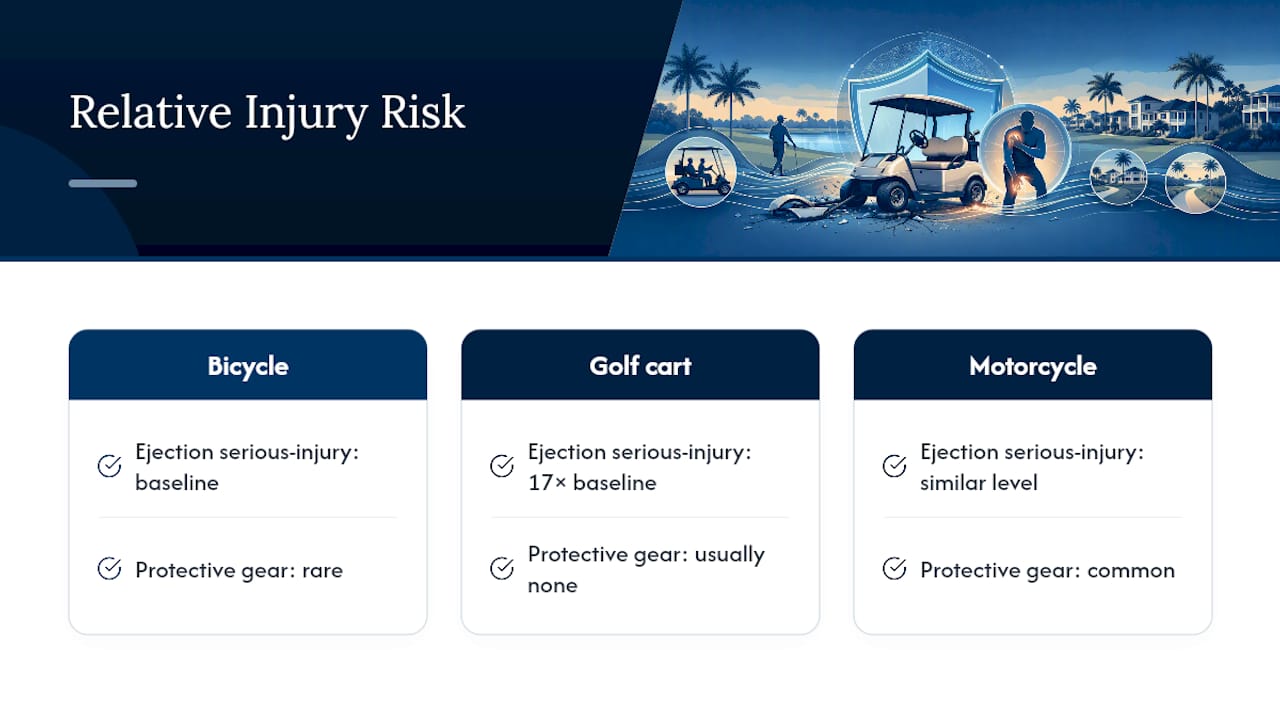
The conventional advice around golf carts treats them like a minor risk, something closer to a bicycle than a vehicle. The data doesn’t support that. A 17-fold jump in serious injury risk from ejection alone puts golf carts closer to motorcycles in terms of what a body experiences during a crash, minus the protective gear most motorcyclists at least consider.
What gets underweighted in most safety conversations is the insurance gap. Families assume their auto policy or homeowner’s policy covers a golf cart crash, and far too often it doesn’t. That gap turns a bad day into a financial crisis on top of a medical one.
If there’s one priority for Florida residents who use carts regularly, it’s this: check your coverage before you need it, not after. The second priority is respecting intersections. Nearly every fatal crash in recent local reporting involved a cart meeting a car where two roads cross. Slow down, look twice, and treat that crossing with the seriousness a car driver would.
— Jorge
How Calillaw Helps After a Golf Cart Accident in Florida
Calillaw represents injury victims and families on a contingency basis, meaning you pay nothing upfront and no fee unless the firm recovers compensation for you. That structure matters most in golf cart cases, where insurance gaps and unclear liability can otherwise leave families facing legal costs while still covering medical bills.
When you come in for a consultation, bring the police report, photos from the scene, medical records, and any insurance correspondence you’ve received. From there, the firm moves quickly on case evaluation and evidence preservation, securing surveillance footage, witness statements, and cart maintenance records before they disappear. Learn more about what a personal injury claim actually involves, or explore the firm’s personal injury practice directly. If your case involves a wrongful death, review what damages Florida law allows families to recover before your first call. Reach out to schedule a free case evaluation and find out where you stand.
Sources
This article draws on the statewide golf cart crash analysis covering 2011 through 2021, published as a peer-reviewed study of crash patterns across Florida. Incident summaries came from NBC Miami’s coverage of a Cutler Bay collision, ABC7’s report on a DUI-related fatal crash in St. Johns County, FOX 13 Tampa Bay’s reporting on the Wesley Chapel ejection crash and its broader coverage of rising crash trends, and WESH’s report on the Sumter County fatal crash.
This article is general information, not a substitute for advice from a qualified lawyer. Consult a qualified legal professional about your own circumstances before acting on anything here.
- Florida golf cart crashes (2011–2021): a statewide analysis of crash patterns and predictors
- Surveillance video shows car crash into golf cart in Cutler Bay
- 2 people die in golf cart crash in Sumter County Friday night


