 Skip to Content

Why Insurance Claims Get Denied — and How to Fight Back
Most insurance claim denials happen for administrative or coverage reasons, not because the insurer has the final word. The most common insurance claim denial reasons fall into six broad categories: incomplete or incorrect patient and policy information, services not covered under the plan, missed timely-filing deadlines, coding and billing errors, missing prior authorization, and medical-necessity disputes. According to KFF’s 2024 analysis of ACA Marketplace plans, the largest reported denial categories were “other” and administrative, together making up the majority of reported reasons, while medical-necessity denials accounted for a smaller share. That means the majority of denials are correctable on paper, not in a courtroom.
Your single most important first action: locate the denial letter or Explanation of Benefits (EOB), save it somewhere you will not lose it, and write down the claim number, the date of service, and the name of the provider or biller. Everything else builds on that document.
The top denial categories at a glance:
- Administrative/other errors (incorrect member ID, wrong date of birth, missing subscriber information)
- Service not covered or excluded under the policy terms
- Timely-filing deadline missed by the provider or the claimant
- Coding and billing errors (wrong procedure code, mismatched diagnosis code)
- Prior authorization or referral not obtained before the service
- Medical necessity not established to the insurer’s standard
- Duplicate claim submitted for the same date of service
- Policy lapsed or canceled before the date of service
- Out-of-network provider used without out-of-network benefits
- Pre-existing condition exclusion applied
The Centers for Medicare & Medicaid Services (CMS) and Calillaw both emphasize that a denial is not a final judgment. Most denials carry an appeal right, and many are reversed when the right documentation reaches the right desk.
Key Takeaways
Most insurance claim denials are administrative or coverage-related and can be corrected through a timely, well-documented appeal before escalation to external review or legal counsel becomes necessary.
| Point | Details |
|---|---|
| Most denials are administrative | KFF found 61% of reported ACA Marketplace denial reasons in 2024 were “other” or administrative, not medical necessity. |
| Preserve paperwork immediately | Save the denial letter, EOB, and claim number the day you receive them; missing the appeal deadline forfeits your rights. |
| Correct first, then appeal | Administrative errors (wrong codes, mismatched IDs) often resolve with a corrected resubmission before a formal appeal is needed. |
| Exhaust internal appeals before external review | CMS requires most consumers to complete the internal appeal process before an IRO can conduct a binding external review. |
| Calillaw handles escalated denials | For unresolved denials involving serious injury or bad-faith conduct, Calillaw offers a free consultation and contingency-fee representation. |
Table of Contents
- What Are the Most Common Insurance Claim Denial Reasons?
- What should you do immediately after a claim denial?
- How do internal appeals and external review work?
- What should your appeal letter include?
- How can you prevent denials before they happen?
- What do denials actually mean, and when is something wrong?
- Why organized, early action changes the outcome
- When a denied claim needs more than an appeal
- Sources
What Are the Most Common Insurance Claim Denial Reasons?
Understanding which category your denial falls into is the fastest way to decide what to do next. Each reason below includes what it looks like on a denial letter, and the quickest path to a fix.
Incomplete or incorrect information
The insurer could not match the claim to a valid member record. Common denial-letter phrases include “member ID not found,” “subscriber information mismatch,” or “date of birth does not match.” According to TechTarget’s RevCycleManagement, missing or incorrect patient and insurance information is one of the most frequent triggers for administrative denials.
Quick fix: Contact the provider’s billing office, confirm the correct member ID, group number, and date of birth, then ask for a corrected claim to be resubmitted. This is often resolved within one billing cycle.
Service not covered or excluded
The plan simply does not cover what was billed, or the service falls under a specific exclusion. Look for language like “not a covered benefit,” “excluded service,” or “benefit maximum reached.” Review your Summary Plan Description (SPD) or Evidence of Coverage document to confirm whether the exclusion is legitimate.
Quick fix: If the exclusion seems wrong, request the specific policy language the insurer relied on. Sometimes a service is covered under a different billing code or a different benefit category.
Timely-filing deadline missed
Every plan sets a window for submitting claims, often 90 days to one year from the date of service, though plan-specific deadlines vary. A denial for timely filing usually reads “claim received outside the filing limit.”
Quick fix: Ask the provider for proof of the original submission date. If the claim was submitted on time but the insurer lost or delayed processing it, that documentation can support an appeal. Common billing mistakes that cause denials include failing to track submission confirmations, which is why getting a submission receipt from the clearinghouse or portal matters.
Coding and billing errors
Wrong procedure codes (CPT), mismatched diagnosis codes (ICD-10), or unbundling errors are among the most correctable denial causes. The Maryland medical-billing resource identifies outdated codes and transposed digits as frequent culprits.
Quick fix: Ask the billing office for the remittance advice or 835 transaction, which lists the exact reason code. Common codes include CO-4 (service inconsistent with modifier), CO-11 (diagnosis inconsistent with procedure), and CO-97 (payment included in another service). Correct the code and resubmit.
Lack of prior authorization or referral
Some services require advance approval from the insurer before they are performed. When that step is skipped, the denial typically reads “prior authorization not obtained” or “referral required.” KFF survey research found that people who run into prior-authorization problems are substantially more likely to report delayed care, worse health outcomes, or higher out-of-pocket costs.
Quick fix: Ask the insurer whether a retrospective (after-the-fact) authorization is available. Some plans allow it for emergency or urgent situations. If not, the provider can appeal on clinical grounds.
Medical necessity
The insurer determined the service was not medically necessary under its clinical criteria. This is the denial category most people fear, but it is also one of the most successfully appealed when the treating clinician provides a detailed letter of medical necessity tied to the insurer’s own coverage criteria.
Quick fix: Request the insurer’s clinical criteria used to make the determination (they are required to provide it). Have the treating physician write a letter directly addressing those criteria.
Duplicate claim
The insurer believes the same service was already paid or is already pending. This often happens when a provider resubmits a claim without marking it as a corrected claim.
Quick fix: Confirm with the billing office whether the original claim was paid. If it was not, resubmit with the correct “corrected claim” indicator (frequency code 7 on a UB-04 or the corrected claim box on a CMS-1500).
Policy lapsed or canceled
Coverage was not active on the date of service. This can happen due to a missed premium payment, an employer enrollment error, or a gap in coverage during a job change.
Quick fix: Request a retroactive reinstatement if the lapse was due to an administrative error. Contact your HR department or the insurer’s enrollment team with proof of eligibility.
Out-of-network provider
You received care from a provider who does not participate in your plan’s network. The denial may read “provider not contracted” or “out-of-network benefits not applicable.”
Quick fix: Check whether your plan has any out-of-network emergency exception. If the out-of-network care was unavoidable (emergency, no in-network provider available), document that and appeal on those grounds.
Pre-existing condition exclusion
For non-ACA-compliant plans (short-term health plans, some grandfathered plans), insurers may still apply pre-existing condition exclusions. The denial will cite the specific exclusion period and condition.
Quick fix: Confirm whether your plan is ACA-compliant. If it is, pre-existing condition exclusions are prohibited. If it is not, review the exclusion period and whether your condition qualifies.
Pro Tip: When you call the billing office, ask them to pull the remittance advice (RA) or 835 file for your claim. The reason codes on that document are more specific than the denial letter the patient receives, and they tell the biller exactly which line item failed and why.
What should you do immediately after a claim denial?
A denial letter is a starting point, not an endpoint. The steps below preserve your appeal rights and give you the best chance of getting the claim paid.
-
Read the denial letter and EOB in full. Identify the specific reason code, the date of the denial, and the deadline to appeal. Most plans require an internal appeal within 30–180 days of the denial date; your EOB or denial letter will state the exact window.
-
Confirm your patient, plan, and provider details. Cross-check the member ID, group number, date of service, and provider name against your insurance card and the provider’s billing record. A single transposed digit can trigger a denial that resolves in one phone call.
-
Request the full claim file and medical records. You have the right to request the complete claim file, including all documents the insurer used to make its decision. Submit this request in writing to the insurer’s appeals address. Also request an itemized bill from the provider.
-
Correct and resubmit, or file an internal appeal. If the denial is administrative (wrong code, missing info), the fastest path is a corrected resubmission by the provider’s billing office. If the denial involves a coverage or medical-necessity dispute, file a formal internal appeal with supporting documentation.
-
Track every deadline and follow up. Log the date you filed, the method (certified mail, portal), and the confirmation number. Follow up with the insurer’s claim representative if you have not received a decision within the plan’s stated timeframe.
-
Document every phone call. Write down the date, time, representative’s name, and what was said. This log becomes evidence if you later need to escalate to a regulator or attorney.
Timelines to watch: Internal appeal deadlines typically range from 30 to 180 days from the denial date, depending on the plan type and state law. External review requests generally must be filed within 4 months of a final internal denial under federal rules, though some states set shorter windows. Always check your specific plan documents — the Summary Plan Description (SPD) or the denial letter itself will state the controlling deadline. Missing a deadline can forfeit your right to appeal entirely, so treat these dates as hard stops.
How do internal appeals and external review work?
When a corrected resubmission does not resolve the denial, the formal appeal process begins. There are three escalating pathways, and knowing which one applies to your situation saves time.
Internal appeal
An internal appeal is a request to the insurer to reconsider its decision. For most health plans, federal law requires insurers to complete an urgent-care appeal within 72 hours and a standard appeal within 30–60 days. You submit your appeal packet (denial letter, supporting medical records, physician letter, and any corrected billing) to the insurer’s appeals department. The insurer must review the claim with a fresh set of eyes, typically someone not involved in the original denial.
External review by an independent review organization
If the internal appeal is denied, or if the plan waives the internal appeal requirement, you may be eligible for external review. CMS explains that after a final internal adverse benefit determination, consumers can request review by an accredited Independent Review Organization (IRO). Under the federal external review process, the IRO’s decision is binding on the insurer. You generally must exhaust internal appeals first, and the request must be filed within 4 months of the final denial. State-level external review programs may have different timelines and eligibility rules, so check your state insurance department’s website for specifics.
State regulator complaint
If the insurer is not following its own procedures, missing deadlines, or refusing to provide written reasons, file a complaint with your state’s Department of Insurance. The Washington State Office of the Insurance Commissioner, for example, publishes sample appeal letters and denial reason explanations that consumers can use as templates. Most state regulators have a consumer assistance unit that can intervene when an insurer is not complying with state law.
| Pathway | Typical timeframe | Decision-maker | Binding on insurer? | Cost to consumer |
|---|---|---|---|---|
| Internal appeal | 30–60 days (standard); 72 hours (urgent) | Insurer’s internal reviewer | No | None |
| External review (IRO) | 30–60 days (standard); 72 hours (expedited) | Accredited independent organization | Yes (federal process) | None or minimal |
| State regulator complaint | Varies by state | State insurance department | Depends on state action | None |
KFF’s 2024 analysis found that administrative and “other” reasons together accounted for 61% of reported in-network denial reasons in ACA Marketplace plans. KFF also cautions that these tallies can be misleading because a single claim can carry multiple denial reasons, each reported separately. The practical takeaway: most denials are not medical-necessity battles. They are paperwork problems that respond to organized, documented appeals.
What should your appeal letter include?
A well-organized appeal letter does two things: it tells the reviewer exactly what you want and why you are entitled to it, and it makes the reviewer’s job easy enough that they do not have a procedural reason to reject it. The Washington State Office of the Insurance Commissioner provides sample appeal language that illustrates this structure clearly.
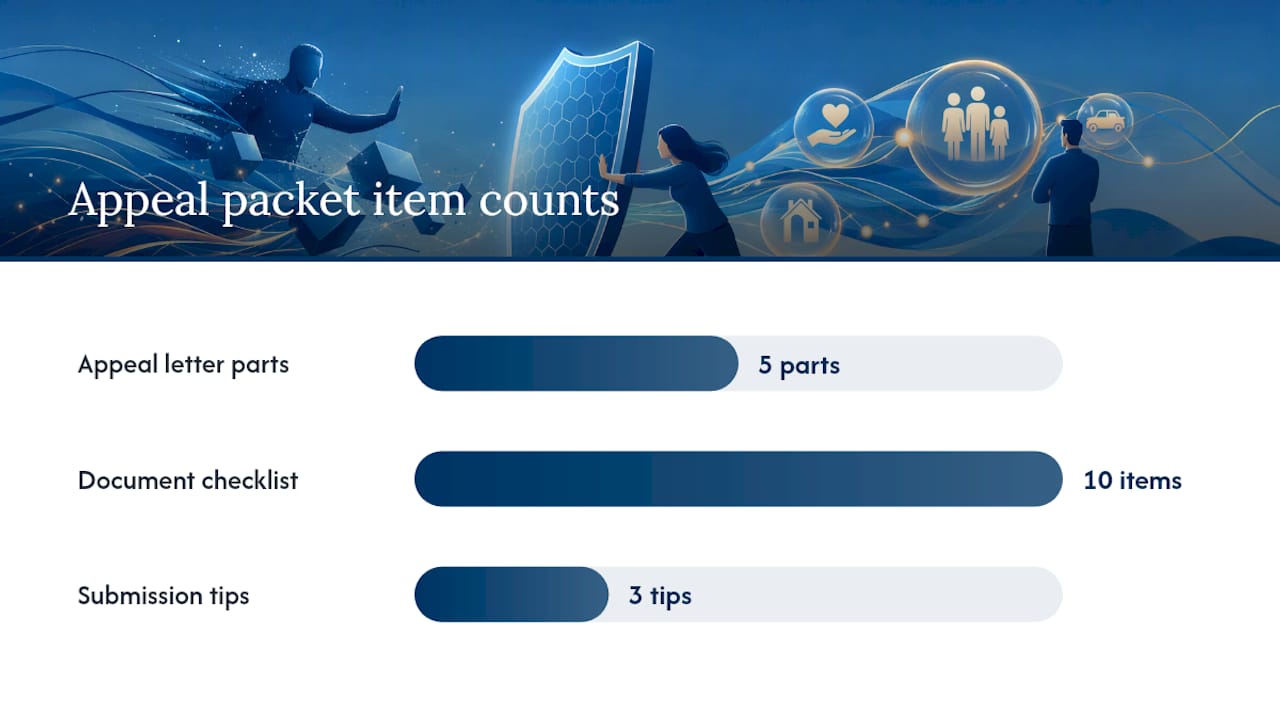
Appeal letter structure:
- Opening statement (BLUF): State your name, member ID, claim number, date of service, and the specific reversal you are requesting. Example: “I am writing to appeal the denial of Claim No. [XXXXX] for services rendered on [date]. I request that this denial be reversed and the claim paid in full.”
- Cite the policy language: Reference the specific benefit or coverage provision you believe applies. If the insurer cited an exclusion, quote it and explain why it does not apply to your situation.
- Chronology of events: A brief, factual timeline: date of service, date of claim submission, date of denial, and any prior-authorization requests.
- Supporting records list: Name every document you are attaching so the reviewer can confirm the packet is complete.
- Explicit request for reversal: Close with a clear, direct sentence requesting payment and stating the deadline by which you need a response.
Document checklist for your appeal packet:
- Denial letter (all pages, including the reason codes)
- Explanation of Benefits (EOB) from the insurer
- Claim number and all reference numbers from prior correspondence
- Provider’s itemized bill (line-by-line, not a summary)
- Medical records relevant to the denied service
- Prior-authorization request and any insurer response
- Proof of timely filing (submission confirmation, clearinghouse receipt)
- Correspondence log (dates, times, representative names, call summaries)
- Treating clinician’s letter of medical necessity (for medical-necessity denials)
- Photos or other physical evidence (for injury or property claims)
Submission tips: Send the appeal packet by certified mail with return receipt requested, or through the insurer’s secure member portal if it generates a confirmation number. Keep a complete copy of everything you send. If you use the portal, screenshot the confirmation page. The chain of custody for your appeal packet matters if the case later goes to external review or litigation, because CMS guidance notes that what you submit internally is often carried forward to the IRO stage.
How can you prevent denials before they happen?
The most effective prevention happens before the claim is ever submitted. A few habits, applied consistently, eliminate the majority of administrative denial causes.
- Confirm in-network status before every appointment. Call the insurer and ask whether the specific provider (not just the practice) is contracted. Provider directories are frequently outdated; verbal confirmation with a reference number is more reliable.
- Get prior authorization in writing. If a service requires pre-approval, request the authorization number and ask the insurer to send written confirmation. Verbal approvals are difficult to enforce.
- Verify your member ID and policy dates at every visit. Present your current insurance card and ask the front desk to confirm the information they have on file matches. A single digit error on the member ID is one of the most common billing mistakes that cause denials.
- Track filing deadlines in a simple claim folder. Keep a folder (paper or digital) for each claim: date of service, provider name, claim number, submission date, and the plan’s filing deadline. Review it monthly.
- Insist on an itemized bill after every service. A summary bill does not show the individual procedure codes. An itemized bill lets you catch coding errors before the claim is processed.
- Check provider credentialing for new providers. A provider who recently joined a network may not yet be credentialed with your insurer. Confirm credentialing status before the appointment, especially for specialists.
- Work with the billing office proactively. Ask the billing coordinator what information they need from you before the claim is submitted. Providing a copy of your insurance card front and back, your referral number, and your prior-auth number at check-in reduces errors at the source.
Pro Tip: Reconcile your EOB against the provider’s bill every month. When the amounts or service descriptions do not match, contact the billing office immediately. Catching a mismatch before the claim ages past the filing deadline is far easier than appealing a timely-filing denial later.
Reviewing common claim pitfalls before you file can also help you avoid the procedural mistakes that most often derail legitimate claims.
What do denials actually mean, and when is something wrong?
A denial does not mean the insurer is right. It does not mean you committed fraud. And it does not mean the claim is over. Many denials are correctable administrative issues that resolve after a single corrected resubmission or a one-page appeal letter. Legal analysis across insurance lines confirms that recurring denial reasons include policy exclusions, documentation gaps, missed deadlines, and coverage disputes, most of which have defined remedies.
That said, some patterns signal something more serious than a paperwork error.
Red flags that may indicate bad-faith handling:
- The insurer refuses to provide a written reason for the denial.
- Appeals are not processed within the plan’s stated timeframe, with no explanation.
- The insurer repeatedly denies the same claim without explaining which medical criteria were applied.
- You are asked to resubmit records you already provided, with no acknowledgment of the prior submission.
- The denial letter cites a policy exclusion that does not appear in your actual plan documents.
- The insurer misrepresents the terms of your coverage in written communications.
When an insurer denies a claim without a written explanation, fails to meet its own appeal deadlines, or applies criteria that do not appear in the policy, that conduct may cross from a coverage dispute into bad faith. Bad-faith handling is a separate legal claim in most states, and it can entitle the policyholder to remedies beyond the original claim amount. If you are seeing these patterns, a state regulator complaint is the right first step, and a consultation with an attorney is worth considering.
If you recognize these red flags, file a complaint with your state’s Department of Insurance. Most states have an online complaint portal and a consumer assistance unit. For Florida residents, the Florida Department of Financial Services handles insurance complaints. If the pattern persists after a regulator complaint, or if the financial stakes are significant, consulting an attorney who handles bad-faith insurance claims is a reasonable next step. A slip-and-fall claim denial in Florida, for example, can involve both coverage disputes and bad-faith conduct, and the two issues require different legal strategies.
Why organized, early action changes the outcome
From my experience handling insurance disputes and related litigation, the single biggest factor separating a successful appeal from a failed one is not the strength of the underlying claim. It is how quickly and completely the claimant documented and organized their case from the moment the denial arrived.

Insurers operate on deadlines. When a claimant misses an internal appeal window, the insurer gains a procedural defense that has nothing to do with the merits of the claim. When records are requested late, the treating physician’s notes may be harder to obtain, memories fade, and the chronology becomes harder to reconstruct. The systematic approach — collect the denial letter immediately, correct what can be corrected, file a complete internal appeal, and escalate through external review or the state regulator if needed — is not just good advice. It is the architecture of a winnable case.
Legal experience in insurance-dispute litigation also reveals something that consumer guides rarely say plainly: the appeal packet you build for the internal appeal is the same packet that goes to the IRO, and potentially to a jury. Every document you add, every phone call you log, and every written request you send builds the evidentiary record. Gaps in that record are the first thing an insurer’s attorney will point to. Calillaw offers case review for clients whose denials have not resolved through internal appeals, and when the facts support it, litigation. Case acceptance follows a free consultation, and representation is on a contingency-fee basis, meaning no upfront cost to you.
When a denied claim needs more than an appeal
When a denial involves a serious injury, a large financial loss, or a pattern of procedural violations, the appeal process alone may not be enough. Calillaw represents individuals and businesses in insurance dispute litigation, including cases where an insurer has denied a legitimate claim without a valid basis or has engaged in bad-faith conduct. There are no upfront legal fees. The firm works on a contingency basis, collecting a fee only when you receive a settlement or court award.
The right time to contact an attorney is when the internal appeal has been denied, the financial stakes are meaningful, or you are seeing the red flags described above. You can learn more about the firm’s approach to insurance claim representation or reach out directly for a free consultation to discuss whether your situation warrants legal action.
Sources
The resources below are primary references for understanding your rights, finding appeal templates, and verifying official processes.
- HHS-Administered Federal External Review Process for Health Insurance Coverage | CMS
- Claims Denials and Appeals in ACA Marketplace Plans in 2024 | KFF
- Common denial reason codes in medical billing – TechTarget
This article is general information, not a substitute for advice from a qualified lawyer. Consult a qualified legal professional about your own circumstances before acting on anything here.


