 Skip to Content

Insurers Cap Matching: 6 Steps Florida Homeowners Must Take
Yes, Florida has a matching statute. Fla. Stat. § 626.9744 requires insurers to make reasonable repairs to adjoining areas when new materials don’t match in color, quality, or size. But entitlement hinges on one crucial phrase: “unless otherwise provided by the policy.” Insurers can and do limit matching through endorsements, so what you’re owed depends heavily on your policy’s fine print and how well you document your claim.
TL;DR:
- Florida’s matching statute requires insurers to repair or replace enough adjoining materials to ensure uniformity, but only if the policy does not limit this obligation.
- Many insurers now restrict coverage with endorsements that cap matching payments or require repairs to be completed before reimbursement, often creating cash-flow challenges.
- Disputes often involve roof, flooring, or cabinetry damage where discontinued or mismatched materials make partial repairs look patchwork, emphasizing the need for thorough documentation.
- Homeowners should document damages, obtain manufacturer confirmation of material discontinuation, and secure contractor estimates before filing a claim, especially if repairs are delayed.
- Legal options include demand letters, Civil Remedy Notices, and consulting attorneys, with recent trends leaning toward increased insurer restrictions on matching coverage.
Table of Contents
- What Does Florida’s Matching Statute Actually Say?
- Who Does the Matching Statute Cover, and How Does Policy Language Change Things?
- How Are Insurers Limiting Matching Coverage in Florida?
- When Does Matching Actually Come Up in Real Claims?
- How to Document and File a Matching Claim With Your Insurer
- What Legal Options Do You Have if Your Insurer Denies Matching?
- What Florida Homeowners Should Expect Going Forward
- How Calillaw Helps When Your Insurer Limits Matching Coverage
- Sources
- FAQ
What Does Florida’s Matching Statute Actually Say?
Florida Statute 626.9744 tells insurers that when a covered loss damages part of a roof, floor, wall, or other continuous surface, and replacement materials aren’t reasonably similar in color, quality, or size, the insurer must repair or replace enough of the adjoining material to create reasonable uniformity in appearance. That’s the plain-language core of it.
The statute doesn’t hand homeowners a blank check for whole-house renovations. It directs insurers and adjusters to weigh specific factors: the cost of achieving a match, whether reasonable uniformity is even achievable, and the remaining useful life of the existing materials. A five-year-old roof with widely available shingles gets treated differently than a fifteen-year-old discontinued tile floor.
When you write to your insurer about a matching dispute, cite the statute by its exact section number, Fla. Stat. § 626.9744. Adjusters see vague references to “Florida law” constantly. A specific citation signals you’ve done your homework and expect a substantive response, not a form letter.
Who Does the Matching Statute Cover, and How Does Policy Language Change Things?
The statute applies when your policy settles claims on a repair or replacement cost basis, not when you’ve chosen actual cash value (ACV) only coverage. That distinction matters because the statute’s language begins with “unless otherwise provided by the policy,” meaning your specific policy terms can narrow or eliminate matching obligations that would otherwise apply.
This is where many homeowners get surprised. Standard replacement cost coverage often includes matching by default. But insurers increasingly attach endorsements that cap or restructure that coverage. A common example: an endorsement limiting matching payments to a small percentage of your Coverage A dwelling limit, which may cap matching costs well below what full-surface replacement would actually cost.
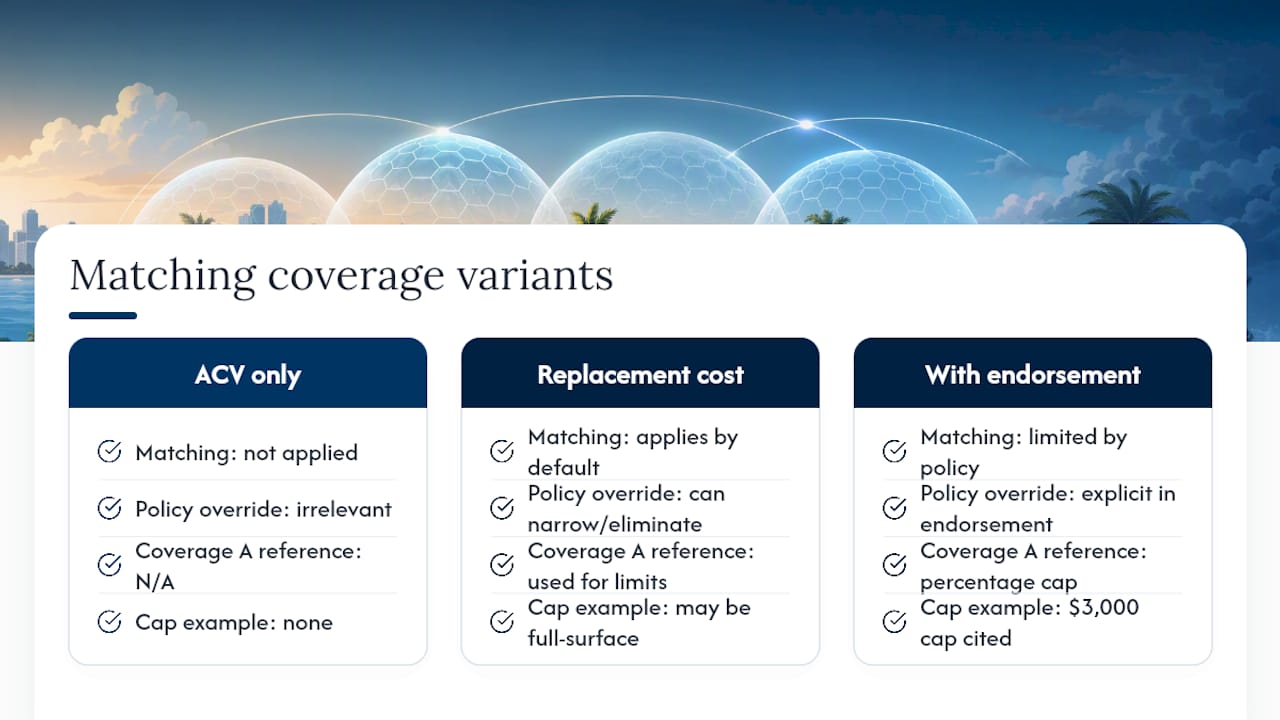
If your roof needs one slope replaced and the rest doesn’t match, a $3,000 cap might not come close to covering it. Read your declarations page and endorsement list before you file a claim, not after a denial letter arrives.
How Are Insurers Limiting Matching Coverage in Florida?
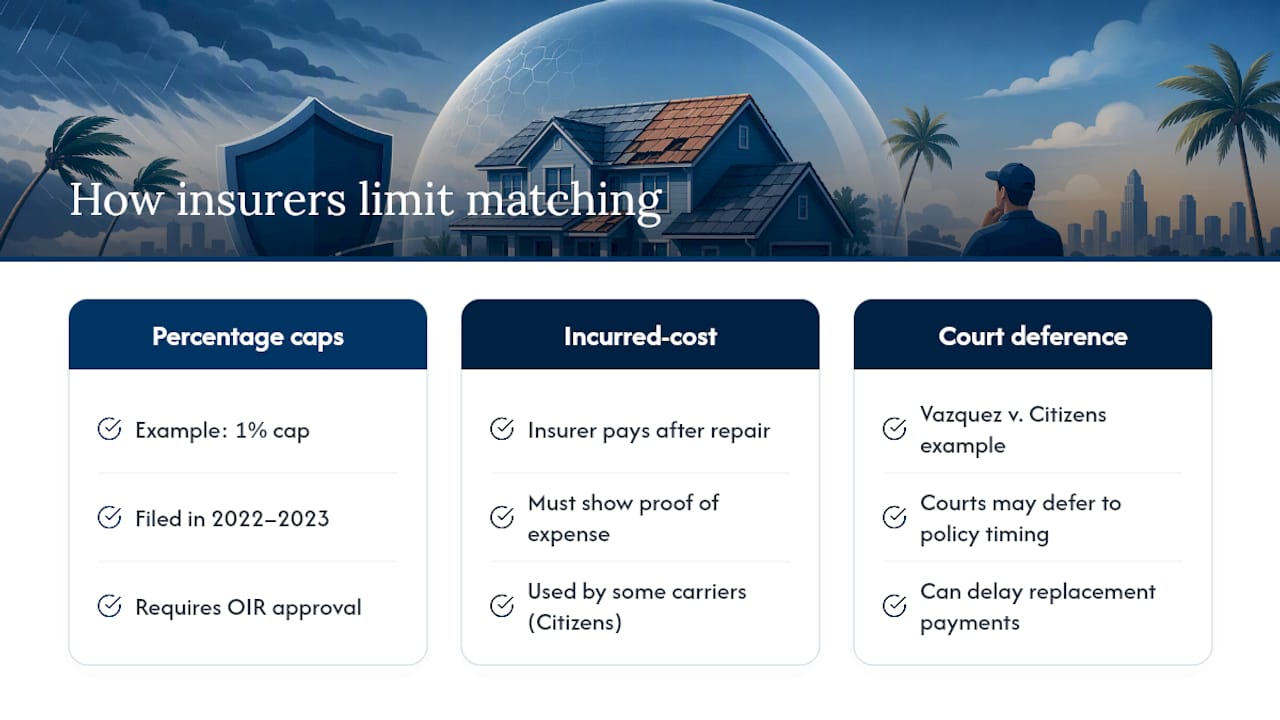
Carriers have moved aggressively to restructure how matching gets paid. Industry reporting from Gen Re shows insurers filing and receiving approval for matching-limitation endorsements throughout 2022 and 2023, with multiple carriers seeking Florida Office of Insurance Regulation authorization for caps and timing restrictions.
Two mechanisms dominate. First, percentage caps like the 1% example above. Second, “incurred cost” requirements, meaning the insurer won’t pay the matching portion until you’ve actually completed the repair and can show proof of expense. Some carriers, including Citizens, have adopted this approach directly.
Case law adds another layer. Analysis from Kubicki Draper points to Vazquez v. Citizens Property Ins. Corp. as an example of courts sometimes deferring to policy language on timing, meaning replacement-cost payments, including matching amounts, aren’t always due until repairs are complete.
For you, this translates into a cash-flow problem. You may need to front the cost of full-surface repairs before your insurer reimburses the matching portion. That’s a real financial hurdle for a homeowner who wasn’t expecting to pay contractors out of pocket while waiting on a claim.
When Does Matching Actually Come Up in Real Claims?
Matching disputes cluster around a handful of predictable situations. Roof claims are the most common: hail or wind damage hits one slope, and the remaining shingles have granule loss or sun fading that makes a partial repair look patchwork. Tile and hardwood flooring disputes happen when water damage destroys part of a floor and the exact product line has been discontinued. Cabinetry and paint disputes arise less often but follow the same logic, one section damaged, the rest visibly mismatched once repaired.
Adjusters generally ask one question: can the damaged section be repaired reasonably without replacing the whole surface? If discontinued materials make that impossible, the burden often falls on you to prove it.
Documentation wins these disputes. Build a file that includes:
- Clear photos of the damaged area and the surrounding continuous surface
- A written statement from the manufacturer or vendor confirming the exact product is discontinued or unavailable
- At least one independent contractor estimate for full-surface replacement
- Pre-loss photos or a physical material sample, if you have one
Pro Tip: Call the manufacturer’s customer service line yourself and ask for written confirmation that your specific shingle color, tile pattern, or flooring product is discontinued. A dated email or letter carries far more weight with an adjuster than your own opinion that “it doesn’t look the same.”
How to Document and File a Matching Claim With Your Insurer
Handling a matching claim well comes down to sequence and paper trail. Follow these steps in order:
- Photograph everything immediately. Capture the damaged section and the full continuous surface around it before any repairs begin.
- Preserve a physical sample of the original material if it’s salvageable, roof shingle, tile piece, or flooring plank.
- Get vendor or manufacturer confirmation in writing that your exact product is discontinued or unavailable.
- Collect at least two contractor estimates covering both partial repair and full-surface replacement costs.
- Reference Fla. Stat. § 626.9744 by name in your written claim correspondence, and keep dated copies of every letter or email.
- If your insurer requires you to incur costs first, get signed contractor estimates before work starts and consider sending a formal demand letter, or filing a Civil Remedy Notice, if the delay becomes unreasonable.
Pro Tip: Keep a simple timeline log, date of loss, date of first adjuster contact, date estimates were submitted. If your claim ends up in dispute, that timeline becomes evidence of good faith on your part and can support a bad-faith argument if your insurer drags its feet.
What Legal Options Do You Have if Your Insurer Denies Matching?
When an insurer denies or caps matching coverage you believe you’re owed, you have a few paths forward. A written demand letter citing the statute and your documentation is the first step. If that stalls, filing a Civil Remedy Notice with the Florida Department of Financial Services puts the insurer on formal notice and starts a clock for response. You can also file a complaint with the Office of Insurance Regulation if you believe an endorsement was misapplied.
Outcomes vary. Some disputes resolve with negotiated partial matching once documentation is strong enough. Others require the homeowner to complete repairs first and pursue reimbursement afterward, particularly under incurred-cost endorsements. When an insurer refuses to pay after you’ve provided solid documentation, or you notice a pattern of delay tactics, that’s usually the point to bring in an attorney rather than keep negotiating alone.
What Florida Homeowners Should Expect Going Forward
Carriers aren’t backing away from matching-limitation endorsements. If anything, the trend toward caps and incurred-cost timing has accelerated, and homeowners should plan on carrying more of the documentation burden than they did a few years ago. Budget for the possibility that your policy caps matching well below actual repair cost, and treat that gap as a real financial risk, not a technicality.
If matching coverage is central to restoring your home, especially when a lender or mortgage servicer is watching the repair timeline, don’t wait until a denial letter to get legal advice. Early review of your endorsements can save you months of frustration.
— Jorge
How Calillaw Helps When Your Insurer Limits Matching Coverage
Some Florida homeowners turn to legal help when an insurer’s endorsement language works against them instead of for them. Reviewing a matching-limitation endorsement, gathering vendor unavailability letters, and building a documentation file that actually holds up isn’t something most homeowners want to do alone while also managing contractors and a damaged home.
Calil Law Trial Attorneys represents Florida homeowners in disputes over property damage claims, matching entitlement, and bad-faith insurer conduct. Led by a Board Certified Civil Trial Lawyer with over 18 years of Florida experience, the firm reviews your policy and endorsements, prepares demand letters or a Civil Remedy Notice when warranted, and takes cases to litigation when insurers won’t budge. If your insurer has capped or denied a matching claim, get a free case review through the firm’s insurance claim practice page before you sign off on a settlement that leaves your home looking patched instead of repaired.
This article is general information, not a substitute for advice from a qualified lawyer. Consult a qualified legal professional about your own circumstances before acting on anything here.
Sources
FAQ
Does Florida’s Matching Statute Guarantee Full Replacement?
No. Fla. Stat. § 626.9744 requires reasonable repairs to adjoining areas, but the statute defers to policy language and lets insurers weigh cost, achievable uniformity, and remaining useful life. Your specific endorsements can cap or restructure what you’re actually owed.
Can My Insurer Refuse to Pay Matching Costs Upfront?
Yes, some Florida insurers now require homeowners to complete repairs before reimbursing matching costs, an approach courts have sometimes upheld when policy language supports it. Get signed contractor estimates in writing before starting work if your policy includes this requirement.
What Should I Do if My Insurer Denies My Matching Claim?
Send a written demand letter citing the statute and your documentation, and consider filing a Civil Remedy Notice if the insurer doesn’t respond adequately. If denial or delay continues after you’ve submitted solid evidence, Calillaw can review your policy and pursue the claim further, including litigation where necessary.
How Much Does It Cost to Hire an Attorney for a Matching Dispute?
Calillaw handles insurance claim disputes on a contingency fee basis, meaning there’s no upfront cost and fees come only from a successful settlement or award. Current details on representation are available through a free case review.
What Documentation Do I Need to Prove a Matching Claim?
You need clear photos of the damage and surrounding surface, a manufacturer or vendor statement confirming the material is discontinued, and at least one independent contractor estimate for full-surface replacement. Pre-loss photos or a physical material sample strengthen the claim further.


