 Skip to Content

Medical Lien Explained: What Injury Victims Must Know
What is a medical lien in a personal injury case?
A medical lien is a legal claim on settlement proceeds that gives healthcare providers, insurers, and government programs the right to be repaid for your medical treatment before you receive a single dollar. It is not a suggestion or a courtesy request. It is an enforceable legal instrument, and it attaches directly to whatever money your personal injury case produces.
If you were injured in a car accident, a slip and fall, or any other incident caused by someone else’s negligence, you likely received medical care. Someone paid for that care, or agreed to defer payment until your case settled. Either way, that party now has a financial stake in your recovery. They are a lienholder, and they get paid first.
Here is what that means in practice:
- Lienholders are paid before you are. Settlement funds flow to lienholders, then to your attorney for fees and costs, and only then to you.
- Common lienholders include hospitals, health insurers, Medicare, and Medicaid. Each operates under different legal authority and different rules.
- Medical providers sometimes treat patients on a lien basis, deferring their fees entirely until the case resolves.
- Government programs like Medicare and Medicaid hold statutory liens backed by federal and state law, giving them priority that cannot be waived.
- The lien amount directly reduces your net recovery. A $100,000 settlement with $35,000 in liens and $33,000 in attorney fees leaves you with roughly $32,000.
Understanding medical liens early in your case is not just helpful. It is the difference between a settlement that feels like a win and one that leaves you blindsided.
How medical liens work within personal injury settlements
Medical liens arise the moment a provider treats you on credit, or when an insurer pays your bills and asserts its right to reimbursement. The lien process runs parallel to your personal injury claim, and it does not wait for your case to finish before it starts creating obligations.
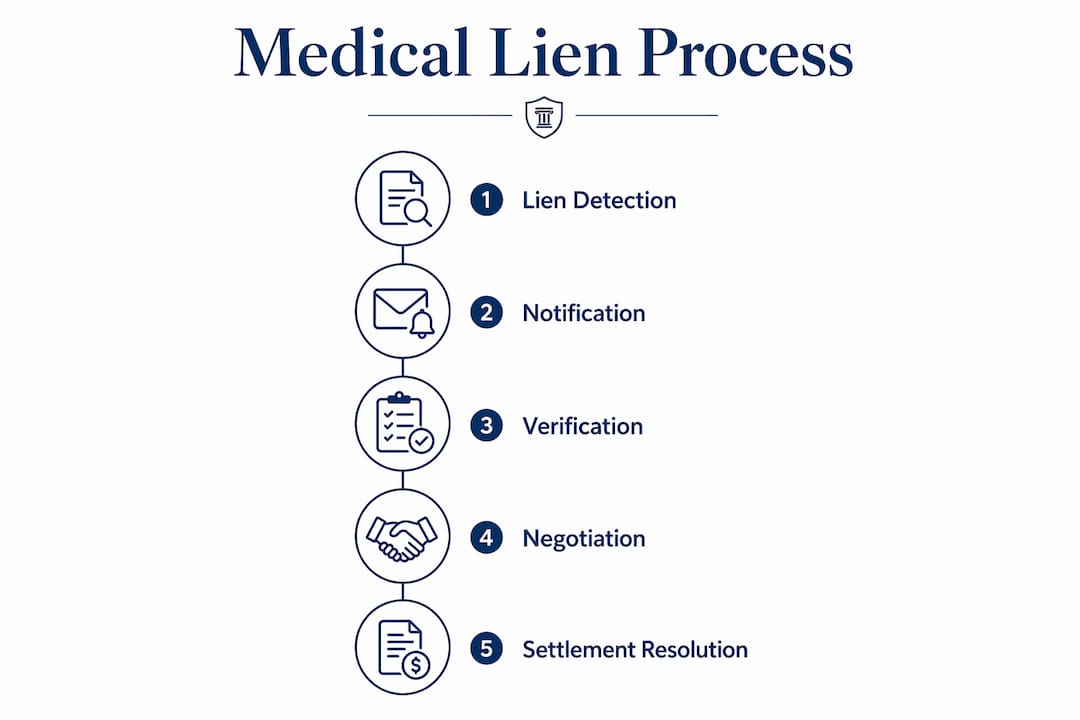
The process generally follows this sequence:
- Treatment and lien creation. A provider treats you and either files a formal lien or sends written notice of its claim against your anticipated recovery.
- Lien identification and verification. Your attorney requests itemized billing records and confirms the legal basis for each lien.
- Negotiation with lienholders. Before settlement funds are distributed, your attorney contacts each lienholder to verify the amount and, where possible, negotiate a reduction.
- Settlement disbursement. Funds are released from the defendant’s insurer, placed in your attorney’s trust account, and distributed to lienholders before you receive your share.
- Final resolution and lien satisfaction. Each lienholder signs a release or satisfaction of lien, confirming the debt is cleared.
Ignoring a lien does not make it disappear. Distributing settlement funds without resolving outstanding liens can trigger lawsuits, attorney disciplinary action, and personal liability for both the attorney and the client. Government liens carry even sharper consequences, which we cover in the sections ahead.
The Medicare Secondary Payer process can take several weeks or longer to resolve, requiring a final demand letter before any disbursement. That timeline affects when you actually receive your money, so early identification of every lien in your case matters enormously.

Pro Tip: Ask your attorney to run a full lien audit within the first 30 days of your case. Identifying every potential lienholder early gives you the maximum window to negotiate reductions before settlement pressure mounts.
What types of medical liens can affect your case?
Not all medical liens work the same way, and the type of lien attached to your case determines how much flexibility you have in resolving it. Four main categories arise in personal injury cases, each with distinct legal authority and negotiation dynamics.
Hospital liens
Most states have hospital lien statutes that give hospitals an automatic right to assert a claim against your personal injury recovery. These are statutory liens, meaning the hospital does not need a contract with you to enforce them. The hospital simply files the lien with the appropriate county or state office, and the claim attaches to your settlement by operation of law.
Health insurance subrogation
When your private health insurer pays your medical bills, it typically has a contractual right to seek reimbursement from your settlement. This is called subrogation. The right is written into your insurance policy, and the insurer steps into your shoes to recover what it paid. These liens are generally negotiable, and contractual liens often accept substantial reductions through skilled negotiation.
ERISA liens
If your health coverage comes through a self-funded employer plan governed by the Employee Retirement Income Security Act, the rules change significantly. ERISA preempts most state laws that would otherwise limit subrogation rights, which means the plan can often recover its full payment regardless of how little you net from the settlement. These liens are among the most legally complex in personal injury practice, and they require careful handling. Calillaw’s experience with complex lien disputes is particularly relevant here.
Letters of protection
When an injured person has no insurance, some medical providers agree to treat them in exchange for a letter of protection (LOP). This is a written agreement between the provider, the patient, and the attorney, promising payment from the eventual settlement. LOPs are contractual liens and are generally negotiable, though providers who treat on this basis often charge rates higher than standard insurance rates.
Medicare and Medicaid statutory liens
Medicare’s right to reimbursement flows from the Medicare Secondary Payer Act, a federal statute that makes Medicare a secondary payer when another source, like a liability insurer, is responsible. Medicaid liens are governed by state law but similarly backed by statutory authority. Both are less flexible than private liens, though Medicare does allow proportional reductions to account for attorney fees and costs under the procurement cost doctrine.
How liens affect your settlement and who pays what
The financial reality of a medical lien is straightforward, and it catches many injury victims off guard. Settlement money does not belong entirely to you the moment it arrives. It is held in your attorney’s trust account and distributed according to a strict priority order.
Here is how that order typically works:
- Lienholders are paid first, before attorney fees and before you receive anything.
- Attorney fees and costs come next, typically calculated as a percentage of the gross settlement.
- Your net recovery is what remains after both lienholders and your attorney are paid.
A typical case may lose a significant portion of the settlement to liens plus attorney fees, leaving a substantially smaller net recovery for the plaintiff. That math is not hypothetical. It plays out in cases every day, and it is why lien negotiation often matters as much as the settlement negotiation itself.
The risks of an insufficient settlement deserve direct attention. If your settlement does not fully cover the outstanding liens, lienholders do not simply absorb the shortfall. They can pursue collection against you personally, or they can challenge the distribution in court. Government lienholders have even broader remedies. Medicare lien violations can expose attorneys to liability for double the lien amount under the Medicare Secondary Payer Act.
Understanding how compensation is determined in an injury case, including the lien priority structure, is something every plaintiff should discuss with their attorney before accepting any offer. The gross settlement number your attorney announces is rarely the number that ends up in your account.
Key insight: Medical liens function as a financial bridge, allowing injured people to receive vital medical care immediately, even without insurance, by deferring payment until settlement. That access to care comes with a real cost at the back end of your case.
How attorneys manage and negotiate medical liens on your behalf
Lien management is one of the most consequential things a personal injury attorney does, and it is often invisible to clients until the settlement check arrives. A skilled attorney does not simply pay lienholders whatever they demand. They challenge, verify, and negotiate every claim.
Here is what that process looks like in practice:
- Lien identification. The attorney contacts all potential lienholders, including hospitals, insurers, Medicare, and Medicaid, to obtain formal lien notices and itemized billing.
- Verification of lien validity. Not every lien is legally enforceable. Attorneys review whether the lienholder complied with statutory notice requirements and whether the claimed amount is accurate.
- Negotiation for reduction. Attorneys use several recognized strategies to reduce lien amounts, including demanding itemized bills, identifying billing errors, and invoking the common fund doctrine.
- Common fund doctrine application. This doctrine holds that lienholders who benefit from the plaintiff’s attorney’s work should share proportionally in the attorney fees and costs, resulting in a reduced net lien.
- Documentation and compliance. Every resolution is documented with a signed lien satisfaction or release before funds are disbursed.
Negotiation strategies like demanding itemized bills, invoking the common fund doctrine, and pursuing hospital bill reductions can save clients tens of thousands of dollars. That savings often exceeds what was gained from negotiating with the opposing insurer. Aggressive lien negotiation is frequently the biggest factor in maximizing what you actually take home from a settlement.
The legal risks of failing to resolve liens fall on both the attorney and the client. An attorney who distributes settlement funds without satisfying a Medicare lien, for example, can face double damages liability and disciplinary proceedings. That exposure gives experienced attorneys strong motivation to resolve every lien before closing a file.
Pro Tip: Never assume your settlement amount equals your net payout. Before you sign any release, ask your attorney for a written disbursement breakdown showing every lien, every fee, and your projected net recovery.
Medical providers who treat on a lien basis, as described in the personal injury law firm context, are often willing to negotiate their claims as commercial debts once the case resolves. That negotiability is an asset your attorney should be actively exploiting.
What are the legal requirements to file a medical lien?
Filing a medical lien is not a casual act. It requires compliance with specific legal procedures that vary by lien type and by state. Failure to follow those procedures can render a lien unenforceable, which is exactly why your attorney scrutinizes every lien’s legal foundation.
For hospital liens, most state statutes require the hospital to file a written notice of lien with the county recorder or clerk within a specified window after the patient is admitted or discharged. The notice must typically identify the patient, the date of treatment, the amount claimed, and the name of the person or entity responsible for the injury. Some states also require the hospital to send written notice to the defendant and the defendant’s insurer.
For Medicare and Medicaid liens, the process is governed by federal statute and Centers for Medicare and Medicaid Services (CMS) regulations. Attorneys must notify CMS of a pending personal injury claim, request a conditional payment letter, and resolve the lien before or at the time of settlement. Failing to notify CMS is not a technicality. It is a federal compliance obligation with real financial consequences.
For health insurance subrogation claims, the insurer typically asserts its rights through written notice to the plaintiff’s attorney, citing the subrogation clause in the policy. The attorney must then verify the amount paid, confirm the policy language, and negotiate the reduction.
For letters of protection, the written agreement itself serves as the lien instrument. No separate filing is required, but the terms of the LOP govern the provider’s right to payment and must be honored at settlement.
The common thread across all lien types is written notice and timely action. Lienholders who miss their filing deadlines or fail to provide proper notice may lose their right to enforce the lien entirely. Your attorney’s job is to know those deadlines and hold lienholders accountable to them.
How medical lien laws vary from state to state
Medical lien law is not uniform across the United States. Each state has its own statutes governing which providers can assert liens, how those liens must be filed, what amounts can be claimed, and how disputes are resolved. That variation has real consequences for your case depending on where your injury occurred.
California, for example, has one of the most developed hospital lien frameworks in the country. California’s Hospital Lien Act allows hospitals to assert liens against personal injury recoveries, but the state also has strong anti-balance billing protections that limit what providers can actually collect. California courts have repeatedly addressed the interplay between lien rights and the collateral source rule.
Florida limits hospital liens in certain respects and has specific Medicaid lien recovery rules governed by state statute. Florida’s Medicaid program, administered through the Agency for Health Care Administration, asserts recovery rights from personal injury settlements, and those rights are subject to negotiation within statutory limits.
Texas has a detailed Health Care Liability statute that affects how medical providers assert liens, and Texas courts have addressed the enforceability of letters of protection in personal injury cases extensively.
New York and Illinois both have hospital lien statutes with specific notice and filing requirements that differ from the majority of states. In New York, the lien must be filed before the action is settled, and the lienholder must serve notice on the parties.
At the federal level, Medicare and ERISA liens apply uniformly regardless of state law. The Supreme Court has addressed ERISA plan reimbursement rights in personal injury cases, confirming that federal law can override state anti-subrogation statutes, which is why ERISA liens are treated as a separate and more complex category.
The practical takeaway is this: the state where your injury occurred, and the state where your medical providers are located, both affect which lien rules apply and how much room exists to negotiate. An attorney who knows your state’s specific lien statutes is not a luxury. It is a necessity.
Understanding the settlement factors that affect your case, including state-specific lien rules, helps you set realistic expectations before you ever sit down to negotiate.
Key Takeaways
Medical liens are enforceable legal claims that reduce your net settlement recovery, and skilled attorney negotiation is the primary tool for protecting what you actually take home.
| Point | Details |
|---|---|
| Lienholders are paid first | Settlement funds go to lienholders before attorney fees and before you receive any money. |
| Four main lien types | Hospital liens, health insurance subrogation, ERISA liens, and letters of protection each carry different rules and negotiability. |
| Government liens are rigid | Medicare and Medicaid liens are backed by federal and state law; the Medicare Secondary Payer process can take 60–90 days to resolve. |
| Ignoring liens creates liability | Distributing funds without resolving liens can expose attorneys to double damages under the Medicare Secondary Payer Act. |
| Negotiation protects your recovery | Contractual liens often accept substantial reductions; the common fund doctrine and itemized billing challenges are key negotiation tools. |
Calillaw is ready to protect your recovery

Medical liens can quietly consume a large portion of your settlement if they are not identified, challenged, and negotiated by someone who knows exactly what they are doing. At Calillaw, our Board Certified Civil Trial Lawyers have spent decades managing exactly these disputes, from hospital lien challenges to complex ERISA plan negotiations, for injured clients across Florida.
You deserve to know what your case is actually worth to you, not just to your lienholders. Our personal injury legal team reviews every lien in your case, verifies its legal basis, and fights to maximize what you take home. We handle the complexity so you can focus on recovering.
Call Calillaw today for a free consultation. Your life has value, and we are here to protect it.


