 Skip to Content

Medical Records in an Injury Claim: Your 2026 Guide
Medical records are the foundation of every successful personal injury claim. They connect your injuries to the incident, establish the severity of your damages, and give insurance adjusters and juries the objective evidence they need to assess your case. Without thorough health records and injury claims documentation, even a legitimate case can fall apart under scrutiny. This guide walks you through exactly what records to collect, how to organize them, and how to avoid the mistakes that cost injured people real money.
What medical records does your injury claim actually need?
The medical records injury claim process requires more than a stack of hospital bills. Simply having medical bills is insufficient; detailed records connecting treatments to injuries are what drive successful claims. That distinction matters enormously when an insurance adjuster is deciding how much your case is worth.
The core records you need to gather include:
- Emergency room reports from the date of the incident, including triage notes and discharge instructions
- Diagnostic imaging such as X-rays, MRIs, and CT scans, along with the radiologist’s written interpretation
- Physician notes from every follow-up visit, including specialist consultations
- Physical therapy and rehabilitation records, including progress notes and functional assessments
- Prescription records documenting medications prescribed as a result of your injuries
- Future care recommendations from your treating physicians, including projected costs and duration
Billing records are separate from medical records. Billing documents show what was charged. Medical records show what happened to your body, what treatment you received, and why. You need both, but they serve different purposes in your claim.
Each appointment record should explicitly include minor symptoms and a prognosis for future care to maximize claim value. Minor symptoms often evolve into significant conditions, and documenting them early prevents insurers from arguing those conditions were pre-existing or unrelated.

Pro Tip: Tell your doctor every symptom at every visit, no matter how minor it seems. A headache you mention once and then dismiss could become documented evidence of a traumatic brain injury if it persists.
How to organize your personal injury medical records effectively
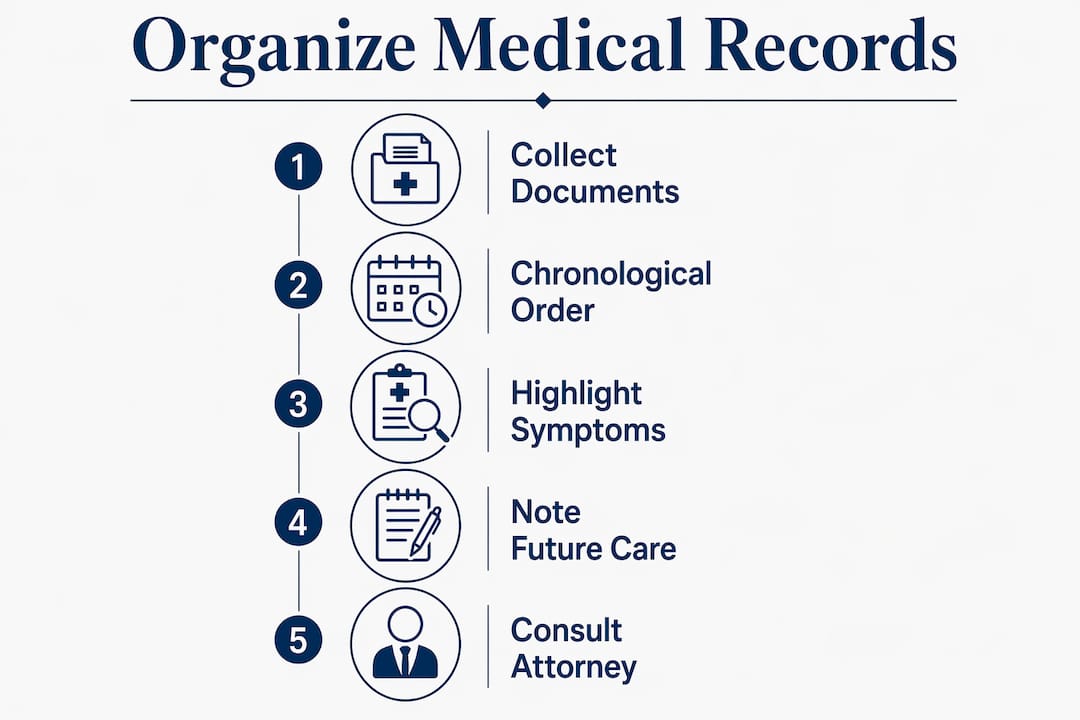
Disorganized records hurt claims. A pile of unsorted documents forces attorneys, adjusters, and juries to work harder, and they will draw their own conclusions when the picture is unclear. Organizing medical records into a clear, chronological timeline helps identify treatment gaps, causation, and functional impairments that are critical to your claim.
Here is a practical system for keeping your documentation tight:
- Create a master chronology. List every medical visit in date order, including the provider’s name, location, reason for the visit, and key findings. This becomes your claim’s spine.
- Separate medical records from billing records. Keep them in distinct folders, physical or digital. Mixing them creates confusion during negotiations.
- Track every provider and every request. Log the date you requested records, the provider’s contact information, and the date you received them. Missing records are common and can delay your claim significantly.
- Document treatment gaps with explanations. If you missed appointments due to financial hardship, transportation issues, or a worsening condition, write it down. Unexplained gaps are a liability.
- Include all out-of-pocket expenses. Co-pays, mileage to appointments, and over-the-counter medications all count as damages.
A well-structured medical chronology does more than keep you organized. A high-quality medical chronology must be paginated and hyperlinked to original records, enabling quick verification during negotiations or trial. That level of organization signals to the other side that your case is prepared and credible.
| Organization task | Why it matters |
|---|---|
| Chronological timeline | Shows continuous treatment and links injuries to the incident |
| Separated billing records | Prevents confusion between charges and clinical findings |
| Provider contact log | Speeds up record requests and tracks missing documentation |
| Gap explanations | Protects claim value when treatment was interrupted |
| Future care documentation | Establishes ongoing damages beyond current treatment |
Pro Tip: Ask your attorney about medical chronology tools. AI-powered chronology tools can reduce manual record processing time from over 10 hours to minutes, giving your legal team more time to build strategy instead of sorting paperwork.
How do medical records prove causation and injury severity?
Causation is the legal bridge between the accident and your injuries. Without it, the defense argues your condition existed before the incident or developed from an unrelated cause. Your medical records carry the weight of proving that connection.
Doctors must explicitly document the link between your injuries and the accident in medical charts. Effective causation language sounds like this: “Patient symptoms are consistent with the trauma sustained in the motor vehicle collision on [Date].” That single sentence, written by your physician, does more legal work than pages of billing records.
The records that most directly establish severity and causation include:
- Physician causation statements explicitly tying your diagnosis to the incident date
- Imaging interpretations that describe structural damage, such as herniated discs or fractures, in clinical terms
- Functional limitation documentation showing what you can no longer do, such as lifting, walking, or working
- Progress notes tracking whether your condition improved, plateaued, or worsened over time
- Specialist referrals that indicate your injuries required care beyond a general practitioner
Insurance adjusters and juries need detailed physician notes and therapy progress reports, not just medical bills, to understand the true impact of your injuries. A documented prognosis showing years of future treatment directly influences the compensation figure your attorney can demand.
Ambiguous language in records creates openings for the defense. If your doctor writes “patient reports pain” instead of “examination confirms lumbar muscle spasm consistent with acute trauma,” the insurer will use that vagueness against you. Ask your doctors to be specific.
Common mistakes that weaken medical records for insurance claims
Most injury claims are not lost at trial. They are weakened long before that, through documentation errors that give insurers the ammunition they need to reduce or deny compensation. Knowing these pitfalls puts you ahead.
- Delaying medical care. Delays of even a few days allow insurers to argue your injuries are unrelated to the accident or less severe than claimed. Seek care immediately after any incident, even if you feel fine.
- Inconsistent symptom reporting. Telling your doctor you feel “fine” at one visit while reporting severe pain to your attorney creates a contradiction the defense will exploit.
- Skipping appointments or stopping treatment early. Treatment gaps and missed appointments allow defense teams to argue you have already recovered, which directly decreases your claim’s value.
- Social media posts that contradict your records. A photo of you hiking posted during a period when your records document severe mobility limitations can destroy your credibility with a jury.
- Giving recorded statements without legal counsel. Insurance adjusters are trained to ask questions that produce answers they can use to minimize your claim. Never give a recorded statement before speaking with an attorney.
Gaps in treatment history can be a major liability in any personal injury claim. If you stopped treatment for financial reasons, transportation barriers, or because a doctor advised rest, document that reason explicitly in your records. An unexplained gap looks like recovery to an insurer. A documented gap with a clear reason is a manageable obstacle.
The steps you take immediately after a car accident set the tone for everything that follows. Consistent, prompt medical care is the single most protective thing you can do for your claim.
Key Takeaways
Medical records are the most powerful tool in any personal injury claim because they establish causation, severity, and damages in objective clinical terms.
| Point | Details |
|---|---|
| Collect all record types | Gather ER reports, imaging, physician notes, therapy records, prescriptions, and future care plans. |
| Organize chronologically | A paginated, hyperlinked medical chronology strengthens credibility during negotiations and trial. |
| Demand causation language | Ask your doctor to explicitly connect your diagnosis to the incident date in writing. |
| Avoid treatment gaps | Missed appointments signal recovery to insurers; document every reason for any interruption. |
| Seek legal counsel early | An experienced attorney coordinates record collection and prevents costly documentation errors. |
What I’ve learned about medical records after years in injury litigation
After handling serious injury cases for decades, I can tell you that the cases we win most decisively are the ones where the client walked into our office with organized, complete medical documentation. The cases that struggle are almost always the ones where treatment was delayed, records are scattered across a dozen providers, or the client stopped going to appointments because they felt better for a week.
Here is what most articles will not tell you: the value of your claim is built in the doctor’s office, not in the courtroom. Every visit, every note, every imaging report is a brick in the structure of your compensation. When clients ask me what they can do to help their own case, my answer is always the same. Go to every appointment. Tell your doctor everything. Follow your treatment plan.
Medical chronologies have changed how we prepare cases. What used to take a legal team days of manual sorting now takes a fraction of that time with the right tools. That efficiency means we spend more time on strategy and less time on paperwork, which directly benefits you.
Working with an experienced personal injury law firm is not just about having someone argue for you. It is about having a team that knows which records to request, how to read them for legal value, and how to present them in a way that moves insurers to pay fair compensation. Documentation is not a formality. It is your case.
— Jorge
How Calillaw supports your injury claim from day one
Injured people should not have to figure out medical record collection on their own while recovering from serious harm.

At Calillaw, our legal team coordinates the full process of gathering, organizing, and analyzing your personal injury medical records from the moment you retain us. We know what insurance companies look for, and we know how to build a documentation file that holds up under pressure. Our attorneys understand the tactics adjusters use to minimize claims, and we counter them with preparation. If you were injured due to someone else’s negligence, your personal injury claim deserves the full weight of experienced legal representation behind it. Contact Calillaw for a free consultation and let us put your documentation to work.
FAQ
What medical records are most important for an injury claim?
Emergency room reports, physician notes, diagnostic imaging, therapy records, and future care recommendations are the most critical. Each must explicitly connect your treatment to the incident that caused your injuries.
How do I get my medical records for an insurance claim?
Submit a written request directly to each healthcare provider or their medical records department. You have a legal right to your own records under HIPAA, and providers must respond within 30 days.
Can a gap in treatment hurt my personal injury claim?
Yes. Treatment gaps allow defense teams to argue recovery, which reduces claim value. Document every reason for any interruption in care to protect your position.
What is a medical records subpoena in an injury case?
A medical records subpoena is a court order requiring a healthcare provider to produce records for use in litigation. Attorneys use subpoenas when providers delay responses or when records from third parties are needed.
Should I see a doctor even if I feel fine after an accident?
Yes. Immediate medical care is crucial because some injuries, including soft tissue damage and concussions, do not produce immediate symptoms. A medical visit creates a record that protects your claim if symptoms develop later.


