 Skip to Content

Mental Anguish in Personal Injury Claims: What to Prove
Mental anguish, in U.S. tort law, means a relatively high degree of emotional pain, suffering, or distress — and yes, it is compensable as a noneconomic damage in a personal injury claim. Courts recognize two primary legal routes to recovery: intentional infliction of emotional distress (IIED) and negligent infliction of emotional distress (NIED). Which path applies depends on the defendant’s conduct and your state’s rules. If someone’s outrageous or negligent behavior caused you genuine psychological harm, the law gives you a mechanism to seek compensation for that suffering.
Table of Contents
- What mental anguish covers legally and how it differs from related terms
- The two legal pathways: IIED vs. NIED explained
- How courts evaluate these claims: the legal standards you must clear
- Concrete examples of compensable psychological harm and the symptoms courts recognize
- How to prove mental anguish: your evidence checklist
- What damages for mental anguish look like and how state rules affect recovery
- Statute of limitations, case timeline, and immediate steps to protect your claim
- What an experienced trial attorney does for your mental anguish claim
- Key Takeaways
- Why documentation is the case, not just evidence
- Calillaw is ready to evaluate your emotional-distress claim
- Useful sources
What mental anguish covers legally and how it differs from related terms
“Mental anguish,” “emotional distress,” and “mental suffering” are often used interchangeably in pleadings and settlement negotiations, but they carry slightly different weight depending on context. The Legal Information Institute at Cornell defines mental anguish as a high-degree emotional pain that courts treat as a basis for noneconomic damages recovery. “Pain and suffering” is a broader umbrella term that typically includes both physical pain and the emotional component; mental anguish sits within that umbrella but refers specifically to the psychological dimension. Clinical diagnoses like PTSD or major depressive disorder are distinct from the legal standard, though they serve as powerful corroborating evidence.
| Term | Typical legal use | Evidentiary support |
|---|---|---|
| Mental anguish | Noneconomic damages in tort claims | Therapy records, clinical diagnosis, witness testimony |
| Emotional distress | Cause of action (IIED/NIED) or damage category | Medical records, expert testimony, journals |
| Pain and suffering | Broad noneconomic damages umbrella | Medical records, testimony, daily-life impact evidence |
| Mental suffering | Synonym for mental anguish in many jurisdictions | Same as mental anguish |
| Psychological injury | Clinical framing used in expert reports | DSM-based diagnosis, neuropsychological evaluation |
Courts generally consider the following within the scope of compensable psychological harm:
- Severe anxiety and panic attacks that disrupt daily functioning
- Clinical depression, including loss of motivation and withdrawal from relationships
- Post-traumatic stress disorder (PTSD) following a traumatic event
- Sleep disturbances, including insomnia or recurring nightmares
- Loss of enjoyment of life and inability to engage in prior activities
- Somatic symptoms such as headaches, nausea, or appetite changes tied to the distress
The two legal pathways: IIED vs. NIED explained
Emotional distress claims split into two distinct causes of action, and choosing the right one is critical to your case.
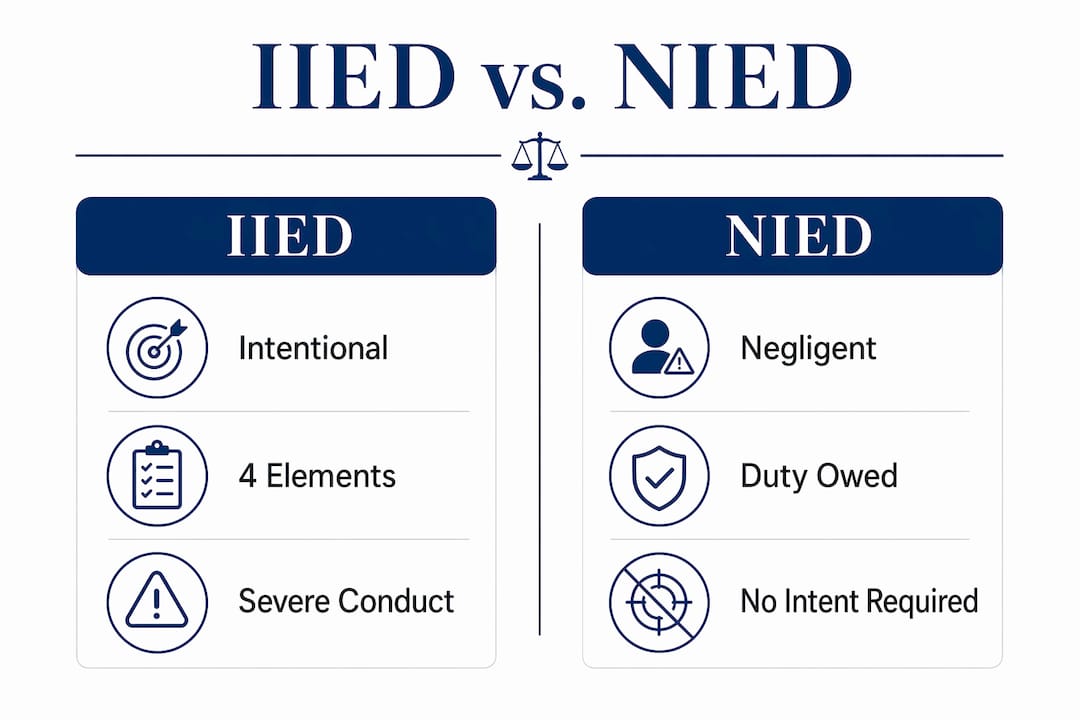
Intentional Infliction of Emotional Distress (IIED) requires proving four elements: the defendant acted; the conduct was outrageous and beyond all bounds of decency; the defendant acted intentionally or recklessly; and the conduct caused severe emotional distress. The bar for “outrageous” is deliberately high. Rudeness, insults, or even aggressive behavior typically will not meet it. Think sustained workplace harassment, threats of violence, or deliberate cruelty targeting a known vulnerability.

Negligent Infliction of Emotional Distress (NIED) does not require intent. Instead, you must show the defendant owed you a duty of care, breached it, and that breach foreseeably caused your distress. Many states add a physical-manifestation requirement — meaning your distress must have produced a physical symptom — or limit recovery to bystanders who witnessed a close family member’s serious injury. NIED claims often carry higher procedural hurdles than IIED.
| Element | IIED | NIED |
|---|---|---|
| Defendant’s state of mind | Intentional or reckless | Negligent |
| Conduct standard | Outrageous, beyond all decency | Breach of duty of care |
| Physical harm required | Generally no | Often yes, or bystander rule |
| Typical plaintiff | Direct target of conduct | Victim or close-by witness |
Key practical differences to keep in mind:
- IIED is harder to prove but does not require physical injury in most states.
- NIED is available in more fact patterns but often demands physical symptoms or a special relationship.
- Some states allow bystander NIED claims when a plaintiff witnesses a loved one’s severe injury.
- Jurisdiction matters enormously — Florida, Texas, California, and New York each apply these standards differently.
Pro Tip: Before filing, confirm which cause of action your state recognizes and whether a physical-manifestation requirement applies. Picking the wrong theory wastes time and can bar recovery entirely.
How courts evaluate these claims: the legal standards you must clear
Courts apply a structured analysis to psychological-pain claims, and understanding each element helps you build a stronger case from day one.
For IIED, the central question is whether the conduct was truly outrageous. The Connecticut Supreme Court has described the standard as conduct that “exceeds all bounds of decency tolerated by a civilized society” — and juries, not judges, typically decide whether specific facts meet that threshold. That jury role matters: a well-documented, emotionally resonant presentation of your experience can move a jury even when the legal standard sounds abstract.
“Applying the IIED tort would pose too great a danger that the jury would punish the defendant for its views on matters of public concern.” — Snyder v. Phelps, 562 U.S. 443 (2011)
Free speech limits IIED in public-figure and public-concern contexts. Under Texas v. Johnson (1989) and Snyder v. Phelps (2011), courts will not impose IIED liability based solely on offensive or radical speech. The defendant must go beyond criticism into genuinely outrageous conduct.
For NIED, courts examine duty, breach, foreseeability, and causation. Severity assessment for both theories looks at:
- Intensity: How severe was the distress at its peak?
- Duration: Has the distress persisted for weeks, months, or years?
- Objective indicators: Did the distress produce measurable changes in behavior, health, or functioning?
- Causation: Is there a clear, traceable link between the defendant’s conduct and your symptoms?
Proximate cause is where many claims stumble. You must show the defendant’s specific conduct — not a pre-existing condition or unrelated stressor — caused the distress you experienced.
Concrete examples of compensable psychological harm and the symptoms courts recognize

Two scenarios illustrate how facts map to legal outcomes.
Scenario one (IIED): A supervisor repeatedly targets an employee with racial slurs, fabricates performance reviews, and threatens termination unless the employee complies with illegal demands. The conduct is sustained, targeted, and deliberately cruel. Courts in most jurisdictions would find this meets the outrageousness threshold, and the employee’s resulting anxiety disorder and PTSD would support a damages claim.
Scenario two (NIED): A parent witnesses a negligent driver strike their child at a crosswalk. The parent suffers acute stress disorder and is unable to return to work for three months. In states that recognize bystander NIED, the parent’s close relationship and direct observation of the traumatic event typically satisfy the foreseeability and proximity requirements.
Research published in peer-reviewed literature confirms that emotional distress symptoms — including severe anxiety, depression, sleep disturbances, and diminished ability to perform daily tasks — are biologically real responses, not fabrications. Courts consider intensity, duration, and the character of the defendant’s conduct when evaluating severity.
Common symptoms courts accept as evidence of compensable distress:
- Persistent anxiety, panic attacks, or hypervigilance
- Clinical depression, including anhedonia and social withdrawal
- PTSD, including flashbacks and avoidance behaviors
- Chronic sleep disturbances or nightmares
- Loss of enjoyment of hobbies, relationships, or work
- Somatic complaints: headaches, gastrointestinal issues, fatigue
A formal clinical diagnosis strengthens your claim, but it is not always legally required. Courts focus on whether a reasonable person in your circumstances would have experienced similar distress and whether objective evidence corroborates your account.
How to prove mental anguish: your evidence checklist
Proof is where psychological-pain claims are won or lost. Courts and juries need objective corroboration — not just your word — that the distress was real, severe, and caused by the defendant’s conduct.
- Medical and therapy records. Obtain records from every treating provider: primary care physicians, psychiatrists, psychologists, and licensed therapists. These establish diagnosis, treatment history, and the timeline of your symptoms.
- Contemporaneous journal entries. A daily log of symptoms, triggers, and their impact on your life is among the most persuasive evidence available. Start one immediately after the incident.
- Prescription records. Medications prescribed for anxiety, depression, or sleep disorders corroborate clinical findings and demonstrate ongoing treatment.
- Employer and school records. Attendance records, performance reviews, and communications showing a decline after the incident document real-world functional impairment.
- Witness statements. Family members, friends, and coworkers who observed changes in your behavior, mood, or daily functioning can provide powerful lay testimony.
- Expert psychological evaluation. A forensic psychologist or psychiatrist can connect your clinical presentation to the defendant’s conduct and quantify the severity of your distress.
- Photos and videos. Visual documentation of the incident scene, physical injuries, or visible signs of distress (weight loss, physical deterioration) adds objective weight.
- Timeline of symptom onset. Document precisely when symptoms began relative to the incident. A clear temporal connection strengthens causation.
The Cleveland Clinic recommends early acknowledgment and treatment of emotional stress — advice that serves both your health and your legal claim. Early treatment produces contemporaneous records that are far more credible than records created months after the fact.
Courts often focus on whether a reasonable person would have experienced similar distress, not solely on whether you received a formal diagnosis. Objective corroboration — changed routines, disrupted relationships, physical symptoms — can be decisive.
Pro Tip: Start a symptom journal the same day you seek medical care. Date every entry, describe specific symptoms, and note how they affected your day. Gaps in documentation are one of the most common reasons injury claims fail.
What damages for mental anguish look like and how state rules affect recovery
Mental anguish falls under noneconomic damages, the category that compensates for harm that has no invoice attached. Unlike medical bills or lost wages, there is no universal formula for calculating psychological pain. Juries have wide latitude in setting these awards, which is why evidentiary presentation matters so much. Factors that raise or lower an award include the severity and duration of symptoms, the degree of the defendant’s culpability, and the concrete impact on the plaintiff’s daily life and relationships.
Many states cap noneconomic damages in personal injury cases. These caps vary significantly by state and claim type; some states apply them only to medical malpractice, while others extend them to all personal injury claims. Florida, for example, has had shifting rules on noneconomic damage caps, and the current framework should be confirmed with counsel for your specific case type. Understanding what damages are available in your jurisdiction is a threshold question before valuing any claim.
Factors courts and juries weigh when assessing a noneconomic award:
- Intensity and duration of the distress
- Whether the distress required ongoing clinical treatment
- The degree to which daily functioning, relationships, or employment was disrupted
- The egregiousness of the defendant’s conduct
- Whether the plaintiff mitigated harm by seeking treatment
Punitive damages are separate from compensatory noneconomic damages and are available only when the defendant’s conduct was particularly egregious or malicious. They are not awarded in every case and are subject to their own constitutional limits.
Statute of limitations, case timeline, and immediate steps to protect your claim
Timing is not a technicality. Miss the statute of limitations and you lose your right to recover, regardless of how strong your claim is.
Most states set a two-year statute of limitations for personal injury and emotional-distress claims, though some states allow one year and others allow three. The clock typically starts on the date of the incident or, in some cases, the date you discovered the harm. Check your state’s specific rule with an attorney as soon as possible.
Typical case stages and approximate timing:
- Immediate (days 1–30): Seek medical and mental-health care; begin symptom journal; preserve all evidence; notify your insurer if applicable; consult an attorney.
- Demand phase (months 1–6): Attorney gathers records, builds the damages narrative, and sends a formal demand letter to the defendant or insurer.
- Negotiation (months 3–12): Settlement discussions; insurer may request independent medical examination.
- Filing suit (if no settlement): Complaint filed before the statute of limitations expires; defendant answers.
- Discovery (months 6–18 post-filing): Depositions, interrogatories, expert disclosures, and document exchange.
- Trial or settlement (months 12–36 post-filing): Most cases settle before trial; those that do not proceed to verdict.
Immediate actions to protect your claim in the first 30 days:
- Seek medical and mental-health treatment right away — do not wait.
- Begin a daily symptom journal with dated, specific entries.
- Preserve all communications, photos, and records related to the incident.
- Avoid posting about the incident or your symptoms on social media.
- Contact a personal injury attorney before speaking with the opposing party’s insurer.
Proper documentation of injuries from the outset creates the evidentiary foundation your attorney needs to build a compelling claim.
What an experienced trial attorney does for your mental anguish claim
A personal injury attorney does not simply file paperwork. In a psychological-pain case, the attorney’s role is to build the evidentiary architecture that makes your suffering legible to a jury or an insurance adjuster.
Concrete tasks an experienced trial lawyer handles:
- Identifying the correct cause of action (IIED vs. NIED) for your jurisdiction and facts
- Retaining and preparing forensic mental-health experts to evaluate and testify
- Gathering and organizing medical records, therapy notes, and prescription histories
- Developing lay witness testimony from family, friends, and coworkers
- Drafting a demand letter that quantifies noneconomic loss with specificity
- Negotiating with insurers who routinely undervalue psychological-pain claims
- Preparing the case for trial if a fair settlement is not reached
Calillaw is led by a Board Certified Civil Trial Lawyer with decades of courtroom experience in Florida. Board certification in civil trial law is a credential awarded to fewer attorneys than most clients realize — it signals demonstrated competence in trial advocacy, not just settlement negotiation. The firm handles cases on a contingency-fee basis, meaning you pay no upfront fees. The firm’s fee comes from a percentage of your recovery, so there is no financial barrier to getting experienced representation.
Pro Tip: Consult an attorney before you give any recorded statement to the opposing party’s insurer. Adjusters are trained to elicit statements that minimize your distress. Hiring a personal injury law firm early protects you from that risk.
Key Takeaways
Mental anguish is a legally compensable noneconomic damage in U.S. personal injury law, recoverable through IIED or NIED, and proven through medical records, contemporaneous documentation, and expert testimony.
| Point | Details |
|---|---|
| Legal definition | Mental anguish means a high degree of emotional pain recognized as noneconomic damages in U.S. tort law. |
| Two legal pathways | IIED requires outrageous, intentional conduct; NIED requires a duty breach and, often, physical symptoms. |
| Evidence priorities | Start a symptom journal immediately; secure medical and therapy records as early as possible. |
| State rules vary | Noneconomic damage caps and physical-manifestation requirements differ by state — confirm your jurisdiction’s rules. |
| Calillaw’s role | Calillaw handles mental anguish and emotional-distress claims in Florida on a contingency-fee basis with no upfront cost. |
Why documentation is the case, not just evidence
Most clients come to us after the fact — weeks or months after the incident — and the first thing we ask for is contemporaneous documentation. More often than not, it does not exist. That gap is not a minor inconvenience; it is often the difference between a strong claim and one that an insurer can dismiss with a form letter.
What I have seen repeatedly is that people underestimate how much their own daily record matters. A clinical diagnosis from a respected psychiatrist is valuable, but a journal that shows, day by day, that you could not sleep, could not work, and withdrew from your family carries its own weight with a jury. Jurors are people. They understand what disrupted daily life looks like. They do not always understand DSM criteria.
The other mistake I see is waiting too long to seek treatment. People push through. They tell themselves it will pass. By the time they see a therapist, months have gone by, and the defense will argue the distress was not serious enough to warrant prompt care. Early treatment is not just good for your health — it is the single most credible signal that your suffering was real and severe.
If you are reading this because something happened to you or someone you care about, do not wait to document and do not wait to get help. Both matter more than most people realize until it is too late.
Calillaw is ready to evaluate your emotional-distress claim
Psychological harm deserves the same serious legal attention as a broken bone. At Calillaw, we represent individuals in Florida who have suffered genuine mental anguish as a result of someone else’s conduct or negligence. We know how to build these cases — from retaining the right mental-health experts to presenting a compelling damages narrative before a jury.

There are no upfront fees. We work on a contingency basis, which means we only get paid when you recover. If you are considering a personal injury claim and believe mental anguish or emotional distress is part of your damages, we want to hear from you. Our team will review your situation confidentially, explain your options clearly, and tell you honestly what your claim may be worth. Contact Calillaw today for a free consultation — your rights and your recovery matter.
Useful sources
- Mental anguish definition — Legal Information Institute, Cornell Law School
- Emotional distress overview — Legal Information Institute, Cornell Law School
- Mental suffering — Legal Information Institute, Cornell Law School
- Intentional infliction of emotional distress — Legal Information Institute, Cornell Law School
- Negligent infliction of emotional distress — FindLaw
- Emotional stress guidance — Cleveland Clinic
- Emotional distress symptoms — PMC peer-reviewed article
- Noneconomic damages valuation guidance — Texas Courts
- IIED standard — Connecticut Supreme Court, Justia
- Proving emotional distress — Family Psychiatry NJ
This article is general legal information, not legal advice. Laws vary by state and individual circumstances differ. Consult a qualified attorney to evaluate your specific situation and confirm the current rules in your jurisdiction.


