 Skip to Content

50% Fault Bars Recovery: Florida’s Modified Comparative Negligence
If you’re hurt in Florida and partly to blame, the math is simple but unforgiving: you recover damages reduced by your percentage of fault, as long as that fault is 50% or less. Go above 50%, and you recover nothing. This is the modified comparative negligence rule set out in Florida Statute 768.81 and rewritten by House Bill 837 in 2023, with a separate carve out for medical negligence claims under chapter 766.
TL;DR:
- Fault above 50 percent means you recover nothing, while fault at 50 percent or less reduces your damages proportionally to your share of responsibility.
- The law applies to most negligence claims like car accidents and product liability but excludes medical negligence and intentional torts.
- Proper fault allocation often involves identifying nonparty at-fault parties, which can significantly lower a defendant’s liability if proven early.
- Preserving evidence quickly and documenting injuries, scene details, and witness information early can prevent faults from being overstated or misrepresented later.
- Engaging experienced trial counsel early improves your chances of accurately assessing fault and protecting your claim before fault narratives are established by insurers.
Table of Contents
- What Does F.S. 768.81 Actually Say?
- How Does the 50% Rule Change Your Payout?
- Which Claims Fall Outside the 50% Bar?
- Who Decides How Fault Gets Divided?
- What Should You Do Right Now to Protect Your Claim?
- How Does Trial Counsel Approach a Comparative Fault Case?
- Why the 50% Bar Deserves More Attention Than It Gets
- How Calillaw Helps You Navigate the 50% Bar
- Sources
- FAQ
What Does F.S. 768.81 Actually Say?
Before House Bill 837 passed in 2023, Florida ran on pure comparative negligence. That era is over.
F.S. 768.81 now governs how fault gets divided and how damages get reduced in most negligence based lawsuits, including standard negligence, strict liability, products liability, and professional malpractice claims. The statute does three things worth understanding:
- It requires courts to reduce both economic and noneconomic damages by the claimant’s percentage of fault.
- Subsection (6) sets the hard line: a claimant found more than 50% at fault recovers nothing.
- It directs judgment against each defendant based on that defendant’s own share of fault, rather than holding every defendant jointly liable for the whole amount.
House Bill 837 is the vehicle that made this happen. It moved Florida from the old pure comparative negligence model to the modified version most other states already use, and it did so retroactively for causes of action accruing after the bill’s effective date. If you want to read the actual bill language rather than a summary, the Online Sunshine statute page carries the full current text, and FindLaw’s annotated version is useful if you want plain-language notes alongside the statute itself.
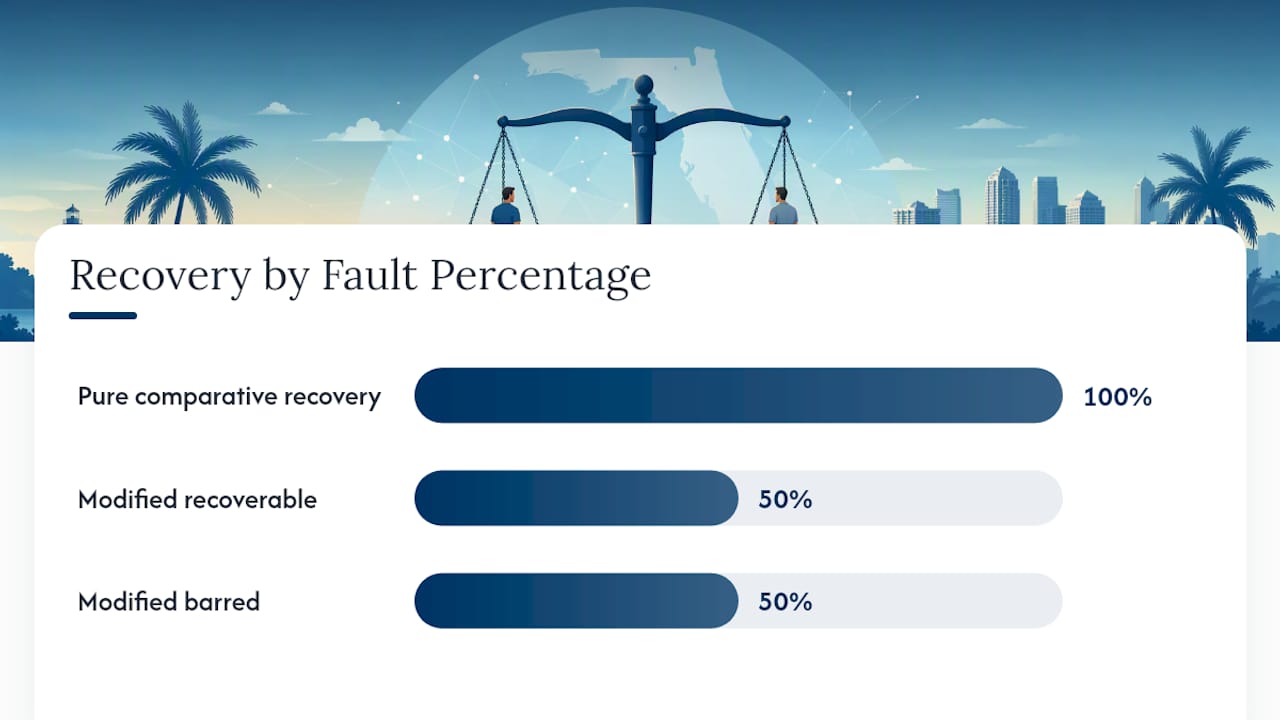
The distinction between “pure” and “modified” sounds academic until you’re the one filing a claim. Under the old rule, fault percentage only ever shrank your check. Under the current rule, it can eliminate your recovery entirely if your fault exceeds the statute’s threshold.
How Does the 50% Rule Change Your Payout?
The math is proportional, not punitive. Your damages shrink by exactly your percentage of fault, and not one point more.
Here’s how a straightforward case breaks down:
- A jury or judge calculates total damages, say $100,000 in medical bills, lost wages, and pain and suffering.
- The trier of fact assigns a fault percentage to the plaintiff, for example 20%.
- The award is reduced by that percentage: $100,000 × (1 − 0.20) = $80,000.
- If the plaintiff’s fault had come in at 55% instead of 20%, the entire claim would be barred under the statute, and the recoverable amount drops to zero.
There’s no sliding scale softening the cliff. F.S. 768.81 draws the line at exactly 50%, and courts apply it without discretion once the percentage is set.
This is why fault allocation isn’t a side issue in Florida litigation anymore. It’s the central fight in nearly every contested case.
Which Claims Fall Outside the 50% Bar?
Not every injury case runs through this framework. The statute carves out specific categories, and knowing which bucket your claim falls into matters before you file anything.
Claims excluded from the modified comparative negligence bar include:
- Personal injury and wrongful death claims arising from medical negligence under chapter 766, which keep their own separate fault rules.
- Certain statutory pollution and environmental claims carrying their own liability schemes.
- Intentional torts, where the wrongdoer’s conduct was deliberate rather than negligent.
Claims that do fall under the modified rule cover most of what typically lands in a Florida courtroom: standard vehicle collision negligence, premises liability, products liability, and general professional malpractice outside the medical field. Teaching hospitals in medical malpractice cases receive special statutory treatment as well, reflecting the legislature’s effort to keep healthcare litigation on a distinct track from the broader tort reform.
Misclassifying your claim at intake, treating a medical negligence case like an ordinary negligence case, can lead to filing under the wrong legal theory entirely. That’s a mistake worth catching early, not after a motion to dismiss.
Who Decides How Fault Gets Divided?
The trier of fact, whether that’s a jury at trial or a judge in a bench proceeding, apportions fault among every person who contributed to the harm, not just the parties actually named in the lawsuit. That includes nonparties a defendant claims share the blame, provided the defendant properly pleads and proves that nonparty fault at trial, as required under F.S. 768.81.
This matters more than it sounds. Defendants routinely try to shift blame onto an empty chair, another driver, a subcontractor, a property manager, hoping to dilute their own share and, ideally for them, push the plaintiff’s percentage higher.
- Every additional at-fault party identified and proven can lower the percentage assigned to any single defendant.
- Failing to name a responsible party early can leave a gap defendants exploit at trial.
- Settlement leverage often hinges on how airtight your fault allocation looks before a case ever reaches a jury.
Pro Tip: If you’re negotiating with an insurance adjuster before an attorney gets involved, assume the adjuster is already building a fault argument against you. Document who else was involved in causing your injury before that conversation happens, not after.
What Should You Do Right Now to Protect Your Claim?
Evidence preservation isn’t a formality anymore.
- Get medical treatment documented immediately, even for injuries that feel minor at first.
- Photograph the scene, vehicles, hazards, or conditions before anything gets moved, repaired, or cleaned up.
- Collect names and contact information for every witness on scene, not just the ones who volunteer.
- Request preservation of surveillance footage and electronic data (vehicle event data recorders, dashcams, phone GPS logs) before it’s overwritten or deleted.
- Avoid giving a recorded statement to any insurer until you understand how your own conduct might be characterized.
The Stetson Law Review’s analysis of the 2023 reform notes that this shift has moved negotiating leverage toward defendants, since they now have more incentive to fight over fault percentage rather than settle early.
Pro Tip: Accident reconstruction and contemporaneous witness statements collected in the first days after an incident tend to carry far more weight than anything gathered months later, once memories fade and physical evidence disappears.

How Does Trial Counsel Approach a Comparative Fault Case?
Trial-tested strategy under this rule starts before a complaint is even filed. That means investigating the full chain of responsibility immediately, identifying every party who may share fault, and gathering evidence while it’s still fresh, not waiting until an insurer forces the issue.
A Board Certified Civil Trial Lawyer prepares for apportionment disputes from day one, anticipating how a defense team will try to shift blame and building the evidentiary record to counter it before trial. That preparation preserves settlement leverage, because insurers negotiate differently when they know a case is trial ready.
At a consultation, bring medical records, the police or incident report, photographs, and contact information for any witnesses. Counsel can then assess your comparative-fault exposure honestly, before a fault percentage gets locked in against you.
Why the 50% Bar Deserves More Attention Than It Gets
That’s backwards. The percentage line is the whole story now, and treating it as secondary is the biggest mistake I see in how this reform gets discussed.
Conventional advice tells injured people to “gather evidence” and “talk to a lawyer,” which is true but empty. What actually matters is the order of operations. Evidence collected in week one, before memories drift and footage gets overwritten, is what decides fault percentages. Evidence collected in month three is what loses cases.
The other overlooked piece is nonparty fault. Readers focus on their own conduct, when defendants are just as likely to spend their energy trying to invent blame elsewhere. If you’re not actively identifying every responsible party early, you’re letting the defense write that narrative alone.
Prioritize speed over completeness in the first week. A partial record collected fast beats a perfect one collected late.
— Jorge
How Calillaw Helps You Navigate the 50% Bar
Some Florida accident victims need trial-tested strategy from the first phone call, not just paperwork filed after the damage is already done. When fault allocation can decide whether you recover anything at all, having a Board Certified Civil Trial Lawyer evaluate your exposure early, before an insurer locks in a fault narrative against you, is the practical difference between a fair settlement and a barred claim.
If your case involves a serious injury, multiple potentially responsible parties, or a defendant already pointing fingers elsewhere, hiring counsel sooner rather than later protects your leverage. Bring your medical records, the police report, photographs from the scene, and witness contact information to your consultation. Experienced trial attorneys can evaluate your comparative-fault risk directly and provide an assessment of where your case stands. Start by reviewing what qualifies as a personal injury claim and take the next step toward a consultation before evidence disappears.
This article is general information, not a substitute for advice from a qualified lawyer. Consult a qualified legal professional about your own circumstances before acting on anything here.
Sources
- Chapter 768 Section 81 – 2024 Florida Statutes – The Florida Senate
- Tilting the Scales: Florida’s Shift to Modified Comparative Negligence — Stetson Law Review
- F.S. 768.81 text — Online Sunshine (Florida Legislature)
FAQ
What is the recovery threshold under Florida’s modified comparative negligence rule?
768.81.
Does the 50% bar apply to medical malpractice cases?
No. Personal injury and wrongful death claims arising from medical negligence under chapter 766 are excluded from the modified comparative negligence bar established by House Bill 837.
How is a fault percentage decided in a Florida negligence case?
A jury, or a judge in a bench trial, apportions fault among every person shown to have contributed to the injury, including nonparties a defendant properly pleads and proves at trial.
Did Florida always use modified comparative negligence?
No.
Should I hire a lawyer before talking to an insurance adjuster?
Getting legal guidance before any recorded statement is wise, since adjusters often build a fault argument against you early, and firms like Calil Law Trial Attorneys can evaluate that risk before you say something that gets used against your claim.


