 Skip to Content
Nursing Home Arbitration in Florida: Your Rights
A nursing home arbitration agreement is a contract clause that sends any future injury or neglect claim to a private arbitrator instead of a judge and jury. In Florida, signing one does not automatically close the courthouse door. Federal rules say a facility cannot make you sign it to get care. Florida courts refuse to enforce these clauses when the wrong person signed, when the resident lacked capacity, or when the clause strips away the remedies Florida law gives residents. At Calil Law, we review these agreements for families whose loved one was hurt in a facility, because the answer often decides whether a jury ever hears the case.
TL;DR
- Federal rules bar a nursing home from requiring an arbitration agreement as a condition of admission or continued care, and you have 30 calendar days to rescind it.
- Who signed, and in what capacity, matters. A family member who signed only as “responsible party” has often not bound the resident.
- A resident who could not understand the agreement when signing it may not be held to it.
- Clauses that cap damages or waive punitive damages have been struck down by the Florida Supreme Court.
- A court, not the arbitrator, usually decides these challenges first, so act before the case is sent away.
Table of Contents
- What a nursing home arbitration agreement actually does
- Can a facility make you sign it?
- Who is allowed to sign for the resident?
- Capacity: what if the resident could not understand the agreement?
- Clauses that take away Florida remedies
- What federal law limits
- Arbitration versus a Florida court case
- What to do if your loved one was hurt
- Why a trial lawyer matters here
- Talk to Calil Law about your case
- FAQ
- Sources
What a nursing home arbitration agreement actually does
Most admission packets are long. Buried among consent forms, billing terms and facility rules, there may be a clause stating that disputes with the facility will be resolved by binding arbitration. Binding means the arbitrator’s decision is final, and appeal rights are very narrow. It also usually means no jury.
The Florida Supreme Court described the stakes in cases where the clause also limited what a resident could recover. Those limits matter because Florida gives nursing home residents statutory remedies for negligence and for violations of residents’ rights, set out in section 400.023 of the Florida Statutes. An arbitration clause that shrinks those remedies can be challenged.
If your loved one was hurt, you do not need to guess whether the paperwork blocks you. You need to know what was signed, by whom, when, and under what circumstances.
Can a facility make you sign it?
No. Under the federal rule that took effect in 2019, a long-term care facility must not require a resident or representative to sign an arbitration agreement as a condition of admission or of continuing to receive care, and the agreement must say so explicitly.
The same Federal Register rule adds several requirements:
- The agreement must be explained to the resident and representative in a form and language they understand, with their acknowledgment.
- The resident can rescind it within 30 calendar days of signing.
- It cannot discourage anyone from contacting government officials or regulators.
- The facility must keep a copy, along with the final decision in any dispute, for five years after the dispute is resolved.
CMS explained that the rule is meant to spare residents a choice between needed skilled nursing care and signing, and that the 30-day window lets them get legal advice if they want it.
What this means for you: if the admission paperwork was presented as mandatory, or if no one told you that you could refuse or cancel, that fact belongs in your case file. Write down who handed you the packet, what was said, and how long you had to read it.
Who is allowed to sign for the resident?
This is where many Florida arbitration fights are won or lost. Families often sign admission papers in a hurry, in a hospital discharge, with a spouse or parent in distress. The label next to the signature can change everything.
“Responsible party” is not the same as attorney-in-fact
In Etheridge v. Palm Garden of Winter Haven, LLC (Fla. 2d DCA Nov. 18, 2022), a daughter held a broad durable power of attorney, which is a document that lets someone act for another person in financial and legal matters. But she signed the admission agreement only as the “responsible party.” The court held that this did not bind the resident to arbitration and reversed the order sending the case to arbitration.
Similarly, in Sovereign Healthcare of Tampa v. Estate of Yarawsky (Fla. 2d DCA 2014), a wife signed only as “responsible party,” and the court held that the resident was not bound as a third-party beneficiary because no one had signed on his behalf.
A health care surrogate cannot waive a jury trial
A health care surrogate or proxy is someone chosen to make medical decisions. Florida appellate courts have held that waiving a jury trial is not a medical decision. In Burleson-Castillo v. Brancato Health Services (Fla. 2d DCA Apr. 19, 2024), the court held an arbitration provision unenforceable where the signer acted as health care surrogate rather than as attorney-in-fact. The court in Moen v. Bradenton Council on Aging (Fla. 2d DCA 2017) reached the same result for a daughter who signed as health care proxy for a mother with no durable power of attorney.
When the resident chose the signer
The picture is not one-sided. In Fi Evergreen Woods, LLC v. Estate of Robinson (Fla. 5th DCA 2015), the resident had told the admissions director she wanted her husband to handle the paperwork. The court held she was bound by his signature under apparent agency, because the facility reasonably relied on her statement. That is why the facts around the signing matter as much as the signature line itself.
| Who signed, and as what | How Florida courts have treated it |
|---|---|
| Attorney-in-fact under a durable power of attorney | Can bind the resident if the document’s authority covers it |
| “Responsible party” only | Did not bind the resident in Etheridge and Yarawsky |
| Health care surrogate or proxy | Cannot waive a jury trial (Burleson-Castillo, Moen) |
| Spouse the resident chose to handle the papers | Bound the resident in Fi Evergreen Woods on its facts |
These are outcomes of specific cases, not guarantees. Your agreement, your signature block and your facts will decide your result.
Capacity: what if the resident could not understand the agreement?
A contract requires a person who can understand what they are agreeing to. Residents with dementia are often admitted at exactly the moment they are least able to read a dense legal clause.
In Dolphin Pointe Health Care, LLC v. Moravia (Fla. 5th DCA May 11, 2026), the court affirmed denial of a motion to compel arbitration. The trial court had found, on competent substantial evidence, that the resident, who had a dementia diagnosis, could not comprehend the nature and effect of the agreement when he signed it. The person challenging the agreement must prove incapacity by a preponderance of the evidence, meaning it is more likely than not.
Evidence that helps includes medical records from the weeks around admission, physician and nursing notes about orientation and memory, and the facility’s own assessments. If you are building this proof, our guide to medical records in an injury claim explains what to request and why it matters.
Clauses that take away Florida remedies
Even a validly signed agreement can be unenforceable if its terms violate public policy. In Shotts v. OP Winter Haven, Inc. (Fla. 2011), the Florida Supreme Court held that provisions adopting arbitration rules and barring punitive damages undermined the statutory remedies residents have, and that the offending provision could not be severed despite a severability clause.
In Gessa v. Manor Care of Florida, Inc. (Fla. 2011), the court held that a clause capping noneconomic damages at $250,000 and waiving punitive damages violated public policy. In both cases, the court, not the arbitrator, decided that question.
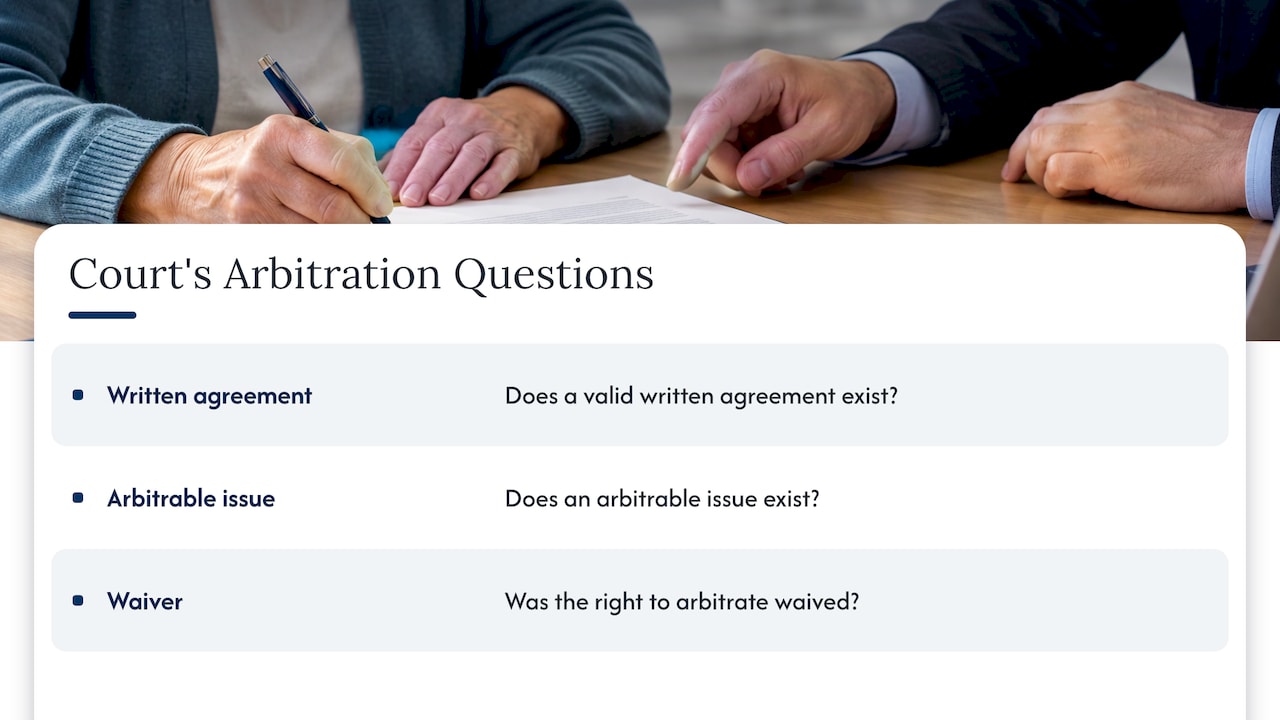
That last point is practical. Shotts also set out the three questions a Florida court asks when someone asks it to compel arbitration: whether a valid written agreement exists, whether an arbitrable issue exists, and whether the right to arbitrate was waived. Those are the doors your lawyer pushes on first.
What federal law limits
It would be unfair to promise that Florida can simply void every clause. It cannot. The U.S. Supreme Court held in Marmet Health Care Center, Inc. v. Brown (2012) that the Federal Arbitration Act displaces a state rule that categorically bars arbitration of nursing home injury and wrongful-death claims. The Court left ordinary contract defenses, such as lack of capacity or lack of authority to sign, available. Those are the defenses described above, and they are why the details of your signing matter.
Another 2025 ruling shows how courts keep reading these clauses broadly. In a March 2025 opinion, the Second District held that a facility affiliate that never signed could still compel arbitration under the agreement’s broad language and equitable estoppel. So a clause can reach more parties than the nursing home named on the first page.
Arbitration versus a Florida court case
The main differences are practical, and the exact rules depend on the agreement. Read yours for these points:
- Decision-maker. A jury of local citizens in court. A single arbitrator, or a small panel, in arbitration, often chosen under rules the agreement names.
- Appeal. A court judgment can be appealed for legal error. An arbitration award can be challenged only on narrow grounds.
- Remedies. Florida law sets the damages available in court. Some agreements try to limit them, which is what Shotts and Gessa addressed.
- Privacy. Arbitration is private. A public trial can reveal a pattern of neglect.
- Costs. Many agreements set out who pays arbitrator and administrative fees. Find that paragraph before you decide anything.
If the clause names specific rules or fee splits, bring the full agreement to a lawyer. Those details are rarely visible in a summary.
What to do if your loved one was hurt
- Find every document that was signed. Request the complete admission file in writing, including any arbitration agreement and the signature page.
- Note dates. If you are inside the 30-day rescission window, the federal rule gives you a right to cancel the arbitration agreement.
- Identify the signer and the capacity. Was it the resident, an attorney-in-fact, a surrogate, or a family member as “responsible party”?
- Gather medical records that show the resident’s cognitive condition at admission.
- Document the harm. Photographs, incident reports, hospital records and names of staff. Our pieces on signs of nursing home abuse and on the difference between abuse and neglect help you recognize what you are seeing. Abuse can also be criminal; one example of how a state defines it is an elder abuse criminal statute.
- Do not sign anything new from the facility or its insurer without advice.
- Call a trial lawyer early. The arbitration question is usually decided at the very start.
If you believe a resident is in immediate danger, call 911 first.
Why a trial lawyer matters here
A fight over an arbitration clause is a fight over where the case will be heard. The facility’s lawyers usually file a motion to compel arbitration early, and the response needs evidence: who signed, what the resident could understand, what was said at admission. It also needs a lawyer prepared to take the case in front of a jury if the court agrees the clause does not hold.
That is the work we do. Our firm is led by a Board Certified Civil Trial Lawyer who is also a Supreme Court Certified Mediator, with more than 18 years of Florida experience. You can read more about the signs and your options in our Florida nursing home abuse guide.
A word from our firm
Families often tell us they signed the packet because they were exhausted and frightened, and they assumed the paperwork was standard. It was not their fault. A signature made in a hospital hallway is not always the end of the story, and your loved one’s life has value.
We look at the arbitration agreement the same way we look at any contested document: who signed it, what authority they had, what the resident could understand, and whether its terms respect Florida law. Then we prepare the case as if a jury will hear it, because that is how we approach every serious matter, and because preparation is what makes a strong position in front of an arbitrator too.
You will have direct access to experienced attorneys who personally review your case. That is how we build trust, and it is how we protect families when the outcome matters.
Jorge
Talk to Calil Law about your case
We represent individuals and families in nursing home abuse, wrongful death and other serious injury cases across Florida, on a contingency fee basis, so there are no upfront fees: we are paid only if you receive a settlement or award. Bring us the admission packet, and we will tell you what it means for your claim.

Learn more about how we handle personal injury and wrongful death claims, or contact Calil Law to schedule a consultation.
FAQ
Can a Florida nursing home refuse admission if I will not sign the arbitration agreement?
Not under the federal rule. A facility cannot require signing as a condition of admission or continued care, and the agreement must state that. If you were told otherwise, keep a note of who said it and when, and share it with your lawyer.
Does my signature as “responsible party” mean I gave up my loved one’s right to sue?
Not necessarily. Florida appellate courts have held that signing only as responsible party did not bind the resident in cases like Etheridge and Yarawsky. The result depends on the wording of the agreement and any other authority you held, so have a lawyer read the signature page.
Can I still cancel an arbitration agreement my parent signed?
The federal rule allows rescission within 30 calendar days of signing. After that window, the agreement can still be challenged on grounds such as lack of capacity, lack of authority to sign, or terms that violate Florida public policy.
Who decides whether the arbitration clause is valid?
In Shotts and Gessa, the Florida Supreme Court held that the court, not the arbitrator, decides whether the clause violates public policy. Capacity and authority challenges are also typically raised in response to a motion to compel in court.
Sources
- Federal Register, Vol. 84, No. 138 (July 18, 2019): CMS arbitration rule
- CMS fact sheet on long-term care arbitration agreements
- Florida Statutes, section 400.023
- Etheridge v. Palm Garden of Winter Haven, No. 2D22-1125
- Sovereign Healthcare of Tampa v. Estate of Yarawsky
- Burleson-Castillo v. Brancato Health Services
- Moen v. Bradenton Council on Aging
- Fi Evergreen Woods v. Estate of Robinson
- Dolphin Pointe Health Care v. Moravia, No. 5D2024-1771
- Shotts v. OP Winter Haven, Inc.
- Gessa v. Manor Care of Florida, Inc.
- Marmet Health Care Center v. Brown
- Second District opinion No. 2D2024-0660 (Mar. 19, 2025)
- Elder abuse criminal statute (Penal Code § 368)


