 Skip to Content

Personal Injury Help: What to Do Right Now
If you need personal injury help right now, do three things first: get medical care, preserve every piece of evidence you can, and check your state’s filing deadline before it passes. Those three steps protect your rights before anything else.
Immediate actions to take:
- Seek emergency or urgent care — even if you feel fine. Delayed symptoms are common after car crashes and falls, and a gap in treatment is one of the first things insurers use against you.
- Document the scene — photograph injuries, property damage, road conditions, signage, and any hazard that caused the incident.
- Get witness names and contact information while people are still present.
- Notify your employer if the injury happened at work, and report the incident to the property owner or manager if it occurred on someone else’s premises.
- Notify your insurer of the incident, but keep the report factual and brief.
- Keep every receipt related to the injury: prescriptions, co-pays, transportation to appointments, and out-of-pocket expenses.
- Check your state’s statute of limitations. California Courts notes that you generally have up to two years from the date of injury to file a lawsuit in California [California Courts], with shorter deadlines for claims against government entities. Your state may differ.
Pro Tip: Do not give a recorded statement to the other party’s insurer before speaking with an attorney. Adjusters are trained to ask questions that minimize your claim. A brief, factual incident report to your own insurer is fine — a detailed recorded interview with the opposing side is not.
Key Takeaways
The single most important thing you can do after an injury is act fast: get medical care, preserve evidence, and verify your filing deadline before any of those rights expire.
| Point | Details |
|---|---|
| Act within hours, not days | Seek medical care immediately and document the scene before evidence disappears or memories fade. |
| Know your deadline | In California, you usually have two years from the date of injury to file a personal injury lawsuit, but claims against government defendants often require notice within six months or less [California Courts]. Your state may differ, so check your local rules as other states apply different limitations periods. |
| Medical records drive value | Itemized bills, treatment timelines, and prescription records are the primary tools insurers and courts use to calculate damages. |
| Social media can hurt your claim | Avoid posting about your injury, treatment, or activities until the claim fully resolves. |
| Calil Law works on contingency | No upfront fees; the firm is paid only from your recovery — contact Calil Law for a free consultation on serious or complex injury matters. |
Useful resources to check next
- California Courts self-help center — free court forms, filing instructions, and plain-language guidance on personal injury lawsuits in California.
- Usa — find low-cost or free civil legal help, including personal injury matters, for income-eligible individuals across the United States.
- Calil Law personal injury practice page — overview of the firm’s services, practice areas, and contingency fee model.
- What is a personal injury claim? (Calil Law) — plain-language procedural overview for claimants preparing to start a claim.
- How to document injuries after an accident (Calil Law) — step-by-step evidence collection guide.
- Why injury claims fail (Calil Law) — seven common mistakes to avoid during a claim.
A note on jurisdiction: Deadlines, damage caps, small claims limits, and procedural rules vary significantly by state. Always verify the specific rules for your state and county before filing. When in doubt, consult a licensed attorney in your jurisdiction.
This article provides general legal information, not legal advice. Laws vary by state and individual circumstances differ. Consult a qualified attorney to evaluate your specific situation and confirm current rules in your jurisdiction.
This article is general information, not a substitute for advice from a qualified lawyer. Consult a qualified legal professional about your own circumstances before acting on anything here.
Table of Contents
- What type of personal injury case do you have?
- What you need to know before you file a claim
- What forms and filing options are available to you?
- How to protect your privacy and confidentiality during a claim
- When should you talk to a personal injury attorney?
- Your evidence checklist and week-by-week documentation plan
- What Calil Law’s approach means for your case
- Calil Law is ready to help you move forward
- Sources
What type of personal injury case do you have?
Understanding your case category shapes everything: who you sue, what evidence you need, and whether special procedural rules apply. Personal injury is a broad legal category covering physical, psychological, and financial harm caused by another party’s negligence, recklessness, or intentional conduct.
Common personal injury claim types:
- Motor vehicle accidents (cars, trucks, motorcycles, Uber/Lyft, rideshare) — typically handled through the at-fault driver’s liability insurance first.
- Slip and fall / premises liability — property owners have a legal duty to maintain reasonably safe conditions. Businesses, landlords, and municipalities can all be defendants.
- Product liability — a defective product injures you; the manufacturer, distributor, or retailer may be liable under strict liability, not just negligence.
- Workplace injuries — most on-the-job injuries go through workers’ compensation first, but a separate civil claim may exist if a third party (not your employer) caused the harm.
- Assault and intentional torts — a deliberate act that injures you; criminal charges and civil liability can run in parallel.
- Wrongful death — when a fatal injury gives surviving family members the right to sue for damages.
- Nursing home abuse and catastrophic injury — these often involve multiple defendants, institutional defendants, and expert-heavy litigation.
Most routine motor vehicle and slip-and-fall claims move through insurance negotiation before any lawsuit is filed. Product liability, medical malpractice, and cases with government defendants are structurally more complex and almost always benefit from attorney involvement from the start. Medical malpractice in particular operates under its own procedural rules in most states, including expert affidavit requirements and separate damage caps, so treat it as a distinct category.
Watch for these signals that your case is more complex than it first appears: catastrophic or permanent injury, multiple defendants, a government agency or public employee as a defendant, or an insurer that has already denied your claim. For cases involving premises liability or multi-defendant scenarios, Calil Law Trial Attorneys handles exactly these matters. If your income is limited, Usa connects low-income individuals with civil legal help, including personal injury matters.
What you need to know before you file a claim
Getting the legal scaffolding right before you file prevents case-ending mistakes. Here are the core areas to check.
Statute of limitations and filing deadlines
Every state sets a deadline to file a personal injury lawsuit, called the statute of limitations. Miss it, and you lose your right to sue regardless of how strong your case is. California Courts confirms the standard window in California is 2 years from the date of injury, but claims against government entities often require a formal administrative claim within 6 months. Other states range from 1 to 6 years. Verify your specific state’s deadline immediately, and if a government entity is involved, treat the notice deadline as your real deadline.
Who to sue and where to file
Personal injury defendants can be individuals, businesses, insurers, or government agencies. In multi-defendant cases, you may sue all responsible parties in a single action. Venue (the court where you file) generally follows where the injury occurred or where the defendant resides or does business. For claims against police or government entities, see Calil Law’s guidance on personal injury claims against police, which covers the specific notice and procedural requirements that apply.
Insurance coverage to check
Before you negotiate or file, map every applicable policy:
- Your own auto policy — personal injury protection (PIP), medical payments (MedPay), and uninsured/underinsured motorist (UM/UIM) coverage may pay regardless of fault.
- The other party’s liability policy — this is the primary target in most vehicle and premises cases.
- Homeowners or commercial general liability — relevant for slip-and-fall claims on residential or business property.
- Umbrella policies — high-value claims may reach an umbrella layer above the primary policy.
UM/UIM coverage is especially important when the at-fault driver has no insurance or insufficient limits. Review your own declarations page before assuming you are limited to the other side’s policy.
Negligence: the basic legal theory
Most personal injury claims rest on negligence, which requires four elements: (1) the defendant owed you a duty of care, (2) they breached that duty, (3) the breach caused your injury, and (4) you suffered actual damages. Product liability claims can also proceed under strict liability, meaning you do not need to prove the manufacturer was careless — only that the product was defective and caused harm. Intentional torts (assault, battery) require proof of deliberate conduct rather than carelessness.
Damages and how claims are valued
| Damage Type | What It Covers | How It’s Calculated |
|---|---|---|
| Economic | Medical bills, future care costs, lost wages, lost earning capacity | Documented bills, pay stubs, expert projections |
| Non-economic | Pain and suffering, emotional distress, loss of enjoyment of life | Multiplier of economic damages or per-diem method |
| Punitive | Punishment for egregious or intentional conduct | Court discretion; rare in standard negligence cases |
Medical records and expert reports are the primary tools for valuing a claim. Calil Law’s medical records guide explains how treatment timelines and itemized billing directly affect what insurers and courts will pay. Citizens Advice similarly emphasizes that medical evidence sits at the center of any claim valuation — a principle that holds in U.S. courts as well, though you should always verify local rules.
Evidence essentials before you file
- Medical records and itemized bills from every provider
- Photographs and videos of the scene, injuries, and property damage
- Police or incident report
- Witness names, contact information, and written statements
- Employment records and pay stubs to document lost wages
- Repair estimates for damaged property
- All correspondence with insurers
Pro Tip: Organize your evidence in a dedicated digital folder from day one. Name files by date and category (e.g., “2026-03-15_ER_records,” “2026-03-15_scene_photos”). Courts and insurers review hundreds of claims; a well-organized file signals a serious claimant and speeds up the review process.
Statistic callout: Citizens Advice notes that strict time limits apply to personal injury claims and that medical evidence is central to valuing a claim — two facts that hold equally true in U.S. litigation.
What forms and filing options are available to you?
Knowing which path to take — demand letter, small claims court, or full civil litigation — saves time and avoids costly procedural errors.
Demand letters
A demand letter is usually the first formal step. Send it before filing suit to give the other party or their insurer a chance to settle. A strong demand letter includes:
- A factual summary of how the injury occurred and who is responsible
- A description of your injuries and treatment
- An itemized list of economic damages (bills, lost wages, out-of-pocket costs)
- A non-economic damages request with a brief explanation
- A specific dollar demand and a response deadline (typically 30 days)
- A statement that you will file suit if the demand is not met
Send demand letters by certified mail with return receipt requested. Keep the tracking confirmation and the signed return card as proof of delivery.
Small claims vs. civil court vs. administrative claims
| Route | When to Use | Key Limit to Check |
|---|---|---|
| Small claims court | Minor injuries, clear liability, low dollar amount | Caps vary by state |
| Civil court (state) | Significant injuries, disputed liability, damages above small claims cap | Standard statute of limitations applies |
| Administrative claim | Government defendant (city, county, state agency) | Notice deadline often 6 months or less |
For minor road traffic claims, some states have developed streamlined digital portals, as noted in the Legal Ombudsman’s personal injury factsheet — though that resource reflects UK practice, and U.S. readers should check their state court’s self-help portal for equivalent options.
Where to find court forms
The California Courts self-help center provides free, fillable court forms and plain-language instructions for filing a civil lawsuit. Most state court websites offer similar resources. Search “[your state] courts self-help” to find the official portal for your jurisdiction.
Pro Tip: Before you file in civil court, call the clerk’s office and confirm the current filing fee and whether your county requires a case management statement at the time of filing. Requirements change, and a rejected filing resets your timeline.
How to protect your privacy and confidentiality during a claim
What you say, post, or share during a claim can reduce its value or expose information you intended to keep private.
Settlement confidentiality
Most personal injury settlements include a confidentiality clause. Typically, these provisions prohibit you from disclosing the settlement amount, the terms, or sometimes the existence of the settlement itself. Before signing, read the clause carefully and note:
- Whether it applies to family members or only to you
- Whether there are exceptions for tax reporting or court-ordered disclosure
- Whether it restricts you from discussing the underlying facts of the incident (not just the settlement amount)
A confidentiality clause that is too broad can prevent you from warning others about a dangerous condition. Negotiate the scope before you sign, not after.
Social media during an active claim
Insurers and defense attorneys routinely search social media. A single photo of you at a social event, a location tag, or a comment about feeling “fine” can contradict your claimed injuries and reduce your recovery.
- Avoid posting about the incident, your injuries, or your treatment.
- Do not accept new friend or connection requests from people you do not know personally during the claim period.
- Review your privacy settings, but understand that courts can order disclosure of private posts if they are deemed relevant.
- Do not delete existing posts once litigation begins — deletion can constitute spoliation of evidence.
Pro Tip: The safest approach is to go quiet on social media from the date of injury until your claim resolves. Tell close family members the same. Defense teams have used a spouse’s or sibling’s public post to undermine a plaintiff’s case.
When should you talk to a personal injury attorney?
Some claims are straightforward enough to handle with a demand letter and organized documentation. Many are not. Call an attorney immediately if any of the following apply:
- Your medical bills are significant or your treatment is ongoing
- You have a permanent impairment, disability, or disfigurement
- Liability is disputed or unclear
- Multiple parties may share responsibility
- A government entity or employee is involved
- Your insurer has denied or significantly underpaid your claim
- You received a settlement offer within days of the injury (a fast offer usually means the insurer knows the claim is worth more)
What a personal injury attorney actually does
An attorney investigates the incident, preserves time-sensitive evidence (surveillance footage, black-box data, maintenance records), coordinates with medical experts to document your injuries, and negotiates with insurers from a position of legal authority. When negotiation fails, they file suit and take the case to trial. For motor vehicle cases specifically, Calil Law’s guide on what to do after a car accident walks through the attorney’s role at each stage.
The contingency fee model
Most personal injury attorneys work on contingency: you pay no upfront fees, and the attorney collects a percentage of your recovery only if you win. If there is no recovery, you owe no attorney fee. The percentage varies by firm and case complexity, typically ranging from 33% to 40% of the gross recovery. Ask any prospective attorney to explain their fee structure, what costs (filing fees, expert fees) are deducted and when, and whether the percentage changes if the case goes to trial.
Questions to ask at your first consultation
- What is your assessment of liability and damages in my case?
- What is your fee percentage, and how are litigation costs handled?
- What is a realistic timeline from filing to resolution?
- Who will be my primary contact, and how often will I receive updates?
Pro Tip: Bring a written timeline of events, your evidence folder, and any correspondence from insurers to your first meeting. Attorneys can give you a far more accurate case assessment when they can review actual documents rather than a verbal summary.
Statistic callout: The Legal Ombudsman’s factsheet notes that conditional fee agreements (the UK equivalent of contingency fees) are among the most common funding tools for personal injury claimants — a model that removes the financial barrier to legal representation on both sides of the Atlantic.
Your evidence checklist and week-by-week documentation plan
Strong evidence is the foundation of every successful claim. The quality of your documentation often determines whether you settle for full value or accept a fraction of what you deserve.
Immediate (day of injury)
- Photograph injuries, the scene, any hazard, and all vehicles or property involved.
- Get the names, phone numbers, and addresses of all witnesses.
- Request a copy of the police or incident report, or note the report number.
- Seek medical care and keep all discharge paperwork and instructions.
- Write a personal narrative of exactly what happened while memory is fresh.
Days 2–30
- Follow all medical treatment recommendations without gaps — gaps in care are used to argue your injuries were not serious.
- Request itemized bills from every provider as they arrive.
- Begin a daily pain and symptom journal: note pain levels, limitations on daily activities, and how the injury affects your work and personal life.
- Obtain your employer’s written confirmation of missed work days and lost wages.
- Collect repair estimates for any damaged property.
- Request your full medical records using a signed HIPAA release form. Calil Law’s guide on medical records explains how to request records and why treatment timelines matter to insurers and courts.
Ongoing
- Keep every prescription receipt and pharmacy record. Medication history can serve as independent evidence of injury severity and treatment duration.
- Save all insurer correspondence, including denial letters and settlement offers.
- Update your symptom journal weekly.
- Store everything in a labeled digital folder with backup copies.
Evidence checklist:
- Medical records from every treating provider
- Itemized medical bills
- Police or incident report
- Photographs and videos (scene, injuries, property damage)
- Witness contact information and statements
- Pay stubs and employer letter confirming lost wages
- Repair estimates
- Prescription receipts and pharmacy records
- All insurer correspondence
- Personal symptom and impact journal
Pro Tip: If physical evidence exists — a defective product, damaged clothing, a broken helmet — do not repair or discard it. Photograph it immediately, place it in a sealed bag, and store it in a safe location. Label the bag with the date and a brief description. Chain of custody for physical objects matters in product liability and catastrophic injury cases, and an attorney will want to inspect the item before any expert examination.
Calil Law’s injury documentation guide provides additional practical steps for gathering and organizing the evidence insurers and courts rely on most.
What Calil Law’s approach means for your case
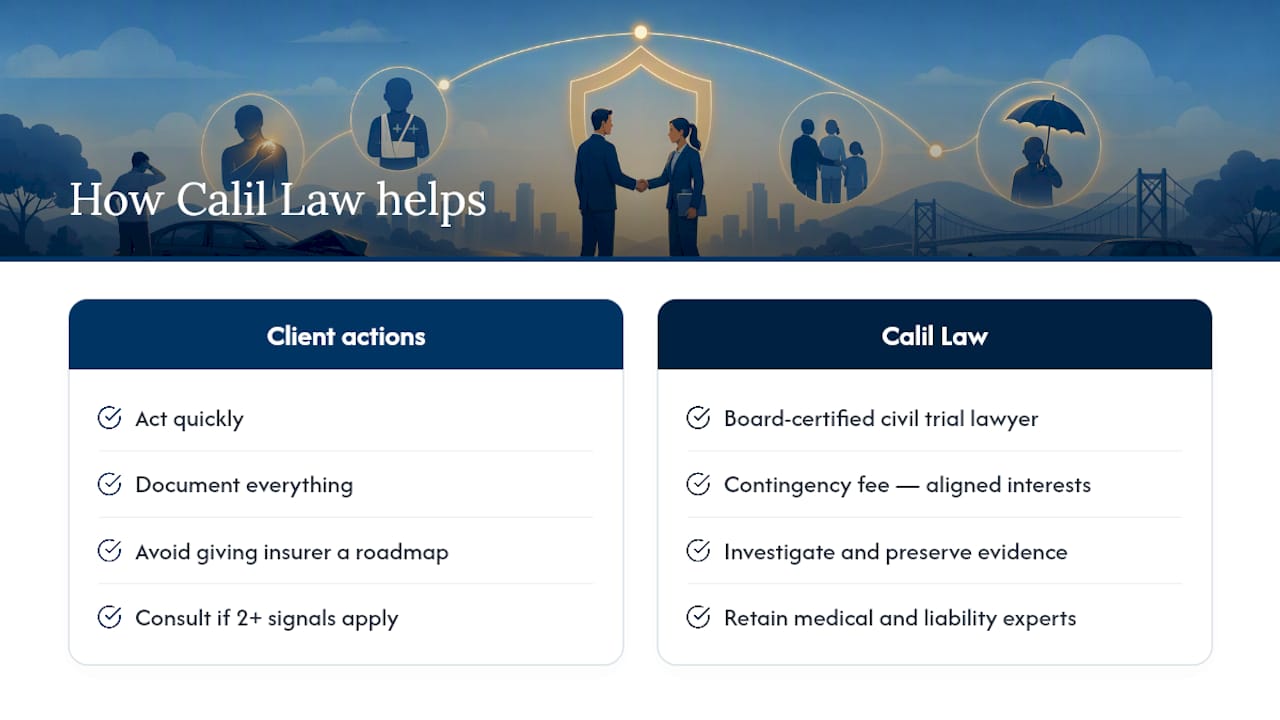
When I look at the personal injury cases that reach our firm, the ones that resolve well share a common thread: the client acted quickly, documented everything, and did not give the opposing insurer a roadmap to minimize the claim before we were involved.
Calil Law Trial Attorneys is led by a Board Certified Civil Trial Lawyer with decades of courtroom experience. That credential matters because board certification in civil trial law requires demonstrated trial experience, peer review, and a written examination — it is not a marketing label. The firm handles motor vehicle collisions, premises liability, catastrophic injury claims, nursing home abuse, product liability, wrongful death, and insurance disputes where insurers have denied or underpaid legitimate claims.
The contingency fee model means we are financially aligned with your outcome. We investigate, preserve evidence, retain medical and liability experts, and negotiate from a position of trial-tested authority. When insurers know a firm will take a case to verdict, settlement negotiations look different. If your case involves complex liability, multiple defendants, or a government entity, the procedural traps are real and the cost of a mistake is high. Compare your situation against the “when to call a lawyer” checklist above. If two or more of those signals apply to your case, a consultation costs you nothing and could protect everything.
Calil Law is ready to help you move forward
Serious injuries deserve serious representation. Calil Law Trial Attorneys offers free consultations for personal injury matters, with no upfront fees and no payment unless you recover. When you call or reach out, bring your incident timeline, any insurer correspondence, and whatever documentation you have gathered so far — even a partial file gives us a meaningful starting point.

The firm handles the full range of personal injury claims — from motor vehicle collisions and slip-and-fall cases to catastrophic injuries and denied insurance claims. For readers who want a plain-language overview of the process before calling, Calil Law’s explainer on what a personal injury claim involves covers your legal rights and what to expect at each stage.
No upfront fees. No payment unless you win. If your injuries are significant, your liability situation is complicated, or your insurer has already pushed back, this is the moment to get experienced counsel in your corner. Contact Calil Law today to schedule your free consultation.
Sources
- Personal injury cases | California Courts | Self Help Guide
- Find a lawyer for affordable legal aid | USAGov
- Claiming compensation for a personal injury – Citizens Advice
- Making a Personal Injury claim
- Personal injury – Wikipedia
Recommended
- How to Document Injuries After an Accident: A Practical Guide – Calil Law
- What Is a Personal Injury Claim? Your Legal Rights Explained – Calil Law
- 5 Things You Should Do After a Car Accident – Calil Law
- Why Using A Personal Injury Law Firm Is Critical Before Filing A Lawsuit In An Accident Case – Calil Law


