 Skip to Content

Property Owner Liability Examples: When Owners Are Responsible
Property owners can be held legally liable when they owed you a duty of care, breached that duty by allowing a dangerous condition to exist, and that breach directly caused your injury and damages. That four-part test, drawn from premises liability law, applies across a wide range of real-world situations.
Here are four scenarios that illustrate the point quickly:
- Supermarket spill with no warning sign. A grocery store employee mops an aisle and walks away without placing a wet-floor cone. A customer slips and fractures her wrist. The store knew about the hazard and failed to warn.
- Unfenced pool that attracts children. A homeowner installs a backyard pool without a fence or gate. A neighboring child wanders in and drowns. The attractive-nuisance doctrine can hold the owner responsible even for a trespassing child.
- Broken stair railing in an apartment common area. A tenant grabs a loose railing on a shared staircase, it gives way, and she falls two flights. The landlord controlled that stairwell and failed to repair a known defect.
- Inadequate security leading to assault. A hotel in a high-crime area removes its security guard to cut costs. A guest is assaulted in the parking garage. Prior incidents on the property can establish that the risk was foreseeable.
If any of these situations sound familiar, act now. Seek medical attention, photograph the scene, collect witness contact information, and speak with a premises liability attorney before evidence disappears or a filing deadline passes.
Pro Tip: Take photos and video of the exact hazard within hours of the incident. Conditions change fast: spills get cleaned, ice melts, and broken fixtures get repaired. Your documentation may be the only record of what actually existed.
Key Takeaways
Property owners are legally liable when they owed a duty of care, breached it by allowing a dangerous condition to persist, and that breach directly caused your injury and measurable damages.
| Point | Details |
|---|---|
| Four elements must be proven | Duty, breach, causation, and damages are all required; injury alone does not establish liability. |
| Notice is the central battleground | Actual or constructive notice of the hazard is what most claims turn on; preserve time-stamped evidence immediately. |
| Visitor status affects your rights | Invitees receive the highest protection; trespassers the least; children may be protected under the attractive-nuisance doctrine. |
| Common defenses to anticipate | Open-and-obvious, lack of notice, and comparative fault are the defenses insurers raise most often. |
| Act within your state’s deadline | Statutes of limitations vary by state; government defendants may require notice within 90 days of the incident. |
Table of Contents
- What premises liability means and the legal elements you must prove
- How your visitor status determines the duty an owner owes you
- Common property owner liability examples and the evidence that proves them
- How liability is actually proven in a premises liability claim
- Common defenses property owners and insurers use against your claim
- What damages you can recover and how claims are typically resolved
- How long a premises liability claim takes and what it costs you
- What to do immediately after a premises injury
- How a premises liability attorney protects your claim and your rights
- What most premises liability advice gets wrong
- Sources
What premises liability means and the legal elements you must prove
Premises liability is a negligence-based doctrine that holds the party in control of a property accountable when a hazardous condition on that property injures someone. Injury alone is not enough. You must prove four distinct elements.
- Duty. The owner or occupier owed you a legal obligation to maintain reasonably safe conditions. The level of duty depends on why you were on the property.
- Breach. The owner failed to meet that duty, either by creating the dangerous condition or by failing to fix or warn about one they knew or should have known existed.
- Causation. The breach directly caused your injury. A hazard that existed but played no role in your fall does not satisfy this element.
- Damages. You suffered actual, measurable harm: medical bills, lost income, pain, or other recognized losses.
Notice is the hinge point in most premises liability cases. Owners are rarely liable for hazards that appeared one second before you fell. Plaintiffs must show the owner had actual notice (they knew about the danger) or constructive notice (the condition existed long enough that a reasonable inspection would have caught it). Insurance adjusters focus on this element immediately, which is why evidence of how long a hazard existed matters so much.
How your visitor status determines the duty an owner owes you
The level of protection you receive under U.S. premises liability law has traditionally depended on why you were on the property. Most states use a three-category framework, though a growing number have moved to a single reasonable-care standard.
| Visitor type | Who qualifies | Duty owed | Example |
|---|---|---|---|
| Invitee | Customers, shoppers, restaurant guests, anyone invited for business or public purposes | Highest duty: inspect, discover, repair, and warn of hazards | Grocery store customer, hotel guest |
| Licensee | Social guests, friends, family visiting a home | Moderate duty: warn of known hidden dangers; no duty to inspect | Friend at a dinner party |
| Trespasser | Person on property without permission | Minimal duty: no intentional harm; no duty to warn of conditions | Adult who cuts through a fenced yard |
The attractive-nuisance doctrine carves out a critical exception for children. When a property contains a condition likely to attract children who cannot appreciate the danger, such as a swimming pool, a trampoline, or abandoned machinery, owners owe a heightened duty even to child trespassers. Courts weigh whether the risk of harm outweighed the burden of taking precautions like fencing.
- States that have abolished the categories. California, Florida, and several others now apply a single reasonable-care standard to all lawful visitors, making visitor classification less decisive but still relevant to the facts.
- Government property. Injuries on public land often require a formal notice of claim filed within a shorter window, sometimes as brief as 90 days, before a lawsuit is permitted.
- Landlord vs. tenant control. When a tenant occupies a space, the tenant typically bears liability for conditions inside the unit. The owner remains liable for common areas they control, such as hallways, parking lots, and stairwells, and for dangers they created or failed to disclose.
Common property owner liability examples and the evidence that proves them
These are the scenarios that most frequently give rise to provable premises liability claims. For each one, liability turns on duty, breach, and whether the owner had notice of the problem.
Slip and fall on a wet or slippery floor
A customer slips on a puddle in a retail store. Liability typically rests on how long the liquid was present. Surveillance footage showing the spill sitting unattended for 20 minutes is powerful constructive-notice evidence. Maintenance logs that show no inspection was conducted during that window reinforce the breach.
Snow and ice on walkways
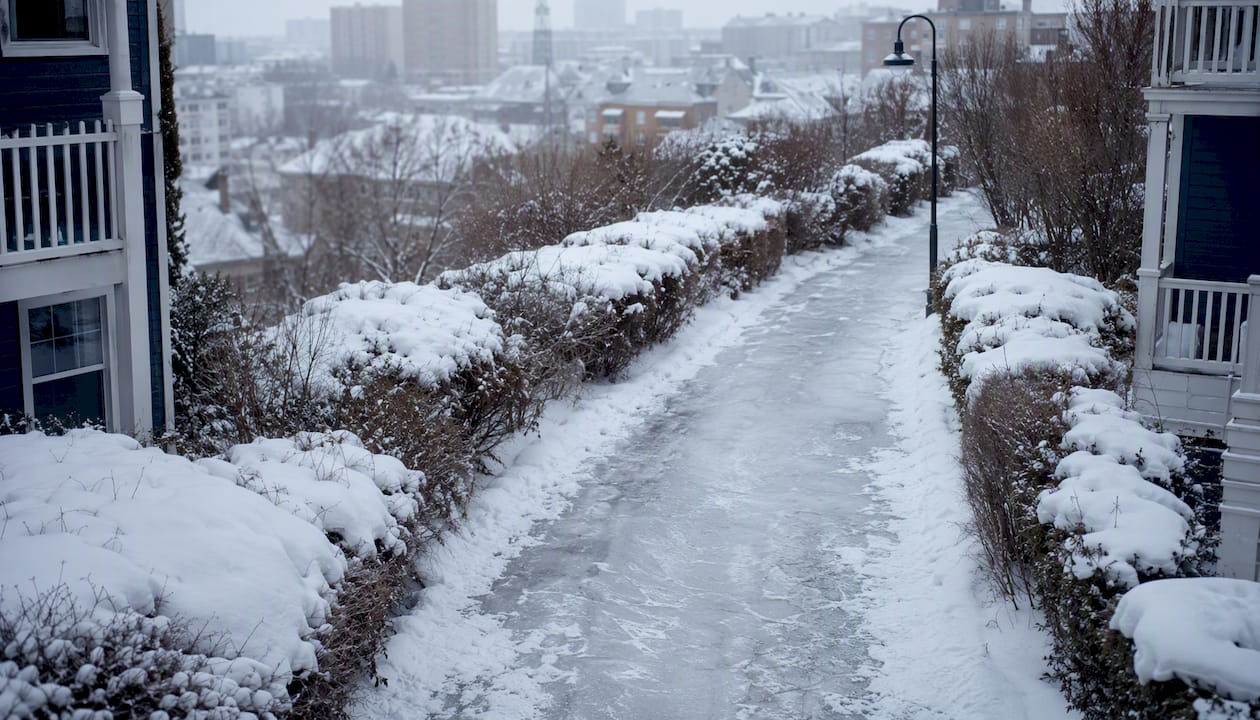
Property owners in states with winter weather have a duty to clear or treat walkways within a reasonable time after a storm ends. A tenant who slips on an icy apartment-complex sidewalk the morning after a storm may have a strong claim if the landlord’s maintenance records show no salting or sanding occurred. Landlords remain liable for common areas including exterior walkways they control.
Broken stairs and defective railings
A loose or missing handrail on a shared staircase is one of the clearest examples of owner negligence. Prior repair requests from tenants, building-code inspection reports, or photographs showing visible rust and deterioration all establish that the owner knew or should have known about the defect. For apartment-specific scenarios in Florida, slip and fall liability at apartment complexes follows the same control-based analysis.
Falling merchandise in retail stores
When improperly stacked shelving collapses and injures a shopper, the store’s own stacking procedures and employee training records become central evidence. Courts look at whether the store followed its own safety protocols and whether prior incidents of falling merchandise were reported.
Inadequate security leading to assault
A property owner in a high-crime area who fails to provide reasonable security measures, working lights, security cameras, controlled access, or guards, can be liable when a foreseeable criminal act injures a visitor. The key evidence is prior crime data for the area and the property, plus any internal communications showing management was aware of the risk.
Dog bites
Most states impose strict liability on dog owners for bites, regardless of whether the dog had bitten before. Florida follows this rule. The owner’s knowledge of the dog’s aggressive tendencies can strengthen a claim in states that require proof of prior dangerous behavior.
Pool and attractive nuisance incidents
An unfenced residential pool is the textbook attractive-nuisance scenario. Courts evaluate whether the owner knew children frequented the area, whether the cost of a fence was reasonable relative to the risk, and whether the child was too young to appreciate the danger. The attractive-nuisance exception extends to trampolines, abandoned vehicles, and open excavations.
Defective fixtures and electrical hazards
A landlord who ignores repeated complaints about faulty wiring, exposed electrical panels, or broken light fixtures in common areas faces liability when a tenant or visitor is injured. Building-code violations documented by a city inspector are particularly damaging evidence for the owner.
Elevator and escalator incidents
Elevator maintenance is typically governed by state and local codes requiring regular inspections. Maintenance logs, inspection certificates, and prior service calls are the first documents an attorney will request. A gap in the inspection record often establishes constructive notice of the mechanical defect.
Construction site hazards
Property owners who hire contractors retain some liability for conditions they control or hazards they created. Unmarked excavations, unsecured scaffolding near a public walkway, and missing barriers can all support a claim against the owner, the contractor, or both.
Pro Tip: In the Ninth Circuit case Petrey v. Princess Cruise Lines, the court held that a plaintiff can create a genuine factual dispute about notice even without prior similar incidents. The configuration of the hazard itself, combined with the owner’s inspection practices, was enough to survive summary judgment. The same principle applies on land: how a condition was arranged matters, not just whether anyone complained before.
How liability is actually proven in a premises liability claim
You must connect each of the four legal elements to concrete, preserved evidence. Here is what that looks like in practice.
The evidence checklist:
- Photographs and video of the exact hazard, taken as close to the incident as possible
- Surveillance footage from the property (request preservation immediately; many systems overwrite within 24–72 hours)
- The incident or accident report filed with the property owner or manager
- Medical records and bills documenting the injury and treatment
- Maintenance logs and work orders showing when the hazard was reported and whether it was addressed
- Prior complaints from other tenants or visitors about the same condition
- Witness names, phone numbers, and written statements collected at the scene
- Building code inspection records or city violation notices
- Expert reports from engineers, safety consultants, or medical professionals
Preservation steps that protect your claim:
- Send a written preservation demand to the property owner or their insurer within days of the incident, specifically requesting surveillance footage, maintenance records, and incident reports.
- Photograph your injuries at regular intervals as they evolve; bruising and swelling often worsen in the 48 hours after a fall.
- Keep every piece of clothing and footwear you wore at the time of the incident, unwashed, in a sealed bag. Defense attorneys sometimes argue that improper footwear contributed to a fall.
- Follow all medical treatment recommendations and keep a written log of symptoms, pain levels, and how the injury affects your daily life.
- Avoid posting about the incident or your injuries on social media. Defense investigators routinely monitor plaintiff accounts.
Pro Tip: Constructive notice is often proven through “time-in-place” evidence. If surveillance shows a spill appeared 30 minutes before your fall and no employee walked through the aisle during that window, the owner had constructive notice. Defense teams attack the time window aggressively, so your attorney needs that footage before it is overwritten.
Common defenses property owners and insurers use against your claim
Expect the property owner’s insurer to raise at least one of these arguments. Knowing them in advance helps you and your attorney build around them.
- Lack of notice. The owner argues they had no actual or constructive notice of the hazard. Counter-evidence includes surveillance footage, maintenance logs showing a recurring problem, and prior complaints from other visitors.
- Open and obvious. If a hazard would be apparent to any reasonable person, owners in many states argue they had no duty to warn. Courts scrutinize this defense closely, asking whether the danger was truly unavoidable or whether the owner should have remedied it regardless of its visibility. A wet floor in a dimly lit aisle is far less “obvious” than a construction barrier in broad daylight.
- Comparative negligence. Most states allow a jury to assign a percentage of fault to the plaintiff. If you were texting while walking and missed a clearly marked hazard, your recovery may be reduced by your share of fault. A handful of states still use contributory negligence, which can bar recovery entirely if you were even 1% at fault.
- Assumption of risk. If you voluntarily entered a known dangerous area, the owner may argue you accepted the risk. This defense is most common in recreational settings like gyms, sports facilities, and amusement parks.
- Trespasser status. Adults who enter without permission receive minimal protection. The owner’s main obligation is to refrain from intentional or willful harm.
- Statutory immunities. Some states grant limited immunity to landowners who open property for recreational use without charge, under recreational-use statutes. The scope of these immunities varies significantly by state.
State-law variation matters. Statutes of limitations for premises liability claims range from one year to six years depending on the state, with two years being common. Florida’s current statute of limitations for negligence claims is two years. Government defendants often require a pre-suit notice of claim filed within 90 to 180 days of the incident, a deadline that runs independently of the main filing deadline.
What damages you can recover and how claims are typically resolved
Victims of premises liability negligence can recover three categories of damages.
- Economic damages cover measurable financial losses: past and future medical bills, lost wages during recovery, reduced earning capacity if the injury is permanent, and out-of-pocket rehabilitation costs. Proof requires medical records, billing statements, pay stubs, and expert testimony on future care needs.
- Non-economic damages compensate for pain and suffering, emotional distress, loss of enjoyment of life, and loss of consortium. These are harder to quantify, and experienced counsel makes a significant difference in how insurers value them. For a deeper look at how these categories are calculated, compensatory damages in personal injury claims explains the framework in detail.
- Punitive damages are available in limited cases where the owner’s conduct was grossly negligent or intentional, such as a landlord who knowingly concealed a severe mold problem or a business that ignored repeated safety violations after prior injuries.
Most premises liability claims resolve through insurance settlements rather than jury trials. Insurers are motivated to minimize payouts, and their initial offers frequently undervalue non-economic damages. Attorneys experienced in trial litigation carry credibility in negotiations that unrepresented claimants do not. When an insurer knows a firm is prepared to try a case to verdict, settlement offers tend to reflect that reality.
How long a premises liability claim takes and what it costs you
Claims commonly take several months to a few years, depending on injury severity, the complexity of the liability dispute, and whether the case requires litigation.
- Immediate phase (days 1–30). Seek medical care, document the scene, send a preservation demand, and consult an attorney.
- Investigation phase (weeks 2–12). Your attorney gathers surveillance, maintenance records, medical records, and expert opinions on liability and damages.
- Demand and negotiation phase (months 3–9). Once medical treatment stabilizes, your attorney submits a demand package to the insurer. Negotiations typically follow.
- Litigation phase (months 6–36+). If negotiations fail, a lawsuit is filed. Discovery, depositions, and expert disclosures extend the timeline. Many cases settle during or after discovery once both sides see the full evidence.
Attorney fees and costs. Premises liability attorneys work on a contingency fee basis: you pay nothing upfront, and the attorney collects a percentage of the recovery only if you win. Litigation costs (filing fees, expert witnesses, deposition transcripts) are typically advanced by the firm and reimbursed from the recovery.
Statute-of-limitations warning: Missing the filing deadline ends your claim permanently, regardless of how strong the evidence is. Deadlines vary by state and by defendant type. If a government entity owns the property, a pre-suit notice of claim may be required within 90 to 180 days of the incident. Do not wait to consult an attorney.
What to do immediately after a premises injury
Your health comes first. After that, the steps you take in the first 24–72 hours can determine whether your claim succeeds or fails.
- Seek medical attention immediately, even if you feel the injury is minor. Adrenaline masks pain, and delayed treatment gives insurers grounds to argue the injury was not serious or was caused by something else.
- Photograph the hazard from multiple angles before leaving the scene. Capture the surrounding area, any warning signs (or their absence), and lighting conditions.
- Report the incident to the property manager, store manager, or owner and request a written copy of the incident report before you leave.
- Collect witness information. Get names and phone numbers from anyone who saw the incident or the condition that caused it.
- Preserve your clothing and footwear in a sealed bag, unwashed.
- Send a written request to the property owner asking them to preserve all surveillance footage, maintenance logs, and incident reports related to the date and location of your injury.
- Follow all medical advice and keep records of every appointment, prescription, and out-of-pocket expense.
What not to do:
- Do not give a recorded statement to the property owner’s insurer without speaking to an attorney first.
- Do not post photographs, updates, or comments about the incident or your recovery on social media.
- Do not accept an early settlement offer before the full extent of your injuries is known.
When to contact a lawyer: If your injuries required medical treatment beyond basic first aid, if liability is disputed, or if an insurer contacts you with a settlement offer, consult a premises liability attorney before responding. The earlier you involve counsel, the more evidence can be preserved.
How a premises liability attorney protects your claim and your rights
An experienced attorney does far more than file paperwork. From the moment you hire counsel, the legal work shifts to building a case that can withstand an insurer’s scrutiny and, if necessary, a jury’s judgment.
- Immediate evidence preservation. Attorneys send formal litigation hold letters to property owners and their insurers, legally obligating them to preserve surveillance footage, maintenance records, and communications. This step alone can prevent critical evidence from disappearing.
- Liability evaluation. Counsel reviews the facts against the applicable duty standard for your visitor category, identifies all potentially liable parties (owner, occupier, property management company, contractor), and assesses the strength of the notice argument.
- Medical causation review. Attorneys work with medical experts to connect your diagnosis directly to the incident, countering insurer arguments that your injuries were pre-existing or unrelated.
- Negotiation from strength. Insurers respond differently to attorneys who have tried cases to verdict. A firm with genuine trial experience can negotiate from a position that unrepresented claimants cannot replicate.
- Litigation when necessary. When an insurer refuses a fair offer, filing suit and pursuing discovery often produces the maintenance records and internal communications that prove the owner’s knowledge of the hazard.
Calillaw handles premises liability cases across Florida, including slip and falls, inadequate security claims, landlord negligence, and catastrophic injury matters. For a deeper look at how litigation strategy shapes outcomes in injury cases, commercial litigation strategy for injury plaintiffs walks through the approach.
What to bring to your initial consultation: the incident report, photographs of the scene and your injuries, all medical records and bills related to the injury, any correspondence from the property owner or their insurer, and the names and contact information of any witnesses.
Injured on someone else’s property? Your rights have a deadline.
If you were hurt because a property owner failed to maintain a safe condition, Calillaw is ready to evaluate your claim at no cost to you. Our trial attorneys investigate, preserve evidence, and fight for full compensation, whether that means a negotiated settlement or a verdict at trial.
Learn what a personal injury claim covers or contact us directly for a free consultation. We represent clients throughout Florida on a contingency fee basis. You pay nothing unless we win.
What most premises liability advice gets wrong
Most articles on this topic spend their energy on legal definitions and skip the part that actually determines whether a claim succeeds: the evidence, and specifically the evidence of notice.
Injured people often assume that because they fell and were hurt, liability is obvious. It rarely is. The legal question is almost never “did you fall?” It is “did the owner know, or should they have known, about the condition that caused your fall?” That distinction changes everything about how a case is built. A slip on a freshly spilled liquid that appeared seconds before you walked by is a very different claim from a slip on a puddle that sat unattended for an hour while employees walked past it.
The second thing most advice underestimates is how quickly evidence disappears. Surveillance footage is overwritten. Spills are cleaned. Broken fixtures get repaired, sometimes within hours of an incident, especially once the owner realizes a claim may be coming. The injured person who waits a week to consult an attorney has often already lost the most important evidence in their case.
The third gap is the visitor-status question. People assume that being a paying customer automatically gives them the strongest possible claim. That is generally true, but the analysis gets complicated fast when a tenant is injured in a space the landlord controls, when a contractor’s employee is hurt on a client’s property, or when a social guest is injured at a private residence. Who controlled the condition matters as much as why you were there.
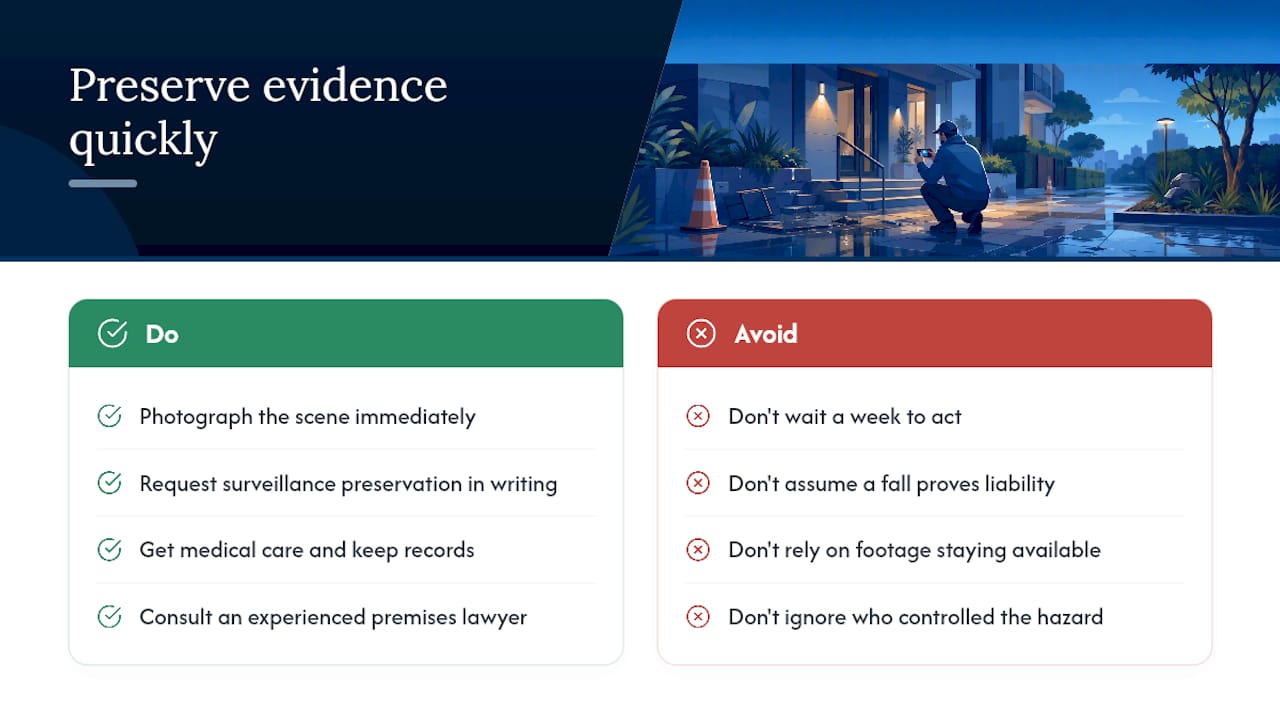
What you should prioritize, above everything else, is documentation and speed. Photograph the scene. Request surveillance preservation in writing. Get medical care and keep every record. Then consult an attorney who has actually tried premises liability cases, not just settled them, because the insurer on the other side knows the difference.
This article is general information, not a substitute for advice from a qualified lawyer. Consult a qualified legal professional about your own circumstances before acting on anything here.
Sources
These resources help you verify the legal principles in this article and explore state-specific rules in more depth.
- Premises Liability
- Property owners’ legal duty to prevent injury — FindLaw
- What Is Premises Liability? What You Need To Know – Forbes Advisor
- UNITED STATES COURT OF APPEALS FOR THE NINTH CIRCUIT — Petrey v. Princess Cruise Lines (2026)
- Property owner and landlord civil liability explained – LegalClarity


