 Skip to Content

Protect Fees: Trial Lawyers’ Take on Florida Proposal for Settlement
A proposal for settlement can force the other side to pay your attorneys’ fees and costs, but only if you serve it within strict timing windows and draft it exactly as Rule 1.442 and Florida Statute §768.79 require. One missing element, one late filing, and the entire fee-shifting remedy disappears. Precision here matters as much as strategy.
TL;DR:
- Filing a proposal for settlement must occur between 90 days after service and 45 days before trial, or it becomes legally ineffective.
- The proposal must include seven precise elements, such as identifying all damages, claim, and whether attorneys’ fees are included, or it risks invalidation.
- The 25% threshold rules govern fee-shifting: if the judgment exceeds or falls short of the proposal by 25%, fee recovery depends on this math.
- Common mistakes like vague damages, nonmonetary terms, or poor apportionment often invalidate proposals and cost fee-shifting rights.
- Careful recordkeeping, strict adherence to timing, and legal counsel speed up compliance and strengthen enforceability.
Table of Contents
- What Is a Proposal for Settlement?
- When Can You Serve a Proposal for Settlement?
- What Must a Proposal for Settlement Include?
- How Does a Proposal for Settlement Affect Fees and Costs?
- What Mistakes Commonly Invalidate a Proposal for Settlement?
- How Do You Prepare and Serve a Proposal for Settlement?
- When Should You Talk to an Attorney About a Proposal for Settlement?
- A Trial Lawyer’s Take on Proposals for Settlement
- How Calil Law Helps You Draft and Enforce a Proposal for Settlement
- Primary Sources for Florida Proposals for Settlement
- Sources
What Is a Proposal for Settlement?
A proposal for settlement is a formal offer to resolve a personal injury case governed by Rule 1.442 and enforced through the fee-shifting mechanics of §768.79. Some practitioners call it an offer of judgment, though Florida’s rule and statute both use “proposal for settlement” as the operative term. Plaintiffs use it to apply pressure before trial: if the final judgment beats the proposal by enough, the rejecting side owes fees and costs, not just the underlying damages.
Every state handles fee-shifting differently. This guide focuses on Florida’s procedural framework as a representative example for readers navigating personal injury litigation, since it’s one of the most detailed and frequently litigated versions in the country.
When Can You Serve a Proposal for Settlement?
Rule 1.442 boxes plaintiffs into a specific window. Serve too early or too late, and the proposal has no legal effect.
- Earliest date: No sooner than 90 days after service of process on the defendant.
- Latest date: No later than 45 days before the scheduled trial date, and that ceiling resets automatically if trial gets continued.
- Acceptance period: The recipient has 30 days to accept in writing.
- Withdrawal: A proposal can be withdrawn anytime before acceptance, but the withdrawal must be in writing to count.
- Filing: Don’t file the proposal with the court unless you’re enforcing it after judgment or the offer was accepted. Filing early clutters the record and can tip your hand for no benefit.
Missing the 45-day pretrial deadline is one of the most common ways plaintiffs lose fee-shifting rights entirely, according to practice commentary from The Florida Bar.
What Must a Proposal for Settlement Include?
Rule 1.442©(2) lists seven required elements. Leave one out, and a judge can strike the whole proposal, even if your timing was flawless.
- Name the offeror and offeree clearly and completely.
- Identify the claim the proposal is meant to resolve.
- State that the proposal resolves all damages for that claim, unless it explicitly says otherwise.
- Exclude nonmonetary terms, with narrow exceptions like a voluntary dismissal with prejudice.
- State the total amount the proposal offers.
- State the amount attributable to punitive damages, if punitive damages are part of the claim.
- State whether the proposal includes attorneys’ fees, and if so, whether that amount is included in the total or separate.
Joint proposals to multiple defendants raise an extra wrinkle. When defendants face separate liability exposure rather than joint and several liability for the same conduct, the proposal must apportion a specific amount to each defendant. A single lump-sum offer to co-defendants with different legal exposure is a frequent target for invalidation, a point The Florida Bar has flagged repeatedly in its practice guidance.
Pro Tip: Cite both Rule 1.442 and §768.79 directly in the body of the proposal. Courts read ambiguous drafting against the offeror, and naming both authorities removes any argument that you meant something informal.
Attach a certificate of service in the proper form, and keep a dated copy of everything you send. That paper trail becomes critical if fee entitlement gets litigated months later.
How Does a Proposal for Settlement Affect Fees and Costs?
Section 768.79 is where the real leverage lives. If a plaintiff’s judgment turns out to be at least twenty-five percent greater than the plaintiff’s demand, the plaintiff can recover reasonable costs and attorneys’ fees dating back to the demand. The reverse applies to defendants: if the judgment is at least twenty-five percent less than the defendant’s offer, the defendant can recover fees from the plaintiff.
The 25% threshold is the entire mechanism. Miss it by a dollar, and there’s no fee award, regardless of how reasonable your proposal looked at the time.
A few details change how that math actually works:
- “Judgment obtained” means the net judgment, adjusted for postoffer collateral source payments and any postoffer settlement reductions, not the jury’s raw verdict number.
- Courts retain discretion to deny fees entirely if they find the underlying offer wasn’t made in good faith, according to the statute itself.
- Comparative fault findings and setoffs can shift a judgment from “beating” a proposal to falling short of it, which is why modeling the math in advance matters more than most plaintiffs realize.
What Mistakes Commonly Invalidate a Proposal for Settlement?
Most invalidated proposals fail for the same handful of reasons, and nearly all of them are avoidable with careful drafting.
- Sneaking in nonmonetary terms. Anything beyond the narrow exceptions (like a dismissal with prejudice) risks the whole proposal.
- Vague damages language. Failing to state clearly that the proposal resolves all damages for the claim invites a challenge.
- Ambiguous fee treatment. Not specifying whether attorneys’ fees are included in or separate from the total amount is a recurring drafting error.
- Sloppy joint-offer apportionment. Lumping co-defendants together without allocating amounts per defendant.
- Missing certificate of service. A technical omission that still gives opposing counsel grounds to challenge validity.
Pro Tip: When in doubt about a nonmonetary term, leave it out entirely. Courts treat this rule strictly, and a single prohibited condition can cost you a fee award worth far more than whatever the nonmonetary term was meant to accomplish.
How Do You Prepare and Serve a Proposal for Settlement?
- Verify the trial date and deadlines first. Confirm you’re past the 90-day floor and still ahead of the 45-day pretrial ceiling before drafting anything.
- Resolve liens and damages figures. Know your real net recovery exposure, including any liens, before setting a number.
- Draft against the seven-element checklist. Confirm each element from Rule 1.442©(2) is addressed explicitly, especially punitive damages and fee treatment.
- Serve the proposal and log the date. Track the 30-day acceptance window (35 days if served by mail) on a calendar, not just memory.
- Hold the proposal unfiled unless it’s accepted or you need it to move for fees after judgment.
- After judgment, run the 25% math against the net judgment, not the raw verdict, before filing a motion for fees.
Good recordkeeping is what turns a valid proposal into an enforceable one. Keep the served copy, the certificate of service, and any written acceptance or rejection together in one file from day one.
When Should You Talk to an Attorney About a Proposal for Settlement?
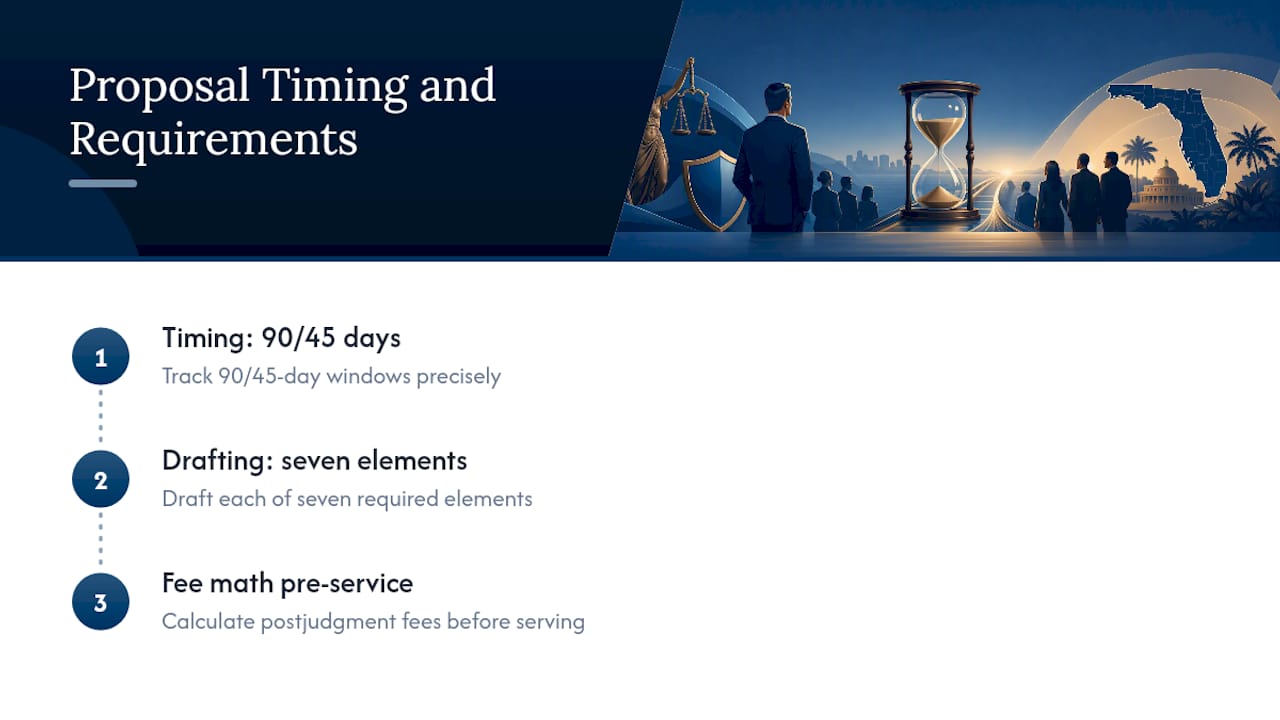
The moment your case involves real damages numbers and a trial date on the calendar, the timing and drafting stakes get high enough that DIY risk isn’t worth it. An attorney tracks the 90/45 day windows precisely, drafts each of the seven required elements without ambiguity, and calculates the postjudgment fee math before you ever serve an offer, not after a judge questions it.
Calil Law Trial Attorneys handles personal injury litigation across Florida, including motor vehicle claims and premises liability disputes, with attorneys who try cases to verdict rather than treat trial as a last resort. If you’re weighing whether to settle or proceed to trial, that trial readiness is what gives a proposal its real leverage: insurers negotiate differently with lawyers they know will actually go the distance.
A Trial Lawyer’s Take on Proposals for Settlement
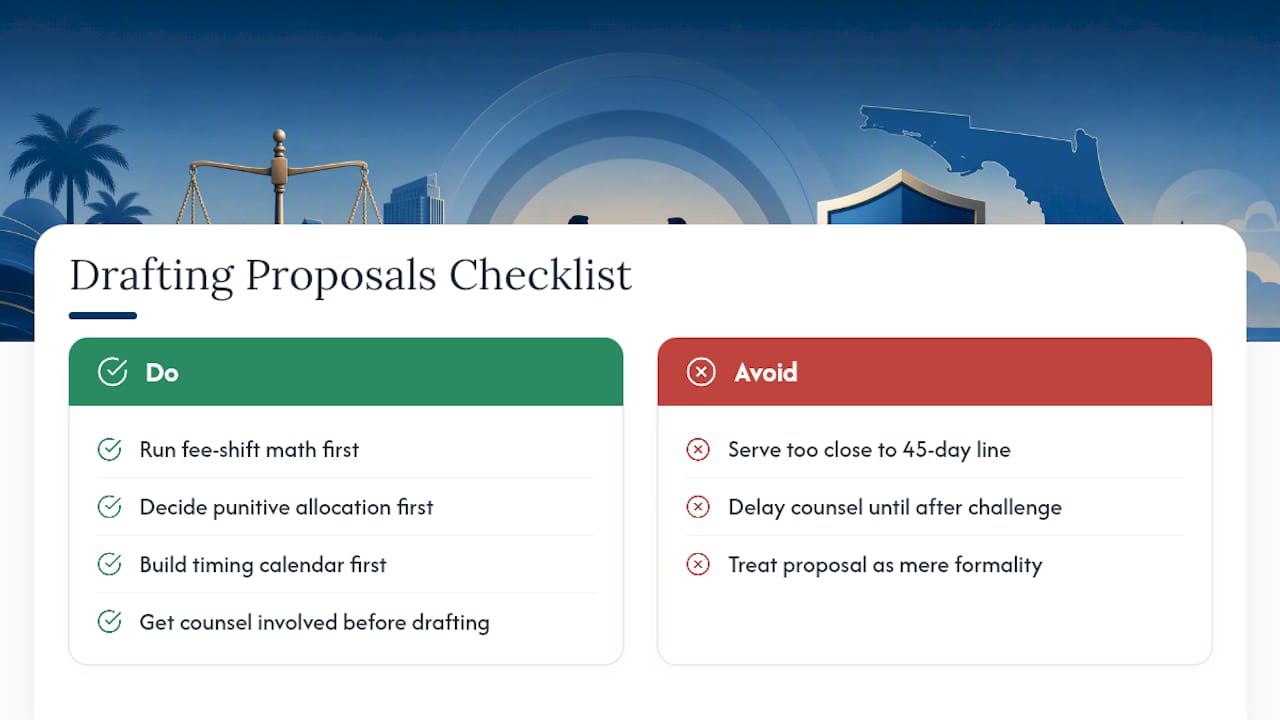
Plaintiffs often treat a proposal for settlement as a formality, a box to check before trial. That’s backwards. The proposals that actually move a case are the ones drafted with the fee-shift math already run, the punitive damages allocation already decided, and the timing calendar already built before the first draft goes out.
The single biggest mistake I see isn’t a bad number. It’s serving the proposal too close to the 45-day line, leaving no room to fix a drafting error before it becomes irreversible. Check your deadlines the day you consider serving one, and get counsel involved before you draft, not after opposing counsel challenges it.
— Jorge
How Calil Law Helps You Draft and Enforce a Proposal for Settlement
Some firms work on a contingency fee basis, meaning attorneys have an incentive to ensure proposals hold up and shift fees in favor of their clients. Decades of courtroom experience often lead attorneys to draft every proposal thoroughly, anticipating possible challenges.
If you’re facing a trial date and wondering whether a proposal for settlement makes sense in your case, that’s exactly the kind of decision that benefits from a second set of experienced eyes before you serve anything. Visit the personal injury practice page to learn how Calil Law evaluates cases, or start with a personal injury claim overview to see how the firm’s contingency model works from intake through judgment. Reach out for a consultation before your next deadline passes, not after.
Primary Sources for Florida Proposals for Settlement
For the full legal text behind everything covered here, consult Rule 1.442 for form, timing, and service requirements, §768.79 for the fee-shifting mechanism itself, and The Florida Bar’s practice commentary for common drafting pitfalls. Readers evaluating negotiation strategy more broadly may also find this overview of the settlement negotiation process useful background before drafting a proposal.
This article is general information, not a substitute for advice from a qualified lawyer. Consult a qualified legal professional about your own circumstances before acting on anything here.
Sources
- Fla. R. Civ. P. 1.442 — Proposals for Settlement | Florida Rules of Civil Procedure
- Chapter 768 Section 79 – 2023 Florida Statutes – The Florida Senate
- Proposals for Settlement: Minding Your P’s and Q’s Under Rule 1.442 – The Florida Bar
- Statutes & Constitution : View Statutes : Online Sunshine


