 Skip to Content

Rental Car Accident in Florida: Who Pays and What to Do
After a rental car accident in Florida, the person who pays depends on who caused the crash, what insurance sits behind each vehicle, and whether the rental company carries any responsibility of its own. Several policies can apply at once: yours, the driver’s, the rental company’s and sometimes a credit card’s. Each one has its own rules and deadlines. If you were injured, the first weeks decide how much of this you can recover. Our trial attorneys at Calil Law handle car accident claims for injured people across Florida, including crashes in rental vehicles. We do not charge upfront fees. We are paid only if you receive a settlement or award.
TL;DR
- Florida law makes a rental company responsible for a renter’s driving only up to set limits, and it stays fully responsible for its own negligence, such as handing out a car with bad brakes.
- Your own PIP (personal injury protection) coverage pays 80% of reasonable medical bills and 60% of lost wages regardless of fault, but you must get initial treatment within 14 days.
- Florida bars recovery if you are found more than 50% at fault, so what you say at the scene matters.
- Most negligence claims now have a two-year filing deadline, so do not wait to speak with an attorney.
- Report the crash to police, notify the rental company, and keep every document, photo and medical record.
Table of Contents
- Why rental car crashes are harder than ordinary crashes
- Who is liable when a rental car causes a crash
- Which insurance pays for your injuries
- Beyond PIP: seeking full compensation
- How shared fault changes your claim
- What to do after a rental car accident in Florida
- Deadlines you cannot miss
- When an insurer denies or disputes the claim
- What Calil Law does for rental car crash victims
- Our perspective
- FAQ
- Sources
Why rental car crashes are harder than ordinary crashes
A normal collision involves two drivers and two insurers. A rental car crash adds a third party, the rental company, and often a fourth: the policy you bought at the counter, or the card you paid with. The car belongs to a company, the driver may be a tourist from another state or country, and the rental agreement may say things about insurance that nobody read at 11 p.m. in an airport lot.
For injured people, this creates two common problems. First, insurers point at each other. The rental company says the renter’s policy is primary, the renter’s insurer says the rental company’s coverage applies, and your medical bills sit unpaid. Second, the rental agreement may limit who was allowed to drive, which gives insurers an argument to deny coverage.
You can be in any of three positions, and the answers differ for each:
- You were a passenger or driver in the rental car and someone else caused the crash.
- You were hit by a rental car driver, as a driver, passenger, cyclist or pedestrian.
- You were the renter and you may share blame.
Who is liable when a rental car causes a crash
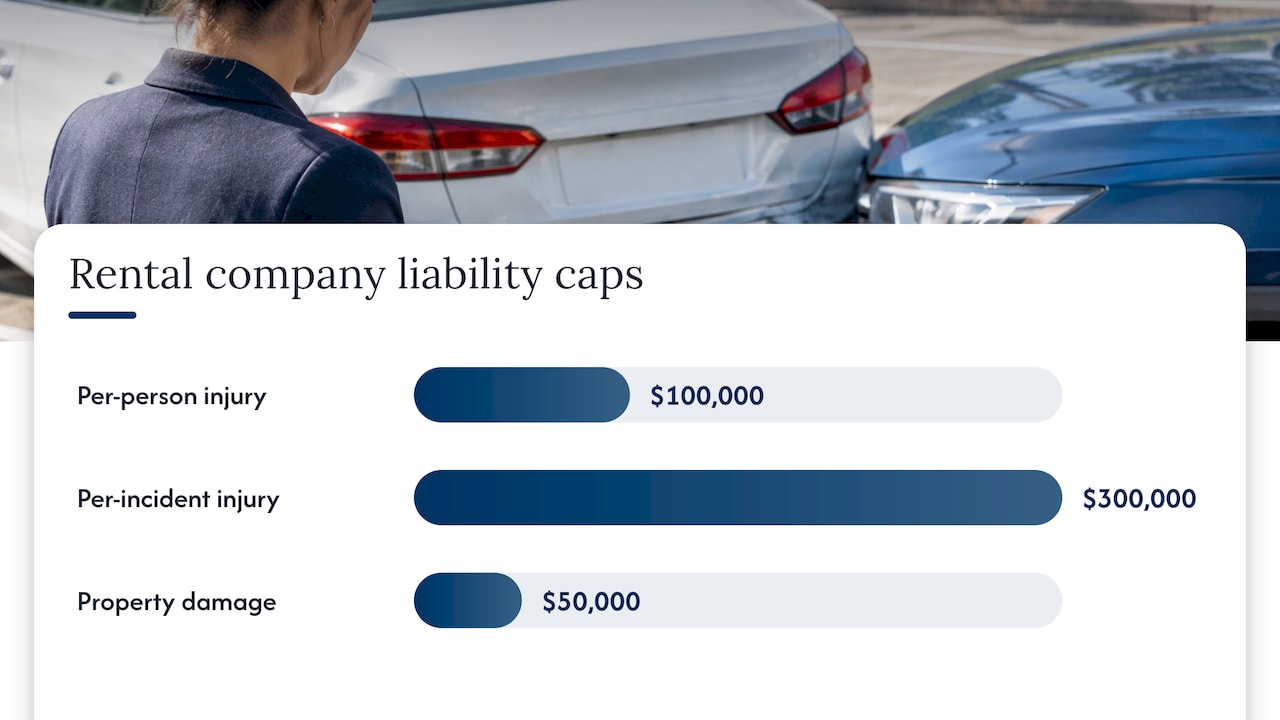
In most Florida crashes, the driver at fault is responsible. Rental vehicles add a rule about the company that owns the car. Under Florida Statute § 324.021, a company that rents a motor vehicle for less than one year is treated as the owner when liability for the car’s operation is decided, but only up to $100,000 per person and $300,000 per incident for bodily injury, and $50,000 for property damage.
There is a second layer. If the renter or driver is uninsured, or carries less than $500,000 in combined liability coverage, the rental company can be liable for up to an additional $500,000, but only for economic damages, and that amount is reduced by whatever you recover from the driver and their insurance. Economic damages are the measurable losses: medical bills, lost income and similar costs. The same statute says none of this changes the company’s liability for its own negligence.
In plain terms:
- The driver is the primary target. If a renter ran a red light, that renter’s liability coverage is the first source of payment.
- The rental company can add a layer of recovery. The statute gives injured people access to the company’s financial responsibility up to the stated limits, particularly when the driver has little or no insurance.
- The company can be liable for its own mistakes. Examples include renting out a vehicle with known brake or tire defects, skipping recalls, or renting to a driver it should have known was unfit. This kind of claim is not capped by the owner-liability limits.
Other parties can also share responsibility. A trucking company, a negligent property owner, or a manufacturer of a defective part can be part of the picture, which is one reason it helps to understand liability after a car accident before talking with an insurer. If a commercial truck or a rideshare vehicle was involved, the layers of coverage multiply, and we handle those cases as well, including truck accidents.
A worked example
Suppose a visitor rents a car in Orlando and rear-ends you, causing a broken wrist and three weeks off work. The visitor carries only minimal coverage from home. Your claim would look first to the visitor’s liability insurance. Because that coverage is below the statutory threshold, the rental company’s statutory responsibility can also come into play for your economic damages, reduced by what you recover from the driver’s insurer. If the rental company had also ignored a recall notice on the brakes, a separate negligence claim could reach further. Each step needs documents: the rental agreement, the declarations page of every policy and the maintenance history. Sorting out who owes what is the work an attorney does while you recover.
Which insurance pays for your injuries
Your PIP coverage
Florida is a no-fault state for the first layer of injury payments. Florida’s Department of Financial Services explains in its Automobile Insurance Toolkit that PIP pays 80% of necessary and reasonable medical expenses regardless of fault, 60% of lost wages, a $5,000 death benefit and 100% of necessary replacement services. Two rules matter most:
- Initial treatment within 14 days. Payment depends on getting initial services and care within 14 days after the accident.
- The emergency condition limit. Non-emergency treatment is capped at $2,500. If a physician, osteopath, dentist, physician’s assistant or advanced registered nurse practitioner finds an emergency medical condition, reimbursement can reach $10,000 unless higher limits were purchased.
The state’s personal automobile insurance overview repeats the 14-day rule and notes that follow-up care depends on the diagnosis of an emergency medical condition. Visitors should know that PIP generally follows the vehicle and the policy. In a rental, the rental company’s coverage or your own policy may be where PIP comes from, and which one applies depends on the facts. Our guide to protecting your Florida PIP benefits walks through the 14-day window in more detail.
Your own auto policy
The Department of Financial Services advises checking with your agent or insurer before you rent to find out whether your auto coverage extends to the rental car. The kind of vehicle, its use, where it is driven and your policy limits all affect the answer. If you did not check, gather the policy and rental agreement now, because the answer shapes every claim that follows.
Coverage sold at the counter and through cards
Rental counters offer damage waivers, supplemental liability and personal accident coverage. Some credit cards add their own benefits. These can cover damage to the rental car or add liability protection, but their terms differ. Keep the rental agreement, the receipt and any card benefit documents, because insurers will ask for them.
When the at-fault driver has little or no insurance
If the person who hit you carried minimal coverage, your options may include uninsured or underinsured motorist coverage on your policy. We explain the steps in our article on being hit by an uninsured driver in Florida.
Beyond PIP: seeking full compensation
PIP is a floor, not the ceiling. Once an injury meets Florida’s tort threshold, under § 627.737, you can seek from the at-fault party the costs PIP does not duplicate, according to the Department of Financial Services toolkit. The toolkit also notes that § 626.9541 protects consumers from a premium increase for filing a PIP claim in a not-at-fault accident. A permanent injury is one of the ways to meet the threshold, and we explain the options in Florida’s permanent injury threshold.
Damages that may be available include:
- Past and future medical expenses
- Lost wages and reduced earning capacity
- Pain and suffering and loss of enjoyment of life
- Property damage
- In a fatal crash, wrongful death damages for the family
Documentation is what turns these categories into numbers. Keep every bill, pay stub, doctor’s note and photo of your injuries. Our guide to medical records in an injury claim explains what insurers look for, and our article on medical liens explains what happens when providers are owed money from your settlement.
How shared fault changes your claim
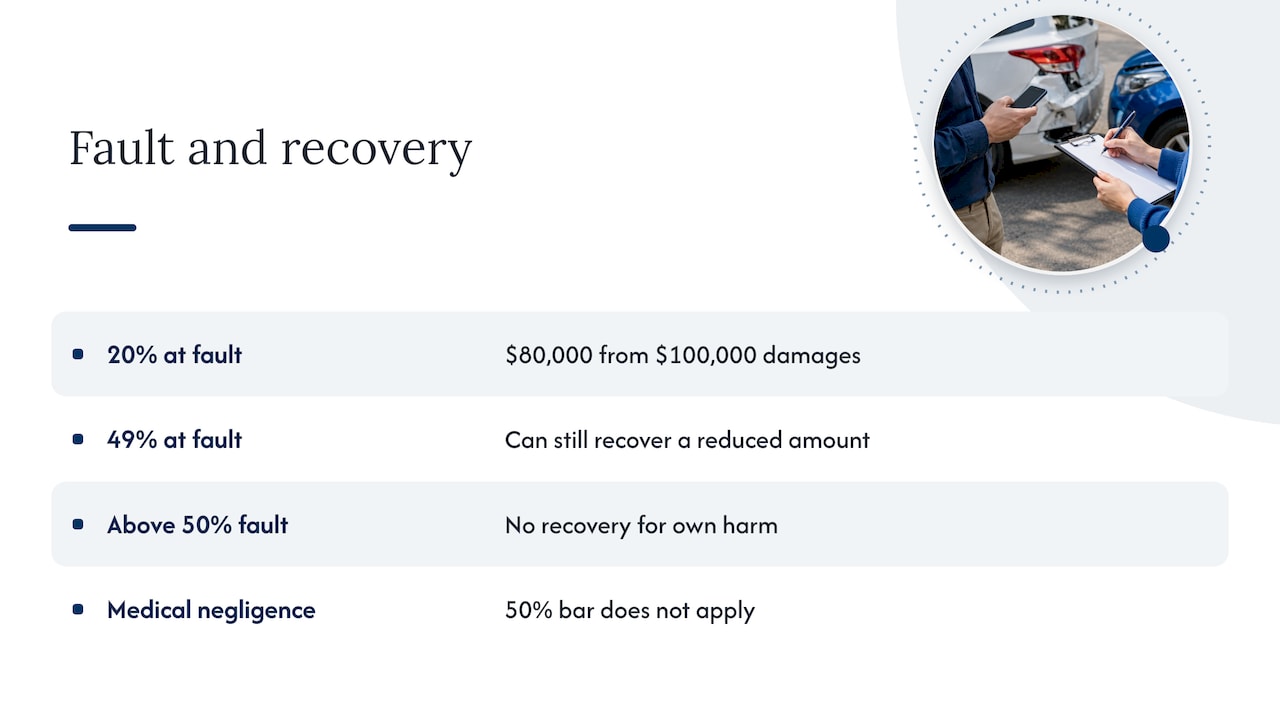
Florida applies comparative negligence. Under Fla. Stat. § 768.81, fault chargeable to you reduces your damages in proportion, but a party found more than 50 percent at fault for their own harm may not recover any damages. The 50% bar does not apply to medical negligence actions. A House analysis of the 2023 change, HB 837, describes the shift from pure to modified comparative negligence and uses a car accident example: at 49% fault you can still recover a reduced amount, and above 50% you cannot.
Here is how that works with numbers. Say your damages total $100,000 and a jury finds you 20% at fault. You could recover $80,000. If the jury finds you 51% at fault, you recover nothing.
This matters for rental drivers in particular. Unfamiliar roads, toll lanes, a car you have driven for two days and a navigation screen can all become arguments about your share of fault. That is why you should say little about fault to an adjuster. Read more in our guides to Florida comparative negligence and what counts as comparative negligence in auto accidents.
What to do after a rental car accident in Florida
1. Get safe and get medical care
Move to safety if you can and call 911 for injuries. Then see a medical professional within 14 days, even if you feel fine. Adrenaline hides whiplash, concussions and soft-tissue injuries, and the PIP rule penalizes delay. Follow the treatment plan, because gaps in treatment give insurers a reason to dispute your injuries.
2. Report the crash to police
Under Fla. Stat. § 316.065, a driver in a crash involving injury or death, or property damage of at least $500, must immediately notify local police inside a municipality, or otherwise the county sheriff or nearest Florida Highway Patrol office. A violation is a noncriminal traffic infraction. A police report also gives you an independent record of the scene. Our page on the Florida crash report explains how to request a copy.
3. Notify the rental company
Your agreement likely requires prompt notice. Call the number on the agreement, give the date, time, place and the basic facts, and ask for the claim number. Stick to what happened. Do not guess about speed, fault or injuries, and do not sign anything you have not read.
4. Collect evidence at the scene
- Photos of all vehicles, plates, road conditions and signs
- Names, phone numbers and insurance details of drivers and witnesses
- The rental agreement, the key tag and the contract number
- A note of the car’s make, mileage and any warning lights or defects you noticed before the crash
If the car had a mechanical issue, photograph it before it is repaired or removed. Rental fleets move cars quickly, and the evidence can disappear.
5. Be careful with insurer calls
Insurers for the rental company and the other driver may call within hours. You can give your name and basic facts. Decline recorded statements and settlement offers until you know the extent of your injuries. Early offers rarely account for future treatment.
6. Talk to an attorney early
A rental crash involves statutes, several policies and fault arguments. When we take a case, we look at the rental agreement, every policy, the maintenance records and the crash evidence, and we personally review each case. Read our overview of hiring an auto accident lawyer to know what to expect.
Deadlines you cannot miss
Florida used to give four years to file a negligence suit. The 2023 legislation, CS/HB 837, cut the period under § 95.11 for negligence actions from four years to two. The new period applies to causes of action that arose after the law took effect in March 2023, so a crash today falls under the two-year limit. Exceptions exist, and wrongful death has its own rules. Our guide to the Florida personal injury statute of limitations explains the details. Evidence and witnesses fade quickly, so do not run the clock down.
When an insurer denies or disputes the claim
Denials are common in rental crashes, often because the insurer says another policy is primary or that the driver was not an authorized operator. The Department of Financial Services says insurers must give written notice of a denial. You can send information that contradicts it, and if there is no agreement you may be eligible for voluntary, non-binding automobile mediation before litigation or appraisal. Per the state’s overview, that applies to property damage of any amount and to bodily injury up to $10,000, including PIP injuries.
For larger injury claims, a denial or a lowball offer often calls for litigation. If an insurer fails to act in good faith, we also handle bad faith claims, and our insurance claim team helps with property damage disputes. Our article on why injury claims fail lists the mistakes that give insurers their openings.
What Calil Law does for rental car crash victims
Our firm is led by a Board Certified Civil Trial Lawyer and Supreme Court Certified Mediator with over 18 years of Florida experience. You get direct access to experienced attorneys, and each case is personally reviewed. We represent people injured in car accidents, truck accidents, Uber and Lyft accidents and other crashes involving negligent parties, and we are prepared to try a case to verdict when an insurer will not pay what it is worth. We work on a contingency fee: no upfront fees, and we are paid only when you receive a settlement or court award.
If you were hurt in a rental car crash, contact Calil Law for a free consultation and we will tell you where your claim stands.
Our perspective
Rental car crashes look simple from the outside: a car, a driver, an insurer. In practice, they are some of the most layered claims we see, and the people hurt in them are often far from home, without their own doctors, their own car or their own paperwork.
Our view is that you should not have to untangle the rental agreement, a statutory liability cap and three insurers while you recover. Early on, the most valuable work is quiet: securing the agreement, identifying every policy, preserving the vehicle’s records and making sure your treatment fits inside the 14-day PIP window. Done well, it means that when negotiations begin, we are negotiating from strength.
We also believe your life has value beyond what an adjuster’s first number says. We take the time to understand how the injury changed your work, your family and your days, and we are ready to present that case to a jury when it is necessary.
Jorge
FAQ
Who pays for my medical bills after a rental car accident in Florida?
Your PIP coverage pays first, regardless of fault, covering 80% of necessary and reasonable medical expenses if you get initial care within 14 days. If another driver was at fault and your injury meets the tort threshold, you can seek the remaining losses from that driver’s insurance, and in some cases from the rental company under the statute.
Is the rental company responsible if the renter caused the crash?
Partly. Under § 324.021, the company is treated as the owner for liability purposes up to stated limits, with a possible additional layer for economic damages when the driver has little or no insurance. It is also responsible for its own negligence, such as renting out an unsafe vehicle.
What is the 51% rule in Florida?
If you are found more than 50% at fault for your own harm, you cannot recover damages. If you are 50% or less at fault, your recovery is reduced by your percentage of fault. The bar does not apply to medical negligence cases.
How long do I have to file a claim after a Florida rental car accident?
For most negligence claims arising after the 2023 change, the deadline is two years. Insurance notice requirements and PIP’s 14-day treatment rule are much shorter, so act quickly. An attorney can confirm the deadline that applies to your situation.
Do I need to call the police after a rental car accident?
Yes if anyone was hurt or damage appears to be at least $500. Florida law requires immediate notice to the proper police agency, and the report becomes useful evidence for your claim.
Sources
- Chapter 324, 2024 Florida Statutes
- Automobile Insurance Toolkit, Florida Department of Financial Services
- Personal Automobile Insurance Overview, Florida Department of Financial Services
- Fla. Stat. § 768.81, 2025 Florida Statutes
- House analysis of CS/CS/HB 837 (2023)
- CS/HB 837 bill text (2023)
- Fla. Stat. § 316.065


