 Skip to Content

Seat Belt Defense Florida: What Crash Victims Should Know
The seat belt defense usually reduces a Florida injury settlement rather than wiping it out completely. Under Florida Statute §316.614, not wearing a seat belt is never negligence per se, but it can be raised as comparative negligence under §768.81. That means a jury can shave a percentage off your award, not erase it outright.
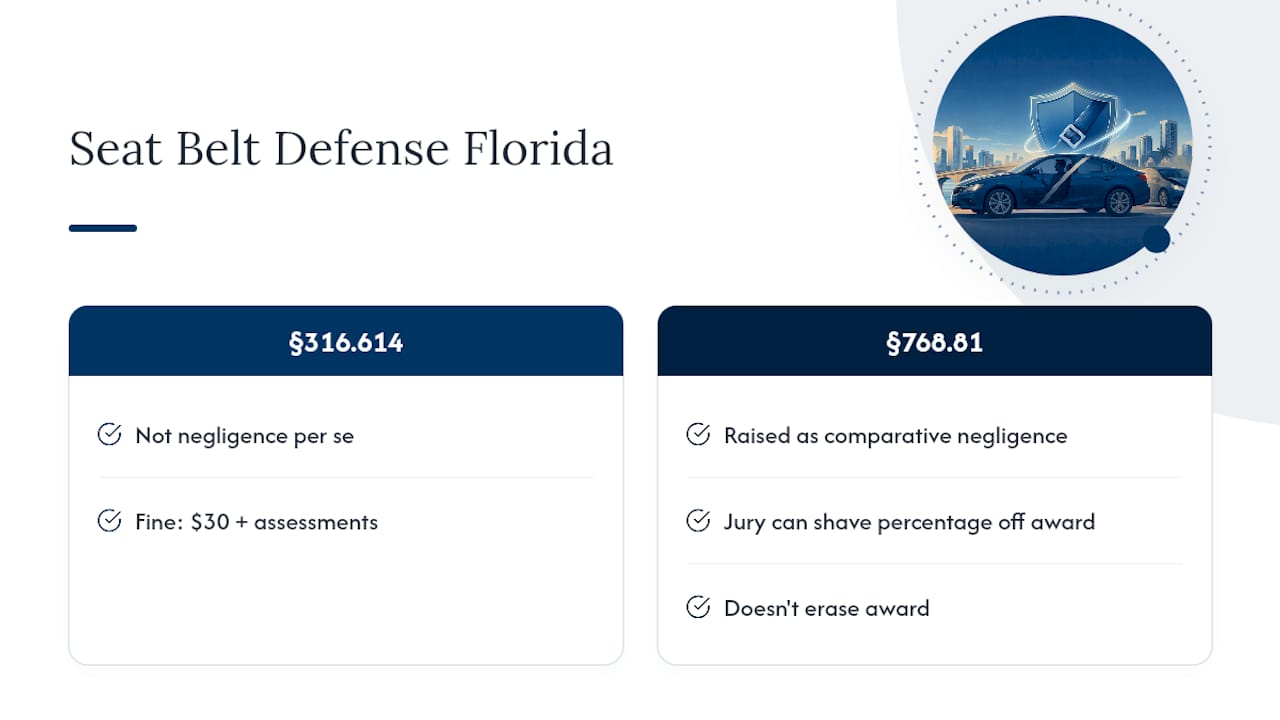
Quick fact: A safety belt violation in Florida carries a $30 fine plus assessments, but its real weight shows up later, in how insurers use it to argue your damages should be smaller.
If you were hurt in a crash and worry an insurer will raise this defense, your first move is simple: get your injuries documented in writing and call an attorney before you say anything else to the adjuster.
Key Takeaways
The seat belt defense in Florida typically reduces damages through comparative negligence rather than barring recovery outright, and strong medical and causation evidence limits how much a jury reduces an award.
| Point | Details |
|---|---|
| Not negligence per se | F.S. §316.614 says seat belt nonuse alone can’t establish negligence, only support a comparative negligence argument. |
| Three elements required | Defendants must prove belt availability, unreasonable nonuse, and a causal link to the claimed injuries. |
| — | Florida’s modified comparative negligence rule cuts off recovery only if you’re found more than 100% at fault. |
| Evidence wins the fight | Medical records, EMS reports, and expert testimony on causation are what actually shrink or defeat the defense. |
| Calillaw builds the record early | Calillaw’s Trial Attorneys handle evidence preservation, expert retention, and negotiation on a contingency-fee basis. |
Table of Contents
- Florida Seat Belt Law: Who Must Buckle Up and Why It Matters
- What Does the Seat Belt Defense Actually Argue?
- How Comparative Negligence Changes Your Payout
- How to Fight Back Against a Seat Belt Defense
- Exceptions: Children, Medical Conditions, and Defective Belts
- What to Do After a Crash to Protect Your Claim
- How a Florida Attorney Handles This Defense
- Timeline and Costs to Expect
- A Trial Lawyer’s View on This Defense
- Get Help Evaluating Your Florida Injury Claim
- Frequently Asked Questions
- Sources
Florida Seat Belt Law: Who Must Buckle Up and Why It Matters
Florida’s seat belt law, formally the Dori Slosberg and Katie Marchetti Safety Belt Law, requires drivers, front-seat passengers, and everyone under 18 anywhere in the vehicle to wear a properly fitted belt. A few narrow exceptions apply, including certified medical conditions and certain delivery or utility work.
Here’s what makes this law different from most traffic statutes: it’s a primary offense. That means an officer can pull you over and cite you for not buckling up, even with no other violation in play.
- Drivers and front-seat occupants: mandatory belt use
- Passengers under 18: mandatory, regardless of seating position
- Fine for violation: $30 plus court assessments
- Certified medical exemptions and specific work-vehicle exceptions apply
A $30 ticket sounds minor, but that same citation can become exhibit evidence in your civil case months later.
What Does the Seat Belt Defense Actually Argue?
Insurance companies use the seat belt defense to argue you contributed to your own injuries by not buckling up, even when their driver caused the crash entirely. Florida’s Supreme Court settled the legal foundation for this in Ridley v. Safety Kleen Corp., which confirmed the defense functions as comparative negligence, not a bar to recovery.
To win it, a defendant generally has to prove three things:
- A working, available seat belt existed in your seating position.
- You unreasonably chose not to use it.
- That failure caused or worsened the specific injuries you’re claiming.
Insurers rarely stop at raising the issue. Demand letters often include language like “the claimant’s injuries would have been substantially less severe had the seat belt been utilized,” paired with a proposed percentage reduction pulled from nowhere in particular. That third element, causation, is where these arguments usually fall apart under scrutiny.
How Comparative Negligence Changes Your Payout
Below that line, your damages just get reduced by your percentage of fault.
Here’s how the math actually works:
- A jury awards $200,000 in total damages.
- It finds the other driver 85% at fault for the crash and you 15% at fault for not wearing a belt.
- Your recovery drops to $170,000, the $200,000 reduced by your 15% share.
The distinction that trips people up: being at fault for causing the crash is entirely separate from having “enhanced” injuries from skipping a belt. The seat belt argument only touches the portion of your injuries the defense can actually attribute to nonuse, using comparative negligence principles that apply narrowly to that specific harm.
How to Fight Back Against a Seat Belt Defense
Winning against this defense comes down to evidence and causation, not arguing that seat belts don’t matter. Build your file early:
- Complete medical records showing injury timing, treatment, and documented mechanism of injury
- EMS run reports from the scene
- Photos of your injuries, the vehicle interior, and the seat belt’s position after impact
- The police crash report
- Witness contact information and statements
- An inspection of the seat belt’s physical condition and any maintenance records
Medical experts matter here. Treating physicians and trauma surgeons can testify about what actually caused your specific injuries, while biomechanical engineers and crash reconstructionists can challenge an insurer’s claim that a belt would have prevented harm. Medical literature on “seat belt syndrome” shows that belt marks don’t reliably predict internal injury severity either way, which cuts against sweeping insurer assumptions.
Pro Tip: Never answer an adjuster’s question about whether you were belted without your attorney present. That one detail, said casually on a recorded call, becomes the defense’s opening exhibit.
Exceptions: Children, Medical Conditions, and Defective Belts
The seat belt defense doesn’t apply evenly across every situation. A few exceptions change the analysis entirely:
- Children under 18 fall under stricter restraint rules, and a parent’s choices about a child’s restraint raise different liability questions than an adult’s own seat belt decision.
- A documented medical exemption, properly certified, defeats the defense outright since the law itself excuses certified conditions.
- If the belt itself failed, buckle malfunction, webbing failure, defective retractor, that shifts the case toward a product liability claim against the manufacturer instead of a comparative negligence fight with the other driver.
What to Do After a Crash to Protect Your Claim
- Get medical evaluation immediately, even if you feel fine. Contemporaneous records are your strongest counter to a delayed-injury argument.
- Photograph your injuries, the vehicle, seat belt position, and any belt damage before repairs happen.
- Preserve evidence: keep the clothing you wore, request the police and EMS reports, and don’t let the vehicle get repaired or scrapped before an inspection.
- Say nothing that sounds like an admission to an insurance adjuster, especially anything about whether you were belted.
Pro Tip: Insurers sometimes call within 48 hours with a quick settlement offer. That timing isn’t a coincidence, it’s designed to lock in a number before your medical picture is fully clear. Florida also caps how long you have to file a claim, so don’t let the calendar sneak up on you either.
How a Florida Attorney Handles This Defense
An experienced attorney’s job is to keep the seat belt defense from doing more damage than the facts actually support. That work includes preserving evidence before it disappears, arranging independent medical review, retaining biomechanical and reconstruction experts when causation is disputed, and negotiating from a position of documented strength rather than guesswork.
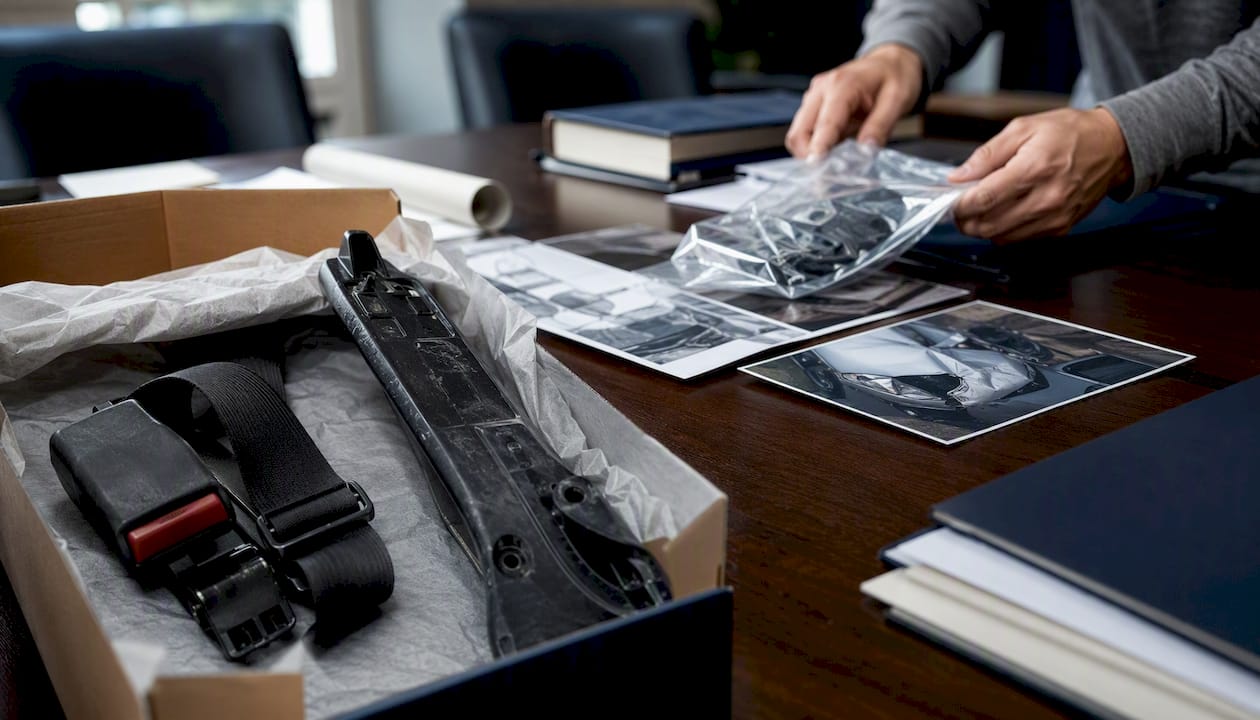
Calillaw’s Trial Attorneys approach these cases with the same courtroom-tested preparation whether a case settles at the demand stage or goes to a jury. The firm’s litigation background covers motor vehicle collisions, catastrophic injury, and insurance disputes where defendants routinely raise comparative negligence arguments.
At an initial meeting, bring:
- Your police report and any citations issued
- Medical records and bills so far
- Photos from the scene
- Insurance correspondence, especially anything mentioning seat belt use
Consultations are free, and representation runs on contingency fee, so you owe nothing upfront.
Timeline and Costs to Expect
Most claims involving a seat belt defense move through predictable stages:
- Immediate medical care and evidence gathering: the first days to weeks after the crash
- Demand negotiation with the insurer: typically weeks to a few months
- Litigation, if the insurer won’t offer fair value: often several months to a couple of years
Attorney fees on a contingency basis mean payment only comes from a successful settlement or verdict. Advanced costs, like expert reports or depositions, are typically fronted by the firm and settled at the case’s resolution. Some cases resolve at the demand letter stage; others, especially where causation is heavily disputed, require suit and eventual trial.
A Trial Lawyer’s View on This Defense
We take the seat belt defense seriously every time an insurer raises it, but we’ve also seen how often it’s used as a scare tactic rather than a genuine causation argument. Preparation and trial readiness change that calculation fast.
Get Help Evaluating Your Florida Injury Claim
If an insurer has already mentioned your seat belt in a phone call or letter, that’s usually a sign they’re bracing to reduce what they owe you, not a sign your case is weak. Calillaw’s Trial Attorneys review the police report, medical timeline, and vehicle evidence before ever discussing numbers with an adjuster, so a seat belt argument gets challenged on the facts instead of accepted at face value.

Consultations are free, and there’s no fee unless we recover for you. Bring your police report, medical records, and any insurance letters mentioning your seat belt, and we’ll walk through exactly how Florida’s comparative negligence rules apply to your situation. Visit the personal injury practice page to schedule a consultation and get a straight answer about where your claim stands.
Frequently Asked Questions
Can the seat belt defense completely bar my Florida injury claim?
No.
Does a seat belt ticket automatically hurt my civil case?
It can be introduced as evidence, but it doesn’t prove the defense on its own. The defendant still has to show the belt was available, that you unreasonably skipped it, and that doing so actually worsened your specific injuries.
What if the seat belt was broken or defective?
That shifts the case toward a potential product liability claim against the manufacturer rather than a straightforward comparative negligence argument with the other driver.
How much can seat belt nonuse actually reduce my settlement?
It varies by case, since a jury sets the percentage based on the evidence presented. Strong causation evidence and credible medical testimony typically keep that percentage lower than what insurers initially propose.
Do I need a lawyer if the insurer raises this defense?
Given how technical the causation argument gets, and how quickly insurers move to lock in low offers, experienced representation makes a meaningful difference in what you ultimately recover.
This article is general information, not a substitute for advice from a qualified lawyer. Consult a qualified legal professional about your own circumstances before acting on anything here.
Sources
- Statutes & Constitution Online Sunshine — F.S. 316.614 Safety belt usage
- Occupant Protection Frequently Asked Questions (FDOT)
- Buckle Up Florida, It’s the Law! (Florida Department of Highway Safety and Motor Vehicles)
- Ridley v. Safety Kleen Corp. (Justia)
- Seat belt–related injuries — NCBI Bookshelf


