 Skip to Content

Settlement vs. Trial Explained: A Guide for Injury Victims
For most personal-injury claimants, a negotiated settlement is the financially sensible choice. Trial is the right path when liability is clear, damages are catastrophic, and the insurer’s offer falls far short of what a jury would likely award.
Here is the core tradeoff in three lines:
- Speed and certainty vs. upside and risk. A settlement delivers guaranteed money, often within months. A trial can take years and may end with nothing.
- Cost and net recovery. Litigation expenses, expert fees, and a higher contingency percentage at trial all reduce what reaches your pocket. Net recovery, not gross award, is the number that matters.
- Emotional and privacy considerations. Settlements are typically confidential and spare you the stress of a public courtroom. Trials create a public record and demand sustained emotional endurance.
Most personal-injury cases settle before a jury ever hears them. Understanding why, and knowing when trial is the stronger play, is the foundation of every sound litigation decision.
Table of Contents
- What a settlement actually includes
- What going to trial actually means
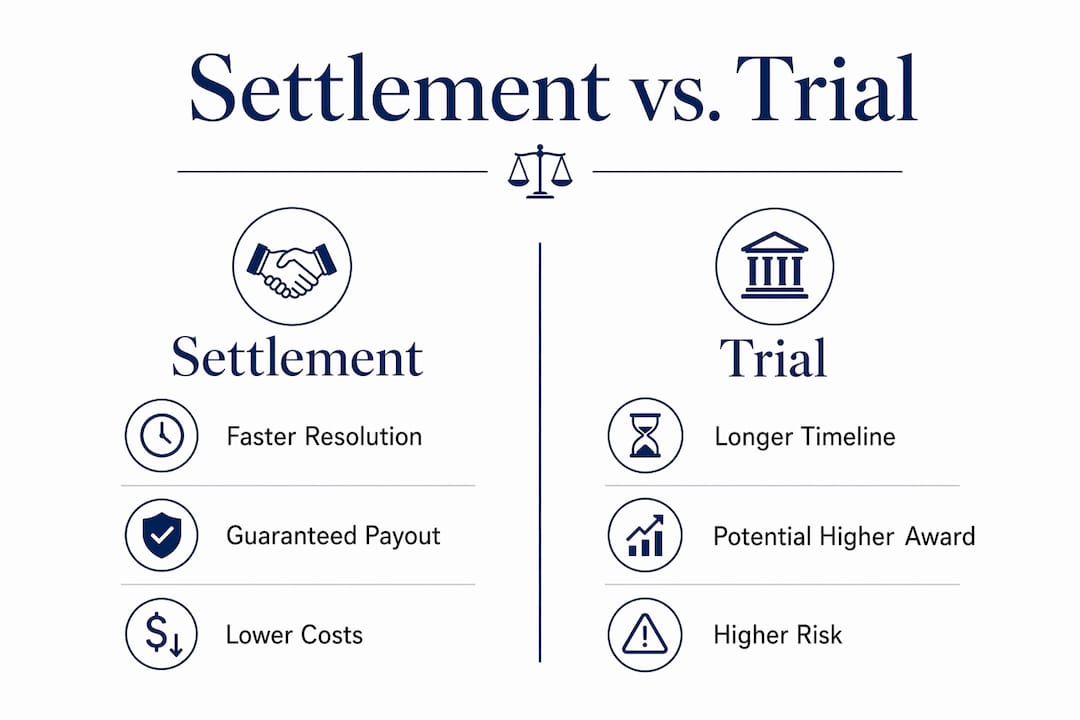
- Settlement vs. trial: a side-by-side comparison
- Why plaintiffs accept settlements: the real advantages
- What you give up when you settle
- When trial can be the right choice
- The real risks of going to trial
- How to decide: a framework and the questions to ask your lawyer
- What to expect financially and how long each path takes
- Common mistakes plaintiffs make when deciding or negotiating
- When mediation and other ADR options make sense
- How Calillaw evaluates whether to settle or try
- Key Takeaways
- The choice between settling and going to trial deserves honest counsel
- What a consultation with Calillaw covers
- Authoritative sources and suggested further reading
What a settlement actually includes
A settlement is a voluntary agreement between the parties that resolves the claim in exchange for payment and a legal release. The Legal Information Institute at Cornell defines it as an agreement that ends a dispute and results in the voluntary dismissal of any related litigation. In plain terms: you accept money, you sign a release, and the case is over.
A properly drafted settlement agreement covers more than a dollar figure. The key components are:
- Payment amount and structure. The agreement specifies either a lump-sum payment or a structured settlement paid in installments over time.
- Release language. This is the most consequential clause. You release the defendant from all claims, known and unknown, arising from the incident. Broad release language can extinguish rights you did not know you had.
- Confidentiality clause. Most insurers require one. You agree not to disclose the settlement amount or terms, which keeps the resolution private.
- Medical lien and subrogation provisions. Health insurers, Medicare, and Medicaid often have a right to reimbursement from your recovery. The agreement must address how those liens are satisfied.
- Allocation of damages. How the payment is allocated between physical injury, lost wages, and pain and suffering can affect your tax exposure.
One timing issue that catches many plaintiffs off guard is Maximum Medical Improvement, or MMI. MMI is the point at which your treating physician determines your condition has stabilized and further significant recovery is unlikely. Signing a release before you reach MMI means you are settling without knowing the full extent of your future medical needs. If your condition worsens after signing, the release bars any further recovery from that defendant.
Pro Tip: Before you sign any release, have your attorney identify every carve-out or reservation of rights that may protect future claims, and confirm in writing that you have reached MMI or that the settlement amount accounts for projected future care costs. For cases involving surgery or long-term rehabilitation, review slip and fall settlements with surgery to understand how timing affects value.
Settlement rate context: Roughly 95% of personal-injury cases resolve without a jury verdict in many jurisdictions. This reflects the practical reality that both sides usually prefer a known outcome over the uncertainty of trial.
What going to trial actually means
Filing a lawsuit and taking a case to verdict is a structured, multi-stage process. It is not simply “going to court.” Understanding each phase helps you appreciate why trials take as long as they do and why the outcome is never guaranteed.
The trial process, step by step:
- Filing the complaint. Your attorney files a formal lawsuit, which triggers the defendant’s obligation to respond and starts the litigation clock.
- Discovery. Both sides exchange evidence: written interrogatories, document requests, and depositions of witnesses and experts. Discovery is often the longest phase, sometimes running 12–18 months on complex cases.
- Expert preparation. In personal-injury cases, medical experts, accident reconstructionists, and economists are retained, deposed, and prepared to testify. Their opinions shape both trial strategy and settlement leverage.
- Pretrial motions. Attorneys file motions to exclude evidence, limit expert testimony, or seek summary judgment. These rulings can dramatically change a case’s value.
- Jury selection (voir dire). Attorneys question prospective jurors to identify bias and seat a panel. In high-stakes cases, this alone can take days.
- Opening statements and evidence presentation. Each side presents its case: witness testimony, exhibits, and expert opinions. The plaintiff bears the burden of proving negligence and damages.
- Closing arguments and jury deliberations. The jury receives instructions from the judge and deliberates. Verdicts can take hours or weeks.
- Verdict and post-trial motions. If the jury finds for the plaintiff, the defendant may move for a new trial or remittitur (reduction of the award).
- Appeals. Either side may appeal. An appeal can add one to three years before any money changes hands.
Settlements frequently occur during discovery or in the weeks just before trial, when both sides have seen the evidence and can realistically estimate risk. That timing is not coincidental. It is when the range of probable outcomes narrows enough for both parties to negotiate from a shared factual foundation.
Pro Tip: Jury unpredictability is real. A sympathetic plaintiff can lose on liability. A credible defense expert can undercut a strong damages case. Witness credibility, courtroom demeanor, and even the composition of the jury panel can shift a verdict in ways no attorney can fully predict.

Settlement vs. trial: a side-by-side comparison
The table below compares the two paths across the dimensions that matter most to a plaintiff making a real decision.
| Dimension | Settlement | Trial |
|---|---|---|
| Speed / timeline | Weeks to months after demand | Several years from filing to verdict |
| Certainty / predictability | Guaranteed outcome | Jury verdict is unpredictable |
| Potential compensation | Capped by negotiation and policy limits | Potentially higher, including punitive damages |
| Cost of pursuing | Lower; fewer expert and court costs | High; depositions, experts, court fees accumulate |
| Privacy / confidentiality | Typically confidential by agreement | Public record; no confidentiality |
| Control over outcome | Both parties agree; plaintiff retains control | Jury decides; neither party controls the verdict |
| Risk of receiving $0 | None once signed | Real; a defense verdict means no recovery |
The practical takeaway: settlement trades upside for certainty. Trial trades certainty for the possibility of a larger award, but that possibility comes with genuine downside risk, including the chance of walking away with nothing after years of litigation.
Why plaintiffs accept settlements: the real advantages
Speed is the most obvious benefit, but it is not always the most important one. Here is what actually drives most settlement decisions:
- Guaranteed recovery. A signed settlement agreement is enforceable. There is no jury to persuade, no appeal to survive. The money is coming.
- Lower total cost. Avoiding depositions, expert witness fees, court costs, and trial preparation can save tens of thousands of dollars in litigation expenses, all of which reduce your net recovery.
- Faster access to funds. Medical bills, lost wages, and ongoing care costs do not pause while a lawsuit proceeds. A settlement can fund those needs in months rather than years.
- Privacy. Confidentiality clauses keep the terms out of the public record, which matters when the facts of your injury are sensitive or when you simply do not want your compensation disclosed.
- Lower emotional burden. Depositions, cross-examination, and trial testimony are stressful. Settling spares you and your family from months of sustained legal combat.
- Insurer incentives align with yours. Insurers prefer settlement because it eliminates their own uncertainty and expense. That shared interest in resolution often produces fair offers when liability is reasonably clear.
Settlement rate: Roughly 95% of personal-injury cases settle before reaching a jury. This is not because plaintiffs are giving up but because a well-negotiated settlement often delivers better net results than a trial that carries real risk.
Pro Tip: Always evaluate net recovery, not gross settlement amount. Subtract your contingency fee, litigation costs already incurred, and any medical liens before comparing a settlement offer to a projected jury award. For Florida-specific context on how settlement values are calculated, how slip and fall settlements are calculated walks through the math in detail.
What you give up when you settle
Settlement is final. That finality is its greatest strength and its most serious risk. Once you sign a release, the claim is extinguished.
- You waive future claims. If your condition worsens after settlement, you cannot return to court for additional compensation. The release covers all future damages arising from the same incident.
- Early offers are often low. Insurers extend early offers before your full damages are documented. Accepting at that stage almost always leaves money on the table.
- No public accountability. A confidential settlement means the defendant faces no public record of wrongdoing. For plaintiffs motivated by accountability or deterrence, that can feel like an incomplete resolution.
- Confidentiality cuts both ways. While privacy protects you, it also prevents you from warning others about a dangerous product, property, or driver.
- Tax and lien complexity. Compensation for physical injuries is generally excluded from federal income tax under IRC Section 104, but allocations for punitive damages, emotional distress unconnected to physical injury, or lost wages may be taxable. Medical liens from Medicare, Medicaid, or private insurers must be resolved from the settlement proceeds. State rules vary, and you should confirm your specific tax exposure with a qualified tax professional.
Accepting a settlement before you fully understand your future medical needs is one of the most common and most costly mistakes in personal-injury cases. The release you sign is permanent. The medical bills that follow may not be.
When trial can be the right choice
Trial is not a fallback for failed negotiations. For the right case, it is the strongest strategic move available.
- Potential for a higher award. Juries can award compensatory damages well above what an insurer will offer in negotiation, particularly for catastrophic injuries with significant future care costs.
- Punitive damages. In cases involving gross negligence or intentional misconduct, trial opens the door to punitive damages that are unavailable in settlement.
- Public accountability. A jury verdict creates a public record. For plaintiffs who want the defendant’s conduct documented, trial is the only path.
- Full damages presentation. At trial, your attorney can present the complete picture: medical history, expert testimony on future needs, economic loss projections, and the human impact of your injuries. Insurers in negotiation rarely engage with that full picture.
- Leverage in late negotiations. Preparing seriously for trial often produces better settlement offers. Defendants who see a well-prepared plaintiff with strong expert support frequently increase their offers as the trial date approaches.
Pro Tip: When liability is clear and the injuries are catastrophic, jury sympathy can translate into verdicts that dwarf insurer offers. Truck accident cases illustrate this well: strong evidence of negligence combined with severe injuries often produces jury awards that no pre-trial offer would have matched.
The real risks of going to trial
The potential upside of trial is real. So is the downside. Every plaintiff considering trial should weigh these risks honestly.
Trials can produce higher awards, especially for catastrophic injuries, but they carry a real risk of receiving nothing. A defense verdict is not a rare anomaly. It is a genuine possibility in every contested case.
- Time. A case that goes through discovery, pretrial motions, trial, and appeal can consume three to five years. During that time, you are living with the financial and emotional weight of unresolved litigation.
- Cost. Expert witness fees, deposition costs, court filing fees, and trial preparation expenses accumulate quickly. In complex cases, litigation costs alone can reach five figures before the first day of trial.
- Higher contingency percentage. Many firms charge a higher contingency fee for cases that go to trial compared to pre-suit settlements. That difference directly reduces your net recovery.
- Emotional stress. Cross-examination is adversarial by design. Reliving your injuries in a public courtroom, with a defense attorney challenging your credibility, is genuinely difficult.
- Public exposure. Trials create public records. The facts of your case, your medical history, and the verdict become accessible to anyone who searches.
- Defense verdict risk. If the jury finds for the defendant, you receive nothing, and you may owe litigation costs depending on your fee agreement.
Risk callout: The decision to try a case should never be driven by frustration with the insurer or a desire to “make them pay.” Those are understandable emotions, but they are not a litigation strategy. The question is always whether the probability-weighted expected value of a trial verdict, after costs and fees, exceeds the guaranteed net recovery from settlement.
How to decide: a framework and the questions to ask your lawyer
The decision to settle or go to trial should be driven by evidence, damages, and realistic risk assessment, not by fatigue, pressure, or attorney preference. Here is a practical framework.
Decision checklist:
- Assess evidence strength. How clear is liability? Are there witnesses, video, or physical evidence that establish fault without ambiguity? Weak liability cases carry high trial risk.
- Calculate full damages. Document every economic loss: past and future medical costs, lost wages, reduced earning capacity, and cost of future care. Do not negotiate until this number is complete.
- Evaluate policy limits and collectability. If the defendant’s insurance policy limits are low and they have no personal assets, a trial verdict above those limits may be uncollectable. Know the ceiling before you decide.
- Assess settlement timing. Is the current offer coming before or after discovery? Early offers are almost always low. Offers made after depositions and expert exchanges reflect a more accurate risk calculation.
- Clarify your goals and risk tolerance. Do you need money now for medical bills? Are you motivated by accountability? How would a defense verdict affect you financially and emotionally?
- Model net recovery under both scenarios. Compare guaranteed settlement net of fees and liens against a probability-weighted trial verdict net of higher fees and litigation costs.
- Evaluate credibility factors. How will you present as a witness? Are there gaps in your medical treatment that a defense attorney could exploit? Credibility gaps hurt verdicts.
Questions to ask your lawyer before deciding:
- What is your estimated trial value for this case, and how did you calculate it?
- What is your honest probability estimate of a plaintiff’s verdict?
- What are the projected litigation costs through trial?
- Does your contingency fee percentage increase if we go to trial?
- What is the net recovery comparison between the current offer and a probability-weighted trial outcome?
- Are there any red flags in my medical records or treatment history that a defense expert could use against me?
- Is the insurer’s current offer a genuine assessment of risk, or a tactical low-ball?
Red flags that signal a bad-faith offer:
- The insurer makes a significant offer increase only days before trial, suggesting they were holding back.
- The release language is unusually broad, covering claims unrelated to the incident.
- The offer arrives before your treating physician has documented your full diagnosis and prognosis.
Pro Tip: Keep your medical records current and confirm MMI with your treating physician before signing any final release. A gap in treatment, even a short one, gives defense counsel a narrative that your injuries were not serious. Consistent, documented care protects both your health and your case value.
What to expect financially and how long each path takes
Understanding the financial mechanics of each path is the only way to make a genuinely informed decision. Net recovery, what reaches your pocket after fees, costs, and liens, is the only figure that matters.

Typical cost items and who pays them initially:
| Cost item | Who pays initially | Notes |
|---|---|---|
| Medical records and bills | Attorney (advanced) | Reimbursed from recovery |
| Expert witness fees | Attorney (advanced) | Can reach $5,000–$20,000+ per expert |
| Deposition costs | Attorney (advanced) | Court reporter, transcript fees |
| Court filing fees | Attorney (advanced) | Vary by jurisdiction |
| Mediation fees | Split or advanced by attorney | Usually $150–$300/hour per party |
| Medical lien resolution | Negotiated from settlement | Medicare/Medicaid liens are mandatory |
Timeline comparison:
- Pre-suit settlement: Demand letter sent after MMI; insurer responds within 30–90 days; settlement finalized in 2–6 months from demand.
- Lawsuit to settlement during discovery: Filing to settlement often takes a year or more.
- Lawsuit to trial verdict: Filing to verdict can take multiple years in most jurisdictions; Florida state courts vary by county and docket congestion.
- Trial to final resolution with appeal: Appeals can add additional years for final resolution.
Illustrative net recovery comparison (figures are hypothetical and vary by state, case type, and fee agreement):
Assume a gross settlement offer versus a potential jury verdict with a given probability of winning.
- Settlement net recovery: The settlement amount minus contingency fees and costs results in a guaranteed net amount.
- Trial expected value: The expected trial gross amount multiplied by the probability of winning, minus contingency fees and trial costs, results in a probability-weighted net.
In some scenarios, the settlement produces a higher expected net recovery. The math changes when the probability of winning is higher, damages are larger, or the settlement offer is significantly below trial value. For Florida-specific settlement ranges, average car accident settlements in Florida provide useful context.
Contingency fee note: Contingency fee structures often change when a case proceeds to trial. Always confirm the exact percentage your attorney will charge at each stage before making a final decision.
Common mistakes plaintiffs make when deciding or negotiating
These errors consistently reduce recovery or create legal problems. Avoiding them is as important as any strategic decision.
- Accepting a low early offer. The first offer from an insurer is almost never their best offer. Early offers arrive before your damages are fully documented and before the insurer has assessed real trial risk. Accepting at this stage is the single most common way plaintiffs leave money on the table.
- Failing to document medical care consistently. Gaps in treatment give defense counsel a powerful narrative: if you were not seeking care, the injuries must not have been serious. Attend every appointment and follow your physician’s recommendations without interruption.
- Oversharing on social media. Photos, check-ins, and activity posts that contradict your claimed limitations are routinely used by defense investigators. Assume everything you post is being reviewed.
- Saying the wrong thing during negotiations. Avoid minimizing your injuries in casual conversation with adjusters. Statements like “I’m doing better” or “it’s not that bad” can be used to reduce your claim’s value.
- Signing a release before reaching MMI. As discussed, settling before your condition stabilizes means you cannot recover for future medical needs that emerge after signing.
What not to say during settlement negotiations:
- “I feel fine” or “I’m mostly recovered.”
- “I don’t want to make this a big deal.”
- “I just want this to be over.”
- “I’m not sure the accident caused all of this.”
- Any specific dollar amount you would accept before your attorney has completed a damages analysis.
For a broader look at the errors that derail injury claims, why injury claims fail covers seven of the most damaging mistakes in detail.
When mediation and other ADR options make sense
Alternative dispute resolution, or ADR, sits between direct negotiation and full trial. It is not a compromise or a sign of weakness. Used strategically, it is one of the most effective tools in a plaintiff’s litigation toolkit.
The three main ADR options:
- Mediation. A neutral mediator facilitates negotiation between the parties. The mediator has no authority to impose a result. Both sides must agree to any resolution. Mediation is confidential, relatively fast, and preserves the option to proceed to trial if it fails.
- Neutral evaluation. An experienced attorney or retired judge provides a non-binding assessment of the case’s likely outcome. Useful for resetting unrealistic expectations on either side.
- Arbitration. A neutral arbitrator (or panel) hears evidence and issues a binding or non-binding decision. Binding arbitration is final and generally not appealable. It is faster than trial but sacrifices the jury option.
Benefits of mediation:
- Keeps both parties in control of the outcome.
- Confidential, unlike trial.
- Significantly less expensive than proceeding to verdict.
- Creates a structured forum for reality-testing offers and demands.
- Often produces creative solutions (structured payments, non-monetary terms) that a jury cannot award.
Weaknesses of mediation:
- No guaranteed result. Either party can walk away.
- A bad-faith insurer can use mediation to delay rather than resolve.
- Without strong evidence and a credible trial threat, your leverage is limited.
When to request mediation depends on where you are in the litigation. Early mediation, before discovery closes, often produces low offers because neither side has fully assessed the evidence. Late mediation, after depositions and expert reports are exchanged, is where real leverage lives.
Pro Tip: Request mediation after depositions and expert exchanges are complete. At that point, both sides have seen the evidence and can realistically price the risk of trial. That is when a mediator’s reality check lands hardest on the insurer’s side of the table.
For consumer-rights disputes involving settlement patterns in mass claims, robocall settlement amounts illustrates how ADR and structured settlements operate across different claim types.
How Calillaw evaluates whether to settle or try
At Calillaw, the decision to settle or proceed to trial follows a disciplined, evidence-based methodology. The goal is always the same: maximize the client’s net recovery while honestly accounting for risk.
Our evaluation framework:
- Probability-weighted verdict estimate. We model at least three scenarios: best case, most likely, and worst case. Each is assigned a probability, and we calculate the expected gross verdict across all three.
- Cost projection. We project total litigation costs through trial, including expert fees, deposition costs, and court expenses, and subtract them from the expected gross verdict.
- Net recovery comparison. We compare the probability-weighted net trial recovery against the guaranteed net settlement after contingency fees and liens. The client sees both numbers before making any decision.
- Credibility and evidence audit. We assess witness credibility, treatment consistency, and any evidentiary vulnerabilities that a defense attorney could exploit at trial.
- Client goals alignment. Financial recovery is not the only factor. Some clients want accountability. Some need funds immediately. We factor those goals into the recommendation.
At Calillaw, we never recommend settlement out of convenience or trial out of principle. Every recommendation is grounded in the numbers and the evidence. Our clients deserve to know exactly what they are choosing between.
Calillaw is led by a Board Certified Civil Trial Lawyer with decades of courtroom experience in Florida. Board certification in civil trial law is a credential awarded by The Florida Bar to attorneys who meet rigorous standards of experience, peer review, and examination. It means the attorney advising you on whether to try your case has actually tried cases, at the highest level, and knows what juries respond to.
For cases involving complex liability or multiple defendants, commercial litigation strategy for injury plaintiffs explains how Calillaw approaches high-stakes decisions about when to litigate aggressively.
Calillaw operates on a contingency fee basis. You pay nothing unless we recover for you. If your case proceeds to trial, we will explain exactly how that affects the fee structure and your net recovery before you make any decision.
Key Takeaways
Settlement is usually the financially stronger choice for most personal-injury claimants, but trial is the right call when liability is clear, damages are catastrophic, and the insurer’s offer falls well below the probability-weighted trial value.
| Point | Details |
|---|---|
| Net recovery is the only number that matters | Compare guaranteed settlement net of fees and liens against probability-weighted trial net, not gross figures. |
| Most cases settle before trial | Roughly 95% of personal-injury cases resolve without a jury verdict; settlement is the statistical norm, not the exception. |
| Sign only after reaching MMI | Never sign a final release before your physician confirms your condition has stabilized and future care needs are documented. |
| Trial carries real downside risk | A defense verdict means $0 after years of litigation; model the worst-case scenario before choosing trial. |
| Calillaw provides a trial-tested framework | Calillaw’s Board Certified Civil Trial Lawyer evaluates every case using a probability-weighted net recovery comparison before recommending settlement or trial. |
The choice between settling and going to trial deserves honest counsel
Most attorneys will tell you that settlement is usually the right answer. I agree, most of the time. But “usually” is not a strategy, and it is not advice you can act on without knowing the specifics of your case.
What I have seen, across years of trying cases in Florida, is that the clients who make the best decisions are the ones who understand both paths clearly before they choose. They know what they are giving up when they settle. They know what they are risking when they try. And they have a lawyer who can model the numbers honestly, not just reassure them.
The cases that go to trial at Calillaw go because the evidence supports it, the damages justify it, and the insurer’s offer does not come close to what a jury would likely award. The cases that settle do so because the net recovery is fair, the risk is real, and the client’s goals are better served by resolution than by years of litigation.
If you are weighing this decision right now, bring your questions to a consultation. Ask about the probability-weighted trial value. Ask about the net recovery comparison. Ask what your case looks like to a jury. Those are the right questions, and you deserve straight answers.
What a consultation with Calillaw covers
When you sit down with Calillaw, you are not getting a sales pitch. You are getting a case assessment from a Board Certified Civil Trial Lawyer who has actually tried the kinds of cases you are facing.

A Calillaw consultation covers your case’s liability picture, a realistic damages estimate, the likely timeline for both settlement and trial, and a clear explanation of the fee structure at each stage. You will leave knowing what your case is worth, what it would cost to pursue, and what the honest tradeoffs are between settling and going to trial.
Bring these documents to your consultation:
- All medical records and bills related to the injury
- Correspondence with the insurance company, including any written offers
- Demand letters sent or received
- Photos of the accident scene, injuries, or property damage
- Any police reports, incident reports, or witness statements
- Your health insurance information and any Medicare or Medicaid correspondence
To understand your rights before you come in, what is a personal injury claim explains the legal foundation of your case in plain language. If you are ready to speak with an attorney, the personal injury practice page is the right place to start.
Your life has value. Your recovery matters. We are here to make sure the decision you make, whether to settle or to try, is the right one for you.
Authoritative sources and suggested further reading
The following sources were used in preparing this article. Each is a credible reference for verifying the facts and legal principles discussed.
- Settlement definition — Legal Information Institute, Cornell Law School: Primary legal definition of settlement; supports the definition and release language sections.
- Settlements in General — Colorado Judicial Legal Help Center: Plain-language explanation of how settlements work and the binding nature of stipulations.
- Settlement vs. Trial — FairSettlement: Settlement rate data and timeline comparison; supports the BLUF and comparative snapshot.
- Settlement vs. Trial — Cohen Law: Corroborating 95% settlement rate figure; supports the pros of settlement section.
- Settle or Go to Trial — Richard D. Schibell: Decision framework emphasizing merit-based evaluation; supports the how-to-choose and ADR sections.
- Settlement vs. Trial — CaseValue.law: Net recovery framework and trial risk analysis; supports costs and timeline section.
- Settlement vs. Trial — McNeely Law: Privacy and public record distinctions; supports the comparative snapshot and cons of trial.
- Contingency fee — Legal Information Institute, Cornell Law School: Definition and structure of contingency fees; supports the costs and timeline section.
A note on state-specific rules: Settlement tax treatment, contingency fee caps, and litigation cost rules vary by state. The general principles in this article apply broadly across U.S. jurisdictions, but you should confirm the rules specific to Florida, or your own state, with a qualified attorney and a tax professional before making any final decision.


