 Skip to Content

Federal Target Letter: 72 Hour, 5 Steps to Protect Your Case
A federal target letter tells you prosecutors already have substantial evidence tying you to a crime and consider you a likely defendant. It doesn’t mean you’re indicted, but it usually means the investigation is in its final stretch. The single most urgent move: stop talking to agents and call an experienced federal criminal defense lawyer before you do anything else.
TL;DR:
- A target letter signals that prosecutors have substantial evidence against you and that charges are likely imminent, often within days or weeks.
- The letter type—whether from a U.S. Attorney, a grand jury subpoena, or an investigator—determines whether you are legally obliged to testify or simply invited for voluntary discussion.
- Immediate steps include ceasing communication with investigators, preserving evidence, and contacting a federal criminal defense lawyer without delay.
- Failing to preserve evidence or speaking without counsel can lead to obstruction charges, weaken your defense, or turn a target letter into a conviction.
- The first 72 hours are critical for evidence collection, legal planning, and avoiding common mistakes that escalate legal risks.
Table of Contents
- Target Letter Meaning: The DOJ Definition You Need to Know
- Who Sends Target Letters, and What Kind Did You Get?
- Does a Target Letter Mean You’ll Be Indicted?
- Your First 72 Hours: What to Do Right Now
- How the Grand Jury Process Actually Works
- The Mistakes That Turn a Target Letter Into a Conviction
- What a Target Letter Actually Says and How It Arrives
- What Experienced Counsel Does in the First Weeks
- An Attorney’s First 48 Hours With a Targeted Client
- How Calillaw Approaches a Federal Target Letter Case
- Sources
Target Letter Meaning: The DOJ Definition You Need to Know
The Department of Justice defines a “target” as someone for whom prosecutors or a grand jury already hold substantial evidence linking them to a crime, and whom the prosecutor views as a likely defendant. That definition comes straight from the DOJ’s own Criminal Resource Manual, which includes a sample target letter prosecutors can adapt.
The DOJ separates people touched by an investigation into three tiers:
- Witness — someone with relevant information but no suspected involvement in wrongdoing
- Subject — someone whose conduct falls within the investigation’s scope, without enough evidence to call them a likely defendant
- Target — someone prosecutors already believe committed the crime and may charge
DOJ issues these letters partly out of fairness, giving you notice and a chance to consult counsel, and partly for strategic reasons: a letter can pressure someone toward cooperation before charges are filed.
Who Sends Target Letters, and What Kind Did You Get?
Not every target letter arrives the same way, and the type you received changes what happens next. Two categories dominate.
- Prosecutor-issued letters sent by a U.S. Attorney’s Office when someone is likely to be indicted, often inviting a response or a meeting before charges are filed
- Grand jury subpoena letters, which DOJ practice requires when a subpoenaed witness is also considered a target, since the person must be warned of Fifth Amendment rights before testifying
- Agency-driven notifications, where investigators from the FBI, IRS, SEC, or an Inspector General’s office trigger the process even though the U.S. Attorney’s Office typically sends the formal letter
The distinction between these letter types matters because a subpoena carries a legal obligation to appear, while an “invitation” to speak voluntarily carries none. Confusing the two is how people talk themselves into an interview they never had to attend.
Does a Target Letter Mean You’ll Be Indicted?
Not automatically, but the odds tilt against you. A target letter often signals prosecutors are close to finalizing charges, and some letters give only a short window, sometimes just days, to respond or appear before a grand jury.
Timing varies by case complexity, the strength of existing evidence, and whether prosecutors are still deciding between charging you or seeking your cooperation against someone else. Some investigations move to indictment within weeks of the letter; others stall for months while defense counsel negotiates.
Three outcomes are realistic: no charges at all if defense counsel raises doubts about the evidence, a negotiated plea before indictment, or a grand jury indictment that starts formal prosecution. Which path you land on depends heavily on what happens in the days right after the letter arrives, not just on the evidence itself.
Your First 72 Hours: What to Do Right Now
Everything you do in the first three days after opening that envelope either protects your defense or damages it. Follow this order.
- Do not speak to agents, investigators, or prosecutors. Any statement, even a friendly clarification, can be used against you later, and you have no obligation to explain yourself before consulting a lawyer.
- Preserve everything. Do not delete emails, texts, financial records, or files, and do not let a work device get wiped, reset, or handed off. Untouched digital evidence protects you far more often than it convicts you.
- Call federal criminal defense counsel today, not next week. Early involvement lets a lawyer negotiate timing, request extensions, and start shaping the record before prosecutors finalize their theory of the case.
- Document how the letter arrived — mailed, hand-delivered by agents, or attached to a subpoena — and follow any preservation instructions printed in it word for word.
- If you’re subpoenaed to testify, do not go in alone. Arrange counsel immediately and prepare for what grand jury testimony actually involves before you ever sit down.
Pro Tip: Take a photo of the envelope, the postmark, and every page of the letter before you touch anything else. If a dispute ever arises over when you were notified or what instructions you received, that timestamp can matter.
If mishandled evidence or a careless statement has already hurt someone’s case before, the pattern is familiar. Calillaw’s breakdown of common mistakes that sink claims applies the same lesson: what you say and preserve in the first hours shapes everything that follows.
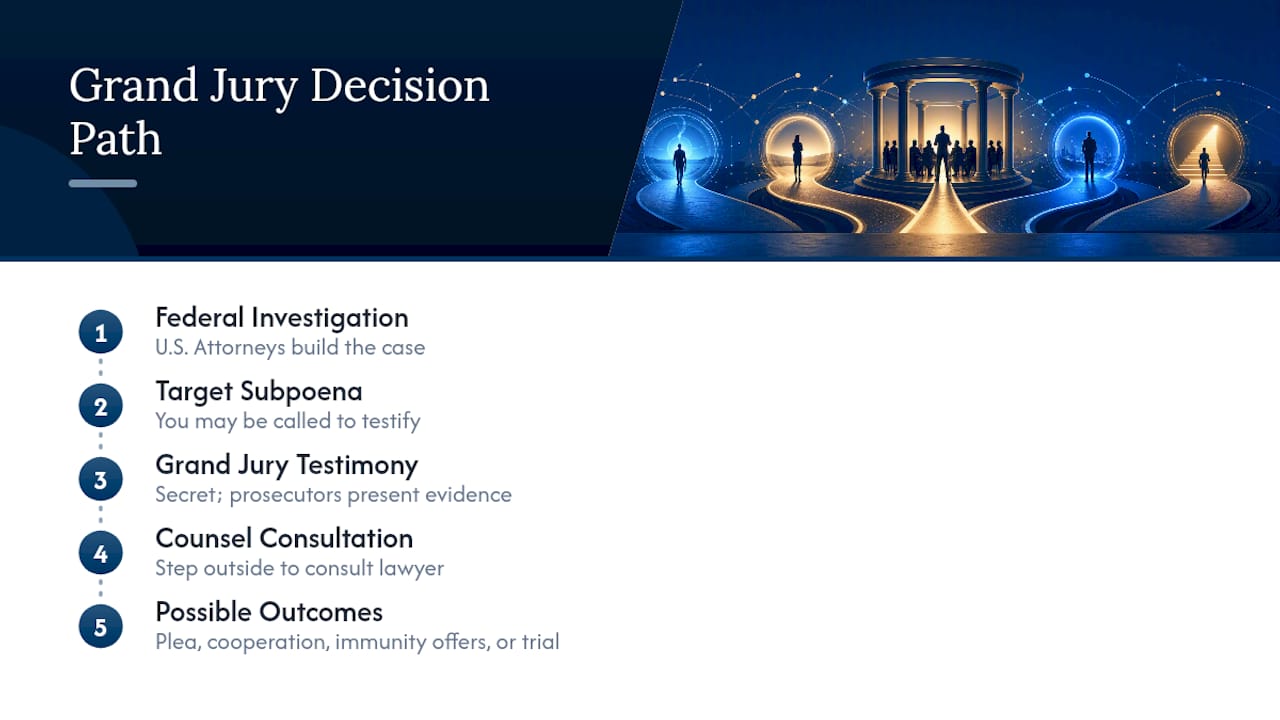
How the Grand Jury Process Actually Works
A federal felony charge requires a grand jury indictment, a group of ordinary citizens who hear evidence presented by prosecutors and vote on whether probable cause exists. The Justice Manual outlines how U.S. Attorneys present cases and how indictments get returned, and the process happens largely outside public view.
If you’re subpoenaed to testify as a target, you can step outside the grand jury room to consult your lawyer at any point, since attorneys aren’t permitted inside during testimony itself. Anything you say under oath can be used against you at trial later, which is exactly why unprepared testimony is so dangerous.
This same stretch of time is often where plea negotiations, cooperation agreements, or even limited immunity offers surface. Prosecutors weigh what you offer against what a trial would cost them, and that calculation only works in your favor if counsel is already at the table.
The Mistakes That Turn a Target Letter Into a Conviction
People rarely get indicted purely because of the original allegation. They get indicted, or make things dramatically worse, because of what they do after the letter arrives.
- Destroying, editing, or “cleaning up” documents once you’re on notice, which can trigger a standalone obstruction charge even if the underlying conduct was never provable
- Talking to agents, coworkers, or posting on social media without counsel present, handing prosecutors admissions they didn’t already have
- Failing to preserve metadata and a clear chain of custody on electronic records, which can look like tampering even when it isn’t
- Assuming the letter is just a formality or open to informal negotiation on your own, when it’s neither
Speaking to investigators without a lawyer remains the most common, and most damaging, mistake targets make.
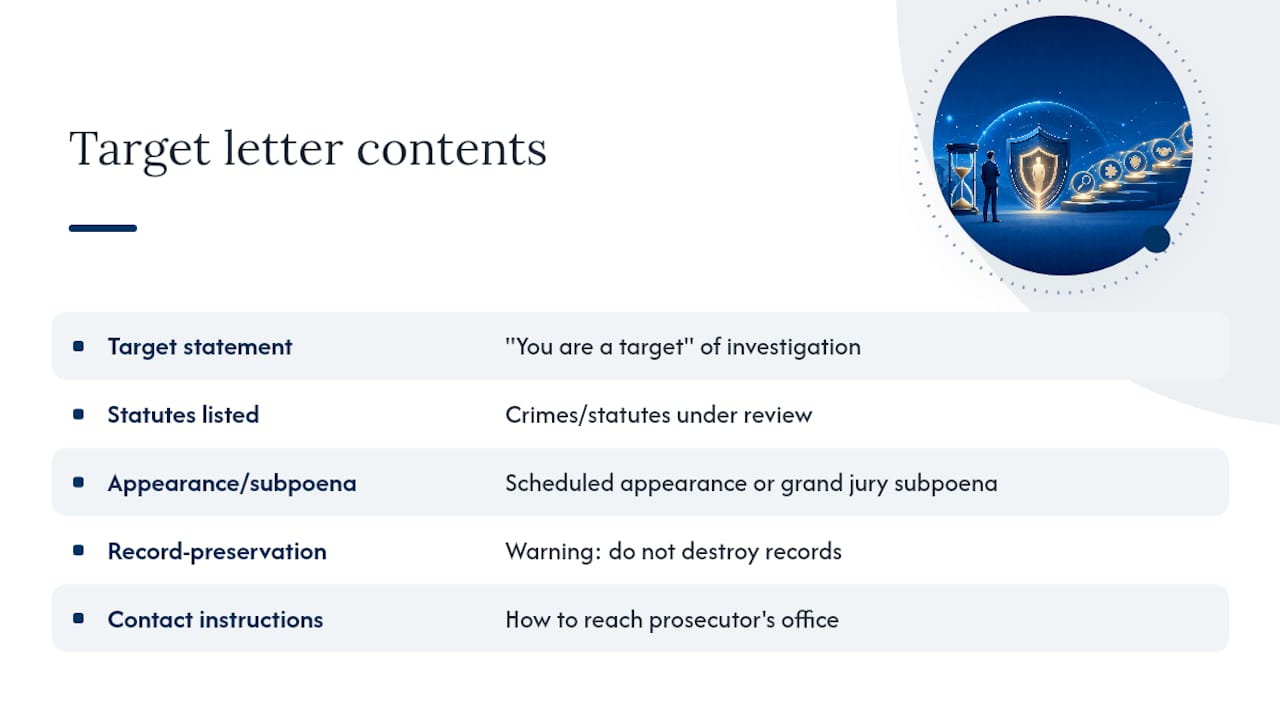
What a Target Letter Actually Says and How It Arrives
Most target letters follow a predictable template: a statement that “you are a target” of a grand jury investigation, the statutes under review, language about a scheduled appearance or subpoena, a warning against destroying records, and instructions for reaching the prosecutor’s office. The DOJ’s published sample target letter uses nearly this exact structure.
Delivery methods vary. Some letters come by certified mail, some arrive hand delivered by federal agents, and others are bundled with a grand jury subpoena that carries a legal appearance date. Each method changes how much time you actually have to respond.
What Experienced Counsel Does in the First Weeks
Hiring the right lawyer isn’t just about having representation on paper. It’s about what that lawyer does in the narrow window before charges get filed.
- Secures forensic imaging of relevant devices and accounts before anything can be altered, lost, or claimed to be altered
- Conducts a privilege review to flag attorney-client or work-product material before any document leaves your control
- Prepares you for potential grand jury testimony through mock questioning, narrowing your factual admissions to only what’s true and necessary
- Weighs cooperation against a trial posture, including whether motion practice could challenge the government’s evidence before a case ever reaches a jury
- Sets clear expectations for communication frequency, confidentiality, and costs, so you’re never left guessing what’s happening with your own case
A criminal defense practice built around these early triage steps treats the first two weeks after a target letter as the most consequential window in the entire case, and that framing holds up. Waiting to “see what happens” is rarely a strategy prosecutors reward.
An Attorney’s First 48 Hours With a Targeted Client
My first priority with a targeted client is always evidence, not conversation. Get devices imaged, get documents locked down, and get the client to stop explaining themselves to anyone but me. Early counsel changes how prosecutors perceive the case, not just how it’s defended later. Clients worry about confidentiality constantly; the honest answer is that everything discussed stays privileged, and a clear plan usually replaces panic within one call.
— Jorge
How Calillaw Approaches a Federal Target Letter Case
If you’re holding a target letter right now, waiting for prosecutors to “clarify things” isn’t a plan, and neither is handling this alone. Legal counsel brings experience to high-stakes matters that require immediate, disciplined strategy, including evidence preservation, grand jury preparation, and confidential case assessment a target letter demands.

A first call with our team focuses on the facts that matter most: how the letter arrived, what deadlines it lists, and what evidence needs to be secured today, not next week. You will be guided through what to expect procedurally and what realistic options exist before speaking further with investigators. If you’ve received a target letter or believe one is coming, reach out now through our personal injury and federal case intake page to schedule a confidential consultation before the window on your options narrows any further.
This article is general information, not a substitute for advice from a qualified lawyer. Consult a qualified legal professional about your own circumstances before acting on anything here.
Sources
- Justice
- What is a target letter? — Nolo
- What is a target letter? 3 things to know — UC Davis (The Conversation)


