 Skip to Content

TBI Injury Settlements: What Victims Need to Know
TBI injury settlements typically range broadly for mild, moderate, and severe or catastrophic brain injuries depending on case specifics and evaluation. The right number for your case depends on factors that only a thorough medical and legal evaluation can pin down. Before you accept anything, preserve every record and speak with a qualified attorney.
Why ranges vary so dramatically:
- Severity and permanence: A concussion that clears in six weeks sits at the low end; a TBI leaving someone with permanent cognitive deficits or requiring lifelong care sits at the high end.
- Future care costs: Lifetime care projections from a life-care planner can add hundreds of thousands of dollars to a claim, often becoming the largest single component of value.
- Liability clarity and insurance limits: Even a devastating injury may be capped by the defendant’s policy limits or reduced by shared fault.
Immediate next steps:
- Document every medical visit, symptom, and functional limitation in writing.
- Preserve all evidence of the accident: photos, police reports, witness contacts.
- Do not sign any release or accept any payment without an attorney’s review.
- Contact a qualified TBI attorney as soon as possible. Statutes of limitations in most states run two to four years from the date of injury, but evidence degrades fast.
Key Takeaways
TBI injury settlements range from tens of thousands of dollars for mild cases to several million for catastrophic injuries, and the difference almost always comes down to documentation, expert support, and trial readiness.
| Point | Details |
|---|---|
| Settlement ranges vary widely | Mild TBI: —; moderate: —; severe: $500,000 to several million dollars. |
| Documentation drives value | Neuropsychological testing and a life-care plan are the two strongest levers on settlement amount. |
| Don’t settle too early | Signing a broad release before reaching maximum medical improvement closes all future claims permanently. |
| Comparative fault reduces recovery | In Florida, your damages are reduced by your percentage of fault; over 50% fault bars recovery entirely. |
| Calillaw handles TBI claims on contingency | No upfront fees; the firm advances expert and litigation costs and collects only upon recovery. |
Table of Contents
- What do TBI injury settlements typically pay out?
- How are TBI settlement values determined?
- How are damages calculated in practice?
- What does the timeline for a TBI case look like?
- Why accepting a quick insurance offer after a TBI is risky
- How does an experienced TBI attorney increase your recovery?
- How to protect your case value during negotiations
- Real-world TBI verdicts and settlements: what the numbers show
- Why Calillaw is built for serious brain injury claims
- How comparative negligence affects your TBI settlement
- Settlement vs. trial: understanding the trade-off
- What actually determines success in a TBI case
- Calillaw is ready to evaluate your TBI claim today
- Primary sources and further reading
- Sources
What do TBI injury settlements typically pay out?
Settlement amounts for traumatic brain injuries vary more than almost any other personal injury category. The label “mild,” “moderate,” or “severe” is a clinical starting point, not a dollar figure. Two people with the same diagnosis can receive wildly different recoveries depending on how their symptoms evolve, what their life looked like before the injury, and how much insurance coverage exists.
A mild TBI with persistent post-concussion syndrome (PCS) can exceed the value of some moderate TBI cases. Why? Because documented functional loss, not the clinical label, drives insurer behavior. CDC surveillance data confirms that while many TBIs resolve quickly, a meaningful share produce long-term disability. That epidemiology is exactly why lifetime care projections dominate the high end of every severity band.
A note on policy limits: Florida’s minimum auto liability limits are far below what a serious TBI costs. If the at-fault driver carries only minimum coverage, your maximum recovery from that policy may be $10,000 or $25,000 regardless of your actual damages. Umbrella policies, employer liability, and underinsured motorist coverage can all expand the pool.
How are TBI settlement values determined?
Every TBI claim is valued through two legal categories: economic damages and non-economic damages. Cornell Law’s framework for compensatory damages defines economic damages as measurable financial losses and non-economic damages as subjective harms like pain, suffering, and loss of enjoyment of life.
Economic damages include:
- Past and future medical expenses (emergency care, hospitalization, surgery, rehabilitation, medications)
- Lost wages from missed work during recovery
- Lost earning capacity if the injury permanently reduces your ability to work
- Future care costs projected by a life-care planner (home health aides, therapy, adaptive equipment, housing modifications)
Non-economic damages include:
- Physical pain and suffering
- Emotional distress and psychological harm
- Loss of enjoyment of life (activities, hobbies, relationships you can no longer participate in)
- Loss of consortium, which allows a spouse or close family member to recover for the relationship harm caused by the injury. Cornell Law’s overview of loss of consortium explains how this claim works and who can bring it.
The experts who build these numbers matter as much as the numbers themselves. A life-care planner projects every medical and support cost from today through the end of the injured person’s actuarial life expectancy. A vocational expert quantifies the gap between what the person could have earned and what they can earn now. A forensic economist converts those future figures to present value. A neuropsychologist documents cognitive deficits through objective testing, which transforms subjective complaints into hard evidence.
Pro Tip: Keep a daily symptom journal from the day of injury forward. Entries that document headaches, cognitive fog, sleep disruption, and emotional changes give your attorney and neuropsychologist a contemporaneous record that is far harder for an insurer to dismiss than memory alone.
How are damages calculated in practice?
Attorneys and their experts use three primary methods, often in combination.
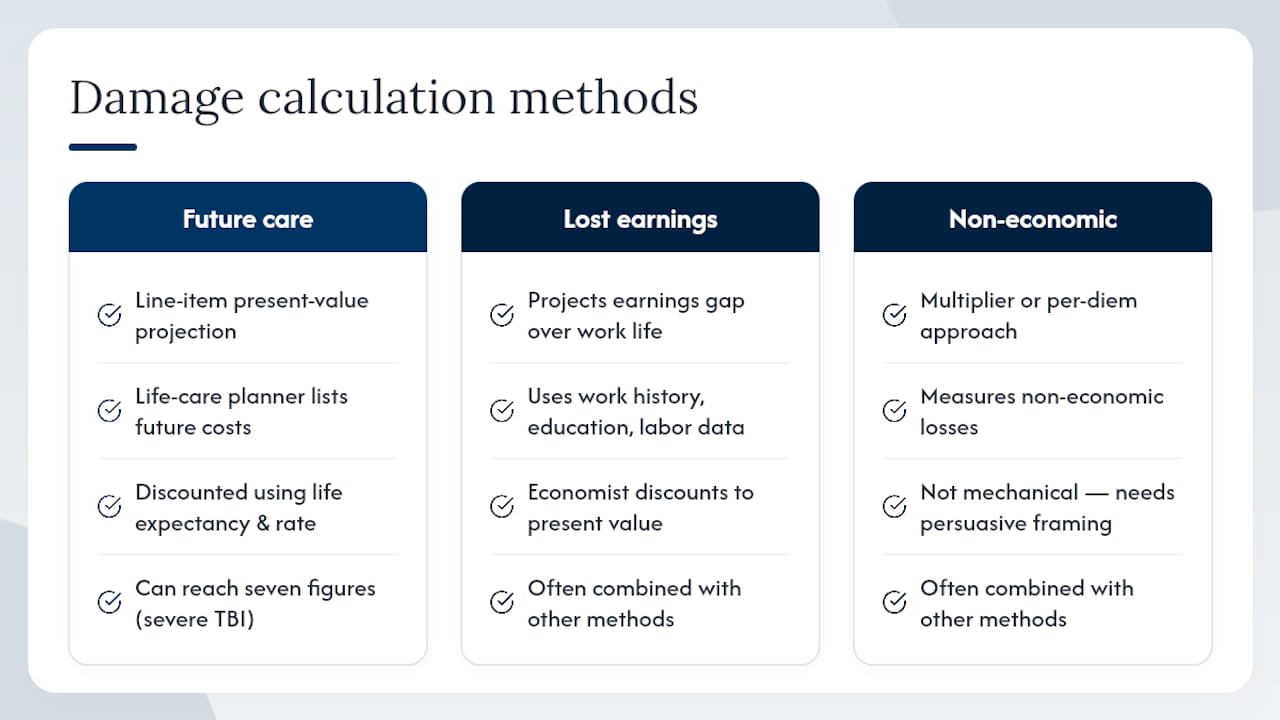
1. Line-item present-value projection (future care)
The life-care planner lists every anticipated future cost: therapy sessions per year, home health aide hours, medication, specialist visits, and adaptive equipment. The forensic economist then discounts that total to present value using actuarial life expectancy and a discount rate. For a 35-year-old with severe TBI, this figure alone can reach seven figures. Research on TBI long-term outcomes confirms that rehabilitation and support needs after serious brain injury are extensive and sustained.
2. Lost-earnings projection
The vocational expert establishes the pre-injury earning capacity (using work history, education, and labor market data) and the post-injury capacity. The economist projects the gap over the remaining work-life expectancy and discounts it to present value.
3. Non-economic multiplier or per-diem approach
Neither method is mechanical; both require persuasive framing.
Worked example: moderate TBI from a motor vehicle collision
This example shows why policy limits matter so much. A case worth over a million dollars in damages may settle for $300,000 simply because that is all the coverage available. Identifying every available insurance source, including underinsured motorist coverage and umbrella policies, is one of the first things a skilled attorney does.
What does the timeline for a TBI case look like?
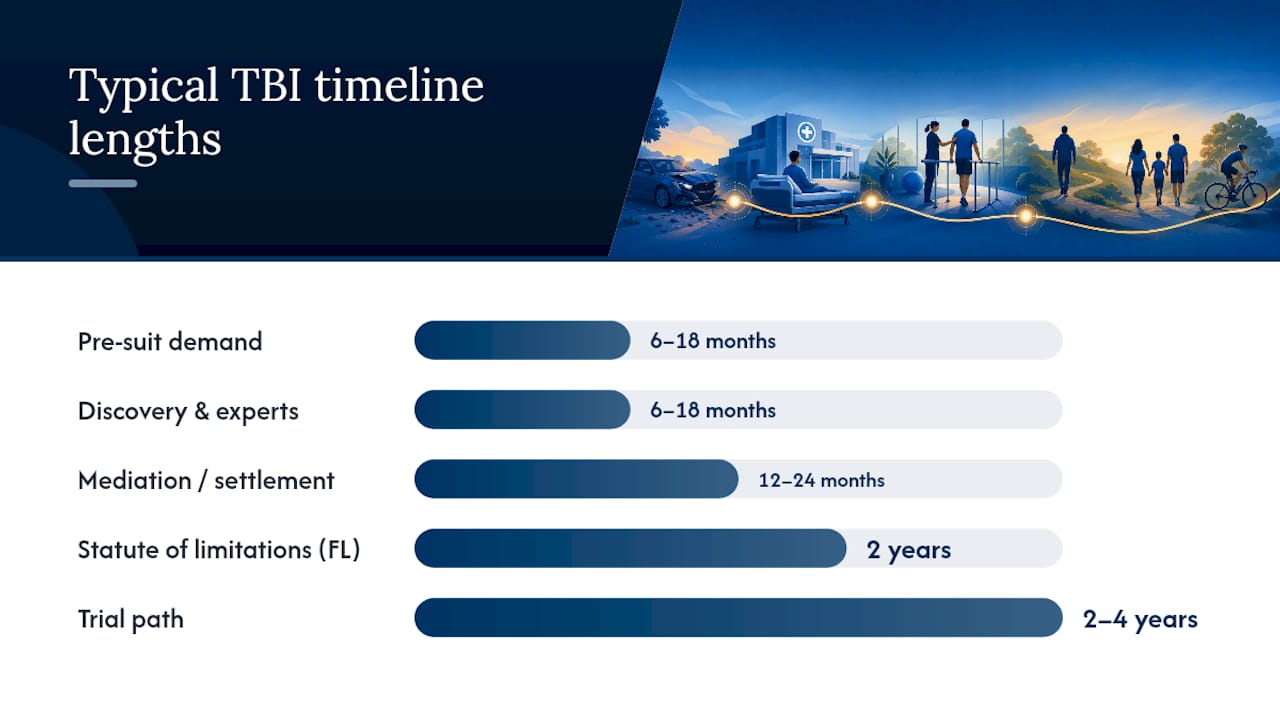
TBI cases take longer than most personal injury matters. Expect a minimum of one to two years for a negotiated settlement, and two to four years if the case goes to trial.
- Immediate care and documentation (Day 1 through medical stability): Seek emergency and follow-up care. Document every symptom, every provider, every prescription. This stage sets the medical foundation for the entire claim.
- Pre-suit demand (typically 6–18 months post-injury): Once your condition reaches maximum medical improvement (MMI), your attorney compiles a demand package with medical records, expert reports, and a damages calculation. The insurer has a statutory period to respond.
- Discovery and expert development (6–18 months after suit is filed): Both sides exchange documents, take depositions, and develop expert testimony. This is where neuropsychologists, life-care planners, and economists produce their formal reports.
- Mediation and settlement negotiations (often 12–24 months post-filing): Most TBI cases resolve at mediation. A neutral mediator facilitates negotiation between the parties. If a number is reached, the case settles. If not, the case proceeds toward trial.
- Trial (if needed): A TBI trial can last one to three weeks. Verdicts can exceed settlement offers substantially, but they can also come in lower. Trial is a calculated risk, not a guaranteed upgrade.
What commonly lengthens a case:
- Unresolved medical prognosis (waiting for MMI before valuing future care)
- Disputed liability (multiple defendants, comparative fault arguments)
- Discovery disputes over medical records or expert qualifications
- Court scheduling backlogs
Statute of limitations: In Florida, the general statute of limitations for personal injury claims is two years from the date of injury. Missing this deadline typically bars your claim entirely. Do not wait.
Why accepting a quick insurance offer after a TBI is risky
Insurance companies move fast after an accident. Their goal is to close your file before the full picture of your injury emerges. For TBI victims, that speed is particularly dangerous.
Mayo Clinic’s clinical overview of TBI documents how symptoms can persist and evolve well beyond the initial injury period. Post-concussion syndrome, cognitive fatigue, mood disorders, and sleep disruption often appear or worsen weeks after the event. A clinical review on persistent post-concussion symptoms confirms these patterns are common enough to materially affect both valuation and the need for neuropsychological testing.
Once you sign a broad medical release and accept a settlement, that case is closed. No future surgery, no emerging cognitive deficit, no worsening psychiatric condition can be brought back to the table.
Red flags in early offers:
- A lump-sum offer within days or weeks of the injury, before any neuropsych evaluation
- Broad release language that covers “all known and unknown claims”
- Pressure to settle before you’ve reached maximum medical improvement
- Requests to provide a recorded statement without your attorney present
- Offers that cover only past medical bills, ignoring future care entirely
The Brain Injury Association of America recommends satisfying specific clinical and legal checkpoints before accepting any settlement, including confirmation of MMI, completion of neuropsychological testing, and a life-care plan review.
How does an experienced TBI attorney increase your recovery?
The gap between what an unrepresented claimant receives and what a represented claimant recovers in serious TBI cases is substantial. Attorneys who handle brain injury litigation bring tools that most individuals simply cannot replicate on their own.
What a skilled TBI attorney does for your case:
- Retains and coordinates a team of experts: life-care planner, vocational expert, forensic economist, neuropsychologist
- Identifies every available insurance source (defendant’s liability, umbrella, underinsured motorist, employer policies)
- Handles Medicare and Medicaid lien resolution, which is required before any settlement can be finalized
- Structures settlements to protect long-term financial security (structured payments, Medicare Set-Aside accounts)
- Prepares the case for trial from day one, which gives the attorney genuine negotiating leverage at mediation
Contingency fees: TBI attorneys in Florida and most states work on contingency, meaning you pay no upfront fees. The attorney advances the cost of experts, filing fees, and litigation expenses. If there is no recovery, you owe nothing.
Questions to ask when interviewing a TBI attorney:
- Are you Board Certified in civil trial law or a recognized specialty?
- Have you taken TBI cases to verdict, not just settlement?
- Do you have established relationships with life-care planners and neuropsychologists?
- How do you handle cases where the defendant’s policy limits are insufficient?
- What is your fee structure, and how are litigation costs handled?
Pro Tip: Trial experience is the single most important credential to verify. An attorney who has never tried a serious injury case to verdict has limited leverage at the negotiating table. Insurers know which attorneys will actually go to trial.
How to protect your case value during negotiations
Negotiation in a TBI case is not a single conversation. It is a months-long process shaped by the strength of your documentation, the credibility of your experts, and your attorney’s willingness to go to trial.
Actions that preserve and increase value:
- Complete all recommended medical treatment and attend every follow-up appointment
- Undergo formal neuropsychological testing to document cognitive deficits objectively
- Obtain a timely vocational assessment if your ability to work has changed
- Maintain a daily symptom journal throughout your recovery
- Preserve all physical evidence of the accident and the scene
Common insurer tactics and how to counter them:
- Lowball first offer: Counter with a fully documented demand package supported by expert reports. Never negotiate down from their number; negotiate up from yours.
- Broad release language: Refuse any release that covers unknown future claims until your condition is fully stabilized and documented.
- Quick lump-sum pressure: Recognize this as a signal that the insurer knows your case is worth more. Slow down, not speed up.
- Mischaracterizing medical records: Have your attorney review every summary the insurer produces. Adjusters sometimes selectively quote records to minimize severity.
What to refuse during settlement talks:
- Recorded statements to the opposing insurer without your attorney present
- Signing any document before your attorney reviews it
- Accepting payment that does not account for future medical care
Understanding how insurers behave after a lawsuit is filed can help you anticipate their moves and respond strategically.
Real-world TBI verdicts and settlements: what the numbers show
No two TBI cases produce the same result. The following examples illustrate how facts, severity, and liability combine to produce vastly different outcomes.
What these examples reveal:
- A young plaintiff with permanent deficits and a clear liability picture commands the highest recoveries.
- Commercial defendants (trucking companies, property owners with umbrella coverage) often have deeper policy limits, which directly affects maximum recovery.
- A moderate TBI with full recovery and disputed liability may settle for less than a mild TBI with documented, persistent cognitive loss.
These figures are illustrative of real-world variability, not guarantees. Your recovery depends on your specific facts. For a closer look at how auto accident compensation is calculated, the range of outcomes in vehicle collision cases follows similar patterns.
Why Calillaw is built for serious brain injury claims
Calillaw Trial Attorneys is led by a Board Certified Civil Trial Lawyer with decades of courtroom experience in catastrophic injury litigation. It signals not just knowledge of the law, but demonstrated trial competence reviewed by peers and tested in court.
How Calillaw builds a TBI case:
- Early medical strategy to ensure the right specialists are involved from the start
- Coordination of a full expert roster: life-care planners, forensic economists, neuropsychologists, and vocational experts
- Identification of all available insurance sources, including underinsured motorist and umbrella coverage
- Medicare and Medicaid lien resolution handled in-house as part of case preparation
- Settlement structure expertise, including structured payment arrangements and Medicare Set-Aside accounts for long-term financial protection
The firm handles motor vehicle collisions, premises liability, catastrophic injury claims, and wrongful death cases throughout Florida. For clients facing a catastrophic injury claim, the firm’s approach to life-care planning and structured settlements is central to every serious case.
Calillaw works on a contingency-fee basis. No upfront costs, no fees unless you recover. Your focus should be on your health. We handle the rest.
How comparative negligence affects your TBI settlement
If you were partially at fault for the accident that caused your TBI, your recovery is reduced proportionally under Florida’s comparative negligence system.
That reduction is significant, and it is one reason why liability investigation matters as much as damages calculation. Florida’s comparative negligence framework governs how shared fault is allocated in personal injury cases, and the rules changed materially in 2023.
Insurers routinely argue that the injured party shares fault, precisely because it reduces what they owe. Your attorney’s job is to gather evidence that minimizes your assigned percentage and maximizes the defendant’s.
Settlement vs. trial: understanding the trade-off
Settling a TBI case offers certainty. A trial offers the possibility of a larger recovery, but it carries real risk.
Settlement advantages:
- Guaranteed recovery: you know the amount before you agree
- Faster resolution: avoids the additional one to three years a trial adds
- Lower litigation costs: expert fees and attorney time increase substantially through trial
- Privacy: settlement terms are typically confidential
Trial advantages:
- No ceiling imposed by policy limits (a jury can award any amount it finds appropriate)
- Non-economic damages can be substantially higher when a jury hears the full human story
- Punitive damages may be available in cases involving egregious conduct
Trial risks:
- A jury may award less than the settlement offer, or nothing at all
- Verdicts can be appealed, delaying payment by years
- The emotional toll of litigation on injured plaintiffs and their families is real
The decision to settle or go to trial is never simple. It depends on the strength of liability evidence, the credibility of your experts, the defendant’s financial exposure, and your own tolerance for risk and delay. Calillaw’s guide to settlement vs. trial walks through this decision in detail for injury victims.
What actually determines success in a TBI case
The cases that produce the best outcomes share a pattern. It is not always the most severe injury that recovers the most. It is the case that is built most carefully, documented most thoroughly, and presented most persuasively.
Early neuropsychological testing changes the trajectory of a case. Objective cognitive data, not just a client’s self-report, gives the insurer and a jury something concrete to evaluate. When a neuropsychologist documents measurable deficits in memory, processing speed, and executive function, the claim moves from “he says he has headaches” to “the testing shows a 2-standard-deviation drop in processing speed that correlates with his inability to return to his prior work.”
Life-care planning is the second lever most people underestimate. A well-constructed life-care plan from a credentialed planner, reviewed by a forensic economist, can add hundreds of thousands of dollars to a moderate TBI claim and millions to a severe one. Inpatient acute rehabilitation costs alone illustrate why these projections carry so much weight in settlement negotiations.
Trial readiness is the third factor. Insurers settle cases they are afraid to try. When your attorney has a track record of taking cases to verdict and the expert team to support it, the negotiating dynamic shifts. Every case is fact-specific, and no article can substitute for a lawyer’s assessment of your individual situation. Get that assessment early.
Calillaw is ready to evaluate your TBI claim today
A serious brain injury changes everything. The medical bills, the lost income, the uncertainty about your future — none of it should fall on you alone when someone else’s negligence caused the harm. Calillaw Trial Attorneys represents TBI victims throughout Florida on a contingency-fee basis, meaning you pay nothing unless we recover for you.

To request a free case evaluation, contact Calillaw directly by phone or through the personal injury intake form. When you reach out, bring your medical records, accident reports, any insurance correspondence you’ve received, and a written summary of how your symptoms have affected your daily life. That first conversation costs you nothing and can clarify exactly where your case stands.
Primary sources and further reading
These are the authoritative references behind the medical, legal, and advocacy guidance in this article.
- CDC TBI Public Report: The primary epidemiological source on TBI prevalence, severity distribution, and long-term disability rates in the United States. Essential for understanding why severity drives settlement value.
- NCBI/PMC — Persistent post-concussion symptoms review: Peer-reviewed clinical literature on post-concussion syndrome and why neuropsychological testing is necessary for accurate valuation.
- NCBI/PMC — TBI long-term outcomes and care: Research on rehabilitation needs and long-term care costs, which underpin life-care plan projections in serious cases.
- Cornell Law — Compensatory damages: The legal definition and framework for economic and non-economic damages, which governs how every TBI settlement is structured.
- Mayo Clinic — TBI symptoms and causes: Clinical overview of TBI symptom presentation and recovery timelines, supporting the guidance on documentation and medical follow-up.
- Brain Injury Association of America — Should I accept a TBI settlement?: Practical advocacy guidance on the clinical and legal checkpoints to satisfy before accepting any settlement offer.
- BIAUSA — Inpatient acute rehabilitation costs: Data on acute rehabilitation costs that illustrate why lifetime care projections are the largest component of serious TBI claims.
- Johns Hopkins Medicine — Rehabilitation after TBI: Clinical guidance on rehabilitation pathways and supportive therapies that should be reflected in a thorough life-care plan.
This article is general information, not a substitute for advice from a qualified lawyer. Consult a qualified legal professional about your own circumstances before acting on anything here.
Sources
- Centers for Disease Control and Prevention — TBI public report
- NCBI / PMC — Clinical review on concussion and persistent symptoms
- Cornell Law — Compensatory damages
- BIAUSA — Should I accept a traumatic brain injury settlement?


