 Skip to Content

Traumatic Brain Injury Claim Explained: Your Legal Guide
A traumatic brain injury claim is a legal action filed to obtain compensation for brain damage caused by someone else’s negligence. Known formally as a personal injury claim or TBI lawsuit, this process requires proving that another party’s careless or reckless conduct directly caused your injury and resulting losses. Approximately 2.8 million Americans sustain a TBI annually, with 75%–80% classified as mild at the time of injury. That classification is misleading. Many of those individuals face lifelong cognitive, emotional, and physical consequences. Understanding the traumatic brain injury claim explained here gives you a foundation for protecting your rights before critical legal deadlines pass.
What evidence is essential to prove a traumatic brain injury claim?
TBI claims are uniquely difficult to prove because the injury is often invisible. A broken arm shows up on an X-ray. A damaged frontal lobe may not appear on a standard MRI or CT scan. That gap between real suffering and visible proof is where many claims fail without proper legal and medical preparation.
Building a strong case requires what legal and medical professionals call a multidisciplinary “fortress of evidence” combining medical records, expert testimony, and neuropsychological testing. Each layer of evidence serves a distinct purpose. Medical records establish the injury occurred. Expert testimony connects the mechanism of injury to the cognitive deficits. Neuropsychological testing quantifies how the brain is actually functioning.

Neuropsychological testing with embedded validity measures is the most critical tool in a TBI claim. Standard imaging often misses brain injury entirely. Neuropsychological assessments measure memory, attention, processing speed, and executive function. They also include symptom validity tests (SVTs) and performance validity tests (PVTs), which demonstrate that the claimant is putting forth genuine effort and is not exaggerating symptoms.
The core evidence categories for a TBI claim include:
- Medical records: Emergency room reports, imaging results, physician notes, and specialist evaluations documenting the injury timeline
- Accident reports: Police reports, workplace incident reports, or premises incident documentation establishing the negligent event
- Witness statements: Accounts from people who observed the accident or who can describe changes in your behavior and function after the injury
- Neuropsychological evaluations: Standardized cognitive testing conducted by a licensed neuropsychologist, with embedded validity measures
- Expert testimony: Medical experts, life care planners, and forensic economists who can explain injury causation and project future costs
- Longitudinal assessments: Sequential testing at multiple points post-injury to document recovery trajectory and permanent impairment
Early and ongoing neuropsychological assessments at 2–3 months, 6–12 months, and 18–24 months post-injury are necessary to capture whether deficits are improving or becoming permanent. A single evaluation taken too early may understate the injury. A single evaluation taken too late may miss the acute phase entirely.
Pro Tip: Never rely solely on self-reported symptoms. Ensure your neuropsychological evaluation follows a validated battery with embedded validity tests. This is the single most effective way to withstand a defense challenge.
How does the TBI legal process work from filing to resolution?
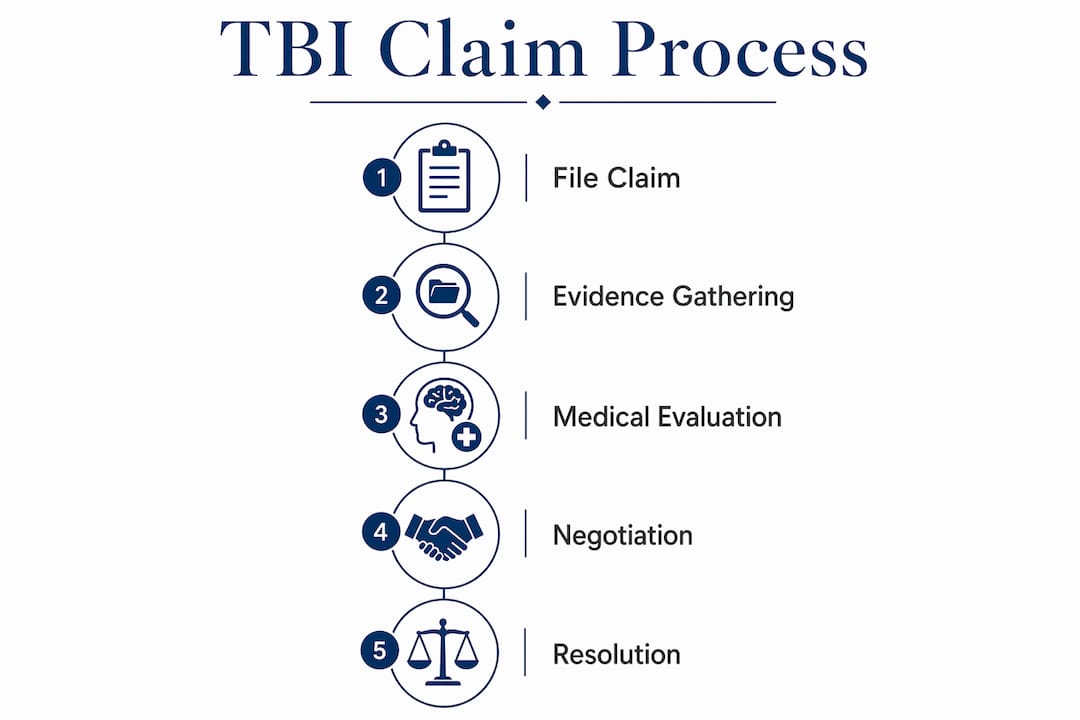
The TBI legal process follows a defined sequence of stages. Each stage has its own requirements, and missing a deadline at any point can permanently end your right to compensation.
-
Consult an attorney immediately. Early legal engagement protects your rights and preserves evidence. Waiting until you reach maximum medical improvement is a strategic mistake. Evidence degrades, witnesses become unavailable, and critical deadlines approach.
-
Understand your filing deadline. In Florida, the statute of limitations for negligence claims is now two years, reduced from four years under Florida HB 837, effective march 24, 2023. Filing after this deadline permanently bars your claim. Check the Florida personal injury statute of limitations for details specific to your case type.
-
Investigate liability and negligence. Your attorney evaluates who caused the injury and whether their conduct meets the legal standard for negligence. This includes reviewing accident reports, surveillance footage, and any applicable safety standards or regulations.
-
Send a Letter of Claim. Your attorney formally notifies the at-fault party and their insurer of your intent to seek compensation. This triggers the insurer’s obligation to investigate and respond.
-
Gather and organize evidence. This phase involves collecting all medical records, retaining expert witnesses, and commissioning neuropsychological evaluations. The strength of this phase determines the value of your claim.
-
Negotiate a settlement. Most TBI claims resolve through negotiation before trial. Your attorney presents the evidence, quantifies your damages, and negotiates with the insurer. Interim payments may be available for severe cases while the full claim is pending.
-
Proceed to trial if necessary. If the insurer refuses a fair offer, your attorney files a lawsuit and prepares for trial. TBI cases that go to trial typically involve severe injuries with disputed causation or high damages.
Timelines vary significantly. Mild TBI claims with clear liability may resolve within 12–18 months. Severe TBI cases involving life care plans and disputed causation can take three to five years. How long you have to file a claim in Florida depends on the specific facts of your case, so early legal advice is not optional.
What types of compensation can a TBI claim include?
Traumatic brain injury compensation covers a broad range of losses, both economic and non-economic. The categories below reflect what courts and insurers recognize as compensable damages in a TBI lawsuit.
Economic damages are measurable financial losses. They include:
- Emergency department treatment, hospitalization, surgery, and rehabilitation
- Ongoing specialist care, medication, and therapy
- Lost wages from time missed at work during recovery
- Diminished earning capacity if the injury prevents you from returning to your prior occupation
The cost data here is significant. Nonfatal TBI treated in emergency departments costs an average of $4,530 in medical spending plus $1,500 in lost work. Inpatient cases are far more serious, averaging $51,241 in medical costs and $6,110 in lost work. These figures represent only the acute phase. Long-term care costs can dwarf initial treatment expenses.
Non-economic damages cover losses that do not come with a receipt. Pain and suffering, emotional distress, cognitive impairment, loss of enjoyment of life, and the impact on personal relationships all fall into this category. These damages are harder to quantify but often represent the largest portion of a TBI settlement.
For severe TBI cases, life care planners and forensic economists play a central role. Settlement values for severe TBI cases can reach $2 million to over $6 million, driven by life care plans that project future attendant care, assistive technology, home modifications, and lost income over decades. The question courts and insurers focus on is whether the injured person can live independently and work. The answer to that question shapes the entire valuation. You can learn more about available damages for injury victims to understand how these categories apply to your situation.
What are the common challenges in TBI claims?
TBI claims face a specific set of defense tactics that injured people are rarely prepared for. Knowing these challenges in advance gives you and your attorney the ability to address them before they undermine your case.
-
Malingering allegations. Defense teams routinely accuse TBI claimants of exaggerating or fabricating symptoms. Objective neuropsychological data and longitudinal documentation are the primary defense against this tactic. A neuropsychological report that includes SVTs and PVTs makes malingering allegations very difficult to sustain.
-
Causation disputes. Insurers frequently argue that your cognitive deficits existed before the accident or resulted from a different cause. Connecting the specific mechanism of injury to your specific deficits requires expert testimony and a clear medical timeline.
-
Undervaluing mild TBI. The word “mild” in a clinical classification does not mean minor in legal terms. Mild TBI can produce lasting memory problems, chronic headaches, depression, and inability to work. Claims that accept the “mild” label without thorough documentation routinely settle for far less than the injury warrants.
-
Statute of limitations pitfalls. Delayed claims are one of the most common and preventable mistakes. Florida’s two-year deadline is firm. Missing it ends your claim regardless of how strong your evidence is.
-
Incomplete documentation. A single neuropsychological evaluation, taken at one point in time, rarely tells the full story. Defense attorneys exploit gaps in documentation. Sequential assessments across the recovery period close those gaps.
Pro Tip: Retain a neuropsychologist who specializes in forensic evaluations, not just clinical treatment. A clinically focused report and a legally defensible report are not the same document.
Key Takeaways
A TBI claim succeeds when it combines timely legal action, multidisciplinary evidence, and accurate damage valuation from the earliest stage of recovery.
| Point | Details |
|---|---|
| File before the deadline | Florida’s statute of limitations is two years; missing it permanently bars your claim. |
| Build layered evidence | Combine medical records, accident reports, witness statements, and neuropsychological testing. |
| Use longitudinal assessments | Test at 2–3 months, 6–12 months, and 18–24 months to document permanent impairment. |
| Quantify all damage categories | Include medical costs, lost wages, future care needs, and non-economic losses. |
| Engage an attorney early | Early legal involvement preserves evidence and maximizes claim value. |
What I’ve learned after years of TBI cases
The most consistent mistake I see injured people make is waiting. They wait for a diagnosis to stabilize. They wait to see if symptoms improve. They wait until they feel ready to deal with the legal process. Every week of waiting costs them something: evidence that disappears, witnesses whose memories fade, and deadlines that creep closer.
The second mistake is treating a TBI claim like a standard personal injury case. It is not. The injury’s invisible nature means the legal team must work harder, not just to prove damages, but to prove the injury itself. That requires a level of coordination between attorneys, neuropsychologists, life care planners, and forensic economists that most people do not anticipate going in.
What I find most important to communicate is this: the legal value of your claim is not determined by how bad you feel. It is determined by how well your suffering is documented, quantified, and presented. Two people with identical injuries can receive dramatically different outcomes based entirely on the quality of their evidence and the experience of their legal team.
The emotional weight of a TBI is real. Cognitive changes affect identity, relationships, and independence in ways that are genuinely devastating. A well-prepared claim honors that reality by translating it into a form that courts and insurers are required to take seriously. That translation is the work. Do not underestimate how much it matters.
— Jorge
Calillaw’s approach to serious brain injury cases
Serious brain injury cases require attorneys who understand both the medical complexity and the legal strategy involved. Calillaw is a Florida litigation firm led by a Board Certified Civil Trial Lawyer with decades of courtroom experience in catastrophic personal injury claims, including traumatic brain injuries caused by motor vehicle collisions, premises liability incidents, and workplace accidents.

Calillaw works with neuropsychologists, life care planners, and medical experts to build the kind of thorough, defensible case that holds up under aggressive defense tactics. The firm offers a free case evaluation so you can understand your rights and options without any upfront cost. If you or someone you care about has suffered a brain injury due to negligence, contact Calillaw before the statute of limitations closes your window to act.
FAQ
What is a traumatic brain injury claim?
A traumatic brain injury claim is a legal action seeking compensation for brain damage caused by another party’s negligence. It requires proving causation, documenting injury and damages, and filing within the applicable statute of limitations.
How long do I have to file a TBI claim in Florida?
Florida’s statute of limitations for negligence claims is two years from the date of injury, following the 2023 reform under Florida HB 837. Filing after this deadline permanently bars recovery.
What does neuropsychological testing do for a TBI claim?
Neuropsychological testing measures cognitive deficits such as memory loss, attention problems, and reduced processing speed. Tests with embedded validity measures also counter defense allegations of malingering by demonstrating genuine claimant effort.
How much is a TBI claim worth?
Compensation varies widely based on injury severity, medical costs, lost income, and future care needs. Severe TBI settlements can reach $2 million to over $6 million when life care plans project long-term attendant care and lost earning capacity.
Do I need an attorney to file a TBI claim?
Retaining an experienced attorney is critical for a TBI claim. The evidentiary requirements, expert coordination, negotiation strategy, and legal deadlines involved make self-representation a significant risk to your recovery and your compensation.
Recommended
- Know What To Do In An Event of A Car Accident and Why You Should Hire An Experienced Attorney – Calil Law
- Navigating Slip and Fall Settlements with Surgery: A Guide
- What does the process look like for a car accident victim looking to get compensation by hiring a car accident lawyer? – Calil Law
- A Guide to Florida Slip-and-Fall Knee Injury Settlements and Claims


