 Skip to Content

Uber Driver Accident Liability Explained for Injured Riders
When an Uber driver causes a crash, the single fact that controls everything is whether the Uber app was active at the moment of impact. That one data point determines which insurance layer pays, how much coverage is available, and who you file your claim against. In most cases, liability falls on the at-fault driver, but the coverage source shifts dramatically depending on the app’s status.
Here is the short verdict by app period:
- App off (offline): The driver’s personal auto policy is the only coverage available. Uber’s insurance does not apply at all.
- App on, waiting for a ride request: Uber provides contingent liability coverage for third-party injury and property damage, but only if the driver’s personal policy denies the claim or its limits are exhausted.
- Ride accepted or passenger onboard: Uber’s primary commercial liability policy responds, providing substantial coverage for third-party bodily injury and property damage, plus contingent collision/comprehensive and uninsured/underinsured motorist (UM/UIM) protection.
Pro Tip: The moment a crash happens, screenshot or photograph the Uber app screen on the driver’s phone before it locks or resets. That timestamp is often the strongest single piece of evidence proving which coverage period applies.
Table of Contents
- How Uber’s insurance layers work based on the driver’s app status
- How courts and insurers determine legal fault in an Uber crash
- What you should do immediately after an Uber accident
- How to file claims and what compensation you can recover
- When can you sue Uber directly as a company?
- Why insurers deny or underpay Uber claims, and how to fight back
- What evidence proves the Uber app status and how to get it
- How experienced trial lawyers evaluate and build Uber accident cases
- Key Takeaways
- A trial lawyer’s perspective on what actually decides these cases
- Calil Law is ready to fight for your rideshare accident recovery
- Useful sources
How Uber’s insurance layers work based on the driver’s app status
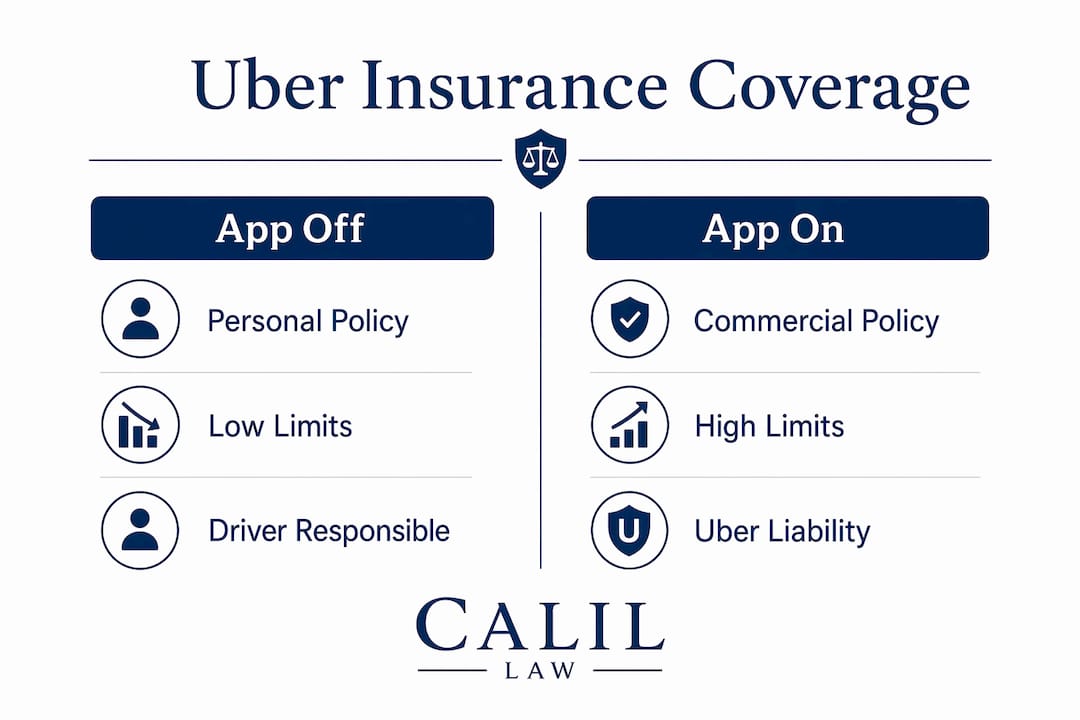
Understanding which policy pays first requires knowing how Uber structures its tiered insurance coverage across three distinct periods. The table below maps each period to the payer, typical coverage limits, and available protections.

| App Status | Who Pays First | Typical Liability Limits | Collision/Comprehensive | UM/UIM Available |
|---|---|---|---|---|
| Offline (app off) | Driver’s personal insurer | Personal policy limits only | Personal policy only | Personal policy only |
| App on, waiting for request | Uber contingent liability | Lower contingent limits (varies by state) | Not available through Uber | Contingent, varies by state |
| Ride accepted / passenger onboard | Uber primary commercial policy | Significant third-party liability coverage | Yes, if driver carries it personally (deductible applies) | Yes, per state requirements |
The app-status determination is dispositive for coverage questions. Courts and insurers treat it as the threshold fact before anything else is analyzed.
State variation matters. Coverage minimums, UM/UIM requirements, and the conditions under which Uber’s contingent policy activates all depend on the controlling state statute. California’s SB 371, effective January 1, 2026, altered certain UM/UIM thresholds for transportation network companies (TNCs) in specific loss scenarios. What applies in Florida may differ significantly from what applies in California or Texas. Always confirm your state’s TNC statute rather than relying on national averages.
Common exceptions that can shift primary responsibility include:
- Personal policy TNC exclusions: Many personal auto policies explicitly exclude coverage when the driver is logged into a rideshare app. If the driver was in Period 1 (app on, waiting) and their personal insurer invokes this exclusion, Uber’s contingent policy becomes the only available coverage.
- Fraudulent app reporting: If a driver falsely claims the app was active to trigger Uber’s coverage, insurers investigate trip logs and GPS records to verify the claim.
- Commercial plates or livery vehicles: Uber’s standard rideshare insurance does not apply to commercially licensed livery drivers operating under a different regulatory framework.
Pro Tip: Ask the responding officer to note the driver’s phone status in the police report. A contemporaneous official record of the app being active is far harder for an insurer to challenge than a statement made days later.
How courts and insurers determine legal fault in an Uber crash
Liability in an Uber accident follows the same negligence framework as any other motor vehicle collision, but with added complexity. To establish negligence, an injured party must prove four elements: the driver owed a duty of care, the driver breached that duty, the breach caused the crash, and the crash caused measurable damages.
Negligence per se simplifies that analysis when a driver violates a specific traffic statute. If the Uber driver ran a red light, was driving under the influence, or exceeded the speed limit, proving the statutory violation may be enough to establish breach of duty without reconstructing the entire sequence of events. The violation itself becomes the proof of negligence.
Florida and most other states apply comparative fault, which means your recovery is reduced by your own percentage of fault. If you are found 20% responsible for the crash, your recoverable damages are reduced by 20%. Some states use pure comparative fault (you can recover even if 99% at fault); others use modified comparative fault (you are barred from recovery if your fault exceeds 50% or 51%). Knowing which rule applies in your state directly affects your claim’s value.
Common driver mistakes that often trigger negligence per se or straightforward liability findings include driving under the influence, which significantly strengthens your position in a rideshare accident claim.
- Distracted driving (texting while waiting for or completing a ride request)
- Driving under the influence of alcohol or drugs
- Running traffic signals or failing to yield
- Excessive speed in a rideshare zone or school zone
- Failure to check mirrors before changing lanes while a passenger is onboard
One point that surprises many people: liability and coverage are separate legal questions. A driver can be fully liable for your injuries even if their insurer denies coverage. That denial does not erase the driver’s personal legal obligation to compensate you. It simply means you may need to pursue other avenues, including Uber’s policy, UM/UIM coverage, or a direct lawsuit against the driver.
Pro Tip: If the driver received a citation at the scene, preserve that citation number and request the full traffic citation report. A DUI charge or a citation for running a stop sign can be the foundation of a negligence per se argument, which significantly strengthens your position before any insurer or jury. Phone forensics, which can show the driver was texting at the moment of impact, serve a similar function.
What you should do immediately after an Uber accident
The actions you take in the first minutes and hours after a crash shape the strength of every claim that follows. Here is the ordered checklist that matters most.
- Prioritize safety and medical care. Move to a safe location if possible. Call 911 immediately, even if injuries seem minor. Adrenaline masks pain, and symptoms like whiplash or internal injuries often appear hours later.
- Request a police report. Ask the responding officer to document the Uber driver’s app status, vehicle information, and any citations issued. Get the report number before you leave the scene.
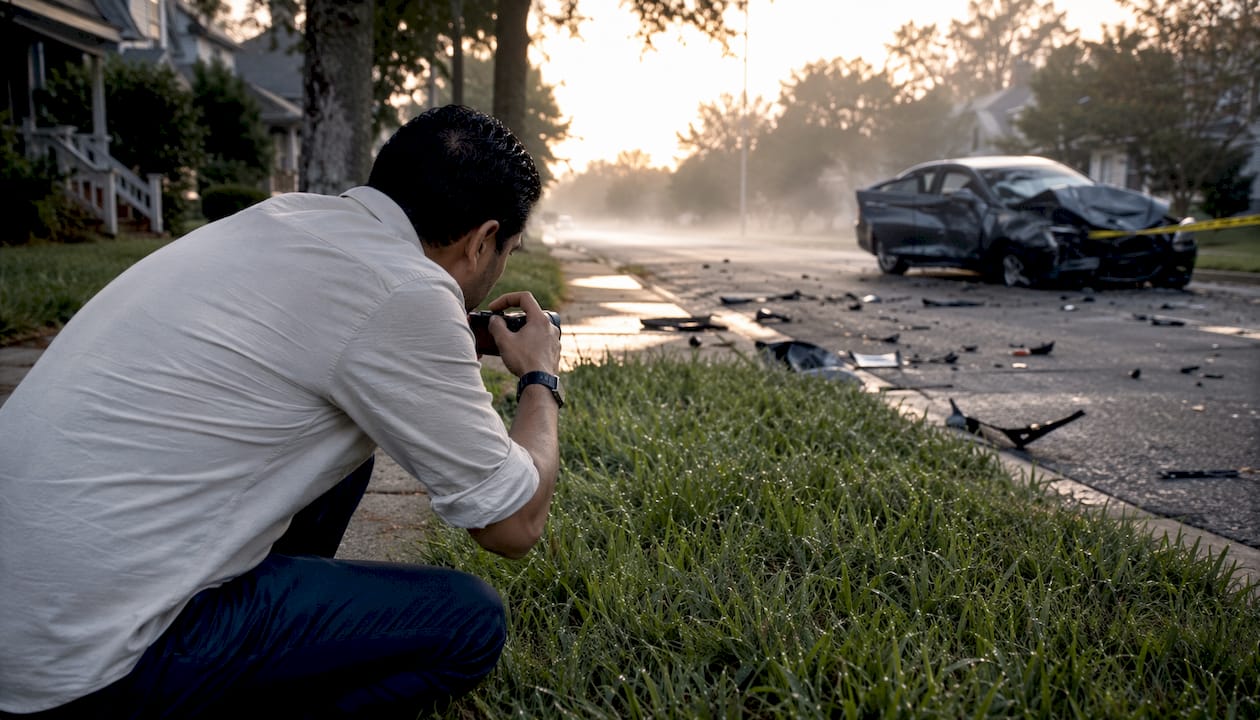
- Photograph everything. Capture the vehicle positions, damage, license plates, road conditions, traffic signals, and any visible injuries. Photograph the driver’s Uber app screen if it is still visible.
- Collect witness contact information. Names and phone numbers from bystanders who saw the crash can be decisive when the driver disputes what happened.
- Document the driver’s statements. Note anything the driver says at the scene, including admissions of distraction or fault. Write it down immediately.
- Seek medical evaluation the same day. A gap between the crash and your first medical visit gives insurers an argument that your injuries were not caused by the collision.
- Report the crash to Uber. Uber’s crash reporting process runs through the Driver app’s Safety Toolkit. As an injured passenger or third party, you can also report through Uber’s support channels.
- Notify your own insurer. Report the crash promptly. Delayed notice can trigger a late-notice defense that complicates your own UM/UIM claim.
- Request preservation of trip data. Send a written request to Uber and any relevant insurer asking them to preserve all trip logs, GPS records, and app data related to the crash. Do this within days, not weeks.
When reporting to your insurer or Uber, state the basic facts: date, time, location, the vehicles involved, and that you are seeking medical care. Do not speculate about fault, minimize your injuries, or give a recorded statement without first speaking to an attorney.
Evidence like surveillance footage from nearby businesses and traffic cameras is often overwritten within 30 days. Trip data on Uber’s servers has its own retention schedule. The early preservation of app data is one of the most time-sensitive actions in any rideshare claim.
Pro Tip: Do not give a recorded statement to any insurer, including your own, before consulting an attorney. Recorded statements are used to lock you into a version of events that insurers later use to minimize your claim. A single poorly worded answer about your prior health history can be used to dispute every injury you suffered.
How to file claims and what compensation you can recover
Filing a claim after an Uber crash involves multiple potential sources of recovery, and the right sequence depends on who was at fault and which coverage period applied.
Step 1: File against the at-fault driver’s insurer. If the Uber driver caused the crash while the app was off, their personal auto policy is the only available coverage. If the app was active, Uber’s contingent or primary commercial policy layers in depending on the period.
Step 2: Trigger Uber’s commercial policy when applicable. For crashes during an accepted trip or with a passenger onboard, Uber’s primary commercial liability policy provides substantial third-party coverage. Passengers injured during an on-trip crash typically have direct access to this policy. The claims process for passengers proceeds against the at-fault driver or, when the Uber driver is responsible, against Uber’s primary commercial policy.
Step 3: File a UM/UIM claim if the at-fault driver is uninsured or underinsured. If another driver caused the crash and lacks sufficient coverage, your own UM/UIM policy or Uber’s UM/UIM coverage (available during active periods) may fill the gap.
Recoverable damages in a rideshare accident claim typically include:
- Medical expenses, past and future (emergency care, surgery, rehabilitation, medication)
- Lost wages and diminished earning capacity
- Pain and suffering and emotional distress
- Property damage to your vehicle or personal belongings
- Future care costs for permanent or long-term injuries
- Non-economic losses such as loss of enjoyment of life
For timeline expectations, insurer acknowledgment of a claim typically occurs within a few weeks of filing, but negotiation and resolution can take months to years depending on injury severity and whether litigation is required. Florida’s statute of limitations for personal injury claims is two years from the date of the crash. Missing that deadline bars your claim entirely. For a detailed look at how long Uber settlements take in Florida, the timeline varies considerably based on case complexity and insurer conduct.
Organize your documentation from day one: keep all medical records and bills, wage statements from your employer, repair estimates, and a personal injury journal documenting daily pain levels and limitations. Each damage category requires its own evidentiary foundation.
When can you sue Uber directly as a company?
Uber classifies its drivers as independent contractors, which limits but does not eliminate the company’s direct legal exposure. Several legal theories can support naming Uber as a defendant.
Negligent hiring and retention is the most commonly pursued corporate theory. If Uber failed to conduct adequate background checks, retained a driver with a documented history of dangerous driving, or ignored red flags about a specific driver’s conduct, the company may be directly liable for the harm that driver caused. These claims target Uber’s corporate resources and policies rather than just the driver’s personal negligence.
Negligent supervision applies when Uber had the ability and obligation to monitor driver behavior and failed to act on known problems. This can include ignoring passenger complaints, failing to deactivate a driver after reported incidents, or inadequate safety protocols.
Respondeat superior (employer liability for employee acts) is harder to apply given the independent-contractor classification, but some states and some fact patterns allow it. When a court finds that Uber exercised sufficient control over the driver’s work, the contractor label may not shield the company.
App design defects represent an emerging theory. If the Uber app’s design contributed to the crash (for example, by requiring driver interaction at unsafe moments), a products liability or negligent design claim may be viable.
State law shapes all of these theories significantly. Some states impose direct statutory duties on TNCs that go beyond what common law negligence requires. California’s legislative activity around TNC obligations is one example of how quickly the legal landscape can shift.
Common fact patterns that support a direct corporate claim:
- A driver with prior DUI convictions that Uber’s screening should have caught
- Multiple passenger complaints about a specific driver that went unaddressed before a serious crash
- Evidence that Uber’s app prompted dangerous driver interaction at high-speed moments
Pro Tip: Request Uber’s driver screening records, complaint logs, and app interaction data early in discovery. Corporate defendants often resist producing these records, and a court order may be required. An attorney experienced in TNC litigation knows exactly which requests to serve and how to enforce them.
Why insurers deny or underpay Uber claims, and how to fight back
Insurer resistance in rideshare cases follows predictable patterns. Knowing the defenses in advance lets you build the evidence to counter them before the dispute even starts.
Common defenses insurers use:
- App-status denial: The insurer claims the driver was not logged in at the time of the crash, placing the claim outside Uber’s coverage period.
- Personal-policy TNC exclusion: The driver’s personal insurer denies coverage because the driver was using the vehicle for a commercial rideshare purpose.
- Comparative fault arguments: The insurer attributes a portion of the crash to your own conduct to reduce the payout.
- Preexisting condition disputes: The insurer argues your injuries predated the crash or were aggravated rather than caused by it.
- Late-notice defense: The insurer claims you failed to report the crash promptly, prejudicing their ability to investigate.
The evidence that counters these defenses is largely the same evidence you should be collecting from day one: trip-log screenshots, the police report, contemporaneous medical records, and witness statements. Each defense has a specific evidentiary answer.
Coverage denials and liability denials are different problems. A coverage denial says the policy does not apply to this situation. A liability denial says the insured driver did nothing wrong. Each requires a different legal response. A coverage denial may require a declaratory judgment action or a bad-faith insurance claim. A liability denial requires building the negligence case through evidence and, if necessary, trial.
Pro Tip: If an insurer denies your claim in bad faith, meaning without a reasonable basis or after unreasonable delay, you may have a separate bad-faith insurance claim against the insurer itself. Document every communication, every delay, and every denial letter. That paper trail becomes the foundation of a bad-faith case if the insurer’s conduct crosses the line.
What evidence proves the Uber app status and how to get it
The app status at the moment of the crash is the dispositive fact in most rideshare liability disputes. Here is the evidence that proves it and how to obtain each piece.
High-value evidence in Uber accident cases:
- Driver app logs: Uber’s server records show when the app was active, when a trip was accepted, and when it ended. These are the gold standard for proving coverage period.
- GPS timestamps: The driver’s phone GPS data tracks location and movement in real time. Combined with app logs, it can place the driver on a specific route at a specific moment.
- Police report: A contemporaneous official record noting the driver’s app status or phone condition carries significant weight.
- Dashcam and body camera footage: Many rideshare vehicles carry dashcams. Police body cameras from the responding officers may also capture the scene and the driver’s phone screen.
- Third-party surveillance: Nearby businesses, traffic cameras, and ATMs often capture footage of the crash location. This footage is typically overwritten within 30 days.
- Witness statements: Bystanders who saw the driver’s phone or the Uber app active provide independent corroboration.
- Phone records: Carrier records and device forensics can confirm whether the driver was using the Uber app, texting, or on a call at the moment of impact.
To request trip data from Uber, send a written preservation letter immediately after the crash. The letter should identify the date, time, and location of the crash, the driver’s name or vehicle information if known, and request that all trip logs, GPS records, and app data be preserved and not deleted. Send it via email to Uber’s legal or support channels and follow up in writing.
For phone records and device forensics, an attorney can issue a litigation hold letter and, if necessary, a subpoena to the driver’s carrier. Uber’s server records typically require a formal legal demand or court order. The sooner that process starts, the less likely critical data is to be lost.
Pro Tip: Send preservation letters to Uber, the driver’s personal insurer, and any third-party surveillance operators within the first week after the crash. Courts have sanctioned parties for failing to preserve evidence once they had notice of potential litigation, and that same principle works in your favor when you put Uber and insurers on notice early.
How experienced trial lawyers evaluate and build Uber accident cases
Rideshare accident cases are not standard car crash claims. They involve layered insurance structures, corporate defendants with significant resources, and evidence that can disappear within weeks. The way a law firm approaches the case from day one determines what recovery is possible.
What a trial-experienced law firm does in a rideshare case:
- Sends immediate preservation letters to Uber, the driver’s insurer, and third-party surveillance operators
- Retains forensic experts to analyze phone data, GPS records, and app logs
- Engages biomechanical experts to connect the crash mechanics to the specific injuries claimed
- Issues subpoenas for Uber’s driver screening records, complaint history, and app interaction data
- Evaluates corporate negligence theories (negligent hiring, retention, supervision) alongside driver negligence
- Monitors insurer conduct for bad-faith indicators and prepares coverage litigation if needed
In settlement negotiations, the clearest cases are those with a documented on-trip status, a police citation against the driver, strong medical records from the day of the crash, and quantified economic losses. Insurers settle faster and for more when the evidence leaves them little room to dispute liability or damages.
At trial, the narrative that resonates with juries is simple: the driver was working for Uber, Uber’s app was active, and the driver’s negligence caused your injuries. The corporate insurance structure exists precisely for this moment. Experienced trial counsel can file a claim against Uber in Florida and pursue every available layer of coverage through verdict if necessary.
If you are evaluating whether to retain counsel, the right time is before you give any recorded statement to any insurer. Bring the police report, any medical records you have, photos from the scene, and the Uber trip receipt if you were a passenger. That is enough to start a meaningful case evaluation.
Key Takeaways
The Uber app status at the moment of the crash is the single most important fact in any rideshare accident claim, because it controls which insurance layer responds and how much coverage is available.
| Point | Details |
|---|---|
| App status controls coverage | Offline means personal policy only; waiting means Uber contingent coverage; on-trip means Uber primary commercial liability coverage. |
| Preserve evidence immediately | Screenshot the app screen, request a police report, and send preservation letters to Uber within days of the crash. |
| Negligence per se simplifies fault | A driver citation for DUI or a traffic violation can establish breach of duty without complex reconstruction. |
| Multiple claim routes exist | You may file against the driver’s insurer, Uber’s commercial policy, or your own UM/UIM coverage depending on who caused the crash. |
| Calillaw handles rideshare claims | Calil Law’s Board Certified trial attorneys preserve app data, engage forensic experts, and pursue every coverage layer for injured clients in Florida. |
A trial lawyer’s perspective on what actually decides these cases
The conventional wisdom on rideshare accident claims focuses heavily on the insurance tiers, and that framework is accurate as far as it goes. But after handling these cases in Florida courts, the thing that actually separates recoveries is not which insurance layer technically applies. It is whether the injured person preserved the evidence to prove it.
Insurers know that app data degrades, surveillance footage gets overwritten, and witnesses become harder to locate with every passing week. Their claims process is designed to move slowly enough that some of that evidence disappears on its own. The clients who recover the most are the ones who treated the first week after the crash as a legal emergency, not just a medical one.
There is also a persistent underestimation of corporate liability theories. Most people assume Uber is untouchable because of the independent-contractor classification. That assumption costs injured people real money. Negligent hiring and retention claims, when the facts support them, reach a fundamentally different level of corporate accountability than a claim limited to the driver’s personal negligence. The question worth asking is not just “did the driver cause this crash?” but “did Uber put this driver on the road knowing what it should have known?”
The rideshare model is built on trust. When that trust is broken and someone is seriously hurt, the law provides real remedies. The challenge is having the legal team that knows how to access them before the evidence is gone.
Calil Law is ready to fight for your rideshare accident recovery
Serious rideshare injuries deserve serious legal representation. Calil Law Trial Attorneys, led by a Board Certified Civil Trial Lawyer with decades of Florida courtroom experience, represents injured riders, passengers, and third parties in Uber and Lyft accident claims throughout South Florida.
When you contact Calil Law, the first step is a free case evaluation. Bring whatever you have: the police report, medical records, photos from the scene, and your Uber trip receipt if you were a passenger. The firm moves quickly on evidence preservation, sending letters to Uber and relevant insurers within the first days of representation. You will not be left navigating insurer calls and recorded statements alone.
Whether your case resolves through a negotiated settlement or requires a jury verdict, Calil Law is built to take it the distance. If you were hurt in a rideshare crash and need to understand your personal injury rights and options, contact the firm today for a confidential consultation. Your life has value, and so does your claim.
Useful sources
- Uber Insurance for Rideshare and Delivery Drivers — Uber’s public summary of its tiered auto insurance coverage by app status, including contingent and primary liability periods.
- Insurance Maintained by Uber for US Rideshare Drivers — Uber’s detailed Help Center article covering coverage limits, collision availability, UM/UIM protections, and the deductible structure.
- Optional Injury Protection for Drivers — Uber’s supplemental driver-focused coverage option, including medical expense limits up to $1,000,000 and disability benefits.
- Negligence Per Se (Cornell Law School Wex) — Primary legal encyclopedia entry defining negligence per se and its application when a defendant violates a statute.
- Uber & Lyft Rideshare Accident Claims Guide — Comprehensive plaintiff-side guide explaining how app status determines coverage and what injured parties should do to preserve claims.
- SB 371 (California) Legislative Text — Full text of California’s 2026 TNC insurance legislation, showing how state law can alter UM/UIM thresholds and coverage obligations.
- Who Is Liable for an Uber/Lyft Car Accident? (Super Lawyers) — Attorney-authored overview of the three-period liability framework and practical examples of coverage scenarios.
- Rideshare Accidents (Daeryun Law) — Plaintiff-side practice guide emphasizing early evidence preservation, corporate negligence theories, and the independent-contractor defense.
- Negligent Hiring and Retention in Uber/Lyft Lawsuits (Makarem Law) — Detailed analysis of corporate liability theories targeting TNC hiring and retention practices in serious injury cases.
- Step-By-Step Guide to File a Claim Against Uber in Florida (Calil Law) — Florida-specific procedural guide for pursuing claims against Uber, including jurisdiction requirements and filing steps.
This article provides general legal information about Uber driver accident liability and insurance coverage in the United States. It is not legal advice for your specific situation. Laws and insurance requirements vary by state and change over time. Consult a qualified personal injury attorney and verify current TNC statutes in your state before making decisions about your claim.


