 Skip to Content

What Is a Conspiracy Claim: How to Recognize and Prove One
A civil conspiracy claim arises when two or more people agree to commit a civil wrong and take at least one action to carry it out, causing you measurable harm. Win that claim, and you can recover damages from every participant in the scheme, not just the person who delivered the final blow. That reach across multiple defendants is the claim’s defining power. The burden you carry is the civil standard: a preponderance of the evidence, meaning more likely true than not. Criminal conspiracy, by contrast, is prosecuted by the government, carries prison time, and requires proof beyond a reasonable doubt. Civil conspiracy is your private remedy, and the stakes are monetary and equitable.
Table of Contents
- What do courts actually mean by “civil conspiracy”?
- What elements must a plaintiff prove in a civil conspiracy case?
- How does civil conspiracy differ from criminal conspiracy?
- Where do civil conspiracy claims actually show up?
- How do you prove a civil conspiracy without a signed agreement?
- What defenses commonly defeat civil conspiracy claims?
- What can you recover if a civil conspiracy claim succeeds?
- When should you consult a lawyer about a civil conspiracy claim?
- Key Takeaways
- Why the conspiracy claim’s real value is often misunderstood
- Useful sources to read next
What do courts actually mean by “civil conspiracy”?
At its core, a civil conspiracy is a concerted plan among two or more parties to commit a recognized civil wrong or to pursue a goal through unlawful means. Courts across the United States recognize two principal forms.
- Conspiracy to commit an unlawful act: The object of the agreement is itself tortious or illegal. Partners who agree to defraud a competitor, for example, are conspiring to commit the underlying tort of fraud.
- Conspiracy by unlawful means: The goal may be lawful, but the method is not. A group of vendors who want to increase market share (a lawful goal) but achieve it through coordinated price-fixing are using unlawful means to get there.
Jurisdictional variation matters here. Some states, including Florida, require that a recognized underlying tort exist before the conspiracy claim can stand on its own. Others focus primarily on the agreement and an overt act. Either way, the conspiracy functions to extend liability to every participant, not just the one who committed the final wrongful act.
What elements must a plaintiff prove in a civil conspiracy case?
Courts generally require a plaintiff to establish four elements. The table below maps each element to a concrete example so you can test your own facts against the standard.
| Element | What It Means | Concrete Example |
|---|---|---|
| Agreement / meeting of the minds | Two or more parties reached a shared understanding to pursue a wrongful plan | Coordinated emails between former business partners discussing how to divert clients to a new competing firm |
| Unlawful objective or unlawful means | The agreed goal was tortious, or the method used to reach a lawful goal was itself unlawful | False statements made to a shared client to induce them to break an existing contract |
| Overt act in furtherance | At least one participant took a concrete step to advance the scheme (required in most jurisdictions) | A sales call made to a diverted client using confidential information taken from the plaintiff’s files |
| Causation and provable damages | The overt act caused actual, measurable harm to the plaintiff | Lost revenue from clients who terminated contracts after receiving the false statements |
One critical point: civil conspiracy is not a freestanding cause of action in most states. It depends on an underlying tort. If the fraud claim fails, the conspiracy claim tied to it typically fails as well. That dependency shapes both how you plead the case and how you defend against it.
How does civil conspiracy differ from criminal conspiracy?
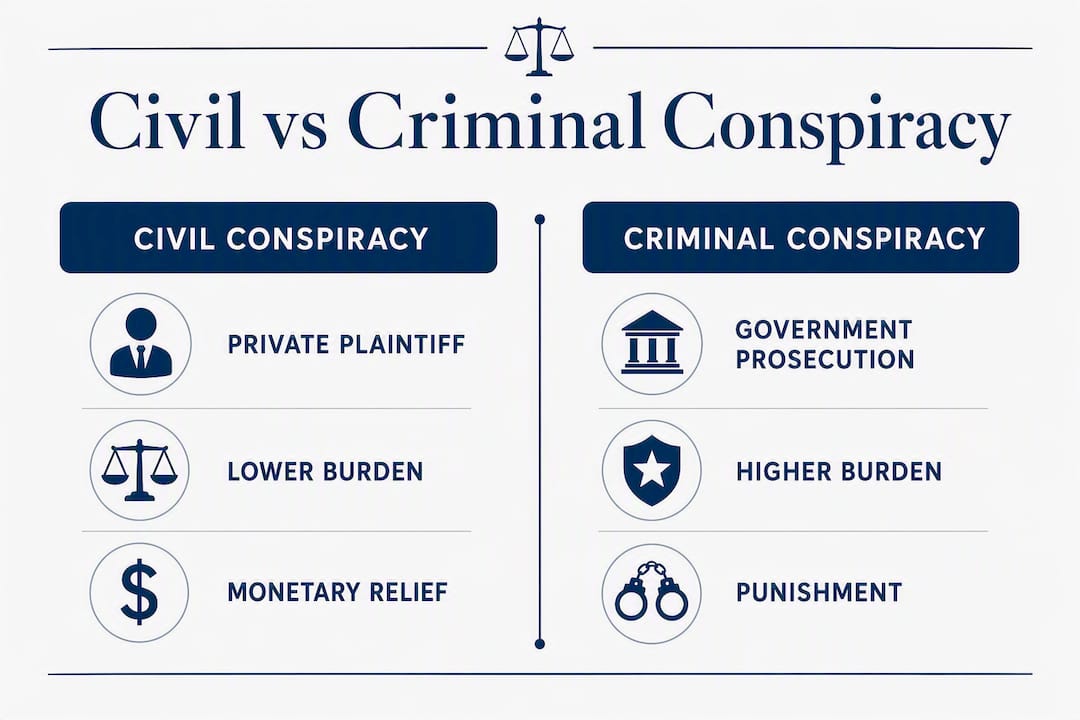
The same coordinated conduct can trigger both a civil lawsuit and a criminal prosecution. They run on separate tracks, with different actors, different burdens, and very different consequences.
| Dimension | Civil Conspiracy | Criminal Conspiracy |
|---|---|---|
| Who brings the case | Private plaintiff (you) | Government prosecutor |
| Burden of proof | Preponderance of the evidence | Beyond a reasonable doubt |
| Primary remedy | Compensatory damages, punitive damages, injunctive relief | Fines, imprisonment, probation |
| Liability mechanism | Joint-and-several liability among co-conspirators | Derivative criminal liability for acts of co-conspirators |
| Parallel proceedings | Can run simultaneously with criminal case | Can run simultaneously with civil case |
Because the civil burden is lower, plaintiffs often pursue civil conspiracy to obtain compensation even when a criminal conviction is unlikely or impractical. A defendant acquitted in criminal court can still lose a civil conspiracy case on the same underlying facts.
Where do civil conspiracy claims actually show up?
Business litigation is the most common arena. Here are the fact patterns that generate these claims most often.

Coordinated client poaching. Two former partners leave a firm, take confidential client lists, and make misrepresentations to those clients to induce them to follow. Each partner is liable for the other’s acts once the agreement is shown.
Defamation campaigns. Multiple individuals coordinate a social-media campaign of false statements targeting a business competitor. The conspiracy theory lets the plaintiff reach every participant, not just the one who posted the most damaging content.
Price-fixing schemes. Vendors agree to submit inflated bids on a contract. The underlying tort is fraud or deceptive trade practices; the conspiracy ties all vendors to the same judgment.
Tortious interference. A group of investors agrees to pressure a lender into withdrawing financing from a rival company. The interference with the business relationship is the underlying tort; the agreement among investors is the conspiracy.
One practical advantage of pleading conspiracy: it can trigger the co-conspirator hearsay exception, allowing statements made by one conspirator in furtherance of the scheme to be admitted against all defendants. That evidentiary benefit alone can shift the dynamics of a complex multi-defendant trial.
How do you prove a civil conspiracy without a signed agreement?
Conspirators rarely document their plans. Courts understand this, and they accept circumstantial evidence to establish agreement. Here is how plaintiffs build the proof:
- Communications. Texts, emails, and direct messages showing coordination, even if they never use the word “agreement,” can establish a meeting of the minds.
- Timing and parallel conduct. When multiple defendants take identical or complementary actions within a tight time window without an independent business reason, courts infer coordination.
- Financial records. Unexplained transfers between co-defendants, shared revenue arrangements, or payments that only make sense if the parties were working together support an inference of agreement.
- Witness testimony. A former employee, a disgruntled co-conspirator, or a third party who observed the coordination can provide direct or corroborating testimony.
- Conduct that lacks independent explanation. If a defendant’s actions only make sense as part of a larger coordinated scheme, that absence of independent justification is itself evidence of agreement.
A persuasive framing in commercial disputes is showing that the conspirators achieved a result together that no single actor could have accomplished alone. That “peculiar power of coercion” argument resonates with juries and judges evaluating whether coordination was real.
Pro Tip: Preserve all digital communications the moment you suspect coordinated wrongdoing. Courts accept circumstantial evidence of agreement, but deleted messages and wiped devices can destroy your case before it starts. Send a written preservation demand to opposing parties early.
What defenses commonly defeat civil conspiracy claims?
Defendants have several reliable tools to challenge these claims, and knowing them helps you understand what gaps to close before filing.
Parallel conduct, not agreement. Defendants argue they acted independently for legitimate business reasons that happened to look similar. Without evidence of actual coordination, parallel conduct alone does not establish a conspiracy.
No underlying tort. This is the most powerful defense in states like Florida. If the plaintiff cannot prove the underlying tort (fraud, tortious interference, defamation), the conspiracy claim collapses with it.
No overt act. In jurisdictions requiring an overt act, a defendant who agreed but never took a step in furtherance may escape liability.
Statute of limitations. Conspiracy claims are subject to the same limitations period as the underlying tort in most jurisdictions. In Florida, many tort-based conspiracy claims carry a four-year window, though the clock can start running from when the plaintiff discovered or should have discovered the harm. Missing that deadline is fatal.
Privilege. Certain communications, such as statements made in litigation or between attorneys and clients, are privileged and cannot form the basis of a conspiracy claim.
Courts sometimes dismiss conspiracy claims as redundant when the plaintiff has already named all conspirators as direct defendants on the underlying tort. Plaintiffs still plead conspiracy strategically because it preserves joint-and-several liability and the evidentiary advantages described above.
What can you recover if a civil conspiracy claim succeeds?
A successful plaintiff can pursue several categories of recovery, and the joint-and-several liability rule is what makes the claim financially meaningful.
Compensatory damages cover actual losses: lost profits, out-of-pocket costs, lost business opportunities, and other economic harm directly caused by the conspiracy. Courts measure these against the damages flowing from the underlying tort. For a deeper look at how courts calculate these losses, the framework for compensatory damages applies across civil contexts.
Punitive damages are available in many jurisdictions when the conduct was intentional, malicious, or egregious. The availability and cap depend on the underlying tort and state law.
Injunctive relief can stop ongoing harm. If the conspiracy is still active, a court can order defendants to cease the conduct while litigation proceeds.
Joint-and-several liability means each conspirator can be held responsible for the entire judgment, not just their proportionate share. If one defendant is judgment-proof, you can collect the full amount from another. That is the strategic core of why plaintiffs pursue conspiracy claims in complex commercial litigation.
When should you consult a lawyer about a civil conspiracy claim?
If you believe coordinated wrongdoing caused you real financial or personal harm, act quickly. The statute of limitations is running, and evidence disappears fast.
Immediate preservation steps:
- Save all texts, emails, and direct messages related to the dispute.
- Preserve contracts, invoices, financial records, and accounting documents.
- Identify witnesses who observed the coordination or its effects.
- Do not delete or modify any devices or cloud accounts that may contain relevant data.
- Send a written litigation hold notice to anyone you believe holds relevant documents.
A civil litigator evaluates whether the underlying tort is provable, whether the evidence supports an inference of agreement, and whether the defendants have assets worth pursuing. They draft the pleadings, coordinate discovery across multiple defendants, and advise on whether a parallel criminal referral makes strategic sense. Early counsel also protects you from procedural missteps, such as filing in the wrong court or missing a limitations deadline that cannot be extended.
If your facts show coordinated acts that caused measurable loss, the time to act is now. Waiting costs you evidence and, eventually, your right to sue.
Key Takeaways
A civil conspiracy claim lets you hold every participant in a coordinated wrongful scheme financially responsible, provided you can prove agreement, a wrongful objective or means, an overt act where required, and measurable damages by a preponderance of the evidence.
| Point | Details |
|---|---|
| Definition | Two or more people agree and act to cause a civil wrong; all participants share liability. |
| Burden of proof | Preponderance of the evidence — more likely true than not, lower than the criminal standard. |
| Underlying tort required | Most states, including Florida, dismiss the conspiracy claim if the underlying tort fails. |
| Joint-and-several liability | Each conspirator can be held for the full judgment, not just their individual share. |
| Act promptly | Statutes of limitations apply; preserve evidence and consult a litigator without delay. |
Why the conspiracy claim’s real value is often misunderstood
Most people who ask about civil conspiracy are focused on the agreement itself. That instinct makes sense, but it misses where the claim’s actual leverage lives. The agreement is just the mechanism. The real power is joint-and-several liability and the ability to reach a defendant with assets when the primary wrongdoer has none.
We see this play out in commercial disputes where one actor orchestrated the harm but structured the scheme so that a wealthier partner appears to have clean hands. Pleading conspiracy, and proving it, pierces that arrangement. Every participant who knowingly joined the plan is exposed to the full judgment.
The other underappreciated point: circumstantial evidence is genuinely sufficient. Clients sometimes come to us convinced they cannot prove a conspiracy because they have no smoking-gun admission. Courts do not require one. Coordinated timing, parallel conduct, and financial flows that only make sense as part of a scheme have carried conspiracy claims to verdict. What destroys cases is not the absence of a written agreement. It is the failure to preserve the circumstantial evidence before it disappears.
At Calillaw, we evaluate conspiracy claims by starting with the underlying tort. If that claim is solid and the evidence supports an inference of coordination, the conspiracy theory adds real strategic value. If the underlying tort is shaky, we say so plainly rather than build a case on a foundation that will not hold. When the facts are there, we pursue these claims aggressively because our clients deserve recovery from everyone responsible, not just the most visible defendant.
If you believe coordinated wrongdoing has caused you serious harm, a case evaluation costs you nothing and could clarify your options before the clock runs out.
Useful sources to read next
The following primary and secondary authorities support the analysis above and give you a starting point for checking state-specific rules.
- Conspiracy — Cornell Legal Information Institute (LII): The foundational definition of conspiracy in U.S. law, covering both civil and criminal applications and the overt-act requirement.
- Burden of Proof — Cornell LII: Explains the preponderance standard and how it differs from the criminal beyond-a-reasonable-doubt threshold.
- Civil Conspiracy: What’s the Use? — University of Miami Law Review: A scholarly analysis of when civil conspiracy adds value over direct tort claims, including the vicarious-liability rationale and evidentiary advantages.
- Civil Conspiracy in Florida: Elements, Damages, and Defenses — LegalClarity: A practical Florida-focused explainer covering the dependency on an underlying tort and common defenses.
- Conspiracy Theory (Legal Term) — Wikipedia): Useful background on how courts use the term “conspiracy theory” as a case theory distinct from its popular meaning.
State law governs the specific elements, limitations periods, and available remedies for civil conspiracy claims. Always verify the rules in your jurisdiction with a licensed attorney before drawing conclusions about your own situation. This article is general legal information, not legal advice, and does not create an attorney-client relationship.


