 Skip to Content

What Is a Corporate Net Worth: A Practical Guide
Corporate net worth is a company’s total assets minus its total liabilities, and it appears on every balance sheet as the shareholders’ equity line. The formula is straightforward:
Assets − Liabilities = Net Worth (Shareholders’ Equity)
To get your number right now, pull the latest balance sheet, whether that’s an internal statement or a public SEC filing, and run that subtraction. Everything below explains what the result means and what to do with it.
Table of Contents
- What does corporate net worth (shareholders’ equity) mean in practice?
- A worked example: calculating net worth from a sample balance sheet
- Which assets and liabilities count, and what are the valuation caveats?
- How does net worth differ from market value and profit?
- What does negative net worth mean for a business?
- Where can you find a company’s net worth in the U.S.?
- Common calculation mistakes and how to avoid them
- Key Takeaways
- Why net worth matters more than most business owners realize
- Useful sources and official references
What does corporate net worth (shareholders’ equity) mean in practice?
Think of the accounting equation this way: everything a company owns (assets) was paid for either by borrowing (liabilities) or by the owners themselves (equity). Net worth is what remains for the owners once every creditor is paid off. According to Esade, net worth represents the owners’ investment plus accumulated retained earnings, making it a core indicator of financial health for investors and small businesses alike.
On a balance sheet, shareholders’ equity typically breaks down into three components:
- Paid-in capital: The money owners or shareholders contributed directly to the business.
- Retained earnings: Cumulative profits kept in the business rather than distributed as dividends.
- Treasury stock adjustments: Shares the company repurchased, which reduce total equity.
You’ll find the equity section at the bottom of the balance sheet, below total liabilities. The SEC’s beginner’s guide to financial statements clarifies exactly how current and noncurrent assets, liabilities, and the equity section are organized on that statement.
Three practical implications worth knowing:
- A positive net worth tells creditors the business has a cushion; it signals the company could theoretically cover its debts from its own resources.
- Lenders often use net worth as a baseline when setting loan covenants or credit limits.
- For owners, a growing net worth over time confirms that profitable operations are building real value, not just generating cash that disappears into expenses.
A worked example: calculating net worth from a sample balance sheet
The table below shows a simplified balance sheet layout example for a fictional small business, Apex Supply Co., illustrating categories of assets, liabilities, and shareholders’ equity without specific dollar amounts, to demonstrate how net worth is calculated as assets minus liabilities.
Notice two accounting adjustments already baked in. The $5,000 allowance for doubtful accounts reduces receivables to what the company realistically expects to collect. The $80,000 accumulated depreciation reduces PP&E to its net book value. Both adjustments pull net worth down from what a raw asset tally would show, and both reflect a more honest picture of the company’s position. The Iowa State Extension’s guidance on whole-farm financial statements confirms this same formula: assets minus liabilities equals the residual value available to owners.

Which assets and liabilities count, and what are the valuation caveats?
Not every number on a balance sheet is straightforward. Here’s how the main categories work in practice:
Assets that count:
- Cash and equivalents: Face value, no adjustment needed.
- Accounts receivable: Stated net of an allowance for doubtful accounts; the gross figure overstates collectible value.
- Inventory: Carried at the lower of cost or net realizable value under U.S. GAAP; LIFO vs. FIFO choices affect the reported amount.
- Property, plant, and equipment: Recorded at historical cost less accumulated depreciation, not current market value.
- Intangibles and goodwill: Goodwill only appears when a company was acquired at a premium; it’s subject to annual impairment testing rather than amortization under current U.S. GAAP. Internally generated intangibles (your brand, your customer relationships) generally do not appear on the balance sheet at all.
Liabilities that count:
- Accounts payable and accrued expenses (short-term obligations).
- Short-term and long-term debt, including the current portion of any long-term loans.
- Lease liabilities (both operating and finance leases now appear on the balance sheet under ASC 842).
- Contingent liabilities: pending litigation, warranties, and guarantees. These appear only when the obligation is probable and estimable under U.S. GAAP.
The FASB Concepts Statement No. 8, Chapter 4 explains why book measures can differ from fair value: recognition and measurement rules prioritize verifiability over current market prices, which is why a building bought in 2005 still sits on the books at its 2005 cost minus depreciation.
Pro Tip: If your balance sheet carries significant goodwill, real estate, or specialized equipment, ask your accountant whether a fair-value restatement would materially change the net worth figure before using it for a loan application, a sale negotiation, or a legal dispute.
How does net worth differ from market value and profit?
These three terms describe different things, and mixing them up leads to bad decisions.
- Net worth (book equity): An accounting measure. It reflects historical costs, accumulated earnings, and adjustments under GAAP. It’s backward-looking by design.
- Market value (market capitalization for public companies): What investors are willing to pay today, based on expected future cash flows, growth prospects, and intangibles that never appear on a balance sheet. Methods like discounted cash flow (DCF) and comparable-company analysis, described by the Corporate Finance Institute, produce market-based estimates that routinely diverge from book equity.
- Profit (net income): A flow measure from the income statement covering a specific period. It is not the same as net worth, though it feeds into it. Each dollar of net income that isn’t paid out as a dividend increases retained earnings, which increases net worth over time.
A tech startup might carry $2 million in book equity while trading at a $200 million market cap because investors are pricing future software revenue, not historical costs. Conversely, a capital-heavy manufacturer might show $50 million in book equity while trading below that if the market doubts its future profitability. Investopedia’s overview of business valuation methods notes that market capitalization, earnings multiples, and asset-based approaches each serve different purposes depending on context.
What does negative net worth mean for a business?
Negative net worth means liabilities exceed assets on the balance sheet. It’s a serious warning, not an automatic death sentence, but it demands immediate attention.
Practical consequences include:
- Litigation exposure. In commercial litigation, a defendant’s negative net worth directly affects collectability of any judgment. Plaintiffs and their attorneys factor this into settlement strategy.
Some companies carry negative book equity for legitimate reasons, such as aggressive share buybacks (which reduce equity) or large one-time charges. Context matters, but the number still requires explanation.
Where can you find a company’s net worth in the U.S.?
For public companies:
The shareholders’ equity section of any public company’s balance sheet is publicly available. SEC EDGAR is the access point: search the company name or ticker, pull the most recent 10-K (annual report) or 10-Q (quarterly report), and navigate to the Consolidated Balance Sheet. The equity total is labeled “Total Stockholders’ Equity” or “Total Shareholders’ Equity.”
For private companies:
Private businesses don’t file with the SEC, so you work with what’s available:
- Internal balance sheet: The most direct source. Request the most recent dated statement, preferably one prepared or reviewed by a CPA.
- Tax returns (Form 1120 or Schedule L): The balance sheet on a corporate tax return gives a rough equity figure, though tax accounting differs from GAAP in several ways.
- Owner-provided financial statement: Common in loan applications. Treat unaudited statements with appropriate skepticism.
Red flags on private statements:
- No date on the balance sheet.
- Assets listed at estimated market value rather than cost (inflates equity).
- Missing liabilities, especially contingent ones like pending lawsuits.
- Equity that doesn’t reconcile with prior-year retained earnings.
When a private company’s net worth matters for a transaction, a loan, or a dispute, an audited or reviewed statement from a licensed CPA carries far more weight than an owner-prepared spreadsheet.
Common calculation mistakes and how to avoid them
Even experienced operators make these errors:
- Mixing book and market values. Using appraised real estate values alongside historical-cost figures for other assets creates an inconsistent, unreliable total.
- Ignoring off-balance-sheet items. Operating leases (pre-ASC 842), factored receivables, and certain guarantees can represent real obligations that don’t appear on older or non-GAAP statements.
- Double-counting assets. Recording both a gross asset and its net-of-depreciation version, or listing a subsidiary’s assets separately while also consolidating them.
- Misclassifying liabilities. Treating long-term debt as current (or vice versa) distorts working capital ratios and can misstate the equity figure if totals are pulled from subtotals rather than the grand total.
- Using the wrong date. Comparing a December 31 balance sheet to a March 31 figure without noting the difference produces a misleading trend.
Validation checklist:
- Confirm that Total Assets = Total Liabilities + Shareholders’ Equity (the accounting equation must balance).
- Reconcile the current-year retained earnings to last year’s balance plus net income minus dividends.
- Check that the balance sheet date matches the period you’re analyzing.
- If the equity figure has changed sharply, look for the explanation in the statement of changes in equity.
Bring in a CPA or auditor when the balance sheet will be used for a loan, a business sale, a legal proceeding, or any decision where a third party will rely on the numbers.
Key Takeaways
Corporate net worth equals total assets minus total liabilities, appears as shareholders’ equity on the balance sheet, and is the single most direct measure of what a business is worth to its owners on an accounting basis.
| Point | Details |
|---|---|
| Core formula | Assets − Liabilities = Net Worth (Shareholders’ Equity); confirm the result matches the equity line on the balance sheet. |
| Calculation frequency | Track net worth monthly or quarterly; trends reveal financial direction better than any single snapshot. |
| Net worth vs. market value | Book equity reflects historical costs; market value reflects future expectations and often differs significantly. |
| Negative net worth | Signals balance-sheet insolvency, triggers covenant risks, and restricts distributions under most state corporate laws. |
| When to get help | Use a CPA for audited statements and an attorney when net worth affects a loan, a sale, or a legal dispute. |
Why net worth matters more than most business owners realize
Corporate net worth analysis is one of those metrics that looks simple on the surface and reveals complexity the moment it matters. The formula never changes. What changes is the context in which you’re reading the number.
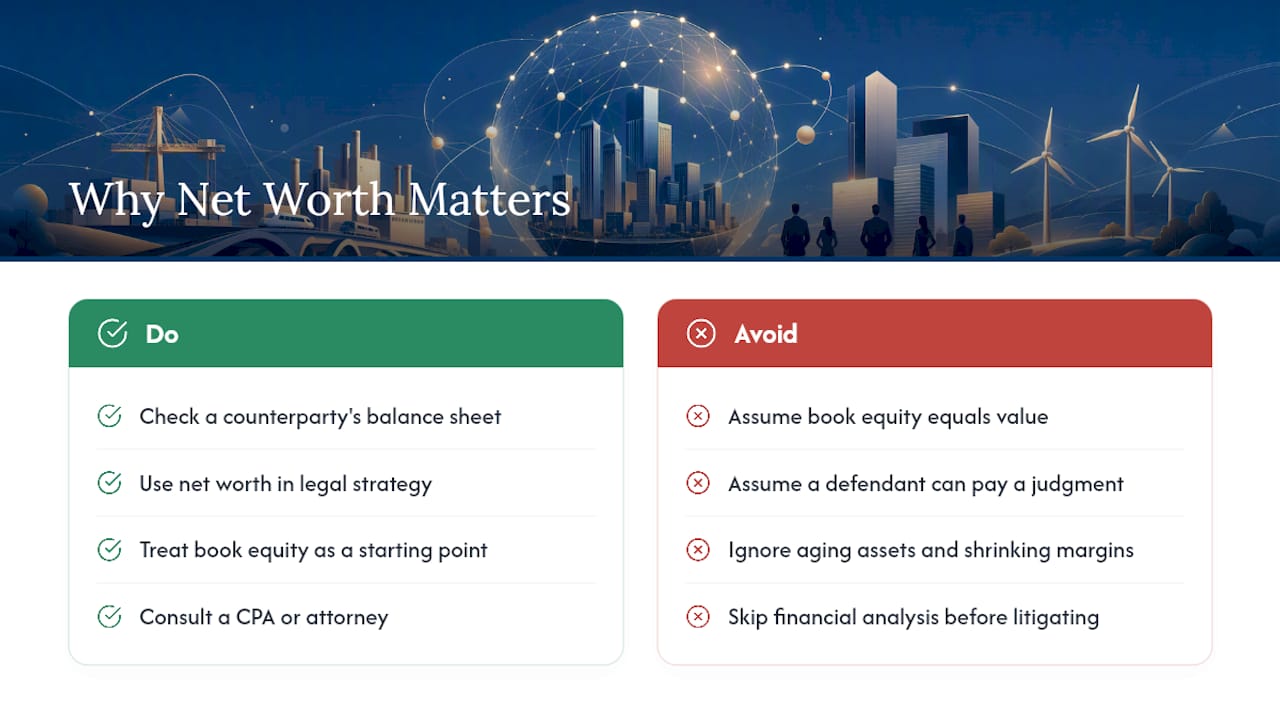
I’ve seen net worth become the central issue in commercial disputes where one party assumed a defendant could pay a judgment, only to discover the balance sheet showed negative equity long before the litigation began. That discovery reshapes everything: settlement leverage, collection strategy, the decision to litigate at all. Understanding a counterparty’s financial position before you commit to a legal strategy is not optional. It’s the foundation.
Book equity is also frequently misread as a valuation. It isn’t. A company with $500,000 in shareholders’ equity might sell for $2 million because buyers are paying for future earnings, customer relationships, and brand value that GAAP never puts on the balance sheet. Conversely, a company with strong book equity can still be a poor investment if its assets are aging and its margins are shrinking. The number is a starting point, not a verdict.
If you’re involved in a business dispute, a contract negotiation, or a situation where a company’s financial health is genuinely at stake, the balance sheet is where the conversation starts. At Calillaw, our commercial litigation practice regularly involves financial analysis of this kind, because knowing the numbers is part of building a case that holds up.
This article is general information, not legal or financial advice. Confirm current rules and figures with a licensed CPA or qualified attorney for your specific situation.
Useful sources and official references
For further reading and verification, these are the primary U.S. authorities:
- Whole-farm financial statements and analysis — Iowa State Extension
- EDGAR — U.S. Securities and Exchange Commission
- What is a company’s net worth | Esade
- How to calculate business net worth and improve it | Xero US
- What is Valuation? Business valuation methods explained | Corporate Finance Institute
- A Beginner’s Guide to Financial Statements — U.S. Securities and Exchange Commission
- Business Valuation: 6 Methods for Valuing a Company — Investopedia
- FASB Concepts Statement No. 8 — Elements of Financial Statements (Chapter 4)
Consult a licensed CPA when preparing statements for a loan, a transaction, or a legal proceeding. When net worth intersects with a business dispute, a damages calculation, or an insolvency question, an attorney experienced in commercial litigation can help you understand what the numbers mean for your legal position.


