 Skip to Content

What Is a Design Defect Claim? Your 2026 Legal Guide
A design defect claim is a legal action asserting that a product is inherently dangerous due to a flaw in its original blueprint, making every unit of that product unsafe, not just one bad batch off the assembly line. Courts typically apply the consumer expectation test or the risk-utility test to decide whether that design is unreasonably dangerous. Understanding what is a design defect claim matters right now because juries are awarding serious verdicts. In 2026, a Minnesota jury awarded $18 million after a Jeep Grand Cherokee rollaway caused an amputation, with the manufacturer’s failure to adopt a safer AutoPark system playing a central role in the outcome. If you were hurt by a product and suspect the design itself was the problem, this guide explains your rights and your path forward.
How does a design defect differ from other types of product defects?
Design defects affect entire product lines, while manufacturing defects affect individual units due to production errors. That distinction shapes everything about how a lawsuit is built and who can join it.
Three categories cover most product liability claims:
- Design defects. The flaw exists in the original blueprint. Every product built to that specification carries the same danger. A car model engineered with a gear-shifter that can slip out of park is defective by design, regardless of how carefully it was assembled.
- Manufacturing defects. The design is sound, but something goes wrong during production. A single batch of brake pads made with the wrong compound is a manufacturing defect. The problem is isolated, not systemic.
- Warning or instruction defects. The product may work as designed, but the manufacturer fails to warn users about known risks. These claims often run alongside design defect claims but are legally distinct.
| Feature | Design defect | Manufacturing defect |
|---|---|---|
| Scope of harm | Entire product line | Individual units |
| Root cause | Blueprint or engineering choice | Production error |
| Proof required | Engineering documents, alternative design | Production records, deviation from spec |
| Recall signal | Multiple model years affected | Isolated batch or serial number range |
| Legal theory | Strict liability, negligence | Strict liability, negligence |
Recalls spanning multiple model years usually signal a design defect rather than a production mistake. One documented example involved 118,600 units affected by a steering failure recall across five model years. That scale of impact raises the stakes for manufacturers and broadens the pool of potential plaintiffs considerably.

Design defect claims require more complex proof than manufacturing defect cases. Instead of pointing to a deviation from the approved spec, you must show that the approved spec itself was the problem.
What legal tests determine if a design defect claim is valid?
Courts apply two primary legal tests to decide whether a design is unreasonably dangerous: the consumer expectation test and the risk-utility test. Some jurisdictions permit both; others require one or the other.
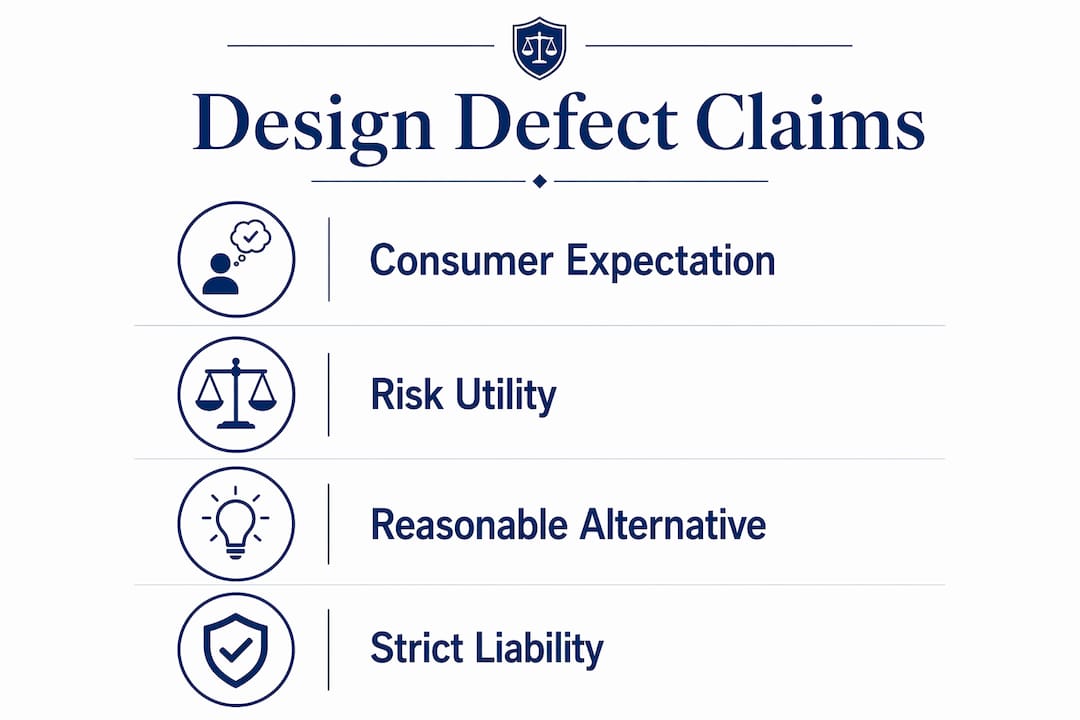
The consumer expectation test asks whether the product performed as safely as an ordinary consumer would expect. If a reasonable person buying a child’s car seat would not expect it to collapse in a moderate-speed collision, that product fails the test. This standard is intuitive and works well for everyday products with obvious safety expectations.
The risk-utility test is more technical. It weighs the risks of the design against its benefits and asks whether a safer alternative was feasible. Factors courts consider include:
- The probability and severity of harm from the design
- The availability of a safer alternative design
- The cost of implementing that alternative
- The product’s utility to consumers and the broader market
- Whether the manufacturer knew about the risk before the injury occurred
The reasonable alternative design, often called RAD, is the pivot point in most modern design defect lawsuits. Proving a safer alternative existed and was ignored is the biggest hurdle plaintiffs face. Jurors find arguments about ignored alternatives far more persuasive than arguments that the existing design is simply dangerous.
Expert testimony is critical to establishing that a safer, economically feasible alternative design existed at the time of manufacture. Engineers, safety analysts, and industry specialists translate technical blueprints into language a jury can evaluate and act on.
Pro Tip: Build your claim around the alternative design, not just the danger. Showing the manufacturer had a safer option and chose not to use it is far more persuasive to a jury than arguing the product was merely risky.
One more important point: strict liability applies in design defect claims. You do not need to prove the manufacturer was negligent. You need to prove the defect existed and caused your injury. That shifts the legal burden in a meaningful way and makes these claims more accessible to injured people who cannot access internal corporate records on their own.
What are notable examples of design defect claims?
Real cases illustrate how design defect legal actions play out and what compensation looks like when liability is clear.
-
2026 Jeep Grand Cherokee rollaway verdict. A Minnesota jury awarded $18 million after a vehicle rolled away and caused an amputation. The manufacturer had knowledge of the defective gear-shifter design and failed to implement an AutoPark system that would have prevented the rollaway. The jury’s knowledge of that ignored alternative drove the verdict.
-
Honda steering recall. A recall covering 118,600 vehicles across five model years for steering failure is a textbook design defect indicator. When a safety-critical failure repeats across that many units and years, the defect lives in the design, not the factory floor.
-
Medical device litigation. Design defect litigation in medical devices relies heavily on discovery of corporate engineering decisions. Hip implants, surgical mesh, and insulin pumps have all generated mass tort cases where plaintiffs argued the approved design was the source of harm.
-
Automotive seat and restraint systems. Seat designs that fail to protect occupants in foreseeable crash scenarios are among the most litigated design defect categories. Evidence that the manufacturer tested safer configurations and rejected them for cost reasons is often the turning point.
“Manufacturer knowledge of a defect and failure to implement a known safer alternative are the two facts that most consistently move juries toward large verdicts in design defect cases.”
You can review product liability claim examples to see how courts have handled similar situations across industries. Design defect cases often predominate in mass tort and multidistrict litigation because the systemic nature of a design flaw means thousands of people may be injured by the same root cause.
How do you file a design defect claim?
Filing a design defect lawsuit requires more preparation than most injury claims. The evidence is technical, the defendants are often large corporations, and the timelines are strict.
- Document everything immediately. Preserve the product in its post-incident condition. Photograph the scene, your injuries, and any visible product failure. Do not attempt repairs or modifications.
- Seek medical attention and keep all records. Medical documentation ties your injury directly to the product. Gaps in treatment create openings for defense attorneys to argue your injuries were pre-existing or unrelated.
- Retain the product and its packaging. Instruction manuals, warning labels, and original packaging are all evidence. Warning labels may limit failure-to-warn claims but do not protect a manufacturer from design defect liability if the design itself is unreasonably dangerous.
- Hire an attorney with product liability experience early. Design defect claims require engineering analysis, expert witnesses, and access to corporate discovery. An experienced attorney builds that infrastructure before the statute of limitations closes.
- Understand your state’s statute of limitations. In Florida, the window to file a personal injury claim is generally two years from the date of injury. Missing that deadline ends your claim regardless of its merit.
Pro Tip: Ask your attorney specifically about the manufacturer’s internal testing records. If the company tested a safer design and rejected it for cost, that document is often the most powerful piece of evidence in the entire case.
Design defect litigation focuses on structural design flaws and relies on corporate decision data and expert analysis. That is why legal representation is not optional in these cases. It is the difference between a claim that reaches a jury and one that gets dismissed on a technicality. Understanding how compensation is determined in product liability lawsuits helps you set realistic expectations before you file.
Key Takeaways
A design defect claim succeeds when you prove the product’s original blueprint was unreasonably dangerous, a safer alternative existed, and that defect caused your specific injury.
| Point | Details |
|---|---|
| Definition of design defect | A flaw in the original product blueprint that makes every unit of that product unsafe. |
| Key legal tests | Courts use the consumer expectation test and the risk-utility test to evaluate design defect claims. |
| Alternative design is critical | Proving a safer design existed and was ignored is the strongest argument in front of a jury. |
| Strict liability applies | Plaintiffs do not need to prove negligence, only that the defect existed and caused the injury. |
| Act fast on evidence | Preserve the product, document injuries, and retain an attorney before the statute of limitations expires. |
What I’ve learned from watching design defect cases go to trial
The most common mistake I see injured people make is assuming that because a product had a warning label, their claim is weaker. Warning labels address failure-to-warn claims. They do not shield a manufacturer from liability when the design itself is the source of danger. A label that says “do not use near water” does not excuse an engineer who designed an electrical component that fails catastrophically when exposed to normal humidity levels. Those are two separate legal theories, and confusing them costs people their cases.
The second thing I’ve observed is that plaintiffs who win large verdicts almost always have a clear story about the road not taken. In the 2026 Jeep Grand Cherokee case, the AutoPark system was the road not taken. The manufacturer knew it existed, knew it would prevent rollaways, and chose not to implement it. That single fact was worth $18 million to a Minnesota jury. Your attorney’s job is to find that fact in your case.
Design defect claims are genuinely hard. They require engineering experts, corporate discovery, and patience through complex litigation. But they are also among the most powerful tools available to injured people because strict liability removes the burden of proving the manufacturer intended to harm anyone. The law simply asks: was this design unreasonably dangerous, and did it hurt you? If the answer to both is yes, you have a claim worth pursuing.
— Jorge
Calillaw is ready to evaluate your design defect case
If a defective product injured you or someone you love, the legal path forward starts with understanding whether the design itself was the problem.

At Calillaw, our trial attorneys have the courtroom experience and technical resources to take on complex product liability cases, including design defect lawsuits against large manufacturers. We handle the engineering analysis, expert coordination, and corporate discovery so you can focus on recovery. Understanding why legal representation matters before you file is the first step toward protecting your rights. Contact Calillaw today for a free consultation and let us evaluate the strength of your claim.
FAQ
What is the definition of a design defect in law?
A design defect is a flaw in a product’s original blueprint that makes every unit of that product unreasonably dangerous. Courts evaluate design defects using the consumer expectation test or the risk-utility test.
How does a design defect claim differ from a manufacturing defect claim?
A design defect claim targets the product’s engineering blueprint and affects the entire product line. A manufacturing defect claim targets a production error that affects only specific units.
Do I need to prove negligence to win a design defect lawsuit?
No. Strict liability applies in design defect claims, meaning you only need to prove the defect existed and caused your injury, not that the manufacturer acted carelessly.
What evidence do I need to file a design defect claim?
You need the defective product preserved in its post-incident condition, medical records documenting your injury, and expert testimony showing a safer alternative design was feasible at the time of manufacture.
Can a warning label protect a manufacturer from a design defect claim?
No. Warning labels may limit a failure-to-warn claim, but they do not eliminate liability if the product’s design is inherently unsafe regardless of any warnings provided.


