 Skip to Content

What Is a Negligent Security Claim? Your Legal Guide
A negligent security claim is a legal action that holds a property owner responsible when inadequate security measures allow a foreseeable crime to harm a visitor on their premises. This type of claim falls under premises liability law, which requires property owners to maintain reasonably safe conditions for anyone lawfully on their property. Four legal elements define every negligent security case: duty, breach, causation, and damages. If you were attacked, robbed, or assaulted at a location where better security could have prevented the crime, you may have grounds to pursue compensation. Understanding these elements is the first step toward asserting your rights.
What is a negligent security claim under premises liability law?
A negligent security claim is a specific type of premises liability action. It applies when a property owner knew, or reasonably should have known, that criminal activity was a risk at their location and failed to take adequate steps to prevent it.
The legal framework rests on four elements:
- Duty: The property owner owed you a legal obligation to provide reasonable security.
- Breach: The owner failed to meet that obligation, for example by leaving lights broken, failing to hire security guards, or ignoring a malfunctioning lock.
- Causation: The security failure directly caused your injury.
- Damages: You suffered real, measurable harm as a result.
The negligent security definition does not require the property owner to guarantee your safety. Property owners are not insurers of visitor safety. Their legal duty is to exercise reasonable care based on the foreseeable risks at their specific location. A hotel in a high-crime area has a higher duty to provide security than a bookstore in a low-crime suburb. The standard scales with the known risk.
What legal standards establish duty and foreseeability?
Foreseeability is the threshold question in every negligent security lawsuit. Courts ask one central question: did the property owner have reason to know that a crime like this one could happen here?

Foreseeability requires evidence of prior similar criminal incidents near the property. Many courts evaluate crime data within a defined geographic area, often within a 500-yard radius of the location. Some states also apportion fault between the property owner and the actual perpetrator, which directly affects how much compensation a victim can recover.
Evidence used to establish foreseeability includes:
- Police reports documenting prior crimes at or near the property
- Crime statistics from local law enforcement databases
- Prior complaints made to property management about safety concerns
- Security audits that identified risks the owner ignored
- Internal incident logs showing a pattern of criminal activity
Property owners must act when a pattern of criminal incidents or warnings about security risks exists. Ignoring that evidence is itself proof of negligence. Courts evaluate crime statistics, prior incidents, and owner warnings together when determining whether a duty was breached.
Pro Tip: If you were harmed at an apartment complex, shopping center, parking garage, or hotel, request public crime reports for that address before your first attorney meeting. That data can establish foreseeability before litigation even begins.
What evidence do you need to prove a negligent security case?
Proving a negligent security case requires specific, documented evidence. General claims that a location “felt unsafe” are not enough. Courts need concrete proof that security failures existed and directly caused the harm.
The most effective evidence falls into these categories:
- Police reports. The incident report from your attack and any prior crime reports at the property establish both the harm and the pattern of risk.
- Maintenance and security system logs. Records showing broken cameras, faulty locks, or burned-out lights prove the owner knew about the failure and did nothing.
- Witness statements. Eyewitness accounts from other visitors, employees, or neighbors corroborate your version of events.
- Surveillance footage. Video evidence is often the most persuasive proof in court, but it disappears fast.
- Internal security audits and incident logs. Internal documents like security audits often serve as decisive evidence that the owner knew of hazards but neglected them. These records are typically discoverable during litigation.
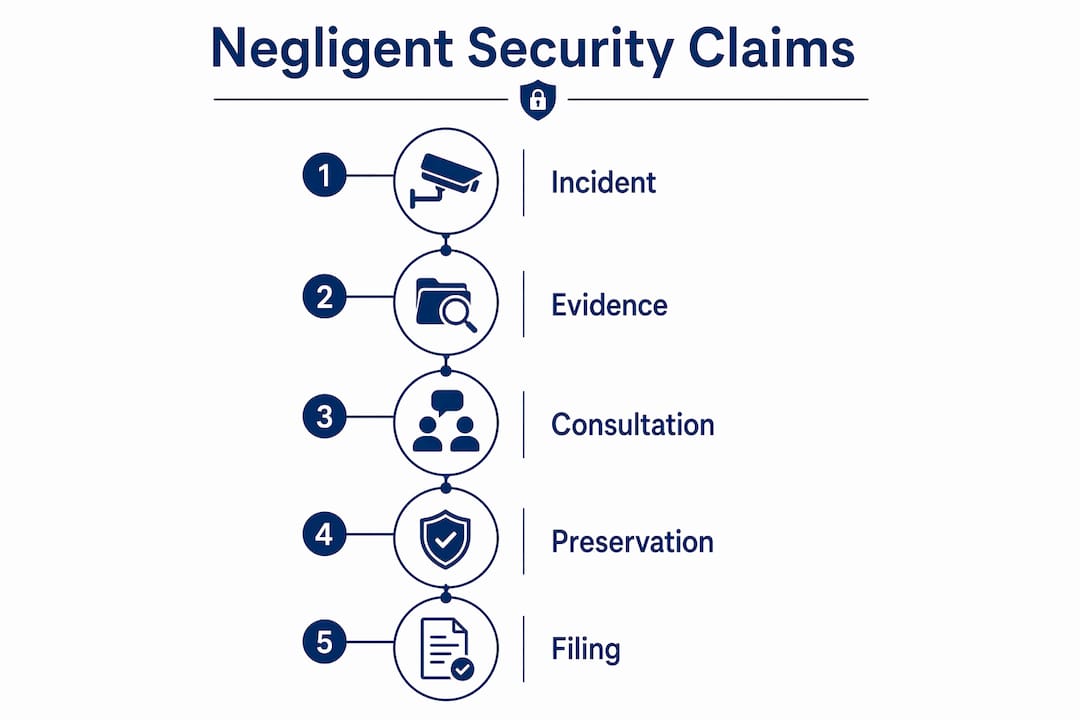
The most urgent concern in any negligent security claims process is time. Surveillance footage and broken equipment logs are perishable. They degrade or disappear rapidly, sometimes within days. Property owners routinely overwrite security footage on a 30-day cycle. Once that footage is gone, it is gone.
Pro Tip: Contact an attorney within days of the incident, not weeks. Your lawyer can send a legal preservation letter to the property owner immediately, which creates a legal obligation to retain all relevant evidence.
What damages can victims recover in negligent security lawsuits?
Damages in a negligent security lawsuit cover the full scope of harm you suffered. The law recognizes both economic and non-economic losses.
| Category | What It Covers |
|---|---|
| Medical expenses | Emergency care, surgery, rehabilitation, ongoing treatment |
| Lost wages | Income lost during recovery, reduced earning capacity |
| Pain and suffering | Physical pain, lasting discomfort, reduced quality of life |
| Emotional trauma | Anxiety, PTSD, depression caused by the incident |
| Property loss | Stolen or damaged personal property during the attack |
Compensation can range from tens of thousands to multi-million-dollar verdicts depending on the severity of injuries. A victim who suffers a broken wrist in a parking lot robbery faces a very different damages calculation than someone left with permanent brain damage after an assault in an unsecured stairwell.
Two legal factors can reduce your recovery. First, Florida’s comparative negligence rules may reduce your award if you are found partially at fault. Second, some states apportion fault between the property owner and the criminal who actually committed the act. Neither factor eliminates your right to compensation. Both factors make skilled legal representation critical to maximizing what you recover.
A negligent security case is a civil matter, entirely separate from any criminal prosecution of the attacker. You do not need a criminal conviction to win a civil claim. The burden of proof in civil court is lower, requiring only a preponderance of the evidence rather than proof beyond a reasonable doubt.
How do 2026 tort reforms affect negligent security claims?
Negligent security litigation has grown more technical in recent years. Courts now demand more rigorous proof at every stage of the case.
Recent tort reforms require plaintiffs to prove that security failures were a substantial factor in causing the injury. Showing that a property was generally unsafe is no longer sufficient. You must connect the specific failure, a broken gate, an absent guard, a disabled camera, directly to the attack that harmed you. That connection is called proximate cause, and proving it now requires detailed event reconstruction.
Key developments shaping negligent security cases in 2026:
- Stricter foreseeability thresholds. Courts scrutinize the geographic and temporal proximity of prior crimes more carefully than before.
- Juror apportionment of fault. Juries are increasingly asked to assign a percentage of fault to the criminal perpetrator, which can reduce the property owner’s share of liability.
- Technology as evidence. Surveillance systems, access control logs, and smart lock data now play a central role in proving or disproving security failures.
- Increased causation burden. Negligent security litigation is increasingly technical, requiring detailed proof that security failures were a proximate cause of harm.
- Expert witnesses. Security industry experts are now routinely retained to testify about what a reasonably prudent property owner should have done differently.
These shifts do not make negligent security claims impossible. They make preparation more important. Victims who act quickly, preserve evidence, and retain experienced counsel are far better positioned to succeed under these standards.
Key Takeaways
A negligent security claim succeeds when you prove that a foreseeable crime occurred because a property owner failed to exercise reasonable care, and that failure directly caused your harm.
| Point | Details |
|---|---|
| Four required elements | Duty, breach, causation, and damages must all be proven to win a negligent security claim. |
| Foreseeability is the threshold | Courts require evidence of prior similar crimes near the property to establish the owner’s duty. |
| Evidence is time-sensitive | Surveillance footage and security logs disappear quickly; contact an attorney within days of the incident. |
| Damages cover full harm | Medical costs, lost wages, pain and suffering, and emotional trauma are all recoverable categories. |
| Tort reforms raise the bar | Plaintiffs must now link specific security failures directly to the attack, not just prove general unsafe conditions. |
What I’ve learned after years of negligent security cases
The biggest mistake I see victims make is waiting too long to call an attorney. They assume the police report is enough. It is not. The police report documents what happened. It does not document what the property owner knew, what security systems were broken, or what warnings management had received and ignored. That evidence lives in the property owner’s files, and it disappears fast.
The second mistake is underestimating the property owner’s defense. These cases almost always involve well-funded defendants, hotels, apartment management companies, retail chains, and their insurers. They move quickly to limit liability. By the time many victims reach out for help, critical footage has been overwritten and maintenance records have been “lost.”
What qualifies as negligent security is not always obvious from the outside. I have seen cases where the decisive evidence was a single internal email showing that management knew a gate lock was broken for three weeks before the attack. That document never would have surfaced without aggressive discovery. You need someone who knows where to look and how to compel production.
My honest advice: do not try to evaluate your own case based on what you read online. The legal standards are jurisdiction-specific, the evidence requirements are technical, and the 2026 tort reform landscape has made these cases more demanding than ever. What you can do right now is preserve everything you have, write down every detail you remember, and get a professional evaluation before any more evidence disappears.
— Jorge
Calillaw is ready to evaluate your negligent security case
If you were harmed at a location where better security could have made a difference, you deserve a clear-eyed assessment of your legal options. Calillaw is a Florida litigation firm led by a Board Certified Civil Trial Lawyer with decades of courtroom experience in premises liability and personal injury cases, including negligent security claims.

Calillaw handles every stage of the negligent security claims process, from evidence preservation and case investigation through negotiation and trial. The firm’s approach is direct: prepare every case as if it is going to a jury, because that preparation is what produces results at the settlement table too. If you are ready to understand what your case is worth, contact Calillaw for a confidential consultation. Your rights matter, and the clock is already running.
FAQ
What is negligent security in personal injury law?
Negligent security is a premises liability claim that holds property owners responsible when inadequate security measures allow a foreseeable crime to injure a visitor. The claim requires proving duty, breach, causation, and damages.
What qualifies as negligent security?
A property qualifies for a negligent security claim when the owner knew or should have known that criminal activity was a foreseeable risk and failed to take reasonable steps, such as maintaining working cameras, adequate lighting, or security personnel.
How do you prove a negligent security claim?
Proof requires police reports, maintenance logs, surveillance footage, witness statements, and internal security audits showing the owner knew of the risk and failed to address it. Evidence preservation must begin immediately after the incident.
How much compensation can you get in a negligent security lawsuit?
Settlements and verdicts range from tens of thousands to millions of dollars depending on injury severity, the strength of the evidence, and applicable comparative fault rules in your state.
Does a criminal conviction affect a negligent security civil claim?
No. A negligent security civil claim is entirely separate from any criminal case. You can win a civil claim without a criminal conviction because the civil burden of proof, a preponderance of the evidence, is lower than the criminal standard.


