 Skip to Content

What Is a Remittitur: When Courts Reduce Jury Awards
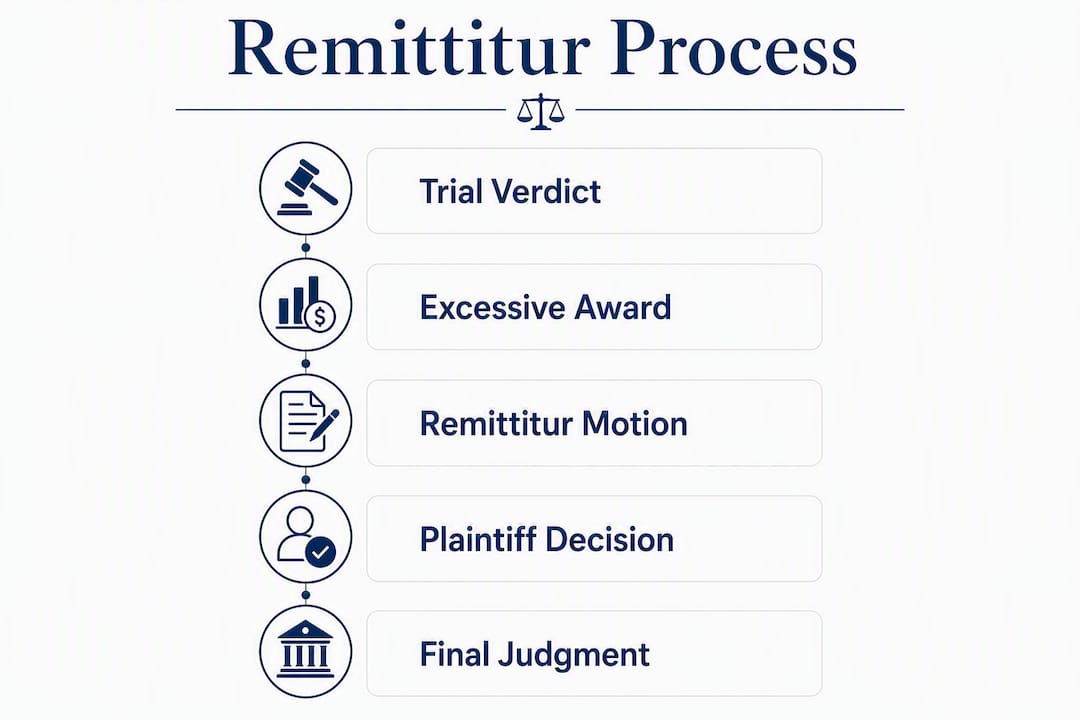
A remittitur is either a judge-ordered reduction of a jury’s damage award or the formal appellate document that returns jurisdiction to the trial court after an appeal. In most U.S. civil cases, the term refers to the first meaning: a judge finds the jury’s verdict grossly excessive and gives the plaintiff a choice between accepting a lower amount or going through a new trial on damages.
Here is what this article covers:
- The two legal meanings of remittitur and which one applies to your situation
- The legal test courts use before ordering a damage reduction
- The procedural timeline from verdict to remittitur decision
- What happens in the trial court after a remittitur is issued
- How remittitur differs from a remand and from additur
- State-to-state variation and constitutional concerns
- Practical next steps and when to call an attorney
Table of Contents
- What does remittitur mean in law?
- When and how is a remittitur issued?
- What legal test does a court apply to reduce a jury’s award?
- What happens in the trial court after a remittitur is issued?
- How does remittitur differ from a remand and from additur?
- Do constitutional concerns limit remittitur in some states?
- How do you pronounce remittitur and use it in conversation?
- When should you talk to an attorney about a remittitur?
- Key Takeaways
- Why remittitur decisions deserve more strategic attention than they get
- Facing a remittitur? Calillaw can help you decide what to do next
- Authoritative sources and further reading
What does remittitur mean in law?
The word remittitur comes from Latin, meaning “it is sent back.” That etymology hints at both uses of the term, but the two applications are distinct enough that conflating them causes real confusion.
The damage-reduction device. According to the Legal Information Institute at Cornell, remittitur is a procedural tool where a judge finds a jury’s damage award grossly excessive and gives the plaintiff a choice: accept a reduced award set by the court or undergo a new trial on damages. This is the meaning most plaintiffs and defendants encounter in U.S. civil litigation, particularly in personal injury, premises liability, and commercial cases. Think of a jury returning a $10 million verdict in a slip-and-fall case where the evidence reasonably supports no more than $3 million. The judge can offer the plaintiff $3 million now or a fresh trial.
The appellate transfer document. In California and several other states, remittitur also refers to the formal document an appellate court issues to return jurisdiction to the trial court once the appeal is decided. Practical Law via Westlaw notes that in California this document is what formally ends the appellate court’s authority over the case and allows the lower court to execute the judgment. Federal courts use the term “mandate” for this function, so the terminology shifts depending on jurisdiction.
There is also a narrow criminal application. Cornell’s Wex notes that in limited circumstances, remittitur appears in criminal settings where a court offers a lesser conviction instead of a new trial on a greater charge. This usage is rare and outside the scope of most civil practitioners’ daily work.
When and how is a remittitur issued?
The timing of a remittitur depends on which meaning is in play. For the damage-reduction context, the sequence typically runs like this:
- Remittitur offered — to the plaintiff: accept the court’s reduced figure or proceed to a new trial limited to damages.
For the appellate-document meaning, the timing is different. After an appellate court issues its decision, it eventually issues the remittitur (or mandate in federal practice) to the trial court. California Rule of Court 8.272 governs exactly when and how the California Courts of Appeal transmit this document, including the waiting period after the decision becomes final. The California Courts Self Help Guide describes the remittitur as the step that formally closes the appellate chapter and reopens the trial court’s authority to act.
Federal practice uses “mandate” rather than “remittitur” for this appellate-transfer function, so if you are in federal court, you will see that term in the rules rather than remittitur.
What legal test does a court apply to reduce a jury’s award?
Courts do not reduce jury verdicts casually. Before granting a damage remittitur, most jurisdictions require that several conditions be met. Cornell’s Wex identifies the typical criteria:
- The damages at issue were unliquidated (not a fixed, calculable sum like a contract price, but rather pain and suffering, emotional distress, or similar subjective harm).
- The verdict was not the product of passion or prejudice on the jury’s part.
- The award is excessive beyond what the evidence reasonably supports.
- The plaintiff consents to the reduction (or is given the option to consent versus face a new trial).
How does a court determine the right reduced figure? Practical Law explains that courts generally reduce excessive awards to the highest amount the jury could reasonably have awarded based on the evidence. The judge is not substituting personal judgment for the jury’s; the goal is to find the outer boundary of what the evidence supports and set the award there.
The plaintiff’s choice and the Wisconsin rule

Once a remittitur is offered, the plaintiff faces a real strategic decision. Accepting the reduced award ends the damages dispute and allows the case to move toward judgment and enforcement. Refusing triggers a new trial on damages, which carries its own risks: the new jury could award less, the same, or more.
There is a nuance worth knowing. Under the Wisconsin rule, a plaintiff who accepts a remittitur can still preserve appellate review of the damages issue in jurisdictions that allow such reservation. Acceptance does not automatically foreclose appeal everywhere. This matters strategically: if you believe the reduced figure is still wrong, some states let you accept under protest and continue fighting on appeal. Your attorney needs to know your state’s rule before you sign anything.
Additur, the mirror image of remittitur, is where a court increases an award the defendant finds too low. Federal courts have largely rejected additur as a Seventh Amendment violation, though some states permit it.
What happens in the trial court after a remittitur is issued?
Once the remittitur process resolves, the trial court moves quickly.
- Plaintiff rejects the reduction: — The court schedules a new trial limited to damages. The liability finding from the original trial typically stands.
- Appellate remittitur (document meaning): — Once the trial court receives the appellate remittitur or mandate, it regains jurisdiction and can enter judgment consistent with the appellate decision, schedule further proceedings, or enforce the judgment.
Record-keeping matters here. Keep every court order, the original verdict form, the remittitur motion, and any correspondence about deadlines. If you later appeal the reduced award, the completeness of the record determines what arguments remain available to you. Understanding the interplay between post-trial motions and your settlement vs. trial options can help you make a more informed decision at this stage.
How does remittitur differ from a remand and from additur?
These three terms appear together often enough that confusion is understandable. Here is how they actually differ:
| Concept | Purpose | Who initiates it | Typical timing | Key legal constraint |
|---|---|---|---|---|
| Remittitur (damages) | Reduce an excessive jury award | Defendant’s motion or court | Post-verdict, pre-appeal or on appeal | Plaintiff must consent or elect new trial |
| Remittitur (appellate doc) | Return jurisdiction to trial court | Appellate court issues it | After appellate decision is final | Governed by court rules (e.g., Cal. Rule 8.272) |
| Remand | Send case back with instructions | Appellate court orders it | After appellate ruling | Specific instructions govern scope of proceedings |
| Additur | Increase an inadequate jury award | Plaintiff’s motion | Post-verdict | Barred in federal court; limited in some states |
The sharpest distinction between remittitur and remand is this: a remand from an appellate court usually comes with specific instructions about what the lower court must do next, whether that is retry the case, apply a different legal standard, or enter a particular judgment. A remittitur, in its appellate-document sense, is more of a formal transmission that restores the trial court’s authority without necessarily dictating a specific outcome. In its damages sense, remittitur is a correction device, not a directive.
Do constitutional concerns limit remittitur in some states?
Yes, and this is an area where state law varies more than most practitioners expect.
- The Seventh Amendment to the U.S. Constitution preserves the right to a jury trial in federal civil cases, and some courts have questioned whether judicial reduction of a jury’s award intrudes on that right.
- Cornell’s Wex notes that some states, including Oregon, have limited or rejected certain forms of remittitur on constitutional grounds precisely because of concerns about interfering with the jury’s role.
- The Wisconsin rule (discussed above) emerged partly as a way to reconcile the plaintiff’s constitutional interests with the court’s need to correct excessive verdicts.
- State constitutions may provide stronger jury-trial protections than the federal Seventh Amendment, which is why a state court might restrict remittitur even when a federal court would permit it.
Pro Tip: If you are facing a remittitur in a state where constitutional challenges to the practice are live, document your objection on the record immediately. Failing to preserve a constitutional argument at the trial court level can waive it on appeal, even if the issue is significant.
Checking your state’s specific rules through resources like Cornell’s Wex or a licensed attorney familiar with local appellate practice is the only reliable way to know where your jurisdiction stands.
How do you pronounce remittitur and use it in conversation?
Remittitur is pronounced ruh-MIT-ih-ter, with the stress on the second syllable. Attorneys sometimes shorten it in conversation to “the remittitur motion” or simply “the remit,” though the full term is standard in written filings.
In context, you might hear: “The judge offered a remittitur reducing the award from $8 million to $3.5 million, and the plaintiff has 20 days to accept or demand a new trial on damages.” That sentence captures the practical meaning cleanly and is exactly how the term appears in court orders and briefs.
When should you talk to an attorney about a remittitur?
Not every post-verdict situation requires immediate counsel, but several circumstances make it urgent.
- A large jury award has been entered in your favor and the defendant has filed a post-trial motion challenging it as excessive.
- You have received a remittitur offer from the court and are unsure whether to accept or demand a new trial.
- The appellate court has issued a remittitur or mandate returning the case to the trial court and you are unsure what happens next.
- You are concerned about enforcement of a judgment after a remittitur reduces the amount.
- The remittitur motion raises constitutional arguments about the jury’s role in your state.
When you do consult an attorney, bring these questions:
- “How would accepting this remittitur affect my right to appeal the damages issue?”
- “What is the highest defensible award based on the evidence in my case?”
- “Does our state follow the Wisconsin rule, and can I accept under protest?”
- “What are the risks of going to a new trial on damages compared to accepting the reduced figure?”
On your own, before the consultation: preserve the full trial record, note every deadline in the court’s remittitur order, and compile your evidence of damages (medical bills, lost wage documentation, expert reports). Arriving organized saves time and helps your attorney give you a sharper answer.
Key Takeaways
A remittitur is a court-ordered reduction of an excessive jury award or the appellate document returning jurisdiction to the trial court, and the plaintiff’s strategic response to a damage remittitur directly affects both the final judgment amount and appellate rights.
| Point | Details |
|---|---|
| Two distinct meanings | Remittitur is either a damage-reduction device or the appellate document that returns jurisdiction to the trial court. |
| Legal test for reduction | Courts require unliquidated damages, no passion or prejudice, an excessive award, and plaintiff consent before ordering a remittitur. |
| Reduced figure standard | Courts reduce awards to the highest amount the evidence reasonably supports, not an arbitrary judge-chosen number. |
| Wisconsin rule matters | In some states, accepting a remittitur does not foreclose appeal of the damages issue if you preserve the objection properly. |
| Calillaw’s role | Calillaw represents injury and commercial litigation clients in Florida through the full post-verdict and appellate process, including remittitur disputes. |
Why remittitur decisions deserve more strategic attention than they get
Most clients hear “remittitur” and assume it is just a procedural formality, a number adjustment before the case closes. That framing costs people real money.
The decision to accept or reject a remittitur is one of the highest-stakes choices in post-trial litigation. Accept too quickly and you may surrender appellate leverage. Reject and demand a new trial on damages, and you expose yourself to a jury that could award less than the reduced figure the judge offered. Neither path is automatically right.
What I find underappreciated is the interplay between the remittitur standard and the quality of the damages evidence presented at trial. Courts reduce awards to the highest amount the evidence reasonably supports. That means the strength of your damages case at trial, your expert testimony, your documented losses, directly controls the floor the judge sets. A well-built damages record narrows the gap between the jury’s verdict and the court’s reduced figure. A thin record gives the judge wide latitude to cut deep.
The constitutional dimension also gets overlooked. In states that have questioned or restricted remittitur, raising the right objection at the right moment is the difference between preserving a viable appeal and waiving it entirely. That is not a procedural technicality. It is the kind of strategic judgment that separates trial attorneys who understand appellate consequences from those who do not.
Facing a remittitur? Calillaw can help you decide what to do next
When a court offers a remittitur after a jury verdict, the clock starts immediately and the stakes are high. Calillaw’s Florida litigation team, led by a Board Certified Civil Trial Lawyer, works with injury and commercial litigation clients through exactly these post-verdict decisions: whether to accept a reduced award, preserve appellate rights, or fight for the full verdict at a new trial on damages.

If you are facing a remittitur motion or have received one, bring your verdict form, the court’s remittitur order, any appellate briefs, and your damages documentation to a case review. Calillaw handles personal injury cases on a contingency fee basis, meaning you pay nothing unless the firm recovers for you. Contact Calillaw today to schedule your consultation and get a clear picture of your options before the deadline passes.
Authoritative sources and further reading
- remittitur | Wex | US Law | LII / Legal Information Institute — The primary plain-language definition of remittitur in U.S. law, covering the damage-reduction device, the appellate-transfer meaning, the Wisconsin rule, and constitutional context.
- Remittitur | Practical Law (Westlaw) — Practitioner-focused entry explaining the “highest reasonable award” standard and California’s appellate-document usage.
- Step 7: Remittitur | California Courts Self Help Guide — State court guidance on how the remittitur document is issued and what it means for parties in a California appeal.
- Rule 8.272. Remittitur | Judicial Branch of California — The governing California court rule on remittitur timing and transmission.
- Remittitur | The Free Dictionary (Legal) — Accessible legal dictionary definition useful for quick reference on the judge’s order and its corrective purpose.
- Remittitur | Wikipedia — Historical background on remittitur’s English common law origins and its evolution in American practice; useful for context, not as a primary legal authority.
This article provides general legal information about remittitur as a U.S. court procedure. It is not legal advice. Procedural rules vary by jurisdiction and change over time. Consult a licensed attorney in your state for guidance specific to your case.


