 Skip to Content

Spinal Cord Injury Claim: How Damages Are Valued
A spinal cord injury claim is a civil lawsuit seeking compensation for every present and future loss caused when another party’s negligence, recklessness, or intentional conduct damages your spinal cord. The goal is not just to cover last month’s hospital bill. It is to fund the rest of your life, including decades of attendant care, specialized equipment, home modifications, and lost earning capacity you will never recover on your own.
The four things you must prove (by a preponderance of the evidence, meaning more likely than not):
- Duty: The defendant owed you a legal duty of care.
- Breach: They violated that duty through careless or wrongful conduct.
- Causation: That breach directly caused your spinal cord damage.
- Damages: You suffered real, documentable losses as a result.
The biggest financial drivers in these cases are the life-care plan (a detailed projection of lifetime medical and support costs), attendant care, and lost earning capacity. Litigated cases typically take several months to a few years to resolve, and plaintiff attorneys almost always work on a contingency fee, meaning you typically pay nothing unless you recover.
Table of Contents
- What is a spinal cord injury claim, medically speaking?
- Common causes: who typically gets sued in these cases
- When you can file: the legal basis for a spinal cord injury claim
- What evidence supports your spinal cord injury claim
- What damages are recoverable in a spinal cord injury claim
- How courts and insurers value a spinal cord injury claim
- What settlement and verdict ranges actually look like
- The step-by-step legal process and what to expect
- Life-care plans and the experts who build your case
- Deadlines you cannot afford to miss
- When to hire an attorney and what to expect
- Key Takeaways
- What I’ve learned building catastrophic SCI cases
- Calillaw is ready to fight for your recovery
- Useful sources and further reading
What is a spinal cord injury claim, medically speaking?
The medical classification of your injury is not just clinical detail. It is the foundation of your legal case’s financial value.
The spinal cord is divided into four regions. Cervical injuries (C1–C8, the neck) are the most severe, often producing quadriplegia, respiratory dependence, and loss of hand function. Thoracic injuries (T1–T12, the mid-back) typically result in paraplegia with preserved arm function. Lumbar and sacral injuries affect leg function and bowel and bladder control but generally leave the upper body intact.
Beyond location, courts and insurers focus on whether the injury is complete or incomplete, as classified by the ASIA Impairment Scale. An ASIA A classification means total loss of motor and sensory function below the injury level. ASIA B through D reflect varying degrees of preserved function. The classification recorded at maximum medical improvement anchors the prognosis and directly shapes damages projections.
Common functional consequences that feed directly into damages include paralysis, loss of bowel and bladder control, respiratory complications, chronic pain, pressure ulcers, autonomic dysreflexia, and secondary infections. Some of these conditions appear weeks or months after the initial injury. When symptoms emerge or worsen over time, the discovery rule may delay when your statute of limitations clock begins, but you should never assume that protection applies without confirming it with an attorney.
Common causes: who typically gets sued in these cases
Spinal cord injuries arise from a predictable set of scenarios, and each one points to a different category of defendant.
- Motor vehicle collisions are the leading cause, including passenger car crashes, commercial truck accidents, motorcycle crashes, and rollovers. High-speed impacts, roof crush events, and collisions involving commercial vehicles tend to produce the most severe injuries and the highest-value claims.
- Falls and premises hazards include construction site falls, slip-and-fall incidents on poorly maintained property, and diving accidents in shallow water. Property owners and employers are the typical defendants.
- Workplace trauma covers industrial accidents, falls from heights, and equipment failures. Workers’ compensation may apply, but a separate civil claim against a third party is often available and far more valuable.
- Medical malpractice includes surgical errors, failure to diagnose spinal instability, and improper patient handling during procedures.
- Defective products such as faulty airbags, collapsing vehicle roofs, and defective safety harnesses. Product liability claims do not require proving the manufacturer was careless in the traditional sense; the focus is on whether the product itself was unreasonably dangerous.
- Acts of violence, including gunshot wounds and assaults, where civil claims against the perpetrator or a negligent property owner may both be viable.
Higher-value patterns tend to involve commercial defendants (trucking companies, hospitals, manufacturers) because their insurance coverage and assets are substantially larger than those of an individual driver.
When you can file: the legal basis for a spinal cord injury claim
Most spinal cord injury claims rest on negligence. A driver has a duty to follow traffic laws. A property owner has a duty to fix known hazards. A hospital has a duty to meet the standard of medical practice. When any of them falls short and your spine pays the price, the legal elements are in place.
The civil standard of proof is preponderance of the evidence, meaning your attorney must show it is more likely than not that the defendant’s breach caused your injury. This is a lower bar than the criminal “beyond a reasonable doubt” standard, but it still requires solid documentation and credible expert testimony.
Beyond standard negligence, several alternative theories may apply:
- Vicarious liability: An employer is legally responsible for the negligent acts of an employee acting within the scope of their job. A delivery driver who causes a crash while on the clock exposes their employer directly.
- Product liability: When a defective component causes or worsens a spinal injury, the manufacturer can be held responsible without proving traditional negligence. The question is whether the product was unreasonably dangerous due to a design flaw, manufacturing defect, or inadequate warning.
- Medical malpractice: Requires showing the provider deviated from the accepted standard of care and that deviation caused the spinal damage or worsened an existing injury.
- Intentional torts: When the injury results from deliberate conduct, punitive damages become a realistic possibility.
The most common defenses you will face are comparative fault (the defendant argues you were partly responsible) and preexisting conditions (the insurer argues your spine was already damaged). Both can reduce your recovery, but neither eliminates it. An experienced plaintiff attorney builds the record early to minimize both arguments.
What evidence supports your spinal cord injury claim
The strength of your case is only as good as the records behind it. Courts and insurers do not take your word for the severity of your injury or the scope of your future needs. Every claim requires documentation.
| Evidence Category | Specific Items | Purpose in the Claim |
|---|---|---|
| Medical records | ER reports, surgical notes, MRI/CT imaging, inpatient rehab records, ASIA assessments, discharge summaries | Establish diagnosis, severity, and prognosis |
| Treating provider opinions | Physician letters, PT/OT notes, specialist evaluations | Connect injury to the incident and document functional limitations |
| Financial records | Payroll records, W-2s, tax returns, employer HR documentation | Quantify past and future lost earning capacity |
| Accident documentation | Police reports, accident reconstruction reports, vehicle inspection records, photographs | Establish how the incident occurred and who was at fault |
| Witness evidence | Eyewitness statements, surveillance footage, phone records | Corroborate the facts of the incident |
| Demonstrative evidence | Life-care plan, economist report, day-in-the-life video, home modification estimates | Translate future needs into dollar figures a jury can award |
| Insurance communications | Demand letters, adjuster correspondence, policy declarations | Document insurer conduct and coverage limits |
Preservation matters as much as collection. Save the clothing you were wearing, preserve any equipment involved, and do not discard vehicle parts. Submit medical records requests early, because hospitals and providers have retention schedules, and records can disappear. Your attorney should also issue litigation hold letters to any corporate defendant to prevent document destruction.
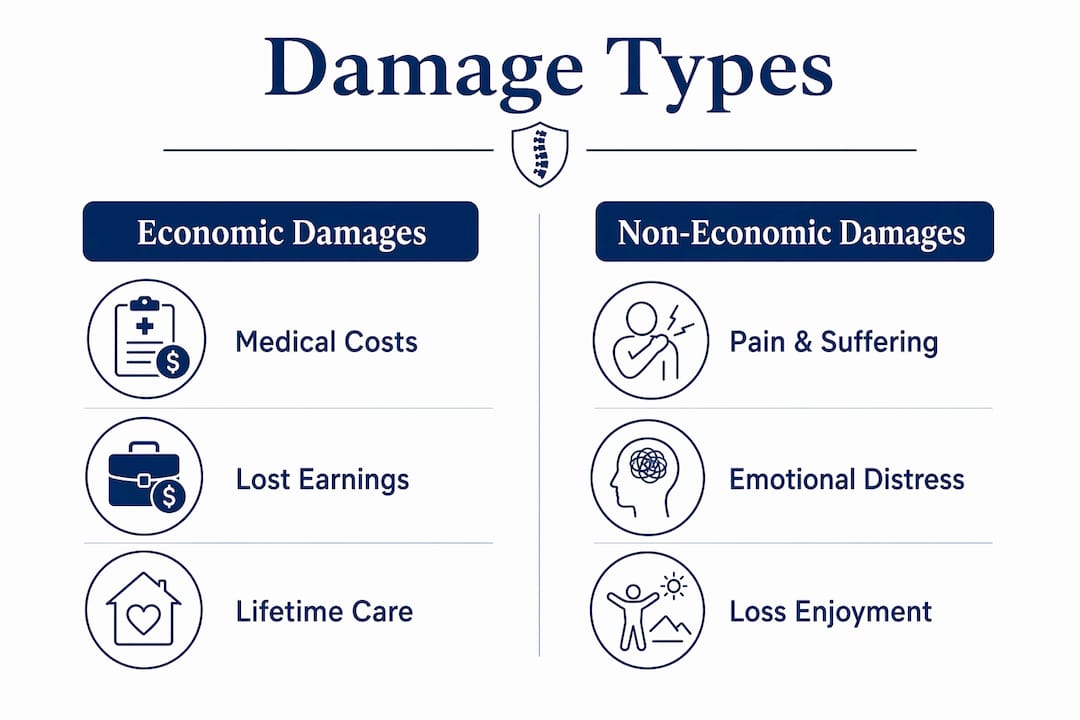
What damages are recoverable in a spinal cord injury claim
Damages in these cases divide into three categories, and the total value depends on the severity of your neurological damage, your age, your earning history, and the strength of your liability evidence.
Economic damages cover every loss you can document with a receipt or a projection:
- Past medical bills (hospitalization, surgery, ICU, inpatient rehabilitation)
- Future medical expenses projected through a life-care plan
- Attendant care costs (often many hours per day depending on injury level)
- Durable medical equipment and replacement cycles
- Home and vehicle modifications
- Past lost wages and future lost earning capacity
- Out-of-pocket costs (transportation, prescriptions, adaptive technology)
Lost earning capacity is frequently the largest single economic component. For younger plaintiffs or those early in a career, a forensic economist projects lifetime earnings based on education, field, and trajectory, then discounts the figure to present value. You can read more about economic damages for crash victims to understand how these calculations work in practice.
Non-economic damages compensate for harm that carries no price tag: physical pain, emotional suffering, loss of enjoyment of life, and the psychological weight of permanent disability. In catastrophic spinal cord cases, non-economic awards frequently rival or exceed the economic total. Valuation approaches include the multiplier method (multiplying economic damages by a factor reflecting severity) and the per diem method (assigning a daily dollar value to pain and suffering and multiplying by life expectancy). Which approach your attorney uses depends on the facts and the jurisdiction.

Punitive damages are rare but available when the defendant’s conduct was egregious or consciously wrongful. They are subject to constitutional limits and state-specific caps, so their availability varies significantly by jurisdiction.
Pro Tip: Private insurers, Medicare, and ERISA-governed employer health plans can assert reimbursement liens against your settlement. Identifying and negotiating those liens early in the case is one of the most important things your attorney can do to protect your net recovery.
How courts and insurers value a spinal cord injury claim
Case value is not a formula. It is a judgment call shaped by a specific set of factors, and understanding them helps you see where your case sits on the spectrum.
Primary valuation factors:
- Injury completeness and level: An ASIA A cervical injury produces far larger damages projections than an incomplete lumbar injury.
- Age at injury: A 25-year-old with 50 years of projected attendant care and lost earnings faces a much larger life-care plan than a 65-year-old.
- Pre-injury earning trajectory: A surgeon or engineer with documented high earnings has a larger lost-capacity claim than someone early in their career.
- Insurance limits and defendant assets: Policy limits cap what an insurer will pay; defendant assets determine whether a judgment is collectible beyond those limits.
- Strength of liability: Clear-cut negligence with no comparative fault argument produces higher offers than contested liability cases.
- Quality of medical records: Gaps in treatment, delayed diagnosis, or inconsistent records give defense experts room to minimize the injury’s severity.
- Life-care plan and economist: A professionally prepared plan with a credentialed economist’s present-value analysis is the single most powerful tool for anchoring a high demand.
- Jurisdictional jury tendencies: Some venues are known for large plaintiff verdicts; others are conservative. Defense counsel knows this and adjusts offers accordingly.
Secondary factors that can move the needle include preexisting spinal conditions (which defense teams will exploit aggressively), any comparative fault argument, the speed of your initial diagnosis, and the quality of your demonstrative evidence.
A note on realistic expectations: Insurers investigate aggressively, look for preexisting conditions, and hire their own defense experts. Initial offers are typically well below actual case value. The gap between the first offer and a fair resolution is often where the real litigation happens.
What settlement and verdict ranges actually look like
Public-facing guides and settlement calculators report wide ranges, and those ranges are real. They reflect the enormous variation in injury severity, age, earning history, and defendant resources.
Based on reported data, settlement ranges for U.S. spinal cord injury cases generally fall into these bands:
- Incomplete SCI: $500,000–$5 million
- Complete paraplegia: $2 million–$10 million or more
- Complete quadriplegia: $5 million–$20 million or more
Nuclear verdicts against deep-pocket defendants, including auto manufacturers, trucking companies, and hospitals, can reach very high amounts for catastrophic cases. These outcomes are atypical. They tend to occur when the defendant is a large corporation, the conduct was particularly egregious, and the plaintiff’s legal team presented powerful demonstrative evidence.
Lifetime care cost projections from life-care plans commonly range from $1.6 million to more than $4.7 million depending on injury severity and age; catastrophic cases with 24-hour attendant care and home modifications can run much higher. Defense teams hire their own Certified Life Care Planners to produce competing projections with lower numbers. The battle between competing life-care planners is often the central dispute at trial, which is why the quality and credentials of your planner matter as much as the numbers themselves.
The step-by-step legal process and what to expect
Cases rarely resolve quickly because treatment and prognosis evolve, and no competent plaintiff attorney will settle before the full picture of your long-term needs is clear. Here is what the process typically looks like:

1. Initial consultation and investigation (weeks 1–8)
Your attorney reviews the facts, orders records, issues preservation letters, and assesses liability and insurance coverage. For motor vehicle cases, this often includes retaining an accident reconstructionist early. See how this process works for car accident victims to understand the investigation phase in detail.
2. Medical treatment and records gathering (months 2–12+)
The case stays open while you reach maximum medical improvement. Settling before that point almost always leaves money on the table because future costs are still unknown.
3. Demand letter and insurer negotiations (months 12–18)
Once the life-care plan and economist report are complete, your attorney sends a formal demand package. Negotiations follow. Many cases settle here, but insurers often need the credible threat of trial to move to fair value.
4. Filing a complaint (if negotiations fail)
Your attorney files a formal complaint identifying every defendant, the facts, the legal theories, and the damages sought. Filing fees vary by jurisdiction.
5. Discovery (months 6–24 after filing)
Both sides exchange documents, take depositions, and disclose expert witnesses. Defense experts will depose your life-care planner and economist. Your attorney will depose theirs.
6. Mediation and settlement conference
Most courts require mediation before trial. A neutral mediator facilitates negotiation, and the vast majority of spinal cord cases settle at or before this stage.
7. Trial (if mediation fails)
A judge or jury hears the evidence, determines liability, assigns any comparative fault, and calculates the final award. Trial preparation, including day-in-the-life videos and expert rehearsal, is where the case is often won or lost.
Overall timeline for litigated cases: several months to a few years is typical, though complex cases involving multiple defendants or ongoing treatment can run longer.
Life-care plans and the experts who build your case
A life-care plan is the financial backbone of any catastrophic spinal cord injury claim. It is a written projection of every medical, therapeutic, equipment, attendant care, home modification, and transportation cost the injured person will need for their remaining life expectancy.
Who prepares it: A Certified Life Care Planner (CLCP), typically a registered nurse or physical therapist with specialized credentialing. Plans for severe SCI commonly run hundreds of pages and project costs in present-day dollars across dozens of line items.
What it covers:
- Routine and complication-related medical care
- Wheelchair maintenance and replacement (typically every 5–7 years)
- Assistive equipment: transfer boards, hospital beds, pressure-relief mattresses
- Home modifications: ramps, widened doorways, roll-in showers, accessible kitchens
- Vehicle modifications
- Attendant care (often billed at rates varying by region and level of care)
- Physical, occupational, and recreational therapy
- Psychological support
The economist’s role: A vocational economist takes the CLCP’s projected costs and discounts them to present value, producing a single lump-sum figure a jury can award today that accounts for decades of future expenses. The same expert typically projects lost earning capacity using your education, work history, and pre-injury trajectory.
Defense response: Insurers hire their own CLCPs to produce competing plans with lower numbers. Preparing your planner to withstand cross-examination and rebutting the defense plan with contemporary billing records is central to trial strategy.
Pro Tip: A professionally produced day-in-the-life video, filmed while your needs are at their most acute, is one of the most persuasive pieces of demonstrative evidence you can bring to mediation or trial. Jurors understand what they see far more viscerally than what they read in a spreadsheet.
Deadlines you cannot afford to miss
Every state sets a statute of limitations for personal injury claims. For most states, the window is a few years from the date of injury, with variation depending on jurisdiction. Miss the deadline by a single day and the court will almost certainly dismiss your case regardless of how strong your evidence is.
Critical points to understand:
- Negotiations do not pause the clock. Informal insurer negotiations do not toll the statute of limitations. Only filing suit or obtaining a written tolling agreement stops the deadline from running.
- The discovery rule may delay the start of the clock when symptoms or the cause of injury are not immediately apparent, but this exception is narrow and state-specific.
- Minor plaintiffs typically have the clock tolled until they reach the age of majority, but the rules vary by state.
- Government defendants (a city, county, or state agency) require a formal notice of claim filed within a much shorter window, often 90–180 days from the incident. Missing this notice deadline can permanently bar the claim.
- Preexisting conditions and delayed diagnosis can complicate when the clock starts, but you should never assume a favorable tolling rule applies without legal confirmation.
The safest approach: consult an attorney as early as possible, preserve all evidence and records immediately, and never assume negotiations with an insurer are buying you time.
When to hire an attorney and what to expect
You should contact a plaintiff attorney immediately if you or a family member has suffered a suspected spinal cord injury. The reasons are practical, not just precautionary. Understanding why legal representation matters from the start can protect both your evidence and your recovery.
Immediate triggers for retaining counsel:
- Any injury involving suspected spinal cord damage, paralysis, or loss of sensation
- Cases with multiple potentially liable parties (employer, manufacturer, property owner)
- Aggressive insurer contact or requests for a recorded statement
- Government defendants with short notice-of-claim deadlines
- Any situation where the insurer’s initial offer seems far below your actual losses
What a plaintiff firm does for you:
- Issues preservation letters and secures accident scene evidence before it disappears
- Orders and organizes medical records and bills
- Retains life-care planners, economists, and medical experts
- Handles all insurer communications so you are not pressured into a premature statement
- Files suit when negotiations stall, protecting your statute of limitations
- Prepares demonstrative evidence and expert witnesses for trial
What to bring to your first consultation:
- All medical records and bills you have received
- The accident or police report
- Employer and payroll records, or tax returns if self-employed
- Insurance information for all parties involved
- Contact information for any witnesses
- Photographs of the scene, vehicle, or equipment
Most plaintiff firms handling catastrophic injury cases work on a contingency fee, meaning their fee is a percentage of the recovery and you pay nothing unless you win. Typical contingency fees in personal injury cases range from 33%–40%, with higher percentages if the case goes to trial. Litigation expenses (expert fees, filing costs, deposition costs) are typically advanced by the firm and reimbursed from the recovery.
Key Takeaways
A spinal cord injury claim requires proving duty, breach, causation, and damages, and its value is built almost entirely on the quality of the life-care plan, the economist’s projections, and the strength of the liability evidence.
| Point | Details |
|---|---|
| Four legal elements | Prove duty, breach, causation, and damages by a preponderance of the evidence to establish liability. |
| Life-care plan drives value | Lifetime care cost projections commonly range from $1.6 million to more than $4.7 million; catastrophic cases with 24-hour attendant care and home modifications can run much higher. |
| Statute of limitations is absolute | Most states allow 2–3 years; negotiations do not pause the clock, and missing the deadline bars the claim permanently. |
| Settlement ranges vary widely | Incomplete SCI cases may settle for $500,000–$5 million; complete quadriplegia cases can exceed $20 million depending on age, earnings, and defendant resources. |
| Calillaw handles catastrophic SCI claims | Calil Law is a Board Certified Civil Trial firm with trial-tested experience in catastrophic injury cases, including life-care planning and insurer negotiation. |
What I’ve learned building catastrophic SCI cases
The single biggest mistake I see in spinal cord injury cases is not legal. It is timing. Families are focused, understandably, on survival and rehabilitation in the first weeks after injury. Evidence disappears. Recorded statements get given to adjusters without counsel present. Treatment gaps appear in the records because the focus is on the person, not the paperwork. By the time a family calls an attorney, the defense already has a head start.
The cases that produce the best outcomes share a common thread: early preservation, a complete and unbroken medical record, and a life-care plan built while the plaintiff’s needs are most visible and acute. A day-in-the-life video filmed six months post-injury, when the reality of 24-hour care is still raw and present, is worth more at trial than any expert’s testimony. Jurors see what they cannot unsee.
On settlement strategy, I will say this plainly: insurers for large corporate defendants do not move to fair value because you asked nicely. They move when they believe a jury will hear the case and the demonstrative evidence is compelling. The decision to push toward trial is not a failure of negotiation. It is often the only way to get a number that actually funds a lifetime of care.
The other thing families consistently underestimate is the lien negotiation. Medicare, private insurers, and ERISA plans will assert claims against your settlement. Negotiating those liens down before distribution can mean the difference between a recovery that changes your life and one that barely covers what you have already spent. That work happens quietly, behind the scenes, but it is as important as anything that happens in the courtroom.
Avoiding the mistakes that kill injury claims starts with understanding what those mistakes are before you make them.
Calillaw is ready to fight for your recovery
Facing a spinal cord injury is one of the most difficult things a person and a family can endure. The financial reality, decades of care, lost income, and a life that looks nothing like it did before, demands a legal team that knows how to build and try catastrophic injury cases, not just settle them.

Calillaw is a Florida litigation firm led by a Board Certified Civil Trial Lawyer with decades of courtroom experience in catastrophic personal injury cases. The firm handles every stage of a spinal cord injury claim: early evidence preservation, life-care planning, economist coordination, insurer negotiation, and trial when that is what it takes to reach a fair result. All representation is on a contingency basis, so there is no fee unless you recover.
Your first consultation is free. Bring your medical records, the accident report, and any insurance correspondence you have received. The earlier you call, the more options you have. Learn more about how Calillaw approaches personal injury claims or visit the firm’s personal injury practice page to take the first step.
This article is general legal information, not legal advice. Laws and deadlines vary by state. Consult a qualified attorney for guidance specific to your situation.
Useful sources and further reading
The following resources provide authoritative information on spinal cord injury statistics, medical classification, and legal frameworks. Rules on statutes of limitations, damage caps, and procedural requirements vary significantly by state, so national-level data should always be confirmed against your jurisdiction’s specific statutes.
- National Spinal Cord Injury Statistical Center (NSCISC) — The primary U.S. source for SCI incidence, prevalence, and lifetime cost data. Published figures are national averages; individual case costs depend on injury level, age, and care setting.
- Mayo Clinic: Spinal Cord Injury — Authoritative medical overview of injury classification, including the ASIA Impairment Scale and functional consequences by injury level.
- CDC: Spinal Cord Injury — National epidemiological data on causes, demographics, and prevention.
- Model Systems Knowledge Translation Center (MSKTC) — Evidence-based rehabilitation and outcomes research for SCI survivors, useful for understanding long-term functional prognosis.
- State statutes of limitations — Each state sets its own deadline for personal injury claims. Check your state’s civil practice statutes directly or consult a licensed attorney in your jurisdiction. For reference, Washington State’s general personal injury limitation is codified at RCW 4.16.080 as an example of how these statutes are structured.
For jurisdiction-specific questions about damage caps, comparative fault rules, and government notice requirements, consult a licensed plaintiff attorney in your state. National guides, including this one, reflect general U.S. principles and cannot substitute for state-specific legal advice.
Recommended
- What Kind of Damages is Available to Car Crash Victims? – Calil Law
- Catastrophic Injury Claim Explained: Your 2026 Guide – Calil Law
- What Are Compensatory Damages in Personal Injury Claims? – Calil Law
- How Accident Cases And Their Compensation Are Determined When A Lawsuit Is Filed Against The Insurance Companies – Calil Law


