 Skip to Content

What Is a Truck Inspection Report (DVIR)? A Clear Guide
A truck inspection report, formally called a Driver Vehicle Inspection Report (DVIR), is a driver-signed document required by 49 CFR 396.11 and 396.13 that records the safety condition of a commercial motor vehicle and identifies any defects affecting safe operation. The Federal Motor Carrier Safety Administration (FMCSA) mandates that the report cover six core vehicle systems at minimum: service brakes, steering, lights and reflectors, tires and wheels, coupling devices, and emergency equipment.
- When a DVIR is legally required: Any time a driver discovers a defect or deficiency that affects safety, a DVIR must be completed at the end of that operating day.
- When a DVIR is strongly recommended: Industry best practice calls for completing a post-trip DVIR at the end of every shift, even when no defects are found, to build a documented audit trail.
Table of Contents
- Who must complete a DVIR, and when?
- What does a DVIR need to include?
- What happens after a defect is reported?
- How do electronic DVIRs (eDVIRs) work with ELDs?
- How long must DVIRs and inspection records be kept?
- Why do DVIRs matter for safety, compliance, and legal claims?
- When a DVIR matters after a crash — what Calillaw can do for you
- Key Takeaways
- The documentation habit that carriers underestimate
- When inspection records affect your claim — Calillaw is ready to help
- Authoritative sources and official references
Who must complete a DVIR, and when?
Not every driver faces identical DVIR obligations, but the rules are clear once you know which category applies to you.
Passenger-carrying vehicles: Drivers operating commercial motor vehicles (CMVs) designed to carry passengers must prepare a DVIR after every trip, regardless of whether defects were found.
All other CMVs: Under 49 CFR 396.11, drivers of non-passenger CMVs must prepare a DVIR at the end of each day’s work when defects or deficiencies are discovered. If no defects are found and the vehicle is not a passenger carrier, a written report is technically required only when something is wrong — though daily completion is the smarter practice.
Pre-trip obligations under 49 CFR 396.13: Before operating a vehicle, a driver must review the previous DVIR. If the prior report noted defects, the driver must confirm in writing that repairs were made or that repair was not necessary before taking the wheel.
Multiple vehicles in one shift: Each vehicle a driver operates requires its own separate DVIR. One report does not cover a power unit and a trailer — both must be documented.
- Drivers should note the date, vehicle ID, and odometer reading on each report.
- Dispatchers should confirm that a signed DVIR exists for every unit dispatched.
Pro Tip: Even when federal rules don’t technically require a written report for a defect-free non-passenger CMV, completing one anyway creates a timestamped record that protects both the driver and the carrier during audits, insurance reviews, and litigation.
What does a DVIR need to include?
A lawful DVIR covers specific vehicle systems and contains standard form fields. The FMCSA’s sample DVIR form shows exactly how these elements are laid out, with check-any-defective-item instructions and signature blocks for both the driver and the certifying mechanic.
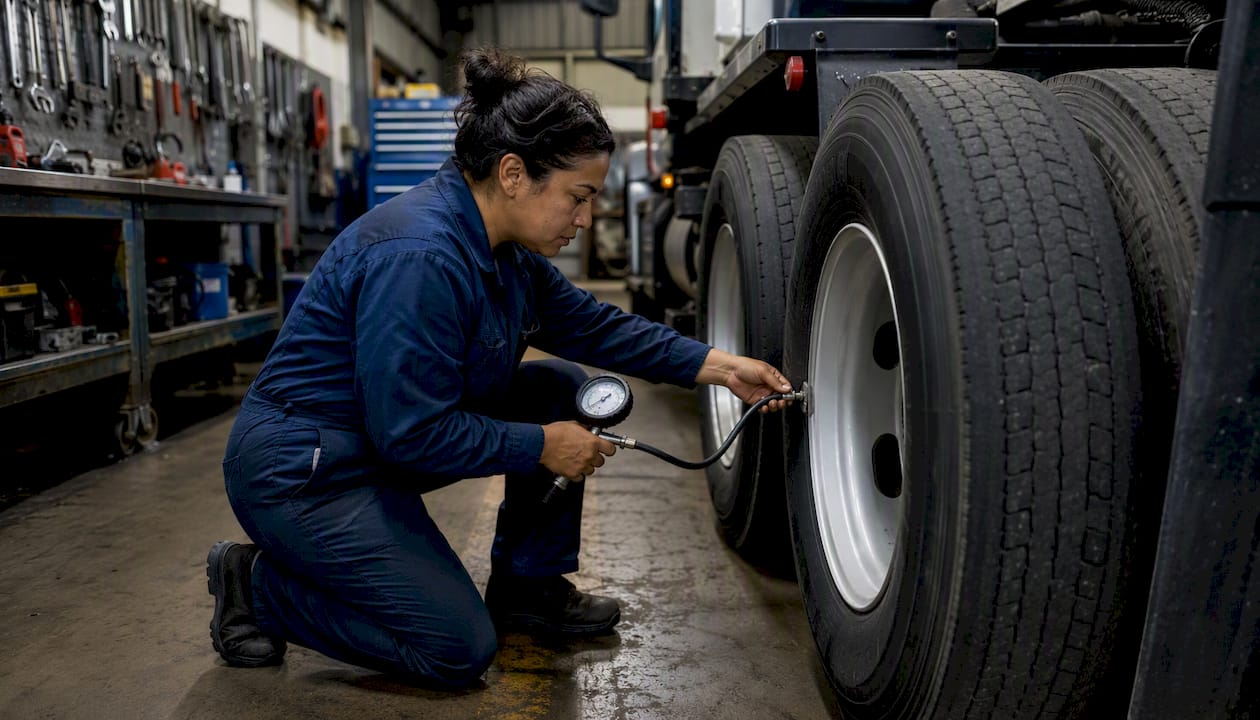
Required vehicle systems on the checklist
Drivers must inspect and report on at minimum:
- Service brakes (including trailer brake connections)
- Parking brake
- Steering mechanism
- Lighting devices and reflectors
- Tires, wheels, and rims
- Horn
- Windshield wipers
- Rearview mirrors
- Coupling devices (fifth wheel, pintle hook, drawbar)
- Emergency equipment (fire extinguisher, warning triangles, spare fuses)
Standard form fields
| Field type | Regulatory requirement | Common carrier addition |
|---|---|---|
| Vehicle identification | Required (unit number or VIN) | License plate, trailer number |
| Date of inspection | Required | Time of inspection |
| Driver signature | Required | Driver ID or employee number |
| Defect description | Required when defects found | Photo attachment |
| Mechanic certification | Required after repair | Repair order number |
| Next-driver signature | Required (acknowledging repair) | Fleet manager co-sign |
| Odometer reading | Not federally mandated | Routinely added by carriers |
| Fuel level | Not federally mandated | Common for fleet tracking |
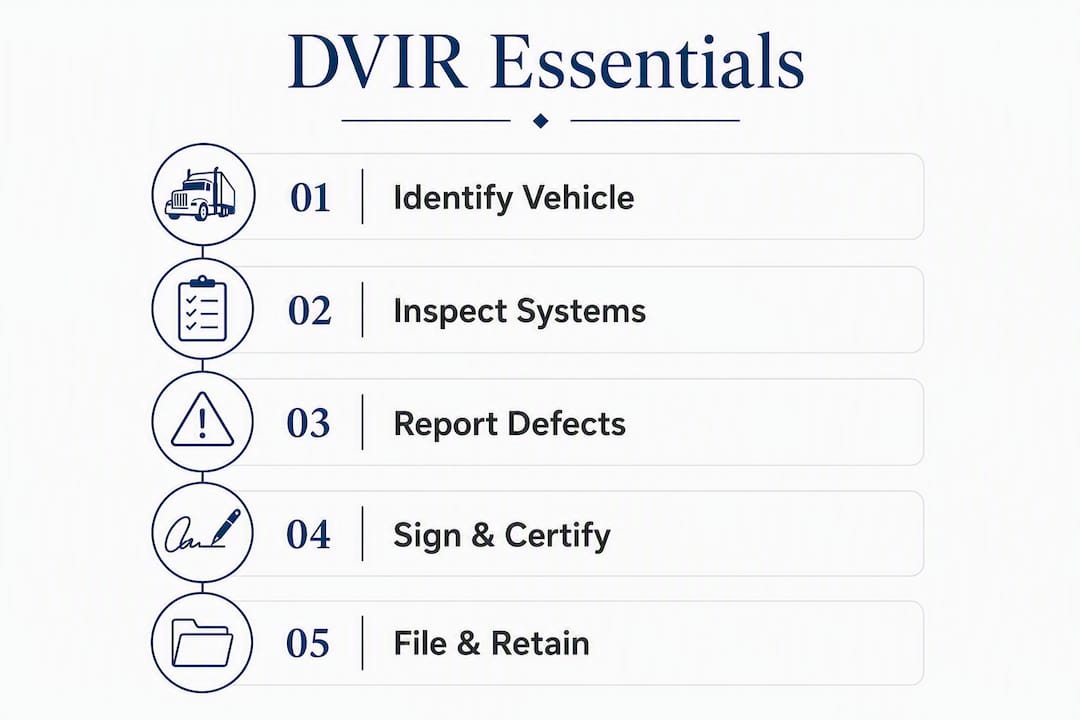
The driver’s signature certifies that the vehicle was inspected. The mechanic’s signature certifies that reported defects were repaired or that repair was not needed. Both signatures are legally meaningful — missing either one is a compliance violation.
What happens after a defect is reported?
A completed DVIR with a noted defect triggers a specific chain of obligations. Skipping any step puts the carrier in violation and, more seriously, puts an unsafe vehicle on the road.
- Carrier repair obligation: The motor carrier must repair every defect that affects safe operation before the vehicle is dispatched again. If the carrier determines a repair is not needed, that determination must be documented on the DVIR itself.
- Mechanic certification: The mechanic or authorized carrier representative who inspects the defect must sign the DVIR, certifying the repair or the decision not to repair.
- Out-of-service orders: When a roadside inspector or enforcement officer finds a defect serious enough to warrant an out-of-service order, the vehicle cannot move until the defect is corrected. State enforcement agencies impose penalties for operating a vehicle under an out-of-service order, and those penalties compound quickly.
- Next-driver sign-off: Under federal regulation, the following driver must sign the DVIR to acknowledge that required repairs were completed, or that repair was certified as unnecessary, before operating the vehicle. This step is one of the most frequently cited compliance failures in carrier audits.
Pro Tip: Carriers should build a strict sign-off workflow: the DVIR travels with the vehicle, the mechanic signs it after any repair, and the next driver physically reviews and signs it before departure. A digital workflow using an eDVIR system makes this sequence automatic and auditable.
How do electronic DVIRs (eDVIRs) work with ELDs?
Paper DVIRs are still legal, but electronic DVIRs have become the standard in modern fleets. An eDVIR is acceptable under federal regulations when it meets the same signature, retention, and carrier-access requirements as a paper form.
Most eDVIR systems integrate directly with Electronic Logging Devices (ELDs), creating a single workflow for hours-of-service and vehicle inspection data. Here is how a typical eDVIR workflow runs:
- Driver opens the ELD or fleet app at the end of a shift.
- The app walks through the inspection checklist, system by system.
- The driver marks any defects and adds notes or photos.
- The driver signs electronically; the timestamp is locked.
- An automatic alert goes to the maintenance team if defects are flagged.
- The mechanic reviews, repairs, and certifies within the same system.
- The next driver receives a notification to review and sign before departure.
The audit-trail advantages are real. Every action is timestamped, every signature is preserved, and the carrier can pull records instantly during a compliance review or after a crash.
- Confirm that your eDVIR system stores original signatures and timestamps in a format the carrier can access for at least the required retention period.
- Verify that the system allows FMCSA or enforcement officials to access records during roadside inspections.
Pro Tip: Before committing to an eDVIR platform, ask the vendor specifically how the system handles signature preservation and what happens to records if you switch providers. Data portability is a compliance issue, not just a vendor preference.
How long must DVIRs and inspection records be kept?
Retention rules differ depending on the type of inspection record. Mixing them up is a common carrier mistake.
| Record type | Retention period | Key deadline |
|---|---|---|
| DVIR originals and repair certifications | 3 months from date of report | — |
| Periodic (annual) inspection reports | 14 months | Must be kept on the vehicle |
| Roadside inspection reports | 12 months | Driver delivers to carrier within 24 hours |
| Carrier certification of roadside corrections | — | Must be completed within 15 days of inspection |
The 24-hour delivery rule for roadside inspection reports catches many drivers off guard. If a roadside inspector hands you a report, you are legally required to deliver it to your motor carrier within 24 hours. The carrier then has 15 days to certify that all violations were corrected and return the completed report.
Periodic inspections, which are required at least once every 12 months, carry their own documentation. The most recent periodic inspection report must stay on the vehicle, and the carrier must retain the report for 14 months.
Why do DVIRs matter for safety, compliance, and legal claims?
DVIRs are the formal communication channel between drivers and maintenance. When a driver notes a brake issue at the end of a shift, the DVIR is what compels the carrier to act before that truck rolls again. Without that documented record, defects go unaddressed, and unsafe vehicles stay in service.
The Commercial Vehicle Safety Alliance (CVSA) enforces uniform inspection standards through its Level I through Level VIII North American Standard inspections. DVIRs feed directly into that system: a pattern of unaddressed defects on a carrier’s DVIRs is exactly the kind of evidence that triggers a targeted CVSA inspection or an FMCSA compliance review.
From a liability standpoint, DVIRs and repair certifications are among the first documents attorneys and investigators request after a serious truck crash. A DVIR that shows a brake defect was reported three days before a collision, with no mechanic certification on file, is powerful evidence of negligence. Conversely, a clean, consistent DVIR record with documented repairs can support a carrier’s defense. Proper recordkeeping is both a regulatory requirement and a practical liability-reduction measure.
Consider two scenarios: In one, a driver reports a steering pull on a DVIR; the carrier repairs it and documents the fix. In another, the same defect is noted but the repair certification is never completed. If either truck is involved in a crash the following week, those two paper trails lead to very different legal outcomes.
When a DVIR matters after a crash — what Calillaw can do for you
DVIRs, roadside inspection reports, and maintenance logs are among the most consequential documents in truck-accident litigation. They establish what the driver and carrier knew, when they knew it, and whether they acted on it. A missing DVIR, an unsigned repair certification, or a pattern of ignored defects can shift liability significantly.
You should speak with an attorney promptly if you were injured in a truck collision and any of the following apply:
- The truck involved had recent defects noted on a DVIR that were not repaired.
- Inspection records are missing, incomplete, or appear to have been altered.
- The carrier failed to certify repairs within the required 15-day window.
- You suspect the truck was dispatched under an out-of-service order.
- The crash involved a brake, steering, or tire failure that a proper inspection should have caught.
Calillaw’s truck accident attorneys handle cases where inspection records are central to proving negligence. The firm’s Board Certified Civil Trial Lawyer and litigation team know how to obtain, analyze, and present DVIR evidence in a way that holds carriers accountable. Calillaw also handles defective vehicle claims where a mechanical failure contributed to the crash.
Pro Tip: After any serious truck crash, photograph the vehicle, secure any paper DVIRs in the cab, and request copies of all inspection records immediately. Records can be lost, overwritten, or destroyed — especially electronic records on systems with short default retention settings. The sooner you act, the stronger your position.
Key Takeaways
A Driver Vehicle Inspection Report (DVIR) is a federally required safety document under 49 CFR 396.11 and 396.13 that records vehicle condition, mandates defect repair before re-dispatch, and serves as critical evidence in crash investigations and litigation.
| Point | Details |
|---|---|
| DVIR definition and legal basis | A driver-signed record required by 49 CFR 396.11/396.13 covering brakes, steering, lights, tires, coupling devices, and emergency equipment. |
| When completion is required | Mandatory when defects are found; daily post-trip completion is best practice for all CMV drivers to maintain an audit trail. |
| Defect repair chain | Carrier must repair or certify non-repair; mechanic signs the DVIR; next driver must sign before operating the vehicle. |
| Retention timelines | DVIRs: 3 months; periodic inspection reports: 14 months; roadside inspection reports: 12 months, with carrier certification due within 15 days. |
| Calillaw’s role | If inspection records are missing or defects went unrepaired before a crash, Calillaw’s truck accident team can help you pursue accountability. |
The documentation habit that carriers underestimate
There is a gap between what carriers think their DVIR process looks like and what it actually looks like when an investigator pulls the records. Drivers rush through end-of-shift paperwork. Mechanics sign off without a physical re-inspection. Next-driver signatures get skipped because “everyone knows the truck was fixed.” These are not rare failures — they are the norm at carriers who treat DVIRs as a checkbox rather than a safety system.
What I see in cases involving serious truck crashes is that the paper trail almost always tells a story the carrier did not intend to tell. A missing mechanic signature on a brake defect. A next-driver sign-off dated two days after the repair was supposedly completed. An eDVIR system that overwrote records after 60 days because no one configured the retention settings correctly. These details matter enormously in court, and they are entirely preventable.
The carriers that get this right treat daily DVIR completion as non-negotiable, use eDVIR systems with verified retention settings, and build the mechanic-sign-off and next-driver-acknowledgment steps into dispatch workflows. That discipline protects drivers, protects the public, and protects the carrier when something goes wrong despite best efforts.
When inspection records affect your claim — Calillaw is ready to help
If a truck crash has turned your life upside down, the inspection records on that vehicle may be the most important evidence in your case. Calillaw represents injured people in Florida whose crashes involved commercial trucks, defective vehicles, and carriers who failed to maintain their fleets. The firm works on a contingency basis, meaning you pay nothing unless you recover.

Preserve every document you can access right now: photographs of the truck, any paper DVIRs visible in the cab, and the roadside inspection report if one was issued. Then contact Calillaw for a confidential review of your situation. The firm’s personal injury attorneys will assess whether the carrier’s inspection records support a claim and advise you on next steps. Understanding what a personal injury claim involves is the first step toward protecting your rights.
Authoritative sources and official references
- 49 CFR 396.11 and 396.13 — Driver Vehicle Inspection Reports (FMCSA): The primary regulatory text governing DVIR requirements, who must complete them, and what they must cover.
This article provides general information about federal trucking regulations and is not legal advice. Rules and requirements can change; confirm current obligations with the FMCSA, your state DOT, or a qualified transportation attorney.


