 Skip to Content

Bodily Injury Liability Coverage: What You Need to Know
What is bodily injury liability coverage?
Bodily injury liability coverage is the part of your auto insurance policy that pays for injuries you cause to other people in an accident. When you’re at fault, it covers the other driver, their passengers, and any pedestrians involved. Think of it as your financial shield against the costs that follow when someone else gets hurt because of your driving.
Most states require this coverage by law. Without it, you’re personally responsible for every dollar of the other party’s medical bills, lost income, and legal costs.
Here’s what bodily injury liability typically covers:
- Medical expenses for the injured party, including hospital stays, surgery, and rehabilitation
- Lost wages if the injured person cannot work during recovery
- Pain and suffering damages, which courts may award beyond direct medical costs
- Funeral costs when an accident results in a fatality
- Legal defense fees, including attorney costs and court expenses if you’re sued
What does bodily injury liability actually pay for?
The scope of this coverage is broader than most drivers realize. Bodily injury liability pays for medical bills, lost wages, legal fees, court costs, pain and suffering claims, and funeral expenses tied to injuries you cause. It applies to the other driver, their passengers, and pedestrians you hit.
Legal defense costs deserve special attention. If the injured party sues you, your insurer steps in to provide an attorney and cover court expenses, but only up to your policy limits. Any amount beyond those limits comes directly out of your pocket.
“Liability insurance compensates a third party for damage caused by the negligence of the insured.” — Legal Information Institute, Cornell Law School
- Medical care: emergency treatment, surgeries, physical therapy, and follow-up care
- Income replacement: compensation for wages the injured party loses while recovering
- Pain and suffering: non-economic damages a court may award
- Funeral and burial costs: covered when injuries prove fatal
- Attorney and court fees: your insurer defends you legally within your coverage limits
How do coverage limits work, and how much do you need?
Most auto policies use a split limit format, written as three numbers such as 100/300/100. The first two numbers represent bodily injury limits: the maximum paid per injured person and the maximum paid per accident total. Split limits are critical to understand when multiple people are injured in a single crash, because the per-accident cap applies across all claimants combined.

State minimums are a floor, not a recommendation. State-mandated minimums often cannot cover modern medical costs, so drivers should consider coverage that matches their net worth. A serious accident involving hospitalization, surgery, and lost income can easily exceed a low minimum policy.
| Coverage Level | Per Person | Per Accident |
|---|---|---|
| State minimum (example) | Typically low limits required by state law | Typically low limits required by state law |
| Moderate coverage | Moderate limits above state minimums | |
| Recommended (higher risk) | Higher limits suitable for greater asset protection |
- Per-person limit: the cap on what your insurer pays for any single injured person
- Per-accident limit: the total cap across all injured parties in one accident
- Net worth consideration: your personal assets are at risk when claims exceed your limits
- Wage garnishment risk: choosing only minimum coverage can expose your future earnings and home equity to collection
How does bodily injury liability differ from related coverages?
Bodily injury liability covers injuries to others. It does not cover your own injuries or your vehicle. That distinction is where drivers most often get confused.
Liability insurance protects third parties based on your negligence. It is fundamentally different from first-party coverages, which pay for your own losses regardless of fault.
- Property damage liability: covers damage you cause to someone else’s vehicle or property, not their physical injuries
- Personal Injury Protection (PIP): pays for your own medical expenses and lost wages, regardless of who caused the accident
- MedPay: covers medical bills for you and your passengers after an accident, also regardless of fault
- Your own injuries: bodily injury liability does not cover your medical bills; those fall under PIP, MedPay, or your health insurance
- Your vehicle: collision or comprehensive coverage handles damage to your own car
For a detailed comparison of PIP vs. bodily injury coverage, the distinction between first-party and third-party protection is worth understanding before you choose your limits.
What factors affect the cost of bodily injury liability coverage?
Your premium reflects your personal risk profile, not just the coverage amount you select. Factors that influence cost include your driving record, location, coverage amount, vehicle type, and claims history.
Higher limits cost more, but the gap between a minimum policy and a $100,000/$300,000 policy is often smaller than drivers expect. The financial exposure from an underinsured accident is far greater than the annual premium difference.
- Driving record: at-fault accidents and traffic violations raise your rate
- Location: urban areas with higher accident rates carry higher premiums
- Coverage limits: higher per-person and per-accident limits increase your premium
- Vehicle type: high-value or high-performance vehicles typically cost more to insure
- Claims history: prior bodily injury claims signal higher risk to insurers
A trial lawyer’s perspective on bodily injury liability
From a litigation standpoint, bodily injury liability coverage is one of the most consequential decisions a driver makes. When limits are too low, the insurer settles within the policy cap and walks away. You remain personally exposed to the rest of the judgment.
When a verdict or settlement exceeds your policy limits, your insurer’s obligation ends there. Your personal assets, including your home equity and wages, become the next target for collection.
Your insurer controls the legal defense within your policy limits. They choose the attorney, direct the strategy, and decide when to settle. If the case goes to verdict above your limits, that gap is yours to cover. Adequate limits give your insurer room to negotiate and protect you fully.
Pro Tip: Consider an umbrella policy on top of your auto coverage. It extends your liability protection significantly and typically costs far less per dollar of coverage than your base auto policy.
Third-party liability claims can escalate quickly, especially when injuries are severe or involve multiple parties. Calillaw has handled these cases from both sides of the courtroom, and the pattern is consistent: drivers with adequate limits fare far better in litigation than those who relied on state minimums.
How the bodily injury liability claims process works
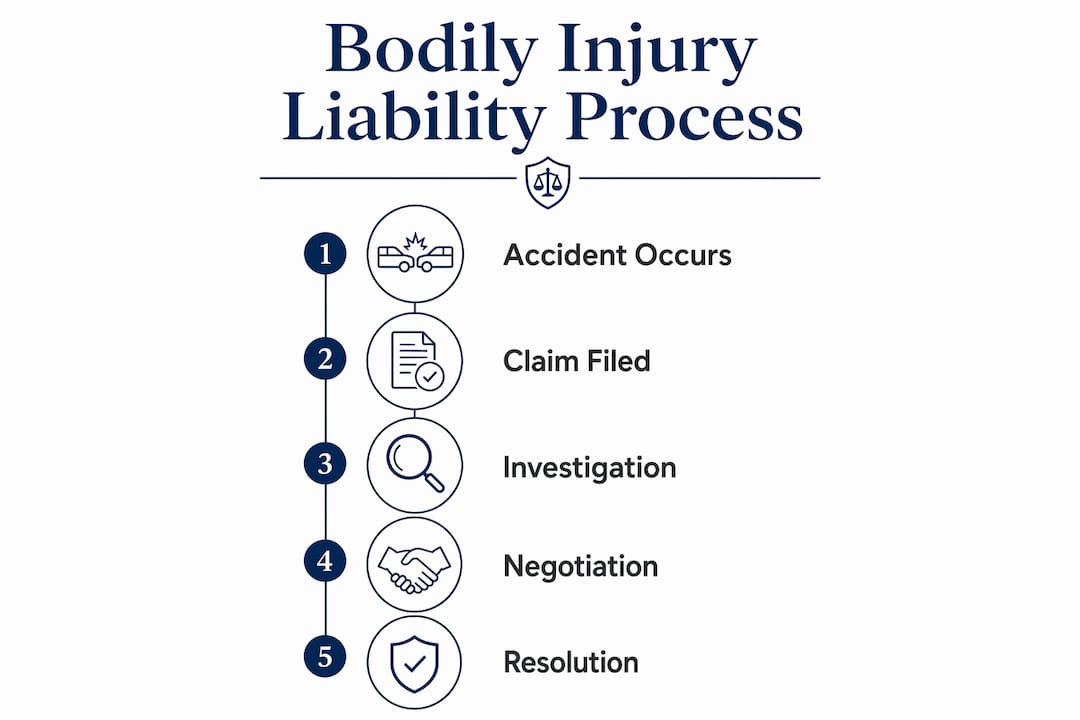
After an accident, the injured party files a claim with your insurance company. Your insurer then investigates the accident, reviews medical records, and evaluates the claim’s value. Throughout this process, legal counsel plays a critical role in defense and negotiation, particularly when injuries are serious.

If the claim cannot be resolved through negotiation, the injured party may file a lawsuit. Your insurer defends you and manages settlement discussions, but only within your policy limits. Understanding what damages are available helps you anticipate the full scope of a potential claim against you.
What bodily injury liability does not cover
Bodily injury liability has clear boundaries. Knowing them prevents costly surprises after an accident.
- Your own injuries: covered by PIP, MedPay, or health insurance, not your liability policy
- Your vehicle damage: handled by collision coverage, not liability
- Intentional acts: coverage does not apply when harm is deliberate
- Criminal conduct: accidents arising from criminal behavior are excluded
- Contractual liability: obligations you assume under a contract fall outside standard coverage
- Injuries to household members: most policies exclude family members living in your home
Real scenarios where bodily injury liability applies
Scenario 1: You run a red light and hit another vehicle. The other driver suffers a broken arm and misses six weeks of work. Your bodily injury liability pays their emergency room bills, orthopedic care, and lost wages, up to your per-person limit.
Scenario 2: You rear-end a car carrying three passengers. All three are injured. Your per-person limit applies to each individual, but the per-accident cap limits the total your insurer pays across all three claims combined. If the total exceeds that cap, you owe the difference personally.
Scenario 3: A pedestrian steps into the road and you cannot stop in time. They sustain a catastrophic injury requiring long-term care. Medical costs alone can reach well into six figures. A policy with only state-minimum limits leaves a substantial gap that becomes your personal debt.
If you’ve been involved in an accident and need to understand your rights or exposure, Calillaw is here to help. Our Board Certified Civil Trial Lawyer and litigation team handle serious personal injury claims and insurance disputes with the depth and determination your case deserves. Contact us for a free consultation.

Key Takeaways
Bodily injury liability coverage protects your personal assets by paying for injuries you cause to others, covering medical expenses, lost wages, legal defense, and pain and suffering up to your policy limits.
| Point | Details |
|---|---|
| Core purpose | Pays for injuries to others when you are at fault, not your own injuries or vehicle damage. |
| What it covers | Medical expenses, lost wages, pain and suffering, funeral costs, and legal defense fees. |
| Split limits structure | Policies use per-person and per-accident limits; exceeding either cap creates personal liability. |
| State minimums are insufficient | Minimum required limits rarely cover serious accident costs; match coverage to your net worth. |
| Exclusions matter | Intentional acts, criminal conduct, and your own injuries fall outside bodily injury liability. |


