Skip to Content

Failure to Warn Claim: Your Legal Rights Explained
What is a failure to warn claim?
A failure to warn claim is a type of product liability case that arises when a manufacturer or seller fails to provide adequate warnings about non-obvious risks associated with a product, and that failure causes injury. The claim does not assert that the product is physically flawed. Instead, it targets the missing or insufficient risk communication that left you unaware of a danger you had no reason to expect.
These claims fall under two main legal theories: strict liability and negligence. Under strict liability, which governs most states, a manufacturer can be held responsible regardless of whether it acted carelessly. Under negligence, you must show the manufacturer breached a duty of care. Either way, the core question is the same: did the product carry a warning adequate enough to protect a reasonable user?
Key elements courts look for in a failure to warn claim:
- The product posed a risk that was known or reasonably knowable at the time of sale
- The risk was not obvious to an ordinary consumer
- You used the product in a foreseeable way
- The missing or inadequate warning was a substantial factor in causing your injury
How to prove a failure to warn claim under 2025 legal standards
Proving this type of claim requires more than showing a label was missing. Courts apply a structured analysis, and each element carries real weight.
- Knowledge of the risk. You must show the manufacturer knew or should have known about the danger. Actual knowledge is not required; if reasonable testing or research would have revealed the risk, liability can attach.
- Non-obviousness. The risk must not be apparent to an ordinary consumer. A steak knife does not need a warning that it is sharp. A chemical cleaning product that reacts dangerously with common household items is a different story.
- Foreseeable use. Your use of the product must have been reasonably predictable. Manufacturers are responsible for foreseeable misuse, not every conceivable one.
- Causation. This is where many claims succeed or fail. You must prove that a proper warning would have prevented or reduced your injury, not simply that the warning was absent. Courts require a direct causal link between the missing warning and harm.
- Adequacy of the warning. Even when a warning exists, it may be legally insufficient. Placement, language, and visibility all matter.
- Strict liability vs. negligence. Under strict liability, the manufacturer’s level of care is irrelevant. Under negligence, you must show the manufacturer fell below the standard a reasonable company would meet.
Pro Tip: Document everything about the product at the time of your injury, including packaging, manuals, and any labels. Courts assess warning adequacy based on what was present at the moment of harm, not what a manufacturer later adds.
What duties do manufacturers carry, and how do they defend these cases?
Manufacturers do not get to walk away once a product ships. Their duty to warn is continuous and lasts as long as the product remains in use. If new safety information emerges after a product reaches the market, the manufacturer must warn existing owners and users. Failing to issue that post-sale warning can create liability just as readily as an absent label at the point of sale.
Common defenses manufacturers raise include:
- Obviousness of risk. Courts generally do not require warnings for hazards an ordinary person would recognize. However, courts assess this inconsistently, and what seems obvious to a manufacturer often is not obvious to a first-time user.
- Unforeseeable misuse. If you used the product in a way no reasonable manufacturer could have predicted, the company may escape liability for that specific risk.
- Learned intermediary doctrine. In pharmaceutical and medical device cases, many jurisdictions apply this doctrine, which shifts the warning duty to physicians or pharmacists rather than requiring the manufacturer to warn patients directly.
- Warning placement disputes. A warning buried in a dense technical manual is often deemed inadequate. Courts expect warnings to be prominent, clear, and accessible to the average user. Power tools, for example, typically require warnings on the product itself, not just in a booklet.
The law here is shaped by policy considerations that balance injury prevention against the practical limits of warning space and consumer attention. That ambiguity cuts both ways, and an experienced attorney knows how to use it.
Real-world examples and what your claim could be worth

Failure to warn claims arise across a wide range of product categories. Pharmaceuticals with undisclosed side effects, power tools without adequate safety instructions, household chemicals that produce toxic reactions when combined, and defective vehicle components without proper handling warnings are among the most common. Consider a consumer who suffers chemical burns after mixing two cleaning products that, unknown to them, produce a dangerous gas. If the manufacturer knew about that reaction and placed no warning on either product, a failure to warn claim is squarely on the table.
What you can recover in a successful claim:
- Medical expenses and future medical costs
- Lost wages and lost future income
- Pain and suffering
- Lost enjoyment of life
- Punitive damages, in cases involving egregious conduct
Expert witnesses play a central role in these cases. A toxicologist, engineer, or medical professional can establish both that the risk was knowable and that a proper warning would have changed your behavior. Without that testimony, causation is difficult to prove.
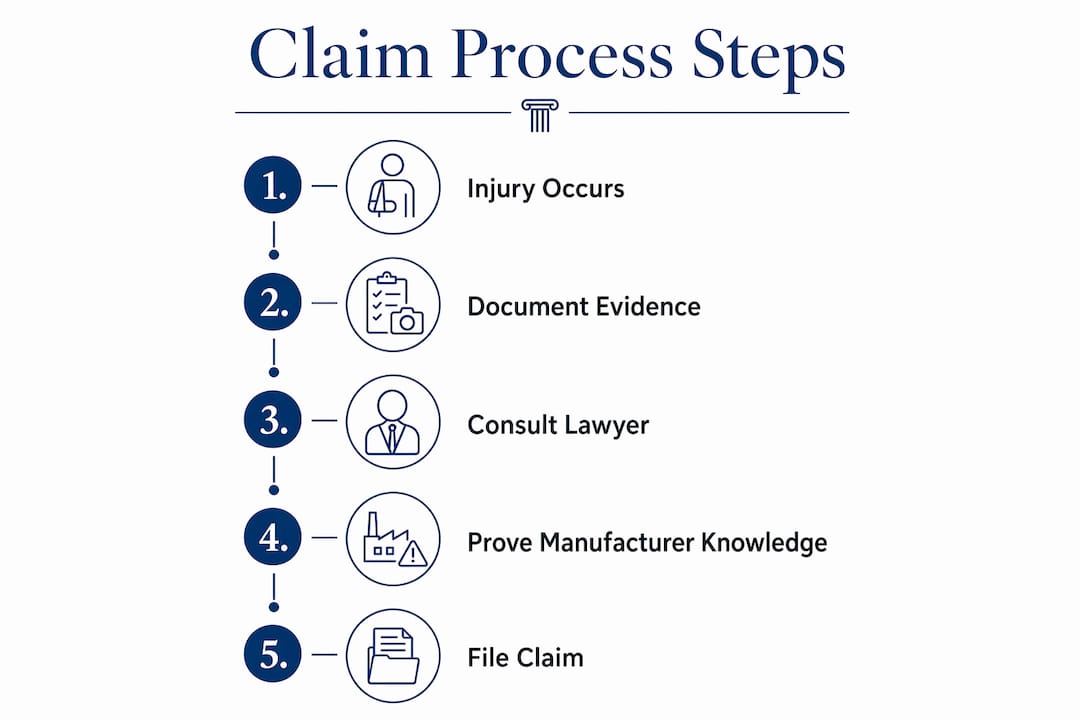
Act quickly after an injury. Statutes of limitations for product liability claims vary by state, but most fall within two to four years from the date of injury or discovery. Preserve the product, its packaging, and any instructions. Photograph your injuries and the scene. Seek medical attention immediately, and consult a personal injury attorney before speaking with any manufacturer or insurer.
Why failure to warn claims matter and what you should do next
A failure to warn claim holds manufacturers accountable when they put profits ahead of your safety. These cases cover a broad spectrum, from a single injured consumer to class actions affecting thousands of people harmed by the same undisclosed risk. Understanding negligence principles and how they apply to product liability gives you a foundation to evaluate your situation clearly.
What you need to remember:
- The claim targets missing or inadequate warnings, not product defects
- Strict liability applies in most states, meaning the manufacturer’s intent is irrelevant
- Causation is the hardest element to prove and requires expert support
- Manufacturers have ongoing duties that extend well past the original sale
- The statute of limitations is real; delay costs you options
Calillaw has spent decades representing injured people in exactly these situations. We know how manufacturers defend these cases, and we know how to counter those defenses with evidence, expert testimony, and disciplined trial strategy. Your life has value, and so does your right to a product that is safe or, at minimum, honest about its risks.
Key Takeaways
A failure to warn claim succeeds when you prove the manufacturer knew of a non-obvious risk, failed to communicate it adequately, and that failure directly caused your injury.
| Point | Details |
|---|---|
| Core definition | A failure to warn claim targets missing or inadequate risk communication, not physical product defects. |
| Causation requirement | You must prove a proper warning would have prevented or reduced your injury, not just that a warning was absent. |
| Manufacturer’s ongoing duty | Manufacturers must warn users of newly discovered risks even after a product has been sold. |
| Obviousness defense | Courts generally do not require warnings for risks an ordinary consumer would recognize, though this standard is applied inconsistently. |
| Act without delay | Most states impose a two to four year statute of limitations; preserve evidence and consult an attorney promptly. |
Ready to find out if you have a claim? Calillaw’s Board Certified Civil Trial Lawyer and our team are here to evaluate your situation with the seriousness it deserves. Contact us today for a free consultation.