 Skip to Content

72 Hours to Act: Wire Fraud Defense in U.S. Federal Cases
Wire fraud convictions hinge on proving specific intent under 18 U.S.C. § 1343, and every text, email, or transfer tied to the alleged scheme can become its own count, so exposure stacks fast. The strongest defenses attack intent or materiality head on. If you’re under investigation, the single most important move is to stop making voluntary statements and call experienced federal defense counsel immediately, before you say anything else to anyone.
TL;DR:
- Proof of specific intent to defraud and a scheme to deceive are essential; negligence or bad judgment do not meet the legal standard.
- Wire communications used in furtherance of a scheme can be any interstate communication that helps move the fraud forward, even weeks after the initial lie.
- Penalties can include up to 20 years in prison, with possible increases to 30 years for schemes involving financial institutions or disasters, and guideline ranges escalate rapidly with higher loss amounts.
- Defense strategies rely heavily on contested “in furtherance” and materiality, with good faith beliefs and third-party communication issues offering potential avenues to reduce charges.
- Immediate legal counsel is crucial upon investigation, as early decisions on cooperation, evidence preservation, and venue challenges significantly impact the case’s outcome.
Table of Contents
- What Wire Fraud Defense Means: The Statute and Its Four Elements
- Penalties and Sentencing: What You’re Actually Facing
- Common Defenses: Where the Government’s Case Can Break
- Timing Matters: What Happens Before an Indictment Is Filed
- How Prosecutors Build a Wire Fraud Case Against You
- What to Do Right Now If You’re Under Investigation
- Why Calil Law’s Trial Experience Matters Here
- Does a Prior Record Change Your Wire Fraud Defense?
- Plea Negotiations: What’s Actually on the Table
- After Conviction: Appeals and Motions to Vacate
- Where the Case Gets Tried: Venue and Jurisdiction Fights
- An Editorial Take on Defending Wire Fraud Charges
- Talk to Calil Law Before You Talk to Investigators
- Primary Sources Worth Reading Directly
- Sources
What Wire Fraud Defense Means: The Statute and Its Four Elements
Federal prosecutors have to clear four hurdles to convict someone of wire fraud, and understanding each one tells you where a real defense can take root. The statute itself, 18 U.S.C. § 1343, does not criminalize bad business decisions or even sloppy communication. It criminalizes a specific combination of conduct and intent.
The government must prove:
- A scheme to defraud. A plan or artifice to deceive someone out of money or property, not a single ambiguous statement.
- Specific intent to defraud. The person had to know the scheme was deceptive and mean to profit from it. Negligence or bad judgment alone doesn’t meet this bar.
- A material misrepresentation or false promise. The lie or omission has to matter to the victim’s decision, not be a throwaway exaggeration.
- Use of interstate or foreign wire communications “in furtherance” of the scheme. This is the hook that gets the case into federal court.
That fourth element is where a lot of first-time defendants get blindsided. The DOJ Criminal Resource Manual’s elements guidance confirms that an ordinary email, a wire transfer, or even a text message crossing state lines can satisfy the wire requirement. The communication doesn’t need to contain the lie itself. It just has to help move the scheme forward and be reasonably foreseeable as part of it. That’s why a routine follow-up email, sent weeks after the alleged misrepresentation, can end up charged as its own separate count.
Penalties and Sentencing: What You’re Actually Facing
A wire fraud conviction carries a statutory maximum of 20 years in federal prison, rising to 30 years if the scheme touched a financial institution or involved a presidentially declared disaster or emergency, according to 18 U.S.C. § 1343. Fines follow the framework in 18 U.S.C. § 3571, which can run as high as $250,000 for an individual, or twice the amount gained or lost, whichever is greater. In financial institution cases, fines can reach $1,000,000.
Those numbers only tell part of the story, though. Actual sentences are driven by the U.S. Sentencing Guidelines §2B1.1, which start most fraud offenses at a base offense level of 7 and then pile on enhancements tied almost entirely to the dollar amount lost.
- A $10,000 loss might add a few levels to the base offense.
- A loss exceeding $550,000 can add over a dozen levels, pushing the guideline range into multi-year territory even for a first offender.
- Sophisticated means, vulnerable victims, and abuse of a position of trust each trigger additional add-ons.
The conviction reality: Wire fraud cases in federal court end in conviction at a high rate, which is exactly why early defense strategy, not a last-minute Hail Mary at trial, tends to produce the best outcomes.
Restitution and forfeiture run on top of any prison sentence and fine, and courts routinely order defendants to repay every dollar tied to the loss calculation. Because each qualifying wire communication can be charged as its own count, a scheme built on a dozen emails can turn into a dozen separate charges, and guideline exposure climbs with every one.
Common Defenses: Where the Government’s Case Can Break
Good faith is the backbone of most wire fraud criminal defense strategies, and it’s worth understanding exactly how it works. Good faith isn’t a separate affirmative defense the defendant has to prove. It negates specific intent, which means the burden stays on the prosecution to disprove it beyond a reasonable doubt. That distinction shapes everything about how a defense attorney builds the case.
Pro Tip: Contemporaneous records, business plans, emails discussing risk, disclosures made to investors or partners at the time, carry far more weight than anything created after an investigation starts. If you believed in the deal when you made it, the paper trail from that period is your best evidence.
Several defense theories tend to recur in wire fraud litigation:
- Lack of specific intent. Showing the defendant genuinely believed in the underlying business, product, or promise, even if it later failed.
- Lack of materiality. Puffery, optimistic projections, and sales exaggeration generally don’t rise to the level of a material misrepresentation the way a hard factual lie does.
- Challenging “in furtherance.” Attacking whether a specific communication actually advanced the scheme, or whether it was incidental and unrelated, can knock out individual counts even when the broader case survives.
- Third-party or agent transmission issues. If someone else sent the wire without the defendant’s knowledge or direction, that breaks the causal chain prosecutors need.
- Suppression motions. Illegally obtained evidence from a search, seizure, or wiretap can be challenged and excluded before trial ever starts.
- Motions to dismiss. When the indictment’s underlying scheme theory is legally insufficient, dismissal can end the case before a jury ever hears it.
Attacking “in furtherance” on even a handful of communications matters more than it sounds like it should. Knocking out a subset of counts can meaningfully lower the loss calculation and, with it, the guideline range that drives sentencing.
Timing Matters: What Happens Before an Indictment Is Filed
The pre-indictment window is where a federal wire fraud defense either gets built correctly or gets away from you. Once charges are filed, a lot of strategic flexibility disappears. Here’s how the timeline typically unfolds and where the decisions get made:
- Retain counsel the moment you learn of an investigation. Whether that’s a grand jury subpoena, a knock from federal agents, or a tip from a business partner, engaging a federal defense attorney immediately preserves options that evaporate later.
- Evaluate whether a proffer session makes sense. A proffer is a formal, protected conversation with prosecutors where your attorney negotiates the terms in advance. It can open doors to cooperation credit or a narrower charge, but statements made can sometimes be used against you depending on the agreement’s terms, so this decision never happens without careful legal analysis first.
- Assess the evidence realistically before choosing a path. Counsel reviews what the government likely has, financial records, communications, witness statements, and weighs plea negotiation against trial based on how strong or weak that evidence actually is.
- Shape the government’s theory early. Skilled negotiation before indictment can sometimes narrow the scope of charges or the number of counts, which directly affects sentencing exposure down the line.
Every one of these decisions is a tactical fork in the road, and the wrong choice made under panic, like agreeing to an unprotected interview, can hand prosecutors the specific intent evidence they were missing.
How Prosecutors Build a Wire Fraud Case Against You
The government’s evidence in a typical wire fraud prosecution isn’t one smoking-gun document. It’s a mountain of ordinary business records assembled into a narrative. Investigators pull emails, call logs, bank transfer records, ledger spreadsheets, and witness interviews, then hand that pile to someone whose job is to make it make sense to a jury.
- Summary witnesses do the heavy lifting. FBI agents or forensic accountants testify to walk jurors through hundreds or thousands of pages of financial records, condensing them into a clean, damaging storyline.
- The narrative, not just the facts, wins convictions. A summary witness’s chart showing money flowing from victim to defendant is often more persuasive to a jury than the underlying documents themselves.
- Independent experts are the primary rebuttal tool. A defense-retained forensic accountant or technologist can challenge the government’s summary, expose selective framing, or show that the “scheme” was actually a legitimate, if failed, business.
- Doctrinal limits narrow what prosecutors can charge. Court rulings on honest services and property theories, discussed in a Congressional Research Service report on mail and wire fraud, have restricted some of the more aggressive prosecutorial theories used in past decades.
Recognizing where the government’s narrative depends on inference rather than direct proof is often where a defense attorney finds the opening a jury needs to acquit.
What to Do Right Now If You’re Under Investigation
If federal agents have contacted you, or a subpoena or search warrant just landed, your next moves matter more than almost anything else in the case.
- Stop talking. Politely decline to answer questions and state that your attorney will respond on your behalf. Voluntary statements are frequently the government’s best evidence of intent.
- Preserve everything. Don’t delete emails, wipe devices, or alter backups. Destroying evidence, even evidence you think looks bad, can add an obstruction charge on top of the fraud allegation.
- Call a federal defense attorney immediately. Every hour matters in the pre-indictment window described above.
- Comply with subpoenas and warrants procedurally, not substantively. Follow lawful instructions from agents executing a warrant, but let your attorney handle every substantive question or production decision.
- Write down what you remember, dated and factual. Contemporaneous notes made now, while your memory is fresh, become useful defense material later.
Pro Tip: If you’re facing an arrest or bail hearing alongside a fraud investigation, understanding your options for fast, affordable bail steps before you’re in custody can prevent unnecessary delays that hurt your defense timeline.
Why Calil Law’s Trial Experience Matters Here
Federal fraud allegations don’t get resolved by hoping the government loses interest. They get resolved through disciplined document review, careful expert selection, and sentencing mitigation work that starts long before any hearing date. Calil Law’s trial attorneys bring decades of courtroom-tested litigation experience to cases that require exactly that kind of preparation, the same rigor the firm applies across its complex litigation practice.
Every case intake starts with a direct conversation about your facts, the evidence the government appears to have, and how urgent your timeline actually is. There’s no generic script. If you’re facing a subpoena, a target letter, or an indictment, the priority is understanding your exposure fast and building a response before the government locks in its theory.
Does a Prior Record Change Your Wire Fraud Defense?
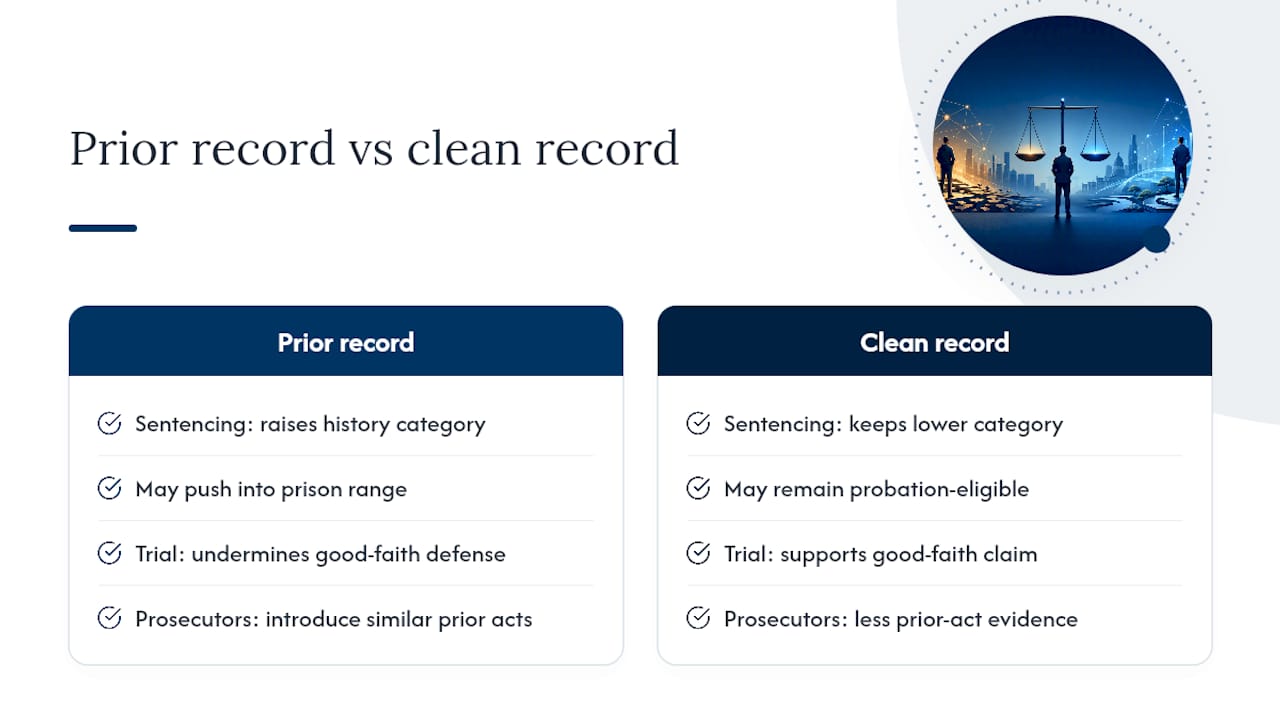
Criminal history affects a wire fraud case in two distinct ways, and both matter more than most defendants expect going in. Under the Sentencing Guidelines, a defendant’s criminal history category sits on a separate axis from the offense level tied to loss amount. The two combine on a sentencing table, and even a modest prior record can push someone from probation-eligible territory into a mandatory guideline range that includes real prison time.
Beyond the math, prior convictions, especially for fraud, theft, or financial crimes, tend to undercut a good faith defense in the eyes of a jury. Prosecutors will often seek to introduce prior similar conduct to argue a pattern of intent to deceive, though defense counsel can frequently challenge the admissibility of that evidence under the rules governing prior bad acts.
A clean record cuts the other way and becomes a real asset. It supports the good faith argument that the defendant had no history of deceptive conduct and genuinely believed in the underlying transaction. It also gives counsel more room to negotiate for probation, home confinement, or a reduced sentence, particularly in cases where the loss amount is modest and no victim suffered catastrophic harm. Either way, criminal history should be assessed early, because it shapes both the intent argument at trial and the number that matters most at sentencing.
Plea Negotiations: What’s Actually on the Table
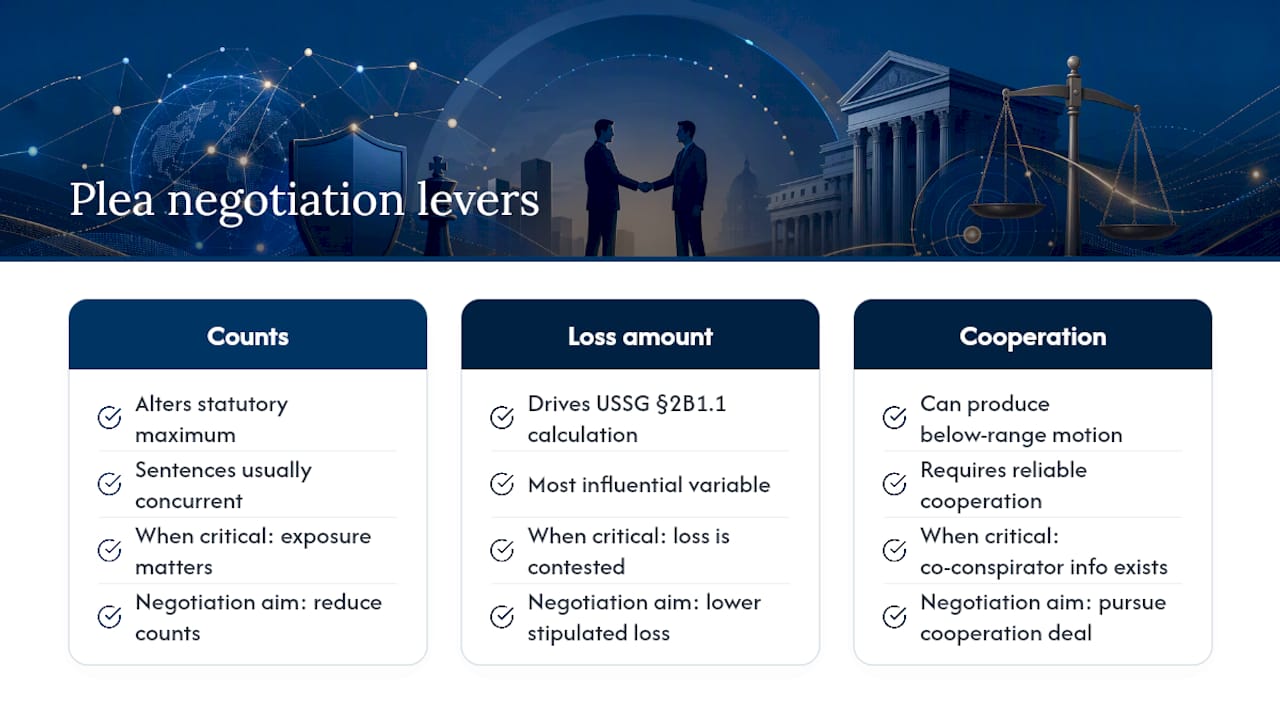
Most federal wire fraud cases resolve through negotiation, not trial, and understanding what’s negotiable helps you make a clear-eyed decision alongside your attorney. Plea discussions in wire fraud cases typically center on three levers: the number of counts charged, the loss amount stipulated for guideline purposes, and any cooperation the defendant might offer.
Reducing the count of counts matters because each count carries its own statutory maximum, even though sentences usually run concurrently rather than stacking to the full theoretical exposure. More importantly, negotiating the stipulated loss amount directly affects the offense level under USSG §2B1.1, since that figure drives the enhancement calculation more than almost any other variable in the case.
Cooperation agreements, where a defendant provides information about co-conspirators or a broader scheme, can result in a formal motion for a sentence below the guideline range. These come with real tradeoffs, though, including exposure if the cooperation doesn’t pan out as promised. A skilled federal defense attorney evaluates the strength of the government’s evidence, the realistic trial risk, and the client’s personal circumstances before recommending any plea posture, since the right strategy varies enormously based on whether the loss amount is contested, whether intent is genuinely defensible, and whether the client has priors that complicate a straightforward resolution.
After Conviction: Appeals and Motions to Vacate
A conviction or guilty plea isn’t necessarily the end of the road. Federal defendants retain several post-conviction options, though each comes with strict deadlines that make timing critical.
A direct appeal challenges legal errors made during trial, sentencing, or pretrial rulings, such as an improperly denied suppression motion or a flawed jury instruction on specific intent. Appeals generally must be filed within 14 days of judgment, which is a narrow window that makes early consultation with appellate counsel essential.
A motion under 28 U.S.C. § 2255 to vacate, set aside, or correct a sentence addresses issues that go beyond simple trial error, most commonly ineffective assistance of counsel, newly discovered evidence, or a constitutional violation that wasn’t raised on direct appeal. These motions face their own filing deadlines and a higher bar for relief, but they remain one of the few avenues available once a direct appeal has been exhausted.
Sentencing itself can sometimes be revisited too, particularly when guideline calculations were miscalculated or when subsequent changes to sentencing law apply retroactively. None of these paths are simple, and courts scrutinize post-conviction motions closely, but defendants who believe a genuine legal or constitutional error occurred at any stage of their case have real, if narrow, options to pursue.
Where the Case Gets Tried: Venue and Jurisdiction Fights
Wire fraud’s reliance on interstate communications creates an unusual venue landscape, and it’s one of the more overlooked defense angles in these prosecutions. Because a wire fraud scheme often touches multiple states, prosecutors have real flexibility in choosing where to file charges, sometimes in a district with little practical connection to the defendant beyond a single routed email or bank transfer.
Federal law generally allows venue in any district where the scheme was executed or where a qualifying wire communication passed through, which can include a server location, a bank’s processing center, or a recipient’s mailbox. That flexibility can work against a defendant, letting the government choose a district with a jury pool or prosecutorial track record less favorable to the defense.
Challenging venue is a legitimate defense tool. If the government can’t show that a specific charged wire actually touched the district where it filed, a motion to dismiss or transfer venue can force the case to a different court, or in some circumstances, undermine a count entirely. These challenges require careful factual work tracing exactly how and where each communication traveled, which is precisely the kind of granular evidence review that separates a well-prepared federal defense from a reactive one.
An Editorial Take on Defending Wire Fraud Charges
The conventional advice you’ll find online treats wire fraud defense as a numbers game: hire someone, negotiate a lower loss figure, hope for the best guideline range. That advice isn’t wrong, but it’s incomplete, and it undersells the moment that actually decides most of these cases: the first 72 hours after you learn you’re under investigation.
Everything downstream, plea leverage, count exposure, the strength of a good faith argument, traces back to whether you stayed quiet and got a lawyer involved before agents finished their interview, or whether you tried to talk your way out of it. I’ve seen the framing shift entirely depending on that single choice. Good faith is a powerful defense, but it only works if the contemporaneous record supports it, and that record can’t be manufactured after the fact.
What gets underrated is venue and “in furtherance” litigation. Defendants fixate on the loss amount because it drives sentencing math, but chipping away at individual counts through targeted, fact-specific challenges often does more for total exposure than any single negotiation session. Prioritize counsel who will fight the case at that granular level, not just negotiate the headline number.
— Jorge
Talk to Calil Law Before You Talk to Investigators
Calil Law is the alternative to waiting until an indictment forces your hand. As a Florida trial firm led by a Board Certified Civil Trial Lawyer with decades of courtroom experience, the firm brings the same disciplined case preparation, evidence review, and jury-tested advocacy to complex litigation matters that demand real strategy rather than a rushed response.

A consultation with Calil Law starts with the specifics of your situation: what agents or prosecutors have communicated so far, what documents and communications exist, and how urgent your timeline is given subpoena deadlines or an approaching grand jury date. That initial conversation is designed to give you clarity fast, not a generic script.
If you’re facing a federal investigation, a subpoena, or charges tied to a business dispute or financial transaction gone wrong, don’t wait for the next letter to arrive. Reach out to Calil Law now to talk through what your legal rights actually look like in your specific situation, and get a clear read on your next move before prosecutors get further ahead of you.
Primary Sources Worth Reading Directly
Every legal claim in this guide traces back to a primary source you can verify yourself. The statute itself, 18 U.S.C. § 1343, lays out the elements and penalties in the government’s own language. The DOJ Criminal Resource Manual explains how federal prosecutors interpret those elements in practice, particularly around materiality and intent. For sentencing mechanics, USSG §2B1.1 shows exactly how loss amounts translate into offense levels. The Congressional Research Service’s report on mail and wire fraud offers useful context on how courts have narrowed certain prosecutorial theories over time.
This article is general information, not a substitute for advice from a qualified lawyer. Consult a qualified legal professional about your own circumstances before acting on anything here.
Sources
- 18 U.S.C. § 1343 — Fraud by wire, radio, or television
- 941. 18 U.S.C. 1343—Elements of Wire Fraud — U.S. Department of Justice
- Congressional Research Service report on mail and wire fraud (R41930)


