 Skip to Content

Get Evidence Fast: Design vs Manufacturing Defects in U.S. Cases
A manufacturing defect happens when one unit comes off the line different from how it was designed, usually because of an assembly error or bad component. A design defect means the blueprint itself is dangerous, so every unit shares the same flaw. That distinction decides what evidence you need, which experts you hire, and how much you can recover. Preserve the product immediately and get it reviewed by a lawyer before it’s discarded, repaired, or lost.
TL;DR:
- Manufacturing defects are specific to individual units or batches due to production errors, making them easier to prove with concrete evidence.
- Design defects involve systemic flaws in a product’s blueprint, requiring expert testimony and analysis of safer alternative designs.
- Strict liability is the most common legal theory for manufacturing defect claims because it does not require proving manufacturer negligence.
- Evidence preservation, including product, records, and witness statements, is critical immediately after injury to support the claim.
- Recalls for manufacturing defects target specific batches, while design defects typically result in recalls of entire product models.
Table of Contents
- Manufacturing, Design, and Marketing Defects: The Three-Part Framework
- What Does a Manufacturing Defect Look Like in Practice?
- Design Defects: When the Entire Product Line Is the Problem
- Strict Liability, Negligence, and Warranty: Which Theory Applies?
- Building the Evidence: Records, Labs, and Experts That Decide Cases
- What Should You Do Right Now After a Suspected Defect Injury?
- How Classification Mistakes Derail Product Defect Claims
- Design vs Manufacturing: How the Burden of Proof Actually Differs
- Where These Defects Show Up Most Often
- How These Defects Drive Recalls and Regulatory Action
- Remedies and Damages: Does the Defect Type Change What You Can Recover?
- A Trial Lawyer’s Take on Product Defect Claims
- Get a Free Case Review Before Evidence Disappears
- Where to Verify the Legal Standards Discussed Here
- Sources
Manufacturing, Design, and Marketing Defects: The Three-Part Framework
U.S. courts sort product defect claims into three categories, and knowing which one fits your injury shapes everything that follows. Product liability law generally requires you to prove your injury falls into one of these buckets, and many states apply strict liability once you do, meaning you don’t have to prove the manufacturer was careless.
- Manufacturing defects happen during production and usually affect a single unit or a limited batch, not the whole product line.
- Design defects live in the blueprint itself, so every unit built to that design carries the same danger.
- Marketing defects, also called failure-to-warn claims, involve a product that works as designed but lacks adequate instructions or warnings about a known risk.
Each type points toward a different legal theory. Manufacturing claims often rely on strict liability or negligence. Design claims usually require expert testimony about safer alternatives. Marketing claims turn on what the manufacturer knew and failed to disclose, a topic we cover in detail in our guide to failure-to-warn claims.
What Does a Manufacturing Defect Look Like in Practice?
A manufacturing defect is a deviation from the intended design that happens somewhere on the production floor, not on the drafting table. The blueprint was fine. Something went wrong when the product was actually built.
Common real-world examples include a bolt left out during assembly, adhesive applied incorrectly on a car part, a contaminated batch of medication, or a safety guard missing from one specific unit of machinery. These cases tend to be narrower and, in some respects, easier to prove because you’re not attacking an entire product category.
Proving one typically means gathering:
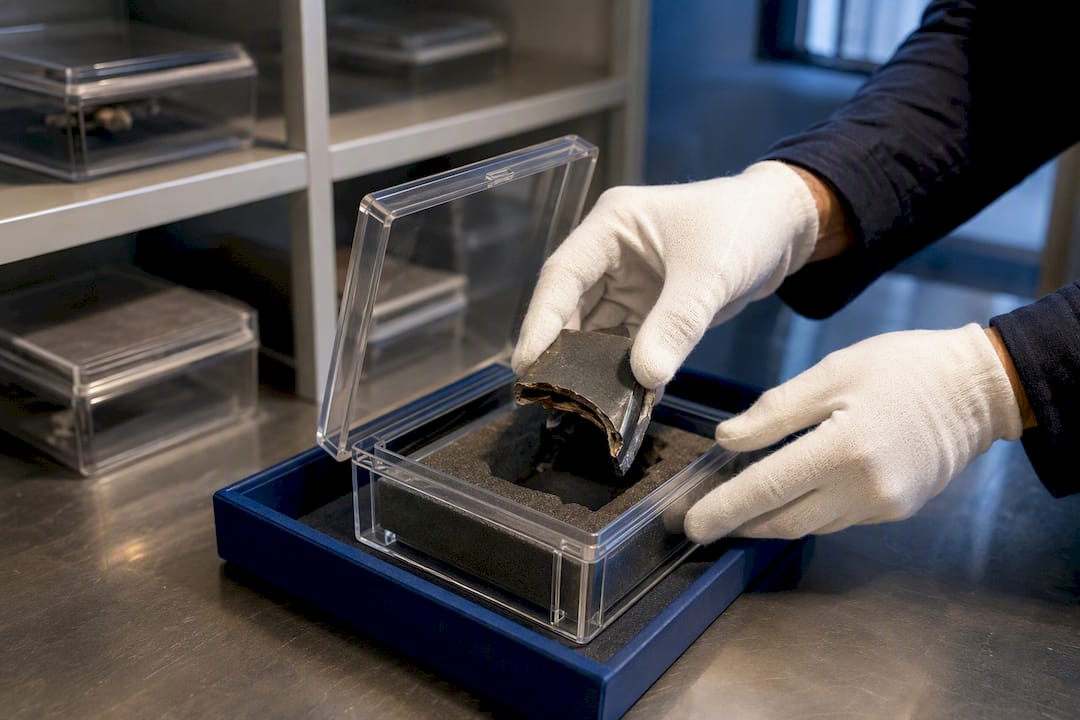
- The actual defective unit, preserved exactly as it was at the time of injury.
- Serial numbers and batch or lot codes tying the unit to a specific production run.
- Quality control and inspection records from the manufacturer.
- Independent lab testing confirming the deviation from spec.
- Photographs and witness statements documenting the failure.
Legal routes usually include strict liability, negligence (sometimes argued through res ipsa loquitur, where the defect implies fault on its own), or breach of implied warranty.
Pro Tip: Do not send the product back to the manufacturer for “inspection” before a lawyer or independent expert examines it. Once it leaves your possession, you lose control over what happens to the evidence.
Design Defects: When the Entire Product Line Is the Problem
A design defect is baked into every unit because the flaw exists in the product’s underlying structure, not in how any single copy was built. That single fact changes the entire shape of a case: you’re no longer arguing about one bad unit, you’re arguing that the entire model is unreasonably dangerous even when built exactly as intended.
Recognizable examples include a vehicle with a rollover-prone stability design, a medical device prone to fragmenting under normal use, or a tool whose ergonomics foreseeably cause repetitive injury. None of these problems come from a factory mistake. They come from how the product was conceived.
Courts typically apply one of two tests:
- The consumer-expectation test asks whether the product was as safe as an ordinary user would reasonably expect.
- The risk-utility test weighs the product’s benefits against its dangers and usually asks whether a feasible, safer alternative design existed at the time.
Design claims almost always demand engineering or human-factors experts, because you’re proving a systemic flaw, not a one-off error. Our design defect claim guide walks through that process in more detail.
Pro Tip: If your injury involved a widely sold product, search for prior complaints or recalls involving the same model. A pattern of similar failures strengthens a design claim considerably.
Strict Liability, Negligence, and Warranty: Which Theory Applies?
The legal theory you pursue depends heavily on which defect type you’re dealing with, and getting this wrong early can cost you the case.
Strict liability is the theory plaintiffs favor most, because it doesn’t require proving the manufacturer was careless. You show the product was defective when it left the manufacturer’s control and that the defect caused your injury. Manufacturing defect claims fit this framework especially well, since the deviation from design speaks for itself.
Negligence and breach of warranty come into play when strict liability isn’t available or when the facts fit better elsewhere:
- Negligence theories work when you can show the manufacturer failed to exercise reasonable care during design, testing, or inspection.
- Warranty claims apply when the product failed to meet promises made in labeling, contracts, or advertising.
- Some states favor the risk-utility test for design claims while others lean on consumer expectation, which changes what evidence carries the most weight.
- Medical devices often face federal preemption issues that limit certain state-law claims, making early legal review critical.
These differences aren’t academic. They determine how a complaint gets pleaded, which experts get retained, and what gets prioritized in discovery.
Building the Evidence: Records, Labs, and Experts That Decide Cases
Cases like these are won or lost on paper trails and physical evidence, often before a lawsuit is even filed. Medical documentation comes first: keep every record connecting your injury to the product. Then preserve the item itself, along with its packaging, purchase receipt, and any maintenance history.
Beyond the product itself, useful documentation includes:
- Quality control logs and maintenance records from the manufacturer or retailer.
- Complaint databases and warranty return data showing prior problems with the same model.
- Independent lab testing, which can confirm a defect but often cannot determine intent or timeline on its own.
- Chain-of-custody documentation proving the product wasn’t altered after your injury.
Different experts play different roles. Engineers typically address design flaws, materials scientists dig into manufacturing deviations, and accident reconstructionists connect the defect to how the injury actually happened. Roughly 400,000 emergency room visits a year involve furniture, appliances, and similar products, which shows how often these evidentiary battles play out in real cases. Contact a lawyer quickly. Spoliation, meaning evidence gets lost, discarded, or altered, kills otherwise strong cases every year.
What Should You Do Right Now After a Suspected Defect Injury?
The steps you take in the first days after an injury often determine whether your claim survives.
- Get medical care immediately and keep every record, bill, and diagnostic image.
- Preserve the product exactly as it was, including packaging, manuals, and serial numbers. Stop using it only if doing so is safe.
- Report the incident to the retailer or manufacturer, and consider filing a report with the Consumer Product Safety Commission if a consumer product was involved.
- Document witnesses, your original purchase receipt, and any prior complaints you can find about the same product.
- Understand that states have limited timeframes to file claims, and evidence degrades fast, so early legal contact protects both your options and your proof.
Pro Tip: Photograph the product from every angle before anyone else touches it, including any packaging or instructions. Timestamped photos are some of the cheapest, strongest evidence you can create yourself.
How Classification Mistakes Derail Product Defect Claims
We’ve seen cases weakened before they ever reach a jury because the claim was framed wrong from the start. Attorneys frequently see clients describe a systemic problem, like a car model prone to a specific failure, as a “manufacturing defect” when courts will recharacterize it as a design claim the moment discovery begins. That reclassification changes the required proof, the experts needed, and sometimes the applicable legal theory entirely.
Our early case screening focuses on collecting the physical product, purchase and repair records, and any prior complaint history before evidence disappears. We retain engineering or materials experts early and send preservation letters to manufacturers and retailers right away, because that timing frequently decides whether a case survives early motions or reaches a fair settlement.
Design vs Manufacturing: How the Burden of Proof Actually Differs
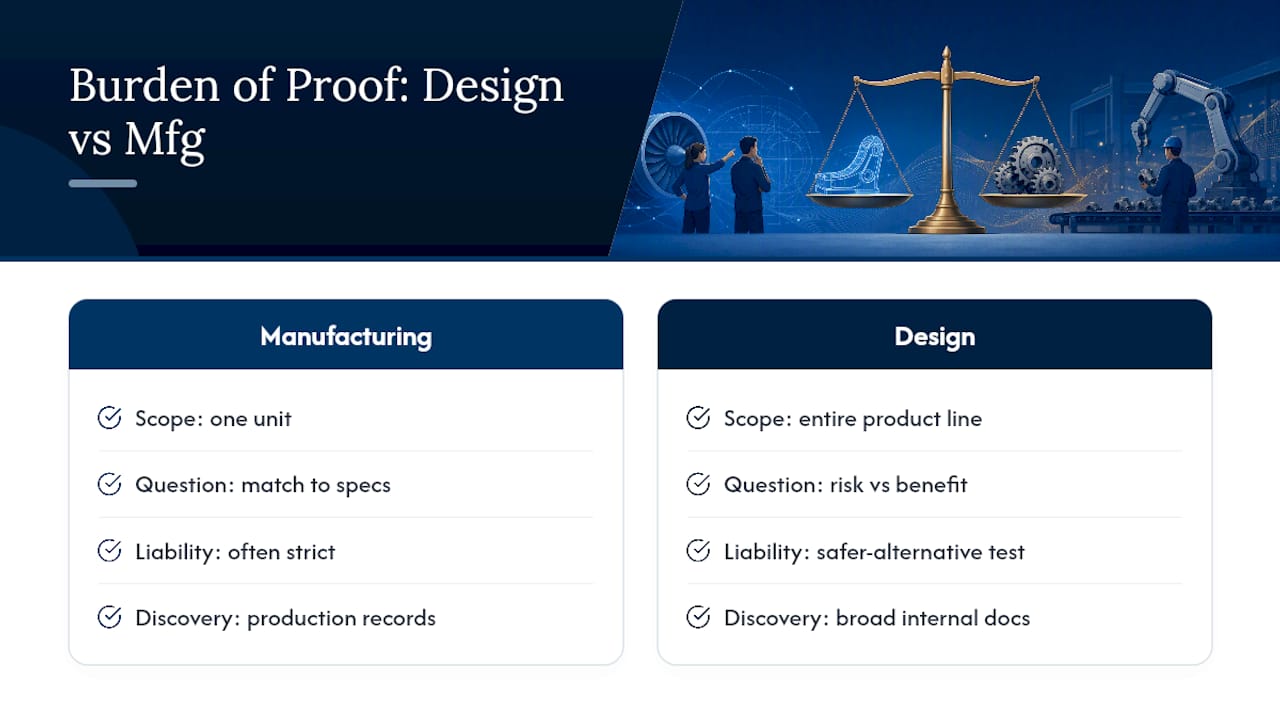
Manufacturing defect claims carry a lighter evidentiary burden in most respects. You’re comparing one unit against its own design specifications, which is a relatively contained question: did this specific product match the blueprint it was supposed to follow? Strict liability often applies cleanly here, and you generally don’t need to prove the manufacturer acted carelessly, only that the deviation existed and caused harm.
Design defect claims ask a much bigger question: was the entire concept behind the product unreasonably dangerous? That requires proving either that an ordinary consumer wouldn’t have expected the danger, or that the risks outweighed the benefits and a safer alternative design was available and practical to build. Courts in many states demand that a plaintiff show this alternative design existed at the time of manufacture, not decades later with the benefit of hindsight.
The practical result is that design cases usually take longer, cost more to litigate, and require more expert testimony. Manufacturing cases can sometimes move faster because the comparison point, the intended design, already exists and isn’t in dispute. Discovery in a design case tends to reach deep into internal company communications, engineering drafts, and cost-benefit analyses that manufacturers rarely want to disclose voluntarily. Discovery in a manufacturing case usually stays narrower, focused on production records and quality control logs from a specific batch or timeframe.
Neither path is easier across the board. Manufacturing claims can stall if a company destroys batch records or if the specific defective unit gets lost. Design claims can stall if a plaintiff can’t find an expert willing to identify a genuinely safer, economically feasible alternative.
Where These Defects Show Up Most Often
Some industries see manufacturing defects far more than design defects, and others run the reverse. Automotive parts, particularly brake components, airbags, and tires, generate a steady stream of manufacturing defect claims tied to specific production runs or supplier batches. Pharmaceuticals see this pattern too, where contamination in one manufacturing lot can affect thousands of doses without touching the drug’s underlying formula.
Design defects dominate in categories where the entire concept, not a single batch, is the problem. Furniture tip-over hazards, certain power tool designs, and consumer electronics with battery placement issues tend to affect every unit sold, not just one production run. Medical devices frequently straddle both categories: a hip implant might fail because of a batch-specific material flaw, or because the entire design was prone to fracturing under normal stress, and those two scenarios lead to very different legal strategies.
Vehicles deserve particular attention because they can suffer from both defect types simultaneously. A car model might have a systemic stability design flaw affecting every unit while a separate batch also suffered a manufacturing error in its steering components. Readers dealing with a suspected vehicle defect can find more detail in our guide to defective vehicle claims.
Children’s products, appliances, and industrial machinery round out the categories where the CPSC sees the highest volume of complaints and recalls tied to both defect types.
How These Defects Drive Recalls and Regulatory Action
Recalls and defect classification are closely linked, because regulators respond very differently depending on which type of flaw caused the harm. A manufacturing defect traced to one production run or supplier batch often triggers a targeted recall covering only the units made during that specific window. You’ll see this in food and pharmaceutical recalls constantly: a particular lot number gets pulled while the rest of the product line stays on shelves.
Design defects trigger a different kind of response. Because the flaw affects every unit built to that specification, a design-related recall usually covers the entire model, sometimes across multiple production years. Regulators like the CPSC and the National Highway Traffic Safety Administration often require the manufacturer to redesign the product entirely, not just fix a production process, before it can return to market.
This distinction matters for your claim even outside the recall itself. A recall notice referencing a specific defect type can serve as powerful supporting evidence, but it can also work against a sloppy claim. If you’re arguing a design defect and the recall notice describes a batch-specific manufacturing issue, that mismatch will hurt your case in front of a judge or jury. Attorneys pull recall history early precisely because it tells you which legal theory the manufacturer itself has effectively already conceded.
Regulatory investigations following either defect type can also produce internal company documents through subpoena power that private litigants might struggle to obtain on their own, which is one more reason recall timing and litigation timing often intersect.
Remedies and Damages: Does the Defect Type Change What You Can Recover?
The available damages in a product defect case don’t change dramatically based on defect type. Both design and manufacturing claims can support compensation for medical expenses, lost wages, pain and suffering, and in severe cases, punitive damages if the manufacturer’s conduct was especially reckless.
What changes is how hard those damages are to secure and how much a case is realistically worth once litigation costs are factored in. Manufacturing defect cases often settle faster because the evidence is more contained. A defective batch, confirmed lab results, and matching production records tend to produce clearer liability, which can push insurers and manufacturers toward earlier settlement to avoid a costly trial.
Design defect cases frequently carry higher potential damages precisely because they expose a manufacturer to liability across every unit sold, sometimes thousands or millions of them. That exposure can make companies fight harder and longer, since a loss doesn’t just resolve one claim, it can invite a wave of similar lawsuits. Punitive damages tend to appear more often in design cases where internal documents show a company knew about a safer alternative and chose not to use it.
Litigation costs also diverge. Design cases typically require more expert testimony, more extensive discovery, and longer timelines before resolution, which affects the net recovery after fees and costs. That’s one more reason getting the classification right at intake matters as much as the injury itself.
A Trial Lawyer’s Take on Product Defect Claims
Product defect cases reward preparation more than almost any other injury claim I’ve reviewed. The physical evidence disappears fast, and the legal theory you choose early tends to lock in the kind of proof you’ll need months later. A board-certified trial background means approaching these cases the way a jury eventually will: with a demand for concrete, physical proof, not assumptions about what probably happened.
Our approach stays evidence-first from day one, preservation-focused before anything else, and handled on a contingency-fee basis. A free case review is simply the fastest way to find out where your situation actually stands.
— Jorge
Get a Free Case Review Before Evidence Disappears
Product defect cases are won or lost in the days right after an injury, not months later once memories fade and evidence gets discarded. Calil Law Trial Attorneys evaluates these cases the way we’d prepare for trial from the start, because that discipline is what actually protects your claim when a manufacturer’s legal team starts pushing back.

A free case review can help determine what evidence you have and what you still need: the product itself if you still have it, photographs, purchase records, medical documentation, and any prior complaints found about the same item. If you’re not sure yet whether your situation qualifies, our overview of personal injury claims explains what to expect at every stage. Reach out today to schedule your free review and find out what your case is actually worth.
Where to Verify the Legal Standards Discussed Here
- Design defect and manufacturing defect definitions, Cornell Law’s Wex.
- Products liability overview, Cornell Law’s Wex.
- Types of products liability claims, Justia.
- Report a dangerous product, U.S. Consumer Product Safety Commission.
This article is general information, not a substitute for advice from a qualified lawyer. Consult a qualified legal professional about your own circumstances before acting on anything here.
Sources
- design defect | Wex | US Law | LII / Legal Information Institute
- products liability | Wex | US Law | LII / Legal Information Institute
- manufacturing defect | Wex | US Law | LII / Legal Information Institute
- U.S. Consumer Product Safety Commission


