 Skip to Content

Negligent Security at Apartments: When a Landlord Is Liable
If you were assaulted, robbed or shot at your apartment complex, and the property had broken gates, dead lights or locks that did not work, the owner may be legally responsible for what happened to you. That is a negligent security claim, a type of premises liability case. It is built on evidence of what the landlord knew, what it failed to fix, and how that failure let an attacker reach you. Those cases are won or lost on records and timing, which is why we at Calil Law, a Florida trial firm, take them on a contingency fee: we are paid only when you receive a settlement or award, and you pay nothing upfront.
TL;DR
- A landlord can be liable when a foreseeable crime happens because of a preventable security failure, such as a broken entry gate, missing locks or burned-out lighting.
- You generally must prove four things: the landlord owed you a duty, it breached that duty, the breach caused your injury, and you were harmed.
- Florida gives multifamily owners a presumption against liability if they substantially implement a list of security measures. The owner must prove it did, so the records matter.
- Prior crimes at or near the property are often the heart of the case, so evidence disappears quickly if no one asks for it.
- Florida sets short filing deadlines and reduces or bars recovery if you are found more than 50 percent at fault, so act early.
Table of Contents
- What negligent security means for apartment residents
- Security failures that can support a claim
- What you must prove
- Florida’s 2023 security presumption
- Deadlines and fault rules that affect your claim
- What to do after an attack at your complex
- Who may be responsible
- What compensation can cover
- How we handle apartment security cases
- Our perspective
- FAQ
- Sources
What negligent security means for apartment residents
Landlords are not insurers of your safety. No court expects an apartment complex to stop every crime. But the law does expect owners to take reasonable steps against crimes they could see coming. In New York’s leading case, the court described a landlord’s common-law duty to take minimal precautions against foreseeable criminal harm. Florida’s Third District Court of Appeal says the same in a December 2025 decision, Guelmes v. Dama: a landlord owes a tenant a duty to protect against reasonably foreseeable criminal conduct, including by warning tenants.
The person who attacked you is the one who committed the crime. The landlord is liable for something different: failing to take ordinary precautions that would have made the crime less likely. For a broader introduction to how these claims work, see our guide to what a negligent security claim is.
Security failures that can support a claim
Courts look at what was wrong with the property and whether it matters to how you were hurt. In a 1993 study of apartment premises cases summarized in an academic paper, the most common complaints were:
| Alleged failure | Share of cases in the study |
|---|---|
| Inadequate locks | 16% |
| Guard problems | 10% |
| Poor lighting | 9% |
| Management knew of prior crimes or failed to warn tenants | 29% |
That study is old, but the pattern is familiar. In practice, the failures we look for include:
- Entry gates or lobby doors that were broken, propped open or never repaired after tenants complained
- Unit door locks, deadbolts, window locks or sliding-door locks that did not work
- Dark parking lots, stairwells, walkways or laundry rooms
- Missing or nonfunctioning security cameras
- Pool gates and perimeter fences left open or damaged
- No patrols, or patrols cut back, despite a known crime problem
- No warning to residents after earlier incidents
A defect alone is not enough. In a Texas case, Ham v. Equity Residential, the plaintiff pointed to burned-out lights, holes in a fence, an inoperable gate and no summer patrol. The court still ruled for the owner because there was no evidence those failures caused her injuries. The failure and the attack have to be connected.
What you must prove
The general framework is the one used in most negligence cases. A plaintiff must prove, by a preponderance of the evidence (meaning more likely than not), duty, breach, cause in fact, foreseeable cause and injury. In an apartment case each element turns into a practical question.
Was the crime foreseeable?
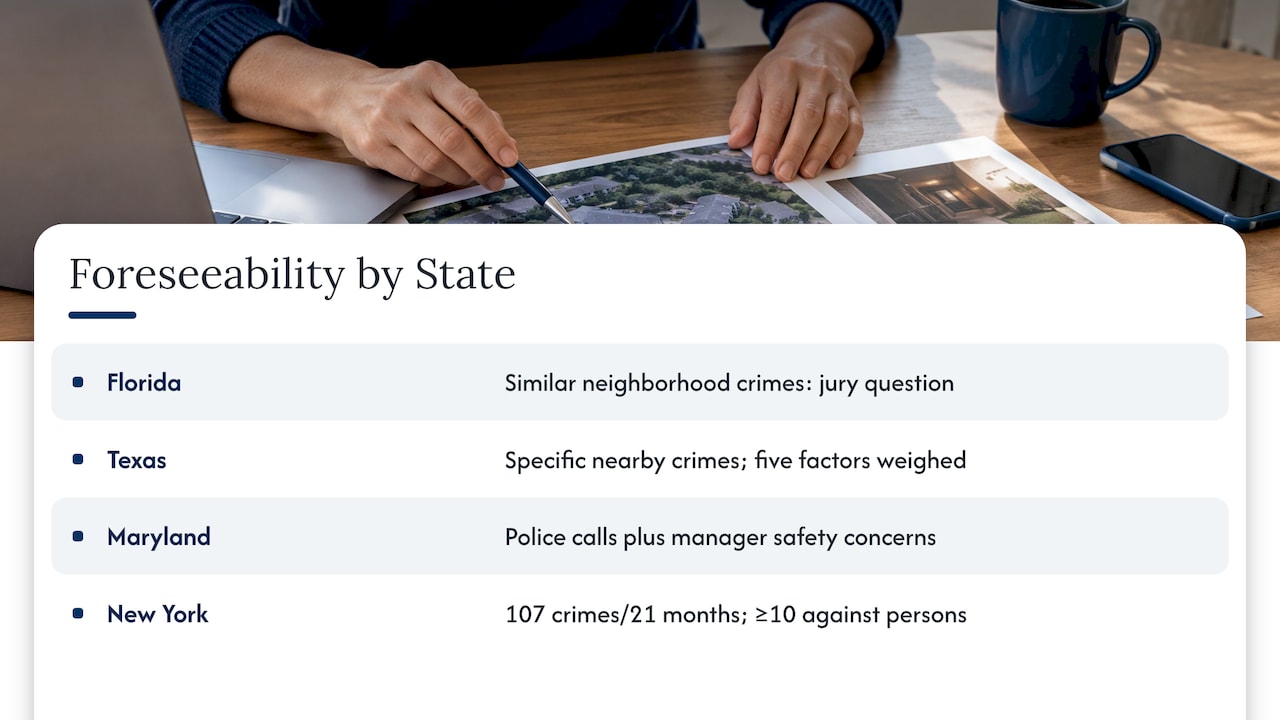
This is usually the biggest fight. Florida courts consider whether the owner had actual or constructive knowledge of earlier crimes (constructive knowledge means it should have known). In Guelmes, the court said prior crimes against both persons and property, even lesser ones, are relevant. General crime in the surrounding area alone may not be enough, but evidence of many similar crimes in the neighborhood made foreseeability a jury question.
Other states set the bar differently. Texas, in Timberwalk Apartments v. Cain, requires evidence of specific previous crimes on or near the property, weighed by proximity, recency, frequency, similarity and publicity. With no violent crime at the complex for ten years, the court found a rape was not foreseeable. The prior crimes need not be identical, but they must be similar enough to warn the owner of the danger.
A Maryland appeals court looked at a different kind of notice. A landlord that knew of police calls reporting shootings, assaults and drug activity in common areas, and whose own property manager voiced safety concerns, was on notice that a shooting could occur.
In New York, the Nallan case let a jury decide after plaintiffs showed 107 reported crimes in 21 months, at least 10 against persons, along with expert testimony that even an unarmed attendant would have deterred crime.
Did the security failure cause your injury?
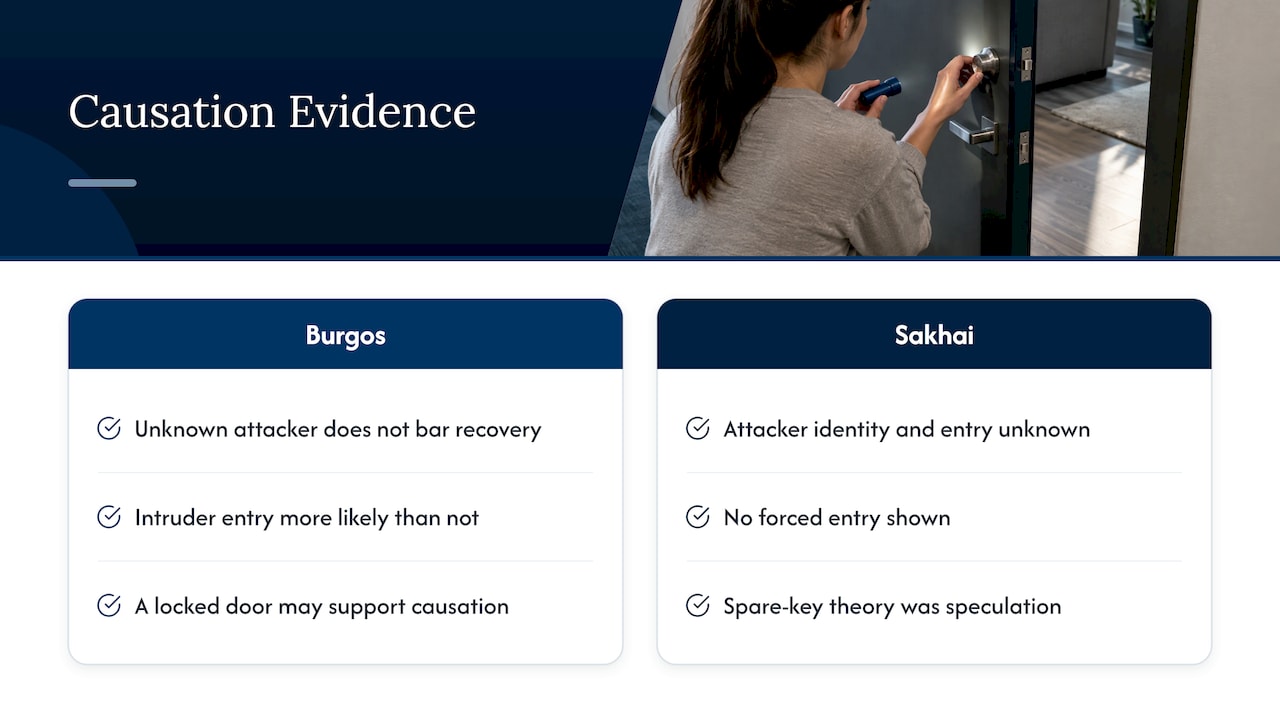
This is where many claims fall apart, especially when police never identified the attacker. New York’s Burgos decision rejected a blanket rule against recovery in that situation. A tenant can still win by showing it was more likely than not that the attacker was an intruder who came in through a negligently maintained entrance, such as a door with no working lock. In 2023 the same court confirmed that a jury may infer causation where a locked door or lobby attendant would have deterred the attacker.
The flip side is speculation. In Sakhai, the attacker’s identity and manner of entry were unknown and the building showed no forced entry. The plaintiff’s theory that a spare key was used was speculation that could not establish proximate cause. Evidence, not assumption, has to fill that gap.
These cases come from other states and show how courts reason. Florida cases turn on Florida law, which is what we handle.
Florida’s 2023 security presumption
Florida changed the landscape for apartment cases with HB 837. Under section 768.0706 of the Florida Statutes, the owner or principal operator of a multifamily property with at least five units on a parcel gets a presumption against liability for crimes by third parties if it substantially implements certain measures. These include:
- Entry and exit cameras with footage retrievable for at least 30 days
- Parking lot lighting averaging at least 1.8 foot-candles, lit from dusk to dawn or by photocell
- Dusk-to-dawn or photocell lighting in walkways, laundry rooms, common areas and porches
- One-inch deadbolts on unit doors, window and exterior-door locks, key or fob access on pool gates, and peepholes on qualifying doors
- A crime-prevention assessment (CPTED, crime prevention through environmental design) no more than three years old, done by law enforcement or a designated Florida practitioner
- Crime-deterrence training for employees, with later hires trained within 60 days
Two details matter to you. First, the owner bears the burden of proving substantial implementation, so the owner has to produce its camera retention records, lighting measurements, assessment and training logs. Second, the statute creates no private cause of action. Your claim still rests on negligence. The statute is a defense the owner raises, and a case lives or dies on whether the paperwork matches what residents actually saw: the gate that never latched, the stairwell light that stayed dark for months.
That is why early evidence requests matter. A presumption that depends on records can be tested, but only if those records are demanded before they are lost or overwritten.
Deadlines and fault rules that affect your claim
Florida’s statute of limitations in section 95.11 sets the time limits for filing. For negligence claims the window is short, generally two years, and wrongful death and other claim types have their own timing. Because the clock affects every option you have, do not wait to find out which deadline applies to you.
Florida also uses comparative fault. Under section 768.81, damages are assigned by each party’s percentage of fault, and a person found more than 50 percent at fault for their own harm may not recover damages. Defendants in these cases often point at the attacker, at the injured resident, or at other parties. Documenting what you did and what the property failed to do protects you.
What to do after an attack at your complex
- Get medical care and report the crime. Your health comes first. A police report also creates an official record of date, time and location.
- Photograph the scene. Capture broken gates, locks, dark areas and missing cameras before they are repaired. Repairs after an incident are common.
- Write down what you know. Note how the attacker got in, what you saw, who witnessed it, and when you last noticed the problem.
- Collect your complaint history. Save maintenance requests, texts, emails, portal messages and notices from management. Showing the landlord knew of a defect is powerful.
- Gather neighbor accounts. Other residents often know about earlier break-ins, assaults or ignored complaints.
- Keep your medical records and bills. They document your injuries and costs. Our guide to medical records in an injury claim explains what to keep.
- Do not give a recorded statement or sign anything for the property’s insurer before you understand your rights.
- Contact us early. Preservation letters to the owner, management company and any security vendor are time-sensitive, because camera footage and incident logs may be overwritten on a routine schedule.
Many claims stall because of avoidable mistakes. We cover the common ones in why injury claims fail.
Who may be responsible
The landlord is not always the only party. The owner, a management company, and a contracted security company can each share responsibility depending on who controlled the gate, the lights and the patrols. Our overview of third-party liability claims shows how that works, and our page on property owner liability gives examples of when owners are responsible.
What compensation can cover
Damages in an injury case generally address losses such as medical expenses, lost income, pain and suffering, and, in a wrongful death case, the harm to surviving family. What your claim is worth depends on the severity of the injury, the strength of the proof, and how fault is divided. We do not promise a figure, because any honest number comes only after review of the records. If medical providers or insurers assert a right to be repaid from a settlement, our explanation of a medical lien will help you understand what that means.
How we handle apartment security cases
Our firm is led by a Board Certified Civil Trial Lawyer and Supreme Court Certified Mediator with more than 18 years of Florida experience. Negligent security cases are part of our premises liability practice, and we represent people injured through the negligence of others, including in wrongful death matters. You get direct access to experienced attorneys, and each case is personally reviewed.
We work on contingency: no upfront fees, and our fee is collected from a settlement or court award. If you were hurt at an apartment complex in Florida, contact Calil Law and tell us what happened. We will start with the facts that decide these cases: what the property knew, what it failed to fix, and what records exist.
We also serve clients through our Boca Raton and West Palm Beach premises liability offices.
Our perspective
Residents do not choose their landlord’s security budget. They sign a lease, trust that the gate closes and the stairwell light works, and go to sleep. When that trust is broken and someone is hurt, the question is not whether crime exists. It is whether the owner did the ordinary things that make crime harder.
Florida’s presumption puts a checklist in front of the court. We read that as an opportunity: if an owner claims it met the list, it has to prove it with dated records, and those records are tested against what residents lived with. We build these cases with that comparison in mind, and we prepare them as if they will be tried, because owners and their insurers pay attention to a firm that is ready to go to a jury.
Your life has value, and so does the safety you were promised. We will review your case personally and tell you plainly where it stands.
Jorge
FAQ
Can I sue an apartment complex for negligence?
Yes, if the owner or manager failed to use reasonable care and that failure caused your injury. In a crime case, you generally have to show the crime was foreseeable and that a preventable security failure contributed to it. In Florida, the owner’s compliance with the security measures in section 768.0706 is also part of the analysis.
What are the four proofs of negligence?
Duty, breach, causation and damages. The landlord owed you a duty of reasonable care, failed to meet it, that failure caused your harm, and you suffered real losses. Apartment cases add a hard question under causation: whether the security failure actually made the attack possible.
What can I do if I feel unsafe in my apartment?
Report the problem to management in writing, such as a broken lock, gate or light, and keep a copy. Call emergency services if you are in danger. Written complaints also create a record showing the landlord knew of the hazard, which matters if you are later hurt.
Is the landlord liable if the attacker was never caught?
It can still be. Courts have allowed claims when evidence showed it was more likely than not that the attacker entered through a negligently maintained entrance. You need real evidence, such as broken locks and the circumstances of the attack, rather than guesses about how the attacker got in.
Sources
- Burgos v. Aqueduct Realty Corp. (N.Y. Court of Appeals, 1998), FindLaw
- Burgos v. Aqueduct Realty Corp., CourtListener
- Guelmes v. Dama, Florida Third District Court of Appeal (2025)
- Timberwalk Apartments, Partners, Inc. v. Cain, 972 S.W.2d 749
- Davis v. Regency Lane, LLC, Maryland Court of Special Appeals (2021)
- Nallan v. Helmsley-Spear, Inc., 50 N.Y.2d 507 (1980)
- Ham v. Equity Residential Property Management Services (Texas Court of Appeals, 2010)
- Scurry v. New York City Housing Authority (N.Y. Court of Appeals, 2023)
- Sakhai v. 411 East 57th Street Corp., 272 A.D.2d 231 (2000)
- Premise liability for lack of security, academic article (1998)
- Florida Statutes section 768.0706 (2026), Online Sunshine
- Chapter 768, 2026 Florida Statutes, The Florida Senate
- Florida Statutes section 95.11 (2026)
- Florida Statutes section 768.81, The Florida Senate


