 Skip to Content

Rear-End Collision Liability in Florida: Who Pays and Why
In Florida, the driver who hits another car from behind is presumed to be at fault. That presumption is where every rear-end claim starts, but it is not where it ends. It can be rebutted with evidence, fault can be shared, and your own PIP coverage pays first no matter who caused the crash. If you were hurt, the way the first weeks go often decides how the claim ends. At Calil Law, our Florida trial attorneys handle car accident claims on a contingency fee, so you pay no upfront legal fees.
TL;DR
- Florida law presumes the rear driver was negligent, but the Florida Supreme Court treats that as a rebuttable presumption, not a fixed rule.
- The front driver can share or carry the blame after an abrupt, unexpected stop, a sudden lane change or a mechanical failure.
- Your own $10,000 PIP coverage pays medical bills first, regardless of fault. Suing the at-fault driver for pain and suffering generally requires a permanent injury.
- Florida bars recovery when you are found more than 50% at fault, and the filing deadline for most negligence claims is two years.
- Photos, the crash report and prompt medical records carry the most weight, even when the impact looks minor.
Table of Contents
- The presumption: why the rear driver usually pays
- The presumption can be rebutted
- Who else can be liable in a rear-end crash
- Shared fault: Florida’s 50% rule
- How insurance pays after a Florida rear-end crash
- Going beyond PIP: when you can bring an injury claim
- Documenting the crash, even when it looks minor
- The filing deadline
- Working with Calil Law on a rear-end claim
- Our perspective
- FAQ
- Sources
The presumption: why the rear driver usually pays
Every driver has a duty to keep a safe distance and to stay alert to traffic ahead. When a car runs into the back of another, the common-sense conclusion is that the rear driver was following too closely, distracted or going too fast. Florida courts turn that conclusion into a legal starting point: the rear driver is presumed negligent.
This is why insurance adjusters often accept fault quickly when their insured was the one who hit you. It is also why the other side works hard to shift part of the blame back onto you once they see how much your injuries may be worth.
If you want the general framework behind this, our guide to auto negligence in Florida explains the four elements of a negligence claim: duty, breach, causation and damages.
The presumption can be rebutted
The Florida Supreme Court addressed this in its 2012 decision in Birge v. Charron. The court explained that the presumption is an evidentiary tool, not a rule that decides the case. It disappears when evidence fairly and reasonably shows that the front driver was also negligent. At that point a jury decides negligence and causation without the presumption’s help.
The court pointed to the kinds of evidence that can do this:
- an abrupt and arbitrary stop
- an unexpected lane change in front of the rear driver
- a mechanical failure, such as sudden brake failure
- a lead vehicle that was stopped illegally and unexpectedly
A rebuttal is not an automatic win for the rear driver. It means the question goes to the jury, and fault is decided on the full facts.
What this means if you were hit from behind
Expect the insurer to look for any argument that you stopped suddenly, braked for no reason, changed lanes just before impact or had a broken brake light. A witness statement, dashcam video or nearby business camera footage can close that door early. Our team reviews each case personally and looks for this kind of evidence before the other side builds its story.
What this means if you hit someone from behind
The presumption works against you, but you are not without a defense. If the car in front cut across your lane or stopped without cause, those facts matter, and they should be documented right away.
Who else can be liable in a rear-end crash
The rear driver is the obvious defendant. It is not always the only one, and it is not always the right one.
- The front driver. A sudden, unexplained stop or an abrupt lane change can make the front driver partly responsible.
- A driver who pushed the rear car forward. In a chain-reaction crash, the car at the back may have shoved the middle car into you. Who hit whom, and in what order, decides who owes what.
- An employer. When the rear driver was working at the time, the company may be responsible for the driver’s conduct, and commercial policies are often larger than personal ones.
- A trucking company. Truck rear-end crashes involve federal safety rules, driver logs and maintenance records. See our overview of truck accident liability in Florida for how those cases differ.
- A rideshare driver or company. If an Uber or Lyft driver hit you, the coverage that applies can depend on whether the app was on and whether a passenger was in the car.
- A vehicle or parts maker. If a brake or accelerator defect caused the crash, the claim may extend beyond the drivers.
Identifying every possible defendant early matters because it determines how much insurance is available to pay for your losses.
Shared fault: Florida’s 50% rule
Florida uses modified comparative negligence. Each party’s share of fault is assigned as a percentage, and your compensation is reduced by your share. Since the 2023 tort reform (HB 837), a person found more than 50% at fault is barred from recovering damages in most negligence cases. Our page on Florida’s modified comparative negligence covers the details, and our guide to comparative negligence in auto accidents walks through how it works for drivers.
Here is a simple example. Say a jury values your damages at $100,000. It finds the rear driver 80% at fault and you 20% at fault because you braked abruptly. Your recovery would be $80,000. If the jury put you at 51%, you would recover nothing.
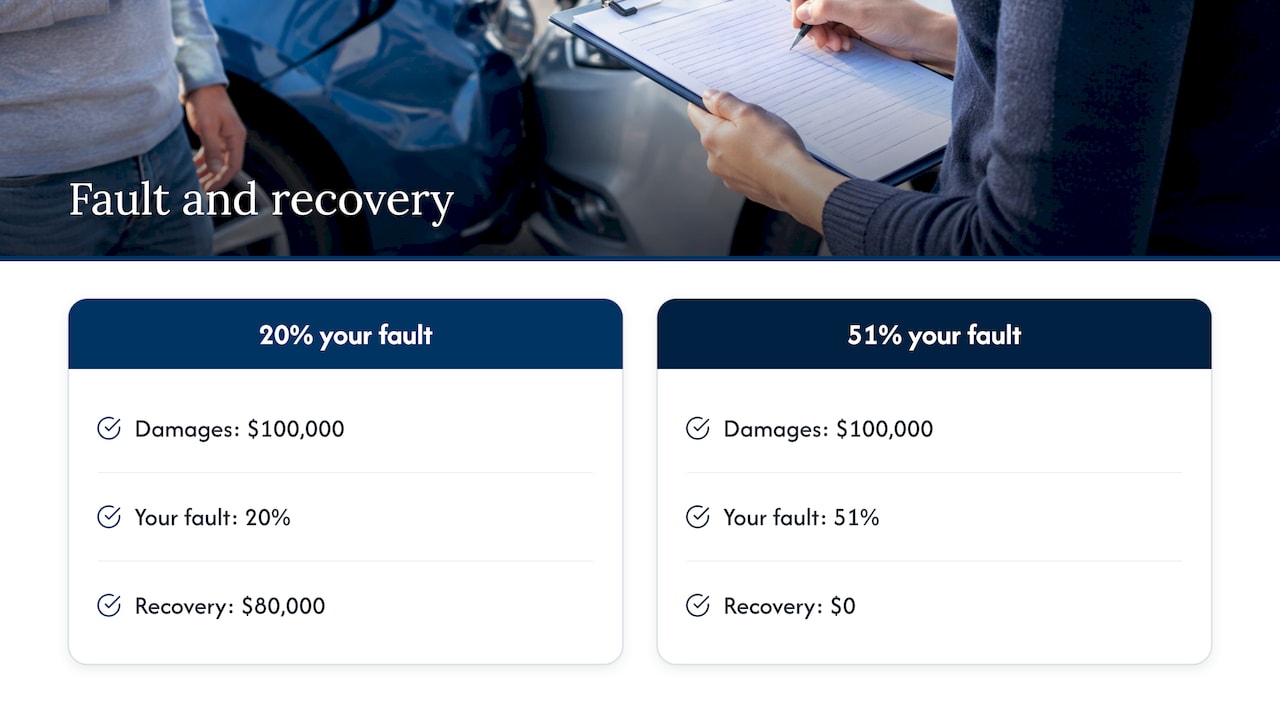
That cliff is why insurers fight over even small percentages. Every point of fault they move to you can cost you money, and past 50% it costs you the claim.
How insurance pays after a Florida rear-end crash
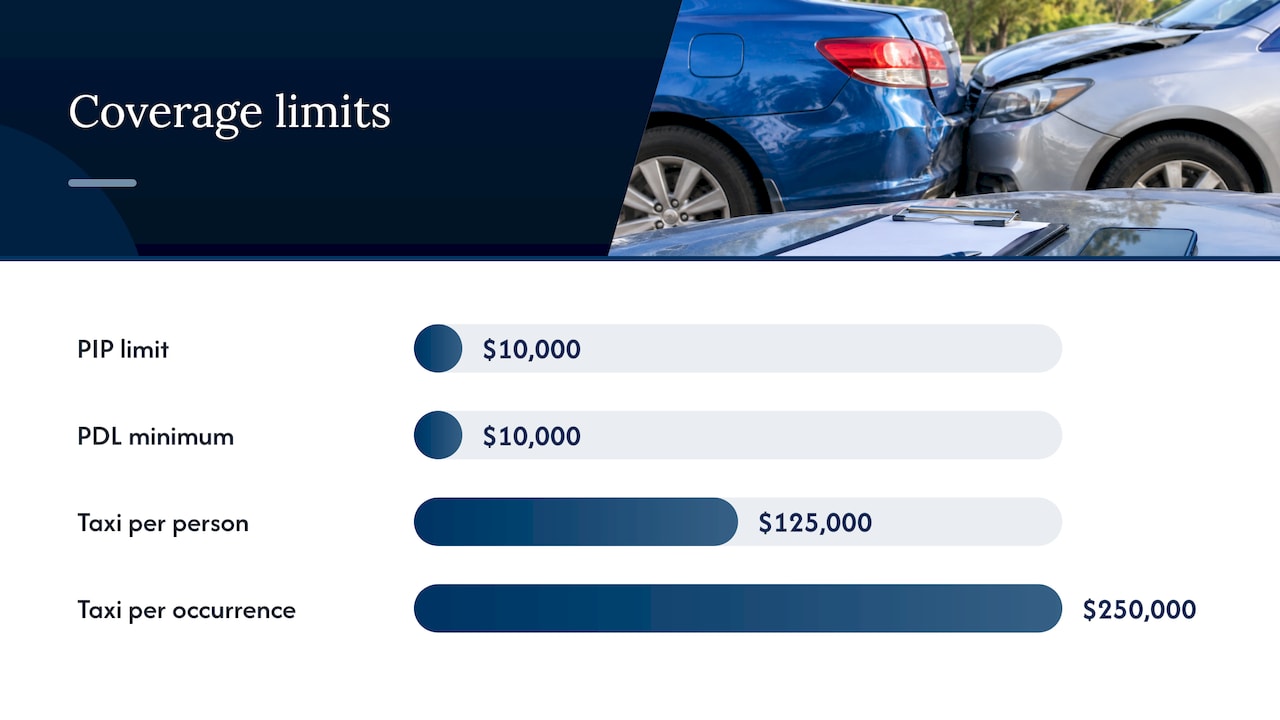
Florida is a no-fault state for the first layer of medical coverage. The Florida Department of Highway Safety and Motor Vehicles requires ordinary registered vehicles to carry $10,000 in personal injury protection (PIP) and $10,000 in property damage liability (PDL).
| Coverage | What it does | Florida minimum for most private vehicles |
|---|---|---|
| PIP | Pays 80% of reasonable medical expenses up to the limit, regardless of fault | $10,000 |
| PDL | Pays for damage to someone else’s property, such as your car | $10,000 |
| Bodily injury liability | Pays for the other driver’s injuries when you are at fault | Not required for most private passenger vehicles |
Two points come out of this table.
First, your own PIP pays your medical bills up to the limit even when the other driver caused the crash. Our 14-day PIP action plan explains the timing rules that keep those benefits from being lost.
Second, bodily injury liability coverage is not required for most private vehicles in Florida. Taxis must carry $125,000 per person and $250,000 per occurrence, according to the same state source. So the at-fault driver may have little coverage for your injuries beyond the minimums, or none. Your own uninsured motorist coverage can matter a great deal, and we explain it in what to do when an uninsured driver hits you.
Property damage
The at-fault driver’s PDL coverage is what pays to repair or replace your vehicle. If the insurer undervalues your car or delays payment, that is an insurance claim in its own right. We handle property damage claims as well as injury claims.
Going beyond PIP: when you can bring an injury claim
PIP is the first stop, but it is capped at $10,000. For pain and suffering and for losses PIP does not cover, Florida requires a permanent injury before you can pursue the at-fault driver. The statute lists categories such as significant and permanent loss of an important bodily function, permanent injury within a reasonable degree of medical probability, and significant and permanent scarring or disfigurement. Our guide to Florida’s permanent injury threshold lays out the legal paths past $10,000 in PIP.
That is also the answer to a question many readers ask: yes, a driver can be sued for rear-ending someone. Whether the lawsuit is worth bringing depends on three things: how serious and lasting the injuries are, how clearly fault can be shown, and how much insurance is available to pay.
Documenting the crash, even when it looks minor
Rear-end crashes at low speed are the ones insurers call minor impact. They argue that a car with little visible damage cannot cause real injury. Neck, back and concussion injuries do not always show up in the bumper. The way to answer that argument is with records made at the time.
- Call the police when the law requires it. Under Section 316.065, you must immediately contact local law enforcement when a crash involves injury, death or at least $500 in estimated property damage, according to the Florida Department of Highway Safety and Motor Vehicles. Otherwise, a Driver Report of Traffic Crash or a Driver Exchange of Information can be filed online.
- Photograph everything. Take pictures of both bumpers, the position of the cars, brake lights, skid marks, road conditions and any visible injury.
- Collect names and insurance details. Get contact information for the other driver and any witnesses.
- See a doctor promptly. A gap between the crash and your first visit is something an insurer will point to. Records from the first days tie your symptoms to the collision. Our guide to medical records in an injury claim shows what to keep.
- Get the crash report. Our Florida crash report guide explains the cost and timing.
- Say little to the other insurer. Give basic facts, and do not guess about fault or speculate about your injuries. Recorded statements are a common source of shared-fault arguments.
The mistakes that sink claims are rarely dramatic. They are small gaps, like a missed appointment or an offhand remark to an adjuster. We cover them in why injury claims fail.
The filing deadline
For most negligence claims arising after the March 2023 reform, Florida’s statute of limitations is two years, cut from four. Wrongful death follows its own rules. Waiting does not just risk lost evidence. Once the deadline passes, the court can dismiss your case regardless of how strong it is. Insurance negotiations do not stop the clock, so a claim that is still being discussed can expire.
Working with Calil Law on a rear-end claim
Rear-end cases look simple, and that is exactly why insurers treat them aggressively once injuries are serious. The fight is over percentages of fault, the cause of your injuries and whether they are permanent.
Calil Law is a Florida litigation firm led by a Board Certified Civil Trial Lawyer who is also a Supreme Court Certified Mediator, with over 18 years of Florida experience. You get direct access to experienced attorneys, and each case is personally reviewed. We take car accident and truck accident cases on a contingency fee: no upfront fees, and we are paid only when you receive a settlement or award. If the insurer has denied or underpaid your claim, our insurance claim team can step in.

To talk through your rear-end crash, start from our Calil Law home page and reach our team.
Our perspective
Most people who are hit from behind assume the law is on their side and the claim will take care of itself. Often the presumption does help. But insurers know the presumption can be rebutted, and they know about the 50% bar. They look for a reason to say you stopped too fast, changed lanes or waited too long to see a doctor.
We prepare every rear-end case as though it will be tried. That means collecting the evidence on fault early, understanding exactly how much insurance is available, and connecting your medical records to the collision so the injury is not dismissed as minor. When an insurer knows the firm across the table is ready to go to a jury, the conversation about settlement changes.
Your life has value, and a crash that was not your fault should not cost you your health and your savings. We have your back.
Jorge
FAQ
Is the rear driver always at fault in Florida?
No. Florida presumes the rear driver was negligent, but the Florida Supreme Court has held that the presumption can be rebutted with evidence of the front driver’s negligence. An abrupt stop, a sudden lane change or a brake failure can change who is held responsible. Fault can also be shared between both drivers.
Can you be sued for rear-ending someone in Florida?
Yes. The injured person can bring a claim against the rear driver, usually through that driver’s liability insurance. To recover damages beyond PIP benefits, such as pain and suffering, the injury generally must meet Florida’s permanent injury threshold.
Do you need bodily injury liability insurance in Florida?
Not for most private passenger vehicles. Florida requires $10,000 in PIP and $10,000 in property damage liability, while taxis must carry bodily injury coverage. That is why your own uninsured motorist coverage can be important after a crash with an underinsured driver.
What if I was partly at fault for the crash?
Your compensation is reduced by your percentage of fault. If you are found more than 50% at fault, Florida generally bars your recovery in negligence cases. This is why the evidence on fault should be gathered as early as possible.
How long do I have to file a rear-end accident lawsuit?
For most negligence claims in Florida arising after March 2023, the deadline is two years. Do not wait for the insurer to finish its review, because negotiations do not pause the deadline.
Sources
- Birge v. Charron, Florida Supreme Court opinion SC10-1755 (2012)
- Florida Insurance Requirements, Florida Department of Highway Safety and Motor Vehicles
- Involved in a Crash?, Florida Department of Highway Safety and Motor Vehicles


