 Skip to Content

What Are Compensatory Damages in Personal Injury Claims?
Compensatory damages are monetary awards a court grants to reimburse an injured person for actual losses caused by another party’s negligence or wrongful act. Unlike punitive damages, which punish bad behavior, compensatory damages follow the legal theory of indemnity, meaning the goal is to restore you to your financial and physical position before the injury occurred. They do not enrich you. They make you whole. If you were hurt in a car crash, a slip and fall, or a medical procedure gone wrong, understanding what compensatory damages cover is the first step toward protecting your rights and building a credible claim.
What are compensatory damages and how do they work?
Compensatory damages are defined as court-awarded payments that cover the real, measurable harm you suffered because of someone else’s wrongful conduct. Courts divide them into two primary categories: economic damages and non-economic damages. A third category, punitive damages, exists separately and is not compensatory in nature. It is awarded only when a defendant’s conduct was especially egregious, and it serves as punishment rather than reimbursement.
The classification of damages matters more than most claimants realize. It affects how you prove your losses, how awards are taxed, and which calculation methods apply. Getting the classification right from the start shapes the entire strategy of your case.

What are the types of compensatory damages?
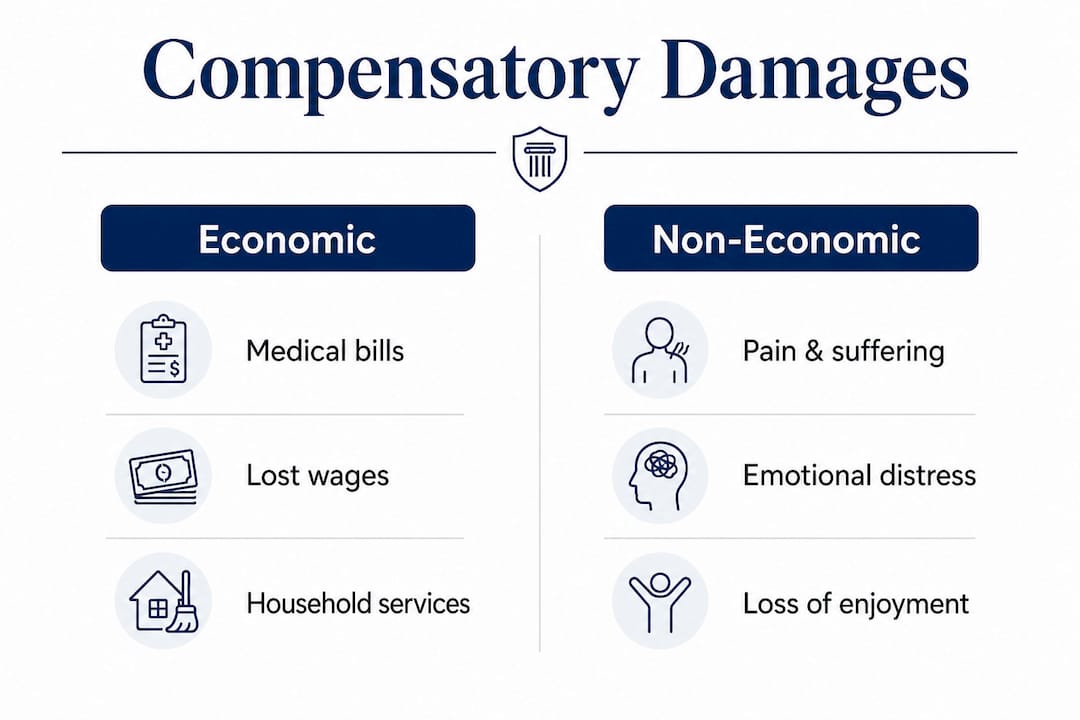
Economic and non-economic damages represent the two core types of compensatory recovery in personal injury law. Each covers a distinct category of harm and requires different proof.
Economic damages
Economic damages cover financial losses you can document with receipts, bills, and records. Common examples include:
- Medical expenses: Emergency room bills, surgery costs, physical therapy, prescription medications, and future treatment costs
- Lost wages: Income you missed while recovering, including salary, hourly pay, tips, and self-employment income
- Property damage: Repair or replacement costs for your vehicle or other property destroyed in the incident
- Household services: The cost of hiring professionals to handle tasks you can no longer perform, such as cleaning, childcare, or yard work
That last item surprises many people. Lost household services are fully recoverable by calculating what it would cost to hire someone to do those tasks. Claimants who overlook this category leave real money on the table.
Non-economic damages
Non-economic damages cover intangible losses. No receipt exists for pain and suffering, but courts recognize these harms as real and compensable. Examples include:
- Physical pain and ongoing discomfort
- Emotional distress and anxiety
- Loss of enjoyment of life
- Loss of consortium, meaning the impact on your relationship with a spouse or family member
- Permanent disfigurement or disability
Economic damages require documentary evidence like medical bills and pay stubs, while non-economic damages are subjective but equally compensable without line-item billing. The distinction matters because the proof standard differs significantly between the two.
| Damage Type | Examples | Proof Required | Calculation Method |
|---|---|---|---|
| Economic (special) | Medical bills, lost wages, property repair | Bills, pay stubs, receipts | Sum of documented losses |
| Non-economic (general) | Pain and suffering, emotional distress | Medical records, testimony | Multiplier or per diem method |
| Punitive | N/A (not compensatory) | Egregious conduct evidence | Jury discretion |
Pro Tip: Keep every receipt, bill, and written communication related to your injury from day one. Courts award what you can prove, and gaps in documentation directly reduce your recovery.
How are compensatory damages calculated?
Economic damages are calculated by adding up all documented financial losses. You gather your medical bills, pay stubs, repair invoices, and receipts, then total them. Future costs, such as ongoing medical care or permanent income loss, require expert testimony to project accurately.
Non-economic damages use one of two common frameworks. The multiplier method takes your total economic damages and multiplies them by a number, typically between 1.5 and 5, based on injury severity. A more serious, permanent injury warrants a higher multiplier. The per diem method assigns a daily dollar value to your pain and suffering, then multiplies it by the number of days you suffered. Neither is a legal formula. Both are negotiation frameworks that attorneys and insurers use to reach a number.
Settlement ranges vary significantly by injury severity. Minor injuries often settle for $15,000–$35,000. Serious injuries typically settle for $80,000–$250,000. Medical malpractice claims can exceed $1,000,000. These figures reflect the wide range of economic and non-economic losses involved across different case types.
Jurisdictional rules also affect your final recovery. States differ on damage caps and fault rules, which can drastically reduce what you actually collect. Florida, for example, reduced its personal injury statute of limitations to two years in 2023, meaning you have less time to file than claimants in most other states. Missing that deadline eliminates your claim entirely, regardless of how strong your evidence is.
Here is a practical checklist of documentation you should gather immediately after an injury:
- All medical records, bills, and treatment notes from every provider
- Pay stubs and employer statements showing missed work and income loss
- Receipts for out-of-pocket expenses, including transportation to appointments
- Photographs of injuries, accident scenes, and property damage
- Written records of daily pain levels and how your injury affects your routine
- Invoices for any household help or services you had to hire
What evidence is needed to prove compensatory damages?
Strong evidence is the foundation of every successful claim. Medical records establish the nature and severity of your injuries. Pay stubs and employer letters document lost income. Receipts and invoices cover out-of-pocket costs. Expert witnesses, including doctors and economists, provide testimony on future medical needs and long-term income loss.
Proving non-economic damages requires a different approach. A personal journal documenting your daily pain, limitations, and emotional state carries real weight with juries. Statements from family members and friends who witnessed your suffering add credibility. Photographs taken throughout your recovery show the visible impact of your injuries over time.
Two categories of loss that claimants frequently miss deserve special attention. First, paid sick leave or vacation days used during recovery have compensable cash value even when your paycheck continued. Courts recognize the loss of that flexibility as a real financial harm. Second, household services, as noted earlier, are recoverable even when a family member stepped in to help. The measure is the market cost of those services, not whether you actually paid someone.
Pro Tip: Ask your attorney about hiring a life care planner or vocational expert early in the case. These professionals quantify future losses with precision and give your claim credibility that general estimates cannot match.
Timely organization of evidence matters as much as the evidence itself. Delays in gathering records allow memories to fade, documents to disappear, and witnesses to become unavailable. The process of building a car accident claim follows the same principle: the earlier you start, the stronger your position.
Examples of compensatory damages in personal injury cases
Concrete examples make the categories easier to understand. Consider a few common scenarios.
A driver rear-ends you at a stoplight. You suffer whiplash and miss two weeks of work. Your economic damages include the emergency room visit, physical therapy sessions, and two weeks of lost wages. Your non-economic damages cover the pain, sleep disruption, and anxiety you experienced. A case like this typically falls in the minor injury settlement range of $15,000–$35,000.
Now consider a more serious scenario. A surgeon operates on the wrong vertebra, causing permanent nerve damage. Economic damages include all surgical costs, corrective procedures, long-term rehabilitation, lost career earnings, and the cost of in-home care. Non-economic damages cover chronic pain, loss of mobility, and the permanent impact on quality of life. Cases at this level routinely exceed $1,000,000.
For car crash victims, common compensatory losses include:
- Hospital and specialist bills
- Vehicle repair or replacement costs
- Lost income during recovery
- Physical therapy and ongoing treatment
- Pain, suffering, and emotional distress
- Loss of enjoyment of activities the victim can no longer perform
Punitive damages enter the picture only when a defendant’s conduct was intentional or reckless to an extreme degree. A drunk driver who caused a fatal crash, or a company that knowingly sold a defective product, may face punitive awards on top of compensatory ones. But punitive damages are the exception, not the rule, and they are not available in every case.
Key Takeaways
Compensatory damages restore injured claimants to their pre-injury position by covering both documented financial losses and intangible human costs, making correct classification and thorough documentation the two most critical factors in any personal injury claim.
| Point | Details |
|---|---|
| Two core categories | Economic damages cover financial losses; non-economic damages cover intangible harm like pain and suffering. |
| Indemnity is the goal | Courts award compensatory damages to restore you, not to punish the defendant. |
| Calculation methods vary | Multiplier and per diem methods frame non-economic damages; economic damages are summed from documented records. |
| Overlooked losses cost claimants | Household services and used paid leave are compensable and frequently missed. |
| Deadlines are firm | Florida’s two-year statute of limitations means late filings lose all recovery rights. |
What I’ve learned about compensatory damages after years in the courtroom
After handling serious personal injury cases for years, the pattern I see most often is this: claimants undervalue their own losses. They focus on the hospital bill and forget the months of physical therapy, the household help they needed, the vacation days they burned, and the activities they gave up permanently. Every one of those losses has a dollar value under the law.
The other mistake I see constantly is confusing compensatory and punitive damages. People come in expecting a windfall because the other driver was reckless. Punitive damages are rare. Compensatory damages are the foundation of every case, and they require proof, not outrage. The strength of your claim comes from organized evidence and realistic expectations, not from how angry you are at the defendant.
Proper damage classification is not a paperwork exercise. It is a strategic decision that shapes what you can recover and how you prove it at trial. Misclassify a loss, and you may face a higher proof burden or lose the claim entirely. Work with an attorney who understands the difference and builds your case around it from day one.
— Jorge
Calillaw’s approach to personal injury damage claims
Serious injuries change lives. The financial pressure that follows, from mounting medical bills to lost income, compounds an already painful situation.

Calillaw represents injured individuals in Florida across motor vehicle collisions, premises liability, catastrophic injury, and insurance disputes. The firm’s personal injury practice is built on trial-tested judgment and direct client communication. Calillaw attorneys help you identify every recoverable loss, gather the evidence needed to prove it, and negotiate from a position of strength. If your case requires a jury, the firm is prepared to take it there. Contact Calillaw for a free consultation and find out what your claim is actually worth.
FAQ
What is the compensatory damages definition in law?
Compensatory damages are court-awarded payments designed to reimburse an injured party for actual losses caused by another’s negligence or wrongful act. The governing legal theory is indemnity: restoring the victim to their pre-injury position, not punishing the defendant.
What is the difference between compensatory vs punitive damages?
Compensatory damages reimburse real losses like medical bills and lost wages. Punitive damages punish defendants for especially reckless or intentional misconduct and are awarded separately, only in cases involving egregious conduct.
How are non-economic damages calculated?
Non-economic damages are typically valued using the multiplier method or the per diem method. The multiplier method multiplies total economic damages by a factor based on injury severity; the per diem method assigns a daily dollar value to pain and suffering.
What types of recoverable injury losses are most commonly missed?
Claimants most often overlook household services they could no longer perform and paid sick or vacation leave used during recovery. Both are fully compensable under personal injury law and can meaningfully increase the total award.
How long do I have to file a personal injury claim in Florida?
Florida reduced its personal injury statute of limitations to two years in 2023. Filing after that deadline eliminates your right to recovery, regardless of the strength of your evidence.
Recommended
- How Accident Cases And Their Compensation Are Determined When A Lawsuit Is Filed Against The Insurance Companies – Calil Law
- What Kind of Damages is Available to Car Crash Victims? – Calil Law
- What does the process look like for a car accident victim looking to get compensation by hiring a car accident lawyer? – Calil Law
- Property Damage Claims – Calil Law


