 Skip to Content
What Is a Negligent Supervision Claim?
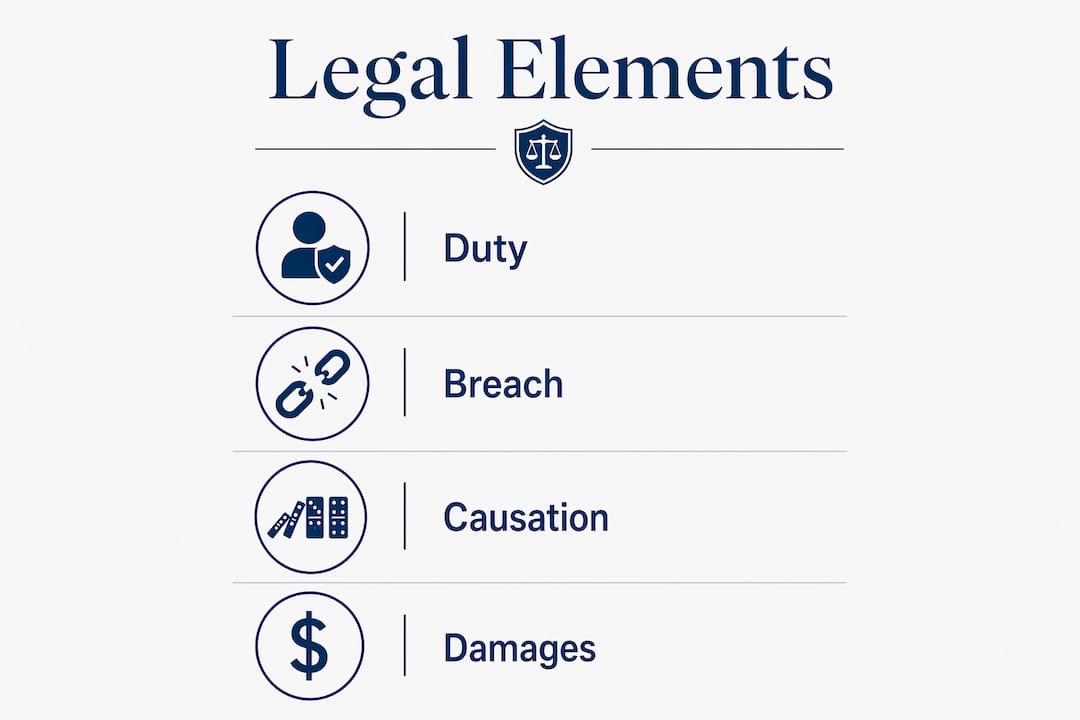
A negligent supervision claim is a legal assertion that a person or organization failed to provide adequate oversight of another, directly causing injury or harm. Courts recognize this claim across a wide range of settings, from daycares and schools to workplaces and healthcare facilities. To succeed, you must prove four core elements: duty of care, breach of that duty, causation, and actual damages. Understanding each element is the first step toward knowing whether you have a viable case.
What is a negligent supervision claim, and how does it work?
A negligent supervision claim holds a responsible party legally accountable for failing to monitor or control individuals or situations that posed a foreseeable risk. The legal definition centers on the idea that the supervising party owed you a duty, broke that duty, and that break caused your injury.
Courts apply a “reasonably prudent” standard. This means the question is not whether the supervisor was perfect, but whether a reasonable person in the same role would have acted differently. A daycare director who ignores a known staff-to-child ratio violation, for example, falls below that standard.
The four elements that every plaintiff must establish are:
- Duty of care. The defendant had a legal responsibility to supervise the person or situation that caused harm.
- Breach. The defendant failed to meet the required standard of oversight.
- Causation. That failure directly caused the injury.
- Damages. The injured party suffered real, measurable harm.
All four elements must be present for a claim to move forward. Missing even one will typically defeat the case.
What are common examples of negligent supervision?
Negligent supervision arises in more settings than most people realize. Duty of care exists in workplaces, daycares, healthcare facilities, schools, camps, and transportation contexts. Each setting carries its own standard of care, but the core failure is the same: someone who was responsible for safety did not do their job.
Daycare and childcare settings
Daycare negligence is one of the most litigated forms of supervision failure. Common examples include staff-to-child ratio violations, staff distraction such as using personal phones, failure to intervene in peer-on-peer violence, and ignoring clear warning signs of behavioral issues. Licensing standards set specific ratios precisely because understaffing creates foreseeable risk. When a facility violates those ratios and a child is hurt, the violation itself becomes powerful evidence of breach.
Workplace and employer liability
Employers have a duty to monitor their workforce and respond to known safety risks. A supervisor who witnesses repeated safety violations and takes no action has breached that duty. In certain states, private employers who opt out of workers’ compensation systems can be sued directly for negligent supervision when an employee is injured as a result.

Healthcare and elder care
Nursing homes and assisted living facilities carry a heightened duty toward vulnerable residents. Failing to monitor a resident with a documented fall risk, or ignoring complaints about an abusive staff member, constitutes a clear breach. Calillaw handles cases involving elder care negligence where supervision failures cause serious physical and psychological harm.
Pro Tip: Regulatory inspection records and complaint histories are public documents in many states. Request them early. They often show a pattern of violations that predates your injury, which strengthens your claim significantly.
What legal elements must you prove to win a negligent supervision case?
Proving negligent supervision requires more than showing that someone got hurt. You must connect each legal element to specific facts. Here is how courts analyze each one.
Duty of care
Duty is established by the relationship between the parties. A school owes a duty to its students. An employer owes a duty to its employees and, in some cases, to third parties harmed by an employee’s conduct. Property owners owe a duty to lawful visitors. The duty of care analysis asks whether the defendant was in a position of authority or responsibility over the person who caused the harm.
Breach of duty
Breach occurs when the supervisor fails to act as a reasonably prudent person would in the same situation. This includes failing to train staff, ignoring known risks, understaffing a facility, or failing to discipline an employee after a prior incident. Regulatory records such as daycare licensing inspections, complaint histories, and staffing ratio violations are frequently used as evidence of breach. A single inspection report showing repeated violations can anchor an entire case.
Causation
Causation is where many claims succeed or fail. You must show that the specific breach, not just poor oversight in general, directly caused your injury. Effective claims require connecting the breach directly to the injury, not just showing a general lack of training or oversight. A child injured on a playground must show that the specific failure to supervise that area at that time caused the fall, not just that the school had loose safety policies overall.
Damages
Damages must be real and measurable. Courts recognize medical expenses, psychological treatment costs, lost wages, pain and suffering, and long-term impact on quality of life. The primary goal for victims is accountability and compensation for all of these categories.
“Organizations are typically liable when they knew, or should have known, of a foreseeable risk and failed to take reasonable corrective action such as retraining, oversight, or termination. Liability is not automatic. It follows from knowledge and inaction.”
How does liability and foreseeability affect your claim?
Liability in negligent supervision cases turns on one central question: did the organization know about the risk, and did it fail to act? Liability frequently arises when organizations fail to act after having notice of a risk, such as ignoring prior complaints or repeatedly violating safety standards. Prior notice is often the pivotal factor that separates a strong claim from a weak one.
The table below shows how different types of notice and organizational responses affect liability outcomes.
| Scenario | Prior Notice | Organization’s Response | Likely Liability |
|---|---|---|---|
| First-time incident, no warnings | None | N/A | Lower likelihood |
| Repeated complaints, no action taken | Yes | Ignored | High likelihood |
| Safety violation documented, corrected | Yes | Addressed | Reduced likelihood |
| Staff ratio violation, injury follows | Yes (regulatory) | None | High likelihood |
| Known dangerous employee, not disciplined | Yes | Ignored | High likelihood |
The distinction between negligence and reckless disregard also matters. Negligence means the organization failed to meet a reasonable standard. Reckless disregard means it knew of serious risk and consciously ignored it. Negligent supervision cases often result in significant jury verdicts because failure to supervise is perceived as deliberate indifference. Juries respond strongly when evidence shows a pattern of ignored warnings.
Common defenses include arguing that the harm was unforeseeable, that the injured party assumed the risk, or that the organization did take corrective steps. Each of these defenses can be challenged with documentation showing the organization’s actual knowledge and inaction. The premises liability framework applies a similar “notice” analysis, making it a useful parallel when building your argument.
How do you file a negligent supervision claim and seek compensation?
Filing a negligent supervision claim starts with identifying every party that owed you a duty and gathering evidence that proves each legal element. Acting quickly matters because evidence disappears and memories fade.
The core steps are:
- Identify liable parties. This may include the direct supervisor, the organization, and in some cases a parent company or franchisor.
- Preserve evidence immediately. Photographs, witness contact information, and any written communications should be secured before they are lost or destroyed.
- Request records. Incident reports, personnel files, and disciplinary records are critical. Much of this evidence is in the exclusive control of the defendant, and formal preservation letters are often necessary to prevent destruction.
- Document your damages. Keep records of every medical appointment, prescription, therapy session, and day of missed work.
- Consult an attorney early. An attorney can send preservation demands, identify all liable parties, and assess whether the facts support each legal element.
Compensation in these cases covers medical and psychological care, pain and suffering, and the long-term impact on your life. Courts also recognize loss of earning capacity when injuries affect your ability to work. Understanding how compensation is determined in civil claims helps you set realistic expectations before litigation begins.
Pro Tip: Never give a recorded statement to the defendant’s insurance company before speaking with an attorney. Anything you say can be used to minimize your damages or shift blame onto you.
Key Takeaways
A negligent supervision claim succeeds when you prove duty, breach, causation, and damages, with prior notice of risk being the single most powerful factor in establishing liability.
| Point | Details |
|---|---|
| Four required elements | Duty, breach, causation, and damages must all be proven for a claim to succeed. |
| Prior notice drives liability | Organizations that ignored complaints or safety violations face the strongest claims. |
| Causation must be specific | Connect the exact breach to the exact injury, not just general oversight failures. |
| Evidence is often controlled by the defendant | Send formal preservation letters early to prevent destruction of key records. |
| Damages are broad | Compensation covers medical costs, psychological care, lost wages, and pain and suffering. |
What I’ve learned about negligent supervision cases after years in the courtroom
The most common mistake I see injured people make is waiting too long to act. They assume the organization will do the right thing, or they are not sure their situation “counts” as negligence. By the time they call, critical records have been purged and witnesses have moved on.
The second mistake is underestimating the power of prior notice. When I review a case and find even one prior complaint that went unanswered, the entire dynamic of the claim shifts. Juries understand that ignoring a warning is a choice. That choice carries consequences.
What surprises many clients is how much regulatory records matter. A licensing inspection report showing a staffing ratio violation from six months before the injury is not just background noise. It is direct evidence that the organization knew the risk existed and chose to do nothing. Those documents are often sitting in a public database, waiting to be found.
The human cost behind these claims is real. A child injured at a daycare, a nursing home resident harmed by an unsupervised staff member, a worker hurt because a known safety hazard was ignored. These are not abstract legal disputes. They are failures of trust by people and organizations that were paid to keep someone safe. That is why I believe every person in this situation deserves a clear-eyed assessment of their rights, not a generic answer.
— Jorge
Calillaw is ready to evaluate your negligent supervision case
If you or someone you love was hurt because a person or organization failed to provide proper oversight, you deserve answers, not uncertainty.
Calillaw’s trial attorneys have decades of experience handling serious personal injury claims, including negligent supervision cases involving daycares, workplaces, healthcare facilities, and schools. We evaluate the evidence, identify every liable party, and build cases designed to go to verdict when settlement is not enough. Our team handles case evaluation, evidence preservation, and full litigation from start to finish. Contact Calillaw for a direct conversation about your situation and what your rights may be worth.
FAQ
What is the legal definition of negligent supervision?
Negligent supervision is the failure of a responsible party to adequately monitor or control individuals or situations under their authority, resulting in foreseeable harm to another person. Courts require proof of duty, breach, causation, and actual damages.
What are the most common negligent supervision examples?
Common examples include daycare staff-to-child ratio violations, employers ignoring known safety hazards, nursing homes failing to monitor vulnerable residents, and schools failing to intervene in documented bullying situations.
How do I prove foreseeability in a negligent supervision claim?
Foreseeability is proven by showing the organization had prior notice of the risk, such as complaint records, prior incidents, regulatory violations, or internal reports, and failed to take corrective action before the injury occurred.
What damages can I recover in a negligent supervision case?
Recoverable damages include medical and psychological treatment costs, pain and suffering, lost wages, loss of earning capacity, and compensation for the long-term impact on your quality of life.
How long do I have to file a negligent supervision claim?
Statutes of limitations vary by state and by the type of defendant involved. In Florida, personal injury claims generally carry a two-year statute of limitations, making early legal consultation critical to protecting your rights.


