 Skip to Content

What Is a Wet Floor Claim? Your Legal Rights Explained
A wet floor claim is a personal injury claim made when someone is injured by slipping or falling on a wet or slippery surface due to another party’s negligence. Under premises liability law, the responsible party must have failed to maintain safe conditions or warn visitors of a known hazard. These claims rest on four legal pillars: duty of care, breach of duty, causation, and damages. Knowing how each element works gives you a clear picture of your rights before you take any action.
What legal elements must be proven in a wet floor claim?
Winning a wet floor claim requires proving three core elements: duty of care, breach of that duty, and causation linking the breach directly to your injury. Each element carries equal weight. A gap in any one of them can end a claim before it reaches a settlement table.
-
Duty of care. Property owners and businesses owe visitors a legal duty to keep premises reasonably safe. A grocery store, restaurant, or office building all carry this obligation the moment a customer or guest walks through the door.
-
Breach of duty. A breach occurs when the owner fails to address a known or reasonably discoverable hazard within a reasonable time. This includes failing to clean up a spill, failing to post warnings, or failing to schedule regular floor inspections.
-
Causation. You must show a direct link between the breach and your injury. A pre-existing condition or an unrelated fall will not satisfy this element. Medical records and accident documentation are the primary tools for establishing causation.
-
Damages. Actual losses must exist. These include medical bills, lost income, pain and suffering, and rehabilitation costs. A fall with no injury produces no compensable claim.
Two knowledge standards shape how breach is evaluated. Actual knowledge means the owner knew about the hazard directly, such as an employee who saw the spill and did nothing. Constructive knowledge means the hazard existed long enough that a reasonable inspection would have discovered it. Constructive knowledge is the most contested element in most wet floor cases. It is also the most common reason claims fail.
Pro Tip: Take a photo of any clock or timestamp visible at the scene. Proving when the spill appeared is central to constructive knowledge arguments.

How do wet floor signs affect slip and fall claims?
Wet floor signs do not automatically protect a business from liability. Courts evaluate whether the warning was reasonable given the size, placement, and visibility of the sign relative to the actual hazard. A small yellow cone tucked behind a display rack does not constitute adequate warning.
Key factors courts consider when assessing signage:
- Visibility. Was the sign placed where a reasonable person would see it before reaching the hazard?
- Adequacy. Did the sign accurately reflect the scope of the danger? A single cone for a large wet area may be insufficient.
- Timing. Was the sign placed immediately after the hazard appeared, or did time pass before it was deployed?
- Condition of the sign. A faded or damaged sign may not meet the standard of a reasonable warning.
The absence of a wet floor sign strengthens your claim but is not required to win. If a business took other reasonable steps to address the hazard quickly, a court may find no breach even without a sign. Conversely, a sign placed over a hazard that should have been cleaned up hours earlier does not erase liability. The sign is evidence, not a shield.
Pro Tip: If you fell near a wet floor sign, photograph the sign’s exact position relative to the spill. That distance and angle can be decisive in court.
What evidence is critical to support a wet floor claim?
Evidence determines whether a wet floor accident claim succeeds or fails. CCTV footage, inspection records, and witness statements are the most powerful tools for establishing how long a hazard existed and what the business knew about it. Collecting this evidence quickly is not optional. It is urgent.
The most important evidence categories are:
- Photographs and video. Capture the wet surface, any signage, your footwear, and the surrounding area immediately after the fall.
- CCTV footage. Request preservation in writing as soon as possible. Businesses routinely overwrite footage within 24–72 hours.
- Inspection logs. These records show whether staff conducted regular checks and when the area was last verified as safe.
- Witness statements. Names and contact details of anyone who saw the fall or the hazard before it are valuable.
- Medical records. Documentation linking your injuries directly to the accident is non-negotiable for proving damages.
- Incident report. Filing a report promptly creates an official record of the event and protects your legal rights.
| Evidence Type | Purpose |
|---|---|
| CCTV footage | Establishes hazard duration and business awareness |
| Inspection logs | Shows whether reasonable checks were performed |
| Medical records | Links injuries to the accident for damages proof |
| Witness statements | Corroborates your account of the hazard and fall |
| Incident report | Creates an official record and preserves legal rights |
Delayed reporting weakens a claim’s credibility. The longer you wait, the harder it becomes to preserve physical evidence and secure witness cooperation.
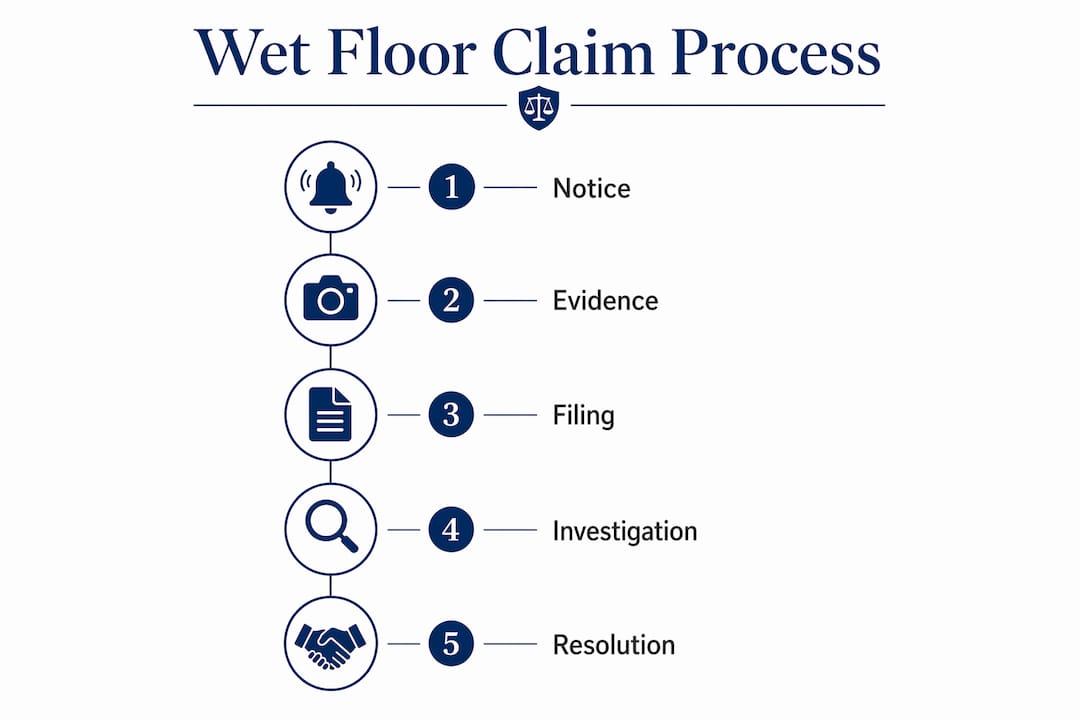
What is the typical process for filing and pursuing a wet floor claim?
A wet floor injury compensation claim follows a defined sequence. Understanding each step helps you avoid costly mistakes and missed deadlines.
-
Report the incident. Notify the property owner or manager immediately. Request a written incident report and keep a copy.
-
Seek medical care. Get evaluated by a doctor the same day, even if injuries seem minor. A gap between the accident and treatment gives insurers grounds to dispute causation.
-
Preserve evidence. Photograph the scene, secure witness contact information, and send a written request for CCTV footage preservation.
-
Consult an attorney. An experienced premises liability attorney can assess the strength of your claim, identify liable parties, and advise on jurisdiction-specific deadlines before you make any statements to insurers.
-
File a notice of claim. Many jurisdictions require formal written notice to the property owner or insurer within a set period. Missing this deadline can bar your claim entirely.
-
Evidence exchange and investigation. The insurer investigates the claim. Your attorney gathers and organizes evidence to counter any attempt to minimize your injuries or shift blame.
-
Negotiate a settlement. Most slip and fall claims resolve through negotiation. Your attorney presents a demand supported by medical records, lost wage documentation, and evidence of the hazard.
-
File a lawsuit if necessary. If the insurer refuses a fair settlement, your attorney files suit. Statutes of limitations vary by state. In Florida, the deadline to file a personal injury lawsuit is a critical factor that your attorney will track from day one.
Wet floor claims proceed through formal stages that require strict compliance with deadlines. Missing any one of them can forfeit your right to compensation entirely.
What types of compensation can claimants receive in a wet floor claim?
Compensation in a wet floor claim can cover medical expenses, lost wages, rehabilitation costs, pain and suffering, and property damage where applicable. The total amount depends on the severity of your injuries, the strength of your evidence, and whether contributory negligence applies to your case.
Contributory negligence reduces your compensation if you were partly at fault. For example, if you were looking at your phone when you fell, a court may assign you a percentage of fault. That percentage reduces your total award proportionally. Florida follows a modified comparative negligence rule, which means your recovery is reduced by your share of fault.
| Compensation Category | What It Covers |
|---|---|
| Medical expenses | Emergency care, surgery, ongoing treatment, and prescriptions |
| Lost wages | Income lost during recovery and reduced earning capacity |
| Rehabilitation costs | Physical therapy, assistive devices, and long-term care |
| Pain and suffering | Physical pain and emotional distress caused by the injury |
| Property damage | Personal items damaged in the fall, such as a phone or glasses |
Pain and suffering damages are often the largest component of a wet floor settlement. They are also the hardest to quantify, which is why experienced legal representation matters. An attorney who has tried these cases to verdict understands how to present non-economic damages persuasively.
Key Takeaways
A wet floor claim succeeds when you prove duty of care, breach, causation, and damages, with constructive knowledge of the hazard being the single most contested element in most cases.
| Point | Details |
|---|---|
| Four legal elements required | Prove duty, breach, causation, and damages to establish a valid claim. |
| Constructive knowledge is decisive | Show the hazard existed long enough for a reasonable inspection to catch it. |
| Signs don’t equal immunity | Courts assess sign placement, visibility, and adequacy, not just presence. |
| Evidence must be preserved fast | Request CCTV footage within 24 hours; businesses overwrite recordings quickly. |
| Contributory negligence reduces awards | Your share of fault lowers your compensation under Florida’s comparative negligence rule. |
What I’ve learned about wet floor claims that most articles get wrong
Most people assume that if a wet floor sign was present, they have no case. That assumption costs injured people real money. Courts do not simply ask “was there a sign?” They ask whether the warning was reasonable, visible, and proportionate to the hazard. I have seen cases where a sign was present but placed around a corner, completely out of the sightline of anyone approaching the spill. That sign did not protect the business.
The second misconception I encounter constantly is that the fall itself is the hardest thing to prove. It is not. The hardest thing to prove is how long the hazard existed before you fell. That single question, the “constructive knowledge” issue, is where most claims are won or lost. Businesses know this. Their insurers know this. They will argue the spill appeared moments before you fell and that no reasonable inspection could have caught it in time.
This is why evidence collection in the first hours after an accident is so critical. CCTV footage, inspection logs, and staff testimony are not nice-to-haves. They are the foundation of your case. If you slipped at an apartment complex or at work, the same principle applies. The property owner’s knowledge of the hazard is always the central question.
My honest advice: do not give a recorded statement to any insurer before speaking with an attorney. Insurers are skilled at using your own words to minimize your claim. A single poorly worded sentence about how you were walking or what you were wearing can be used to assign you comparative fault and reduce your recovery.
— Jorge
Calillaw is ready to evaluate your wet floor claim
Wet floor and premises liability claims are fact-intensive. The difference between a strong claim and a failed one often comes down to evidence preserved in the first 48 hours and legal strategy applied from day one.

Calillaw’s personal injury practice is built for exactly these situations. The firm’s Board Certified Civil Trial Lawyer and litigation team handle premises liability claims with the same disciplined preparation they bring to courtroom verdicts. From securing CCTV footage to negotiating with insurers who undervalue injuries, Calillaw protects your rights at every stage. If you were injured on someone else’s property, contact Calillaw for a consultation and get a clear assessment of what your claim is worth.
FAQ
What is a wet floor claim in simple terms?
A wet floor claim is a personal injury claim filed when someone slips or falls on a wet surface due to a property owner’s negligence. It falls under premises liability law and requires proof of duty, breach, causation, and damages.
Does a wet floor sign mean I can’t file a claim?
A wet floor sign does not automatically bar a claim. Courts assess whether the sign was reasonably visible and adequately placed, and a poorly positioned sign may still leave the business liable.
How long do I have to file a wet floor accident claim?
Deadlines vary by state and claim type. In Florida, statutes of limitations and notice requirements are strict, so consulting an attorney immediately after your accident is the safest approach.
What evidence do I need for a slip and fall claim?
The most critical evidence includes photographs of the hazard, CCTV footage, inspection records, witness statements, medical records, and a written incident report filed promptly after the fall.
Can I still recover compensation if I was partly at fault?
Yes. Florida’s modified comparative negligence rule reduces your compensation by your percentage of fault, but you can still recover damages as long as you are not found to be more than 50% at fault.


