 Skip to Content
Negligent Entrustment Explained for Injured Victims
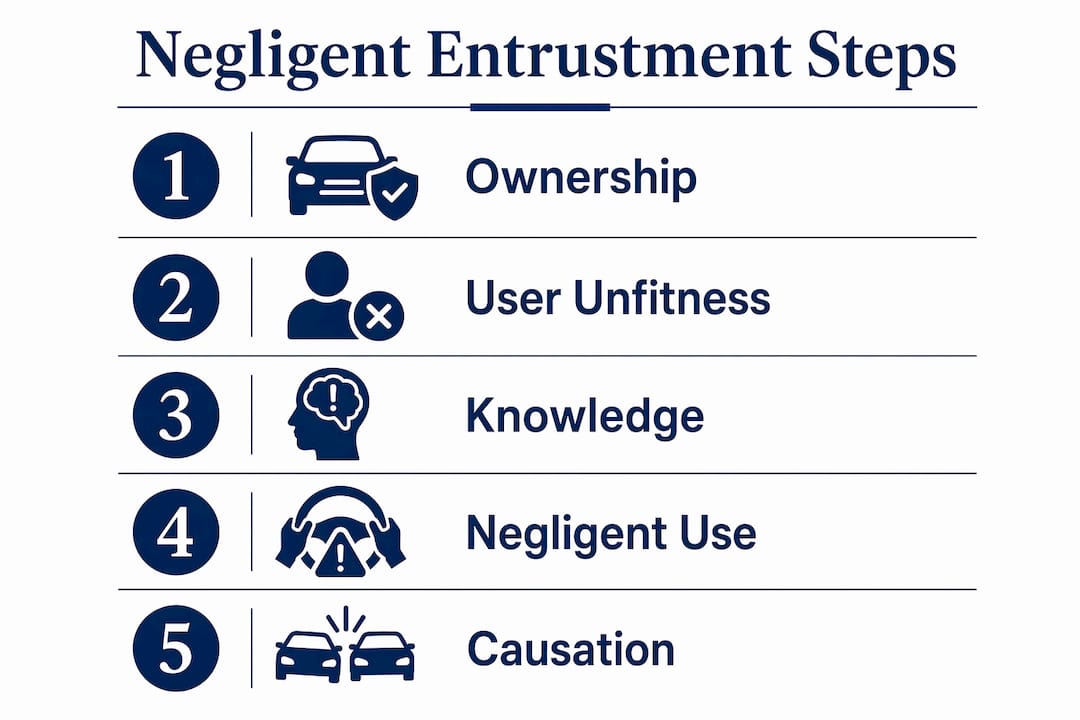
Negligent entrustment holds an owner liable when they supply a dangerous item — a car, firearm, or heavy machine — to someone they knew or should have known was unfit to use it safely, and that person then injures someone else. The doctrine targets the owner’s decision, not just the user’s conduct. At its core, a successful claim requires proving: (1) the owner entrusted the property; (2) the user was unfit; (3) the owner knew or should have known; (4) the user’s negligence caused harm; and (5) real damages resulted.
Table of Contents
- What negligent entrustment means in plain language
- Where the doctrine comes from: Restatement, statutes, and state law
- How to prove negligent entrustment: a step-by-step checklist
- Common scenarios and red flags you should recognize
- How negligent entrustment differs from vicarious liability and related theories
- Common defenses to negligent entrustment claims
- What damages you can recover and how insurers respond
- How hard is it to prove negligent entrustment?
- How owners and employers can avoid negligent entrustment liability
- How an attorney prepares and proves a negligent entrustment case
- Key Takeaways
- Why negligent entrustment claims deserve serious attention
- Injured by someone using another person’s property? Calillaw is ready to help.
- Primary sources and further reading
What negligent entrustment means in plain language
Legally, negligent entrustment arises when an owner supplies a dangerous instrumentality to a person who is incompetent or likely to use it dangerously, and liability flows from that entrustment decision itself. The user’s bad driving or reckless handling is not enough on its own — the owner’s choice to hand over the keys, the gun, or the equipment is the act courts scrutinize.
In everyday terms, think of it this way: if you lend your car to a friend you know has three DUIs and no valid license, and he then hits a pedestrian, you can be sued alongside him. The pedestrian’s attorney is not just going after the driver — they are going after you for making a dangerous choice.
Common examples include:
- Lending a vehicle to an intoxicated person — the owner saw the person drinking, handed over the keys anyway, and a crash followed.
- Giving or selling a firearm to a minor — a parent or seller supplies a weapon to someone legally prohibited from possessing it.
- An employer assigning a commercial truck to a driver with a documented history of at-fault accidents and license suspensions.
Each scenario targets the same thing: the owner’s decision to entrust, not merely the harm the user caused.
Where the doctrine comes from: Restatement, statutes, and state law
The legal foundation sits in two sections of the Restatement (Second) of Torts. §308 addresses permitting another person to use a thing under the actor’s control when the actor knows or should know that doing so creates an unreasonable risk. §390 focuses on supplying a chattel — any personal property — to a person the supplier knows or has reason to know is likely to use it in a way that involves unreasonable risk of harm.
Congress has also used the doctrine’s language in statutory contexts. 15 U.S.C. § 7903(5)(B) defines negligent entrustment in the firearms context as transferring a firearm to a person knowing or having reasonable cause to believe they would use it in a manner involving risk of unlawful injury — a useful statutory reference point for gun cases.
State courts do not apply the Restatement uniformly. Some jurisdictions track §390 closely; others blend §308 and §390 concepts or have developed their own common-law standards. The knowledge threshold also varies: some states require that the owner had actual “reason to know” of the user’s unfitness, while others apply a broader “should have known” standard that encompasses facts the owner could have discovered with reasonable inquiry. Practitioners must check local precedent before framing a claim.
How to prove negligent entrustment: a step-by-step checklist
Courts across the country generally require a plaintiff to satisfy five or six discrete elements. Here is how each one works in practice, with the evidence that tends to satisfy it.

1. Entrustment (ownership and permission)
The plaintiff must show the defendant owned or controlled the property and gave the user permission to operate it. Evidence: vehicle title, registration, insurance documents, text messages granting permission, or a pattern of prior permissive use.
2. Unfitness or incompetence of the user
The user must have been unfit at the time of entrustment. Evidence: suspended or revoked license, prior DUI convictions, documented reckless driving history, intoxication at the time of lending, age (a minor), or lack of any training for the equipment involved.
3. Owner’s knowledge or constructive knowledge
The owner knew, or reasonably should have known, of the user’s unfitness. This is often the hardest element to prove. Evidence: prior conversations about the user’s driving record, visible intoxication, shared household records, employer motor vehicle record checks (or the absence of them), and any written communications acknowledging the risk.
4. The user’s negligent conduct
The entrusted person must have acted negligently in using the property. Evidence: police accident reports, citations issued at the scene, toxicology results, witness accounts, and traffic camera footage.
5. Proximate causation
The user’s negligence must have been the proximate cause of the plaintiff’s injury. Evidence: accident reconstruction reports, medical records linking the crash to the injuries, and expert testimony establishing the causal chain.
6. Damages
The plaintiff must have suffered actual, compensable harm. Evidence: medical bills, lost-wage documentation, property damage estimates, and expert testimony on future care needs or permanent impairment.
A few practical illustrations:
- Parent/teen scenario: A parent who knows their 16-year-old has already received two speeding tickets hands over the family SUV. The teen runs a red light and injures a cyclist. The parent’s knowledge of the prior tickets satisfies element three.
- Employer/fleet driver: A trucking company skips its annual motor vehicle record check and assigns a route to a driver whose license was suspended six months earlier. That failure to check satisfies constructive knowledge.
- Firearm seller/minor: A private seller ignores obvious signs that the buyer is underage and completes the sale. The buyer later injures someone. The seller’s willful blindness can satisfy the knowledge element.
Common scenarios and red flags you should recognize
Negligent entrustment can apply to any chattel that poses an unreasonable risk of harm when used by an unfit person, but certain fact patterns appear repeatedly in litigation.
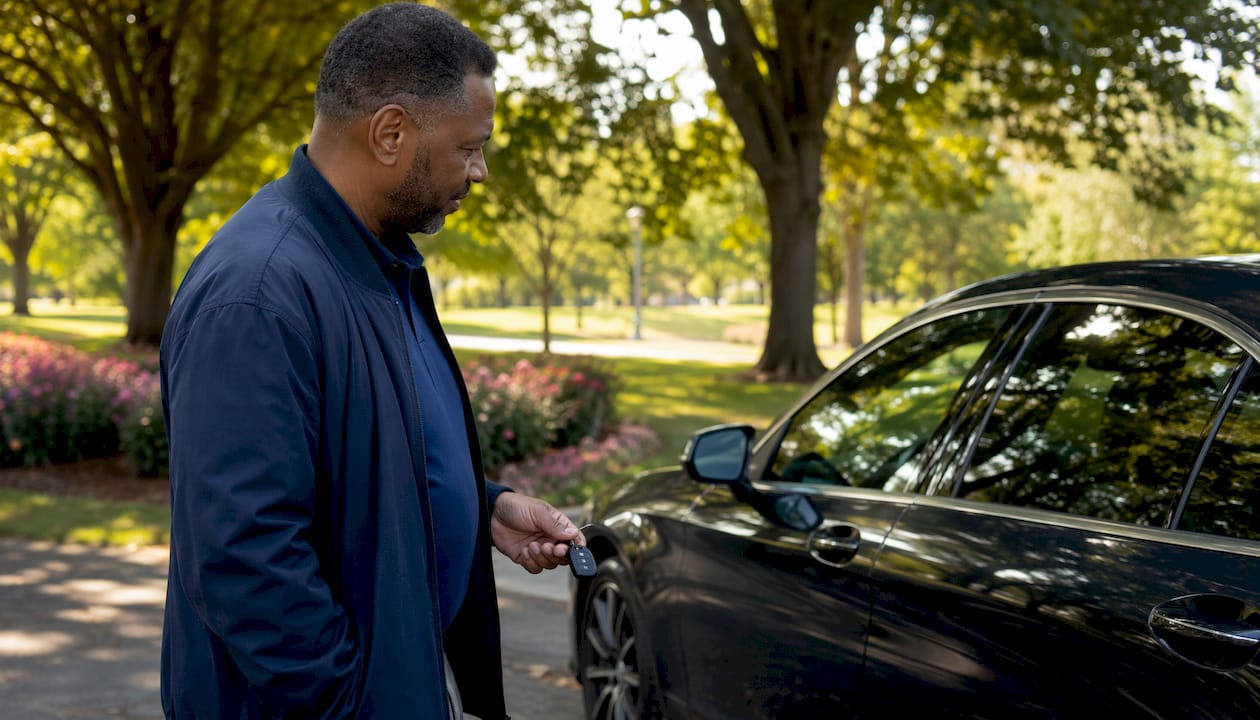
Vehicles are the most common context. Courts look for permission or control — who had the keys, who paid the insurance, whether the owner regularly allowed the user to drive — and for evidence of the driver’s unfitness such as DUIs, license suspensions, or a documented pattern of reckless driving. A single prior DUI that the owner knew about can be enough.
Firearms present a distinct profile. When a seller, parent, or private transferor supplies a gun to someone prohibited from possessing it — a minor, a person with a disqualifying criminal record, or someone visibly intoxicated — the claim maps directly onto §390’s framework. The statutory definition in 15 U.S.C. § 7903(5)(B) reinforces this in federal law.
Employers and commercial fleets face heightened scrutiny. Because driving records and criminal histories are publicly accessible, courts hold commercial operators to a higher inquiry standard than private individuals. A fleet manager who never pulls a driver’s motor vehicle record before assigning a 40-ton truck has a difficult time claiming ignorance.
Heavy machinery and equipment round out the common scenarios. Lending a forklift, crane, or industrial saw to an untrained worker — or renting equipment without verifying operator certification — can expose an owner to liability when the user injures a bystander.
Red flags that courts and juries find compelling:
- Multiple prior DUI convictions or alcohol-related incidents
- A suspended, revoked, or expired license at the time of entrustment
- Documented at-fault accidents in the user’s recent history
- Written or verbal admissions by the owner that they knew about the risk
- Absence of any training, certification, or licensing for the equipment type
How negligent entrustment differs from vicarious liability and related theories
These three theories often appear together in a complaint, but they rest on different legal foundations and carry different proof burdens.
| Theory | Liability basis | Proof burden | Typical use case |
|---|---|---|---|
| Negligent entrustment | Owner’s personal fault in the entrustment decision | Must prove owner’s knowledge of unfitness | Any owner, including private individuals; no employment relationship required |
| Vicarious liability | Employer’s responsibility for employee acts within scope of employment | No fault by employer required; respondeat superior | Employee injures someone while on the job |
| Negligent hiring/retention | Employer’s failure to screen or remove a dangerous employee | Must prove employer knew or should have known of employee’s dangerous propensity | Workplace or commercial context |
| Negligent supervision | Failure to monitor or control a person under one’s authority | Must prove inadequate oversight caused harm | Employers, schools, parents |
The practical difference is significant. Negligent entrustment requires proof of the entrustor’s personal fault, which means a plaintiff can pursue an owner who has no employment relationship with the user at all — a parent, a friend, a private seller. Vicarious liability, by contrast, can make an employer responsible without any fault on the employer’s part, simply because the employee acted within the scope of employment.
Plaintiffs often plead both theories when an employment relationship exists, because vicarious liability is easier to prove but negligent entrustment can unlock punitive damages where the owner’s conduct was especially reckless. For a deeper look at how negligent supervision fits into this picture, that theory focuses on the failure to monitor rather than the initial decision to entrust.
Common defenses to negligent entrustment claims
Defendants raise several standard arguments. Understanding them helps you see where a claim is strong and where it needs reinforcement.
- No permission (theft or unauthorized use). If the user took the property without consent, the owner made no entrustment decision. Plaintiffs counter this by showing a pattern of prior permissive use — courts have found implied consent when an owner routinely left keys accessible and never objected to prior use.
- Lack of knowledge or constructive knowledge. The owner claims they had no idea the user was unfit. Plaintiffs respond with evidence the owner could have discovered with reasonable inquiry: a shared household, visible intoxication, or a driving record the owner never bothered to check.
- No ownership or control. The defendant argues they did not own the property or lacked the authority to permit its use. Title documents, insurance records, and testimony about who controlled access usually resolve this.
- No causal link. The defense argues the user’s unfitness did not cause the accident — perhaps a sudden mechanical failure or an unforeseeable third-party act broke the causal chain. Accident reconstruction experts are often essential to defeat this argument.
- Statute or policy-based defenses. Some states limit negligent entrustment claims by statute or cap damages in certain contexts. Knowing the applicable state law is critical before filing.
Pro Tip: Send a preservation letter to the owner, the employer, and any insurer within days of the incident. Driving records, fleet logs, training certificates, and communications are routinely deleted or overwritten. A timely litigation hold letter creates a legal obligation to preserve that evidence and can support spoliation arguments if records disappear.
What damages you can recover and how insurers respond
Plaintiffs in negligent entrustment cases can pursue the full range of compensatory damages: medical expenses (past and future), lost earnings and earning capacity, pain and suffering, emotional distress, and property damage. Where the owner’s conduct was particularly reckless, punitive damages may also be available, though their availability and limits depend on state law and the proof standard the jurisdiction applies.
The insurance dimension adds complexity. The owner’s personal auto or homeowner’s policy is typically the first line of coverage. If the owner is a business, a commercial general liability or commercial auto policy may apply. Insurers sometimes argue that the entrustment was intentional or outside the policy’s scope, triggering coverage disputes. When an insurer unreasonably denies a defense or refuses to pay a valid claim, bad-faith insurance exposure can arise, potentially adding consequential damages on top of the underlying award.
Punitive damages are a real lever in egregious cases. An owner who handed keys to a visibly intoxicated driver, or a gun seller who ignored obvious signs of a prohibited buyer, may face a jury that wants to send a message. That possibility often shifts settlement dynamics significantly, giving plaintiffs meaningful leverage even before trial.
How hard is it to prove negligent entrustment?
The burden of proof in civil cases is preponderance of the evidence — more likely than not. That is a lower bar than criminal “beyond a reasonable doubt,” but the knowledge element still makes these cases genuinely challenging. Owners rarely admit they knew a user was unfit, and circumstantial evidence must be assembled carefully.
The strongest evidence in these cases tends to be:
- Official records: driving history reports, DUI arrest records, prior crash reports, and criminal background checks
- Employer documents: fleet assignment logs, training certificates, motor vehicle record check dates, and discipline records
- Communications: text messages, emails, or voicemails showing the owner granted permission or acknowledged the user’s condition
- Witness testimony: bystanders, family members, or coworkers who observed the owner’s awareness of the risk
- Police reports and toxicology: contemporaneous documentation of the user’s condition at the time of the incident
Courts evaluate unfitness case by case. There is no bright-line rule — two DUIs alone may not be enough if the owner had no actual knowledge of them, while a single incident combined with a direct admission can be decisive. The combination and quality of evidence is what wins these cases.
Early investigative steps matter enormously. Counsel will typically send preservation letters immediately, subpoena driving records and employer files, request police reports and body camera footage, and retain experts in accident reconstruction or vocational rehabilitation depending on the injuries involved.
How owners and employers can avoid negligent entrustment liability
Prevention is straightforward when the steps are followed consistently. The legal exposure comes almost entirely from skipping the checks that would have revealed a problem.
For individuals:
- Never lend a vehicle, firearm, or dangerous equipment to someone who appears intoxicated, impaired, or emotionally distressed.
- Verify that the person has a valid, current driver’s license before handing over car keys.
- Confirm the person has adequate insurance coverage if they will be operating your vehicle.
- Keep a brief written record of any lending arrangement, including the date, the person’s name, and the purpose.
- If you have any doubt about a person’s fitness, decline. The discomfort of saying no is far less than the cost of a lawsuit.
For businesses and fleet operators:
- Run motor vehicle record checks on every driver before hiring and on a regular schedule thereafter — annually at minimum.
- Establish written policies that define who is authorized to operate company vehicles or equipment and under what conditions.
- Require mandatory training and certification for any specialized equipment, and document completion.
- Implement a zero-tolerance policy for operating company property under the influence, with clear disciplinary consequences.
- Conduct pre-hire background checks that include driving history, not just criminal records.
- Maintain logs of vehicle assignments, including the date, driver, and purpose of each trip.
- Review and act on any reported incidents promptly — a known incident that goes unaddressed becomes evidence of constructive knowledge in the next lawsuit.
Recordkeeping is the difference between a defensible position and an indefensible one. Written consent forms, training logs, and motor vehicle record check dates give a business something concrete to show a jury.
How an attorney prepares and proves a negligent entrustment case
The first meeting with a client in a potential negligent entrustment case is an intake and triage session. Counsel will ask for the police report, any photos from the scene, medical records, insurance information for both the user and the owner, and the names and contact information of any witnesses. If the case involves a commercial vehicle, employment records and the driver’s personnel file become immediate targets.
Within the first days, a competent attorney sends preservation letters to every party who may hold relevant evidence: the owner, the employer, the insurer, and any third-party data custodian such as a fleet telematics provider. Driving records are subpoenaed from the state DMV. If the incident involved a commercial truck, the Federal Motor Carrier Safety Administration’s records on the carrier and driver are requested. Cell phone records may be sought if distracted driving is a factor.
Expert retention follows once the factual picture comes into focus. Accident reconstruction specialists can establish how the crash occurred and whether the driver’s unfitness contributed to it. Vocational experts quantify lost earning capacity. Medical experts project future care costs. In cases where punitive damages are a realistic target, the attorney will document the owner’s decision-making process in detail, looking for communications, prior complaints, or internal records that show the owner knew and proceeded anyway.
Litigation strategy in these cases often involves pursuing both negligent entrustment and vicarious liability simultaneously when an employment relationship exists, and exploring third-party liability theories that may reach additional defendants or insurance policies. Settlement leverage increases substantially when punitive damages are supported by the evidence, because insurers and defendants both understand what a jury might do with a particularly reckless entrustment decision.
Key Takeaways
Negligent entrustment holds an owner personally liable for the harm caused by a user they knew or should have known was unfit — making the owner’s decision to entrust the central fact in every case.
| Point | Details |
|---|---|
| Core definition | An owner who supplies a dangerous item to an unfit user can be held liable alongside that user. |
| Knowledge is the hardest element | Proving the owner knew or should have known of the user’s unfitness requires official records, communications, and witness testimony. |
| Businesses face a higher standard | Fleet operators and employers are expected to run motor vehicle record checks; failure to do so satisfies constructive knowledge. |
| Punitive damages are possible | When an owner’s entrustment decision was especially reckless, state law may allow punitive damages on top of compensatory recovery. |
| Calillaw can help | If you were injured by someone using another person’s vehicle, firearm, or equipment, Calillaw’s trial attorneys can evaluate your claim and pursue all responsible parties. |
Why negligent entrustment claims deserve serious attention
Most people who contact an attorney after a serious crash are focused entirely on the driver who hit them. That instinct is understandable, but it can leave significant compensation on the table. The driver may be uninsured, underinsured, or judgment-proof. The owner who handed over the keys — the employer who skipped the background check, the parent who ignored the warning signs — often carries far more insurance coverage and far more assets.
Holding owners accountable for their entrustment decisions is not just about compensation. It changes behavior. When businesses know that skipping a motor vehicle record check can expose them to a negligent entrustment verdict, they run the check. When parents understand that lending a car to an impaired teenager creates personal liability, they think twice. The doctrine works precisely because it attaches real consequences to the moment of decision, not just to the moment of impact.
If you were injured and you suspect the person who hurt you was using someone else’s property, do not wait to speak with an attorney. Evidence disappears quickly. Driving records get purged. Fleet logs get overwritten. The sooner counsel gets involved, the better the chance of preserving everything that matters. This is general information, not legal advice for your specific situation — confirm the applicable rules with a qualified attorney.
Injured by someone using another person’s property? Calillaw is ready to help.
When negligent entrustment is in play, the case is more complex than a standard car accident claim — and the potential recovery is often larger. Calillaw’s trial attorneys represent injured individuals on a contingency-fee basis, meaning you pay nothing unless we recover for you.
To make the most of your first consultation, bring whatever you have: the police report, photos from the scene, your medical records, insurance information for both the driver and the vehicle owner, and any witness names or contact details. The more we have at the start, the faster we can move to preserve critical evidence and identify every party who may be responsible.
If a vehicle was involved, our auto accident attorneys handle the full scope of these claims, from initial investigation through trial. For a broader overview of your rights after an injury, our personal injury practice page explains how we work and what you can expect. Contact Calillaw today for a free consultation.
Primary sources and further reading
These are the authoritative resources courts and practitioners rely on for negligent entrustment law. Each is worth consulting directly if you want to go deeper.
- 15 U.S.C. § 7903(5)(B) — Cornell Law / Legal Information Institute: The statutory definition of negligent entrustment in the federal firearms context — useful for understanding how Congress codified the doctrine.
- Restatement (Second) of Torts §§308 and 390 — Colorado Bar Association analysis: A practitioner-level article explaining how courts apply the Restatement sections and where states diverge.
- Negligent entrustment overview — Wikipedia: A solid starting point for the doctrine’s history and general elements, with citations to primary sources.
- Negligent entrustment doctrine and elements — LegalClarity: Practical breakdown of the elements, defenses, and common fact patterns, including vehicle and firearm scenarios.
- Negligent entrustment of a vehicle — LegalClarity: Vehicle-specific analysis of the permission, control, and unfitness elements with evidence guidance.
- Justia — negligent entrustment elements overview: A broad legal reference covering the standard five-element formulation used by courts across jurisdictions.
- Calillaw — what is a negligent supervision claim: Explains the related theory of negligent supervision and how it interacts with entrustment claims in employer contexts.


